
Forged or Found? Unpacking the Western Role in Defining South Asia
Exploring the complex interplay between ancient heritage and colonial reshaping in the creation of a modern region.
The assertion that "South Asia as a separate political, economic, social, geographical region was created by Western Countries" touches upon a complex historical debate. While Western influence, particularly through colonialism, undeniably and profoundly shaped the modern configuration of South Asia, attributing its entire creation solely to external forces overlooks the region's deep-rooted indigenous history and inherent characteristics. A nuanced understanding requires examining both the pre-colonial foundations and the transformative impact of Western intervention.
Key Insights
- Colonial Imposition vs. Pre-existing Reality: While Western powers, especially Britain, politically structured modern South Asia by imposing nation-state concepts, fixed borders, and administrative systems, the region possessed distinct geographical features, ancient civilizations (like the Indus Valley), and shared cultural elements long before colonial arrival.
- Economic Restructuring: Colonialism fundamentally altered South Asian economies, integrating them into global capitalist networks primarily as resource suppliers and markets, thereby shaping its modern economic identity and dependencies.
- The "South Asia" Concept: The term "South Asia" itself and its formal definition as a distinct geopolitical bloc gained prominence largely through Western academic, administrative, and geopolitical frameworks during and after the colonial era.
Echoes of Antiquity: Pre-Colonial Foundations
Long before European ships reached its shores, the landmass we now call South Asia pulsed with life, culture, and sophisticated societies. Understanding this pre-colonial context is crucial to assessing the impact of later Western influence.
A Defined Geography
Natural Boundaries
Geographically, South Asia possesses natural boundaries that have contributed to its distinctiveness for millennia. The towering Himalayas, Karakoram, and Pamir mountain ranges to the north, and the vast Indian Ocean to the south, east, and west, create a clearly demarcated subcontinent. This natural enclosure fostered unique ecological zones and influenced migration patterns and cultural development.
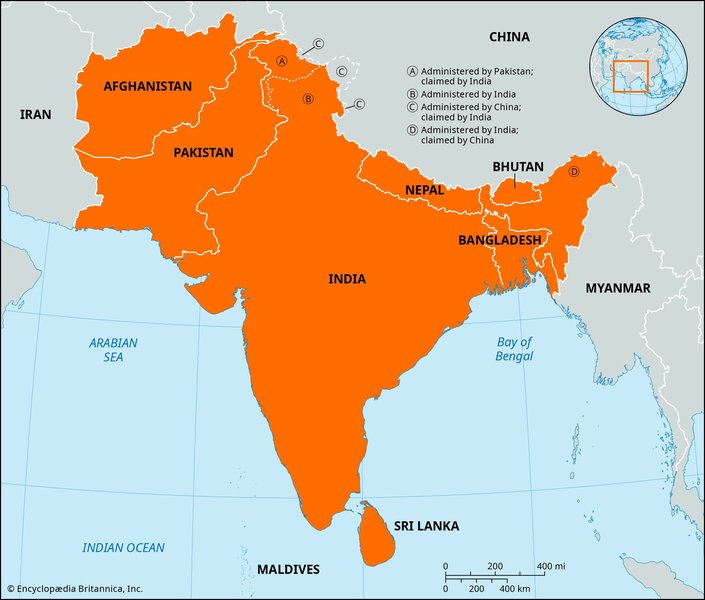
A map indicating the geographical extent commonly referred to as South Asia.
Cradles of Civilization and Culture
Ancient Roots
This geographical area was home to some of the world's earliest civilizations. Settled life emerged around 9,000 years ago, leading to the sophisticated Indus Valley Civilization (circa 3300–1700 BCE), known for its urban planning and advanced drainage systems. Subsequent eras saw the rise of influential religious and philosophical traditions, including Hinduism, Buddhism, and Jainism, which spread across the region and beyond.
Shared Heritage
Despite political fragmentation over centuries, the peoples of the subcontinent developed and shared common cultural threads. Ancient literature in Sanskrit, Prakrit, and regional languages, similar forms of music, dance, ritual practices, artistic expressions, and philosophical ideas created a sense of shared civilizational identity that transcended political divisions. Empires like the Maurya (c. 322–185 BCE), Gupta (c. 320–550 CE), and Mughal (1526–1857 CE) achieved significant political unification at various times, fostering administrative and cultural cohesion across large parts of the subcontinent.
Established Networks
Economic and Political Life
Pre-colonial South Asia had established internal and external trade networks. Political structures, while often fluid compared to modern nation-states, included sophisticated empires and kingdoms with complex administrative systems. The concept of sovereignty and territory differed from the Westphalian model later introduced by Europeans; boundaries were often porous and political control ebbed and flowed.
The Colonial Imprint: Reshaping a Region
The arrival of European powers, beginning in the 16th century and culminating in British dominance, marked a watershed moment. Colonialism didn't operate on a blank slate, but it fundamentally altered the political, economic, and social landscape, leading to the emergence of South Asia as we conceptualize it today.

A political map showing the modern nation-states within South Asia, many boundaries of which were influenced by colonial administration.
Political Restructuring and the Nation-State
Drawing Lines on the Map
Perhaps the most direct impact was political. Colonial powers, particularly Britain, imposed the Western concept of the nation-state with fixed, clearly demarcated borders onto a region characterized by more fluid political arrangements. Administrative convenience, strategic considerations, and resource control often dictated how boundaries were drawn, frequently cutting across existing ethnic, linguistic, and cultural communities. This imposition of a Western legal and territorial framework laid the groundwork for the modern political map of South Asia.
The Shadow of Partition
The culmination of this political restructuring was the partition of British India in 1947, which led to the creation of independent India and Pakistan (East and West). East Pakistan later became Bangladesh in 1971. This event, orchestrated under the departing colonial administration, exemplifies how Western actions directly created the specific nation-state configuration of the core subcontinent, often with devastating human consequences and enduring geopolitical tensions.
Economic Transformation for Imperial Gain
Integration into Global Capitalism
Colonial rule radically restructured the economies of South Asia. Pre-existing trade patterns were disrupted and reoriented to serve the interests of the colonial powers. The region was integrated into the global capitalist system, primarily as a source of raw materials (like cotton, jute, tea) and agricultural products for European industries and as a captive market for manufactured goods. This export-oriented, dependent economic model had long-lasting consequences for post-independence development.
Social and Cultural Reconfiguration
Codifying Identities
Colonial administration often relied on simplifying complex social realities. Western administrators and scholars categorized populations based on religion, caste, ethnicity, and language, sometimes solidifying divisions or creating new ones for governance purposes (e.g., through census-taking and separate electorates). Western education systems and the introduction of English as an administrative language also influenced social structures and cultural identities, creating new elites and fostering certain types of national consciousness that were intertwined with the colonial experience.
Conceptualizing "South Asia"
A Term Emerges
While the geography existed, the explicit labeling and conceptualization of "South Asia" as a distinct geopolitical and academic region gained currency primarily during the 20th century, particularly within Western contexts. It became a convenient way to group countries with shared (often British) colonial histories and certain cultural affinities, distinguishing them from Southeast Asia or East Asia. This external framing influenced how the region was studied, governed, and perceived internationally.
Visualizing the Influences: A Mindmap Perspective
This mindmap illustrates the interplay between the deep-rooted indigenous factors and the significant impact of Western colonialism in shaping the modern entity of South Asia.
(Himalayas, Ocean)"] id1b["Ancient Civilizations
(Indus Valley)"] id1c["Regional Empires
(Maurya, Gupta, Mughal)"] id1d["Shared Cultural Threads
(Religion, Arts, Language)"] id1e["Established Trade Networks"] id2["Western Colonial Influence"] id2a["Political Restructuring"] id2a1["Imposition of Nation-States"] id2a2["Fixed, Artificial Borders"] id2a3["Partition (1947)"] id2a4["Centralized Administration"] id2b["Economic Transformation"] id2b1["Resource Extraction"] id2b2["Integration into Global Capitalism"] id2b3["Export-Oriented Economies"] id2c["Social & Cultural Reconfiguration"] id2c1["Imposed Categorizations
(Caste, Ethnicity)"] id2c2["Influence on Identity & Language"] id2c3["Western Education/Legal Systems"] id2d["Geographical Conceptualization"] id2d1["Formal Mapping & Definition"] id2d2["Strategic Boundary Drawing"] id2d3["'South Asia' as a Term"] id3["Post-Colonial Reality"] id3a["Legacy of Colonial Borders"] id3b["Regional Cooperation (e.g., SAARC)"] id3c["Ongoing Identity Formation"] id3d["Economic Challenges & Development"]
The mindmap highlights how pre-existing geographical, civilizational, and cultural elements formed the base upon which Western colonial powers overlaid new political, economic, and social structures, leading to the complex reality of contemporary South Asia.
Relative Impact: Pre-Colonial vs. Colonial Forces
This chart offers a comparative perspective on the perceived strength of pre-colonial foundations versus the impact of Western colonial influence across various dimensions of South Asian identity. The scores (on a scale of 1 to 10, where 1 is low and 10 is high) represent a qualitative assessment based on the historical analysis.
The chart visualizes the strong impact of colonialism, particularly on political boundaries, economic systems, and the very terminology used to describe the region. However, it also acknowledges the significant enduring strength of pre-colonial geographical realities and cultural identity, suggesting a complex interaction rather than a simple creation.
State Building and Colonial Legacy: A Video Perspective
The following video provides insights into the processes of state building in South Asia, touching upon historical contexts that are relevant to understanding the impact of external influences and internal developments, including the colonial period.
This overview discusses how states formed and consolidated power in the region, offering a lens through which to view the changes brought about by Western imperialism and the subsequent formation of modern nation-states, building upon or replacing earlier political entities.
Comparing Eras: South Asia Before and After Colonialism
This table summarizes key characteristics of South Asia, contrasting the pre-colonial era with the situation shaped by and following Western colonial influence, highlighting the transformative changes.
| Characteristic | Pre-Colonial Era | Colonial & Post-Colonial Era |
|---|---|---|
| Political Structure | Diverse empires, kingdoms; fluid boundaries; varying sovereignty concepts. | Nation-states based on Western models; fixed, often artificial borders; centralized administration (colonial legacy). |
| Economic Focus | Agrarian societies; established regional and overseas trade networks; artisanal production. | Integration into global capitalism; focus on raw material export; dependence on colonial/global markets; industrialization efforts post-independence. |
| Social Identity | Identities based on region, religion, caste, language, lineage; shared civilizational elements. | Reinforcement/codification of categories (religion, ethnicity); rise of modern nationalism; influence of Western education/language. |
| Geographical Definition | Naturally bounded subcontinent; internal regions understood through local/cultural terms. | Formal definition as "South Asia"; boundaries mapped and solidified for administrative/strategic purposes; term prominent in external discourse. |
| Regional Interaction | Significant internal cultural/economic exchange; interactions based on proximity and trade routes. | Political divisions hinder interaction (e.g., India-Pakistan); formal regional cooperation attempts (e.g., SAARC) navigate colonial legacies. |
The table underscores how Western colonialism acted as a powerful catalyst, fundamentally reshaping the political organization, economic orientation, and even the conceptualization of South Asia as a distinct regional entity, while interacting with deep-seated historical realities.
A Synthesis: Redefinition Over Creation
Returning to the original statement, it is more accurate to say that Western countries profoundly *redefined* and *restructured* South Asia, particularly in its modern political and economic form, rather than *creating* it from scratch. The imposition of the nation-state system, the drawing of specific borders (especially during partition), the integration into a colonial economic framework, and the popularization of "South Asia" as a regional label are undeniable legacies of Western influence.
However, this influence was exerted upon a region with its own ancient history, distinct geography, vibrant cultures, and established societies. The South Asia of today is a product of the complex, often traumatic, interaction between these indigenous foundations and the forces of Western colonialism. Acknowledging the role of Western powers is essential, but erasing the millennia of history that preceded their arrival offers an incomplete picture.
Frequently Asked Questions (FAQ)
What countries are typically included in South Asia?
Generally, South Asia includes India, Pakistan, Bangladesh, Sri Lanka, Nepal, Bhutan, and the Maldives. Afghanistan is sometimes included due to cultural and historical ties, reflecting the fluid nature of regional definitions.
Was the partition of India solely a British decision?
The partition plan was implemented by the British administration, but it was the culmination of complex political factors within British India, including the demands of the Muslim League for a separate state and the Indian National Congress's positions. While the final act was British-led, the political dynamics leading to it involved various South Asian actors and movements shaped significantly by the colonial context.
How does the colonial economic legacy persist today?
Legacies include reliance on certain primary commodity exports, infrastructure oriented towards colonial trade patterns (e.g., port cities), economic structures shaped during the colonial era, and ongoing challenges in regional economic integration partly due to politically drawn borders.
Did Western influence completely erase pre-colonial cultures?
No. While colonialism profoundly impacted societies and introduced Western elements (language, governance, education), rich pre-colonial cultural traditions, languages, religions, and social practices continue to thrive and evolve across South Asia. There was significant interaction, adaptation, and resistance, not wholesale erasure.
Recommended Reading
- Explore how the Partition of 1947 specifically shaped the modern borders within South Asia.
- Investigate the primary economic consequences of British colonial rule on the Indian subcontinent.
- Discover the differences between political structures in South Asia before colonialism and the later nation-state model.
- Learn more about when and why the term "South Asia" came into common usage.
References
Last updated May 4, 2025