
What is Dark Matter?
Unveiling the Invisible Mass Shaping Our Universe
Key Takeaways
- Invisible Yet Influential: Dark matter does not interact with light, making it invisible, yet its gravitational effects dictate the motion of galaxies and the structure of the cosmos.
- Comprises 27% of the Universe: Dark matter constitutes a significant portion of the universe’s total mass-energy content, far outweighing ordinary matter.
- Fundamental to Cosmic Structure: It acts as the scaffolding for the formation and evolution of galaxies, galaxy clusters, and the large-scale structure of the universe.
Introduction
Dark matter is a mysterious and invisible form of matter that constitutes approximately 27% of the universe's total mass-energy content. Unlike ordinary matter, which includes stars, planets, and gas, dark matter does not interact with electromagnetic forces, meaning it does not emit, absorb, or reflect light. This makes it undetectable through conventional telescopes or sensors, and its presence is inferred solely through its gravitational influence on visible matter, radiation, and the large-scale structure of the universe.
Key Characteristics of Dark Matter
Invisibility and Interaction
Dark matter does not interact with electromagnetic radiation, rendering it invisible and detectable only through gravitational effects. This lack of interaction means dark matter neither emits nor absorbs light or other forms of electromagnetic energy, distinguishing it from ordinary baryonic matter.
Gravitational Influence
The existence of dark matter is primarily inferred from its gravitational effects. For example, the rotational speeds of galaxies exceed what can be accounted for by the visible matter alone. To prevent stars at the edges of galaxies from flying off, an additional unseen mass—dark matter—is required to provide the necessary gravitational pull. Additionally, dark matter is believed to form large halos around galaxies, binding them gravitationally and influencing their dynamics.
Role in Cosmic Structure Formation
Dark matter plays a crucial role in the formation and evolution of cosmic structures. It acts as a gravitational scaffold, attracting ordinary matter to form galaxies, galaxy clusters, and the intricate large-scale structure observed in the universe. Without dark matter, the assembly of these structures under the known laws of physics would be severely impeded.
Evidence for Dark Matter
Galactic Rotation Curves
One of the earliest and most compelling pieces of evidence for dark matter comes from the study of galactic rotation curves. Observations reveal that stars in the outer regions of galaxies rotate at speeds that cannot be explained by the gravitational pull of visible matter alone. This discrepancy suggests the presence of additional mass in the form of dark matter.
Gravitational Lensing
Gravitational lensing is a phenomenon where the path of light from distant objects is bent around massive structures, such as galaxy clusters. The degree of lensing observed cannot be accounted for by ordinary matter alone, further supporting the existence of dark matter. The Bullet Cluster, in particular, provides significant evidence where the separation of normal matter and dark matter was observed during the collision of two galaxy clusters.
Cosmic Microwave Background (CMB)
The CMB radiation, the remnant heat from the Big Bang, exhibits fluctuations that align with predictions made by models incorporating dark matter. These fluctuations provide insights into the universe's composition, supporting the notion that dark matter played a vital role in its early development.
Large-Scale Structure of the Universe
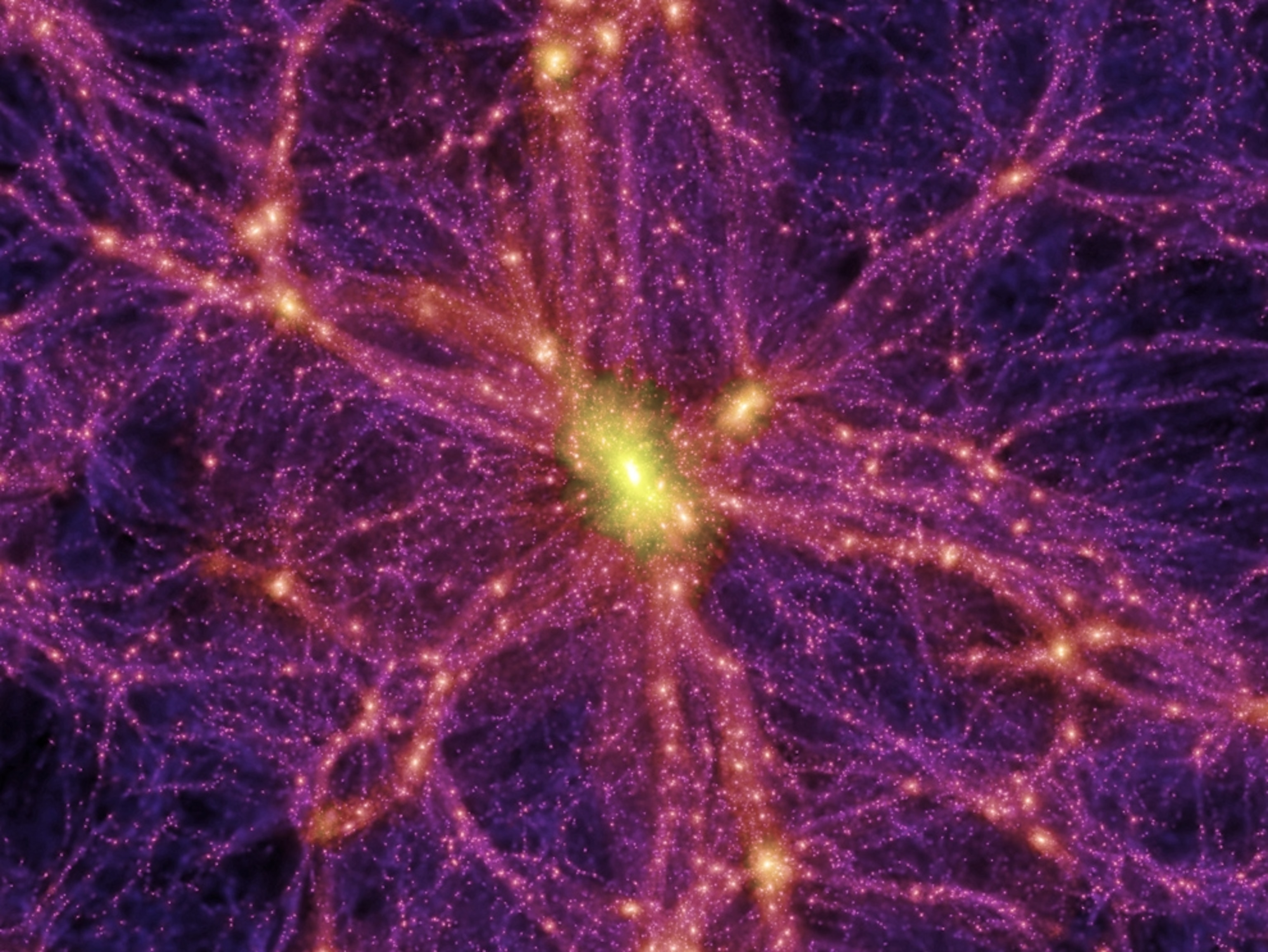
The distribution of galaxies and galaxy clusters across the cosmos forms a web-like large-scale structure. Dark matter's gravitational influence is essential in shaping this structure, with simulations showing that dark matter's presence is necessary to replicate the observed distribution and formation of these cosmic frameworks.
Composition of Dark Matter
Hypotheses on Dark Matter Constituents
The exact nature of dark matter remains unknown, but several leading theories propose that it consists of as-yet-undiscovered particles that interact weakly, if at all, with ordinary matter and electromagnetic radiation. Key candidates include:
-
Weakly Interacting Massive Particles (WIMPs): Hypothetical particles that interact primarily through gravity and the weak nuclear force. They are a strong candidate due to their favorable properties and potential detection methods.
-
Axions: Lightweight particles proposed as a solution to the strong CP problem in quantum chromodynamics. Axions are another compelling candidate for dark matter and are the focus of ongoing experiments.
-
Sterile Neutrinos: Neutrino-like particles that do not interact via the standard weak force, making them a potential form of dark matter.
-
Primordial Black Holes: Black holes formed in the early universe could contribute to dark matter. However, they are unlikely to account for all dark matter unless specific conditions exist.
Distribution of Dark Matter
Dark Matter Halos
Dark matter is thought to form extensive halos surrounding galaxies and galaxy clusters. These halos provide the gravitational foundation necessary for the structures of galaxies to remain stable and for galaxies to orbit within larger clusters. Simulations indicate that dark matter halos are key to understanding the dynamics and distribution of visible matter within galaxies.
Research and Detection Efforts
Particle Physics Experiments
Large-scale experiments and particle accelerators, such as the Large Hadron Collider (LHC) at CERN, are instrumental in the search for dark matter particles. By recreating conditions of the early universe, these experiments aim to detect potential dark matter candidates like WIMPs.
Direct Detection Experiments
Experiments such as XENON and LUX are designed to directly detect dark matter particles by observing their rare interactions with ordinary matter. These experiments involve highly sensitive detectors deep underground to shield them from cosmic rays and other background noise.
Astronomical Observations
Astronomers utilize various observational techniques to infer the presence of dark matter. These include mapping the gravitational lensing effects around galaxy clusters, studying the cosmic microwave background, and analyzing the large-scale distribution of galaxies.
Space-Based Experiments
Space-based observatories and experiments contribute to dark matter research by providing data free from atmospheric interference. Missions like the Dark Energy Survey (DES) help in understanding dark matter’s role in cosmic structure.
Alternative Theories
Modified Newtonian Dynamics (MOND)
Some scientists propose modifications to the laws of gravity to explain the observed phenomena without invoking dark matter. Among these, Modified Newtonian Dynamics (MOND) alters the expected behavior of gravity at low accelerations. However, MOND struggles to account for all observations consistently, such as those from the Bullet Cluster and the Cosmic Microwave Background.
Significance of Understanding Dark Matter
Dark matter is a cornerstone of the current cosmological model, known as the Lambda-CDM model, which describes the universe's composition, structure, and evolution. Discovering the true nature of dark matter would provide profound insights into fundamental physics, the formation of cosmic structures, and the ultimate fate of the universe. It remains one of the most significant challenges in both cosmology and particle physics.
Dark Matter Candidates Compared
| Candidate | Properties | Detection Methods |
|---|---|---|
| WIMPs | Massive, interact via gravity and weak nuclear force | Direct detection experiments, particle accelerators |
| Axions | Lightweight, interact very weakly | Axion haloscopes, microwave cavity experiments |
| Sterile Neutrinos | Neutrino-like, no standard weak interaction | Neutrino observatories, X-ray observations |
| Primordial Black Holes | Black holes formed in the early universe | Gravitational lensing, gravitational wave detections |
Conclusion
Dark matter remains one of the most enigmatic and vital components of our universe. Despite being invisible and undetectable by conventional means, its gravitational influence is indispensable in shaping the cosmos. Ongoing research across multiple disciplines continues to seek direct evidence for dark matter particles, refine our understanding of cosmic structures, and explore alternative theories. Unlocking the mysteries of dark matter is essential for a comprehensive grasp of the universe's fundamental nature and evolution.
References
Last updated January 22, 2025