
Unlocking the Mystery: Why Are Humans Mortal?
Exploring the intricate web of biology, evolution, and physics that defines our finite lifespan.
Humans, unlike some organisms whispered about in biology, face the undeniable reality of mortality. We age, our bodies decline, and eventually, life ceases. But why? Why aren't we biologically immortal, capable of living indefinitely? The answer lies not in a single cause, but in a complex interplay of cellular limitations, evolutionary strategies, and fundamental physical laws.
Key Insights into Human Mortality
- Cellular Clocks Tick Down: Our cells have a built-in limit to how many times they can divide (the Hayflick limit), driven largely by shortening telomeres, leading to cellular aging and tissue decline.
- Evolution Favors Generations: From an evolutionary standpoint, individual immortality is less advantageous than reproduction and generational turnover, which drive adaptation and species survival.
- The Unrelenting Force of Entropy: The second law of thermodynamics dictates a universal tendency towards disorder, meaning biological systems inevitably accumulate damage and decay over time, making perfect, indefinite maintenance impossible.
The Biological Barriers to Immortality
Our very biology is etched with the blueprint of a finite existence. Several key mechanisms at the cellular and organismal level prevent humans from achieving biological immortality.
The Hayflick Limit: A Cellular Countdown
At the heart of cellular aging lies the Hayflick limit. Discovered by Dr. Leonard Hayflick, this principle states that most normal human cells can only divide a finite number of times – typically estimated between 50 and 70 divisions. Each time a cell replicates, the protective caps at the ends of our chromosomes, called telomeres, tend to shorten. Think of them like the plastic tips on shoelaces that prevent fraying. As telomeres become critically short, the cell receives signals to stop dividing, entering a state called senescence, or it may undergo programmed cell death (apoptosis).
Cellular Senescence and Its Consequences
What is Senescence?
Senescent cells aren't dead, but they cease to replicate and change their function. While senescence plays protective roles earlier in life (like preventing uncontrolled cell growth, i.e., cancer), the accumulation of these non-dividing, altered cells contributes significantly to the aging process. They can release inflammatory molecules that damage surrounding tissues, impairing organ function and increasing susceptibility to age-related diseases.
Why Can't We Just Keep Dividing?
While some cells, like certain stem cells or cancer cells, possess an enzyme called telomerase that can rebuild telomeres, this activity is tightly regulated in most somatic (body) cells. Uncontrolled cell division is the hallmark of cancer, so the Hayflick limit acts as a crucial tumor-suppressing mechanism. Achieving cellular immortality would require bypassing this fundamental safeguard, a risky proposition.
Accumulated Damage: The Wear and Tear of Life
Beyond the limit on cell divisions, our bodies constantly battle damage accumulation at the molecular and cellular levels. This is akin to the gradual wear and tear on a complex machine.
Sources of Damage
- Oxidative Stress: Metabolic processes generate reactive oxygen species (ROS) as byproducts. While ROS have signaling roles, excess amounts can damage DNA, proteins, and lipids.
- DNA Damage: Our genetic material is constantly under assault from internal sources (like metabolic byproducts) and external factors (like UV radiation and environmental toxins). While repair mechanisms exist, they are not perfect, leading to mutations and DNA lesions accumulating over time.
- Protein Misfolding and Aggregation: Proteins must fold into specific three-dimensional shapes to function correctly. Aging is associated with errors in this process, leading to misfolded proteins that can clump together (aggregate), disrupting cellular function and contributing to diseases like Alzheimer's and Parkinson's.
- Metabolic Disruptions: Changes in how cells process energy and nutrients occur with age, affecting overall cellular health and function.
This relentless accumulation of damage gradually impairs tissue and organ function, reducing the body's ability to repair itself and maintain homeostasis (a stable internal environment). This systemic decline is what we perceive as aging.
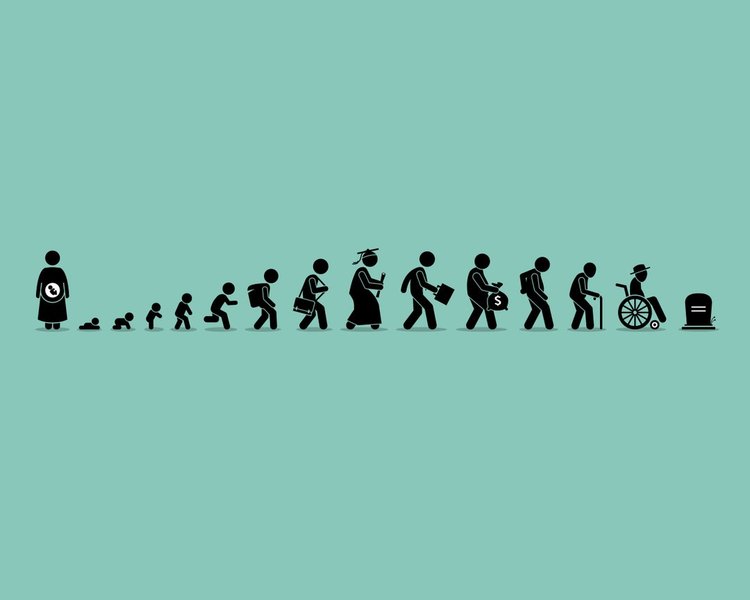
The typical human lifecycle, depicting stages from infancy to old age, illustrates the natural progression towards senescence and mortality.
Genetic Programming and Lifespan Regulation
Aging isn't just passive decay; it's also influenced by genetically regulated pathways. Certain signaling pathways, like those involving mTOR (mammalian target of rapamycin) and IGF-1 (insulin-like growth factor 1), play crucial roles in growth, metabolism, and longevity. These pathways represent complex trade-offs: promoting growth and reproduction early in life might come at the cost of accelerated aging later on. Modulating these pathways is a key area of aging research, but it highlights that our lifespan is, to some extent, genetically programmed and optimized for reproductive success within a finite period, not indefinite survival.
The Evolutionary Perspective: Why Mortality Makes Sense
From an evolutionary standpoint, the mortality of individuals can be beneficial for the long-term survival and adaptation of the species. Immortality, while appealing to the individual, doesn't necessarily align with the "goals" of evolution – namely, the propagation and diversification of genes.
Generational Turnover and Adaptation
Mortality ensures a turnover of generations. Each new generation carries a slightly different genetic makeup due to mutation and recombination during sexual reproduction. This genetic variation is the raw material for natural selection. As environments change, new generations may possess traits better suited for survival, allowing the species to adapt over time. Immortal individuals would "lock in" their genetic makeup, potentially hindering the species' ability to respond to new challenges or opportunities. Death frees up resources (like food, territory, and mating opportunities) for younger, potentially more adapted individuals.
The "Selfish Gene" Concept
Evolutionary biologists often speak of "selfish genes." This concept doesn't imply conscious intent but suggests that natural selection favors genes that are successful at replicating themselves and passing into the next generation. The survival of the individual organism (the "vehicle" carrying the genes) is important only insofar as it facilitates reproduction. Once reproduction has occurred, the evolutionary pressure to maintain the individual indefinitely diminishes significantly. Resources are often better allocated towards raising offspring than towards endlessly repairing an aging body.
Resource Allocation and Preventing Stagnation
Imagine a world populated by immortal humans. Competition for finite resources would become immense. Furthermore, without generational turnover, social and cultural evolution might stagnate. New ideas and adaptations often emerge with new generations. Mortality, in this sense, acts as a driver of dynamism and prevents ecological and social gridlock.
The Physics of Finitude: Entropy's Unseen Hand
Beyond biology and evolution, fundamental laws of physics impose constraints on indefinite life. The most relevant is the second law of thermodynamics.
Entropy: The Universal Tendency Towards Disorder
The second law states that in any isolated system, entropy – a measure of disorder or randomness – tends to increase over time. Living organisms are highly ordered, low-entropy systems. We maintain this order by constantly consuming energy (from food) and exchanging matter with our environment. However, this process is not perfectly efficient. Maintaining complex biological structures requires continuous energy input and repair mechanisms to counteract the natural tendency towards decay and disorder.
How Entropy Affects Biology
Molecular Wear and Tear
At the molecular level, constant thermal motion (the jiggling of molecules due to heat) causes wear and tear on the intricate molecular machines within our cells. Bonds can break, proteins can denature, and structures can degrade. While repair processes counteract some of this, they cannot achieve perfect fidelity forever. Over time, the cumulative effect of this molecular "friction" contributes to cellular dysfunction and aging.
The Impossibility of Perfect Maintenance
Creating and maintaining the extraordinary complexity of the human body requires vast amounts of information encoded in our DNA and intricate regulatory networks. Over long periods, errors inevitably creep into these systems – DNA mutations, epigenetic alterations, misfolded proteins. The sheer complexity makes perfect, indefinite self-repair a thermodynamic improbability. The cost of fighting entropy indefinitely would be immense and likely unsustainable.
Visualizing the Factors Limiting Human Lifespan
Understanding the multifaceted nature of human mortality requires considering the interplay between different limiting factors. This radar chart provides a conceptual visualization of the relative impact of key biological, evolutionary, and physical constraints preventing human immortality.
This chart illustrates that while factors like accumulated damage and cellular limits have a high impact on lifespan and offer some potential for intervention, fundamental constraints like entropy and evolutionary pressures present much greater challenges to achieving immortality.
Mapping the Constraints on Human Immortality
The reasons for human mortality are interconnected. This mindmap provides a visual overview of the primary domains—biological, evolutionary, and physical—and their key contributing factors.
This map highlights how cellular mechanisms, evolutionary imperatives favoring reproduction, and inescapable physical laws like entropy collectively create a framework where finite lifespans are the norm for complex organisms like humans.
Lifespan Limits and the Scientific Outlook
While medical science continuously pushes the boundaries of average life expectancy, there appears to be a natural upper limit to the human lifespan.
The Maximum Human Lifespan
Demographic studies and analyses of supercentenarians (people living past 110) suggest a maximum human lifespan currently hovering around 120-125 years. While average lifespan has increased dramatically due to improvements in sanitation, nutrition, and medicine combating infectious diseases and managing chronic conditions, the maximum lifespan seems to have hit a biological ceiling. This indicates that the aging process itself, driven by the factors discussed above, imposes a fundamental limit that current interventions haven't overcome.
Research Frontiers: Extending Healthspan vs. Achieving Immortality
Current aging research focuses heavily on extending healthspan – the period of life spent in good health, free from chronic diseases and disabilities. Strategies include:
- Senolytics: Drugs designed to selectively clear senescent cells.
- Telomere Maintenance: Exploring ways to safely manage telomere length.
- Metabolic Interventions: Modulating pathways like mTOR and AMPK through diet or drugs.
- Regenerative Medicine: Using stem cells or tissue engineering to repair or replace damaged tissues.
While these approaches hold promise for improving health in old age and potentially increasing average lifespan further, they do not equate to achieving biological immortality. Overcoming all aspects of aging simultaneously, counteracting entropy indefinitely, and rewriting fundamental evolutionary programming remain monumental, perhaps insurmountable, challenges.
Understanding Aging: Insights from Dr. David Sinclair
Researchers like Dr. David Sinclair explore the mechanisms of aging, proposing theories like the "Information Theory of Aging," which suggests that aging results from a loss of epigenetic information over time. While his work focuses on interventions that might slow or even reverse aspects of aging, it underscores the complexity of the process. This video offers perspectives on why humans age and the challenges involved:
The video delves into biological perspectives on aging, touching upon genetic factors and potential avenues for intervention, further illustrating why immortality isn't our current biological reality.
Comparing Human Limits: Factors Summarized
To consolidate the core reasons why humans are not immortal, the following table summarizes the key limiting factors and their primary effects:
| Limiting Factor | Primary Mechanism | Consequence |
|---|---|---|
| Cellular Aging (Hayflick Limit) | Telomere shortening; finite cell divisions | Cellular senescence, tissue degradation, impaired regeneration |
| Accumulated Damage | DNA mutations, oxidative stress, protein misfolding | Reduced cellular function, organ decline, age-related diseases |
| Evolutionary Strategy | Focus on reproduction and generational turnover | Limited selection pressure for extreme longevity; resource allocation to offspring |
| Thermodynamics (Entropy) | Natural tendency towards disorder | Inevitable molecular wear and tear; impossibility of perfect repair |
| Genetic Programming | Control of lifespan via specific pathways (e.g., mTOR) | Trade-offs between growth/reproduction and longevity |
| System Complexity | Interdependence of specialized cells and organs | Difficulty in repairing/replacing all components flawlessly |
| External Factors | Accidents, diseases, environmental hazards | Mortality risk independent of the aging process |
This table reinforces that human mortality results from a confluence of intrinsic biological limits, evolutionary history, and universal physical laws, rather than a single, simple cause.
Frequently Asked Questions
What exactly is the Hayflick limit?
The Hayflick limit refers to the finite number of times a normal human cell population will divide before cell division stops, typically around 50-70 divisions. This limit is primarily linked to the progressive shortening of telomeres (protective caps on chromosome ends) with each division. Once telomeres reach a critical length, cells enter senescence (a state of irreversible growth arrest) or undergo apoptosis (programmed cell death), contributing to the aging process.
Are there any 'immortal' organisms?
Some organisms exhibit what is termed "biological immortality," meaning they don't seem to age or have a predetermined lifespan limit due to senescence. Examples include the *Hydra*, a small freshwater polyp that can regenerate extensively from stem cells, and the jellyfish *Turritopsis dohrnii*, which can revert to an earlier life stage under stress (transdifferentiation). However, "biological immortality" doesn't mean they can't die; they are still vulnerable to predation, disease, and environmental hazards. True immortality (indestructibility) hasn't been observed.
Could technology ever make humans immortal?
Achieving true biological immortality faces immense hurdles due to the biological, evolutionary, and physical constraints discussed. While future technologies (like advanced regenerative medicine, nanotechnology, or genetic engineering) might significantly extend human healthspan and average lifespan by combating aging processes and diseases, overcoming all causes of cellular decay, systemic failure, and the laws of entropy seems highly improbable based on current understanding. Furthermore, even if biological aging were halted, vulnerability to accidents, cosmic events, or unforeseen diseases would remain. Significant lifespan extension is a more realistic goal than true immortality.
How does entropy relate to aging?
Entropy, described by the Second Law of Thermodynamics, is the tendency for systems to move towards greater disorder. Living organisms are highly ordered systems that maintain their structure by constantly consuming energy to counteract entropy. However, this process isn't perfectly efficient. Over time, the cumulative effect of small amounts of un-repaired damage and inefficiencies (a consequence of entropy) leads to the gradual breakdown of biological structures and functions – essentially, aging. It represents a fundamental physical limit on the ability of any complex system, including the human body, to maintain perfect order indefinitely.
Recommended Reading
- Explore the detailed role of telomeres in cellular aging and the Hayflick limit.
- Discover more about organisms like Hydra and Turritopsis dohrnii that defy typical aging patterns.
- Learn about the latest scientific research into anti-aging interventions and extending healthspan.
- Delve deeper into the evolutionary arguments for why mortality is favored over individual immortality.
References
Last updated May 5, 2025