
Unveiling the Grace and Power of Yang Style Tai Chi: Exploring the Essence of "Kai He"
A Deep Dive into the Foundations and Forms of a Globally Practiced Art
- Yang Style Tai Chi is the most widely practiced form globally, known for its slow, continuous, and soft movements, making it accessible to a broad range of practitioners for health and self-defense.
- The core concept of "Kai He" (Open and Close) is fundamental to Tai Chi, embodying the dynamic interplay of expansion and contraction that facilitates Qi flow and enhances structural stability within each movement.
- While "Kai He" is a key principle in many Tai Chi styles, it is particularly emphasized in Wu (Hao) style, which is sometimes referred to as "Kai He" form due to its distinct focus on these opening and closing motions.
Tai Chi Chuan, often simply called Tai Chi, is an ancient internal Chinese martial art renowned for its profound health benefits, meditative qualities, and self-defense applications. Among its various styles, the Yang style stands out as the most popular and widely practiced across the globe. Characterized by its slow, steady, expansive, and soft movements, Yang style Tai Chi offers a flowing form that is accessible to practitioners of all ages and physical conditions. It is a harmonious blend of physical postures, synchronized breathing, and mental focus, often described as "moving meditation."
Understanding "Kai He": The Core of Tai Chi Dynamics
The Philosophy of Opening and Closing
At the heart of many Tai Chi movements lies the fundamental concept of "Kai He" (开合), which translates to "Open and Close." This principle is far more than a simple physical action; it is a profound philosophical and energetic dynamic that underpins the effectiveness of Tai Chi practice. In essence, "Kai" signifies an opening, expansion, or outward movement, allowing energy (Qi) to flow and the body to extend. Conversely, "He" denotes a closing, contraction, or inward movement, gathering energy, connecting the body's structure, and facilitating the circulation of Qi through the limbs.
This perpetual interplay of opening and closing creates a continuous, cyclical pattern of movement, mirroring the natural world and the principles of Yin and Yang. When performed correctly, "Kai He" movements promote internal stretching of tissues, physically stabilizing the body while enhancing the flow of Qi. It's about loosening up to stabilize, disconnecting to connect, and allowing the vital energy to circulate freely throughout the system. This dynamic is crucial for developing sensitivity, balance, and the effortless power inherent in Tai Chi.
The "Kai He" Principle in Tai Chi: A Radar Chart of its Foundational Contributions
"Kai He" in Wu (Hao) Style Tai Chi
While the concept of "Kai He" is integral to all Tai Chi styles, its prominence and specific application vary. The Wu (Hao) style, for instance, is often referred to as "Kai He" forms precisely because of its distinct focus on these opening and closing movements. This style emphasizes smaller, more compact movements and a medium stance, making the subtle internal transitions of "Kai He" particularly noticeable and central to its practice. Unlike the broad, expansive movements of Yang style, Wu (Hao) style refines the "Kai He" principle into a more internalized and condensed expression, highlighting its role in generating and circulating internal energy.
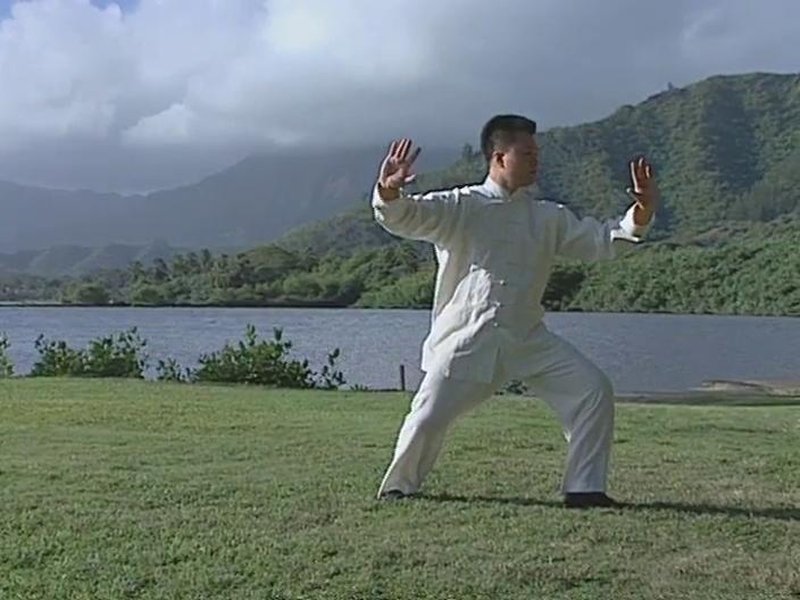
An image illustrating the focus on "Kai He" in Wu (Hao) style Tai Chi.
The Interplay of "Kai He" in Yang Style Forms
Although the Yang style is characterized by its slow, steady, and expansive movements, the principles of "Kai He" are implicitly woven into its fabric. Every posture, from "Commencing Form" to "Single Whip" or "Cloud Hands," involves an subtle yet essential internal opening and closing action. These are not always overt physical contractions and expansions but rather shifts in weight, redirection of intention, and internal energetic adjustments that allow for seamless transitions and efficient energy flow.
For example, in "Parting the Horse's Mane," the outward extension of the arm represents a "Kai" (opening), while the subtle rotation and settling of the body before the next movement incorporate a "He" (closing) to consolidate energy. Similarly, in "Cloud Hands," the continuous circular motion involves constant internal "Kai He" as the hands open and close, and the body shifts weight, maintaining a fluid and interconnected structure. This integration ensures that even the large, flowing movements of Yang style retain internal coherence and power.
Key Movements and Their "Kai He" Essence
Common Movements Highlighting "Kai He"
While "Kai He" is a pervasive principle rather than a distinct set of movements in Yang style, many postures exemplify its essence. Below is a table outlining common Yang style movements and how the "Kai He" concept is applied within them, alongside their Chinese characters and Pinyin.
| Movement Name (English) | Chinese Character | Pinyin | "Kai He" Application |
|---|---|---|---|
| Commencing Form | 起式 | Qǐ shì | Subtle opening to establish posture and calm the mind, followed by an internal settling. |
| Parting the Horse's Mane | 揽雀尾 | Lǎn què wěi | Outward extension (Kai) followed by an internal shift and preparation (He) for the next movement. |
| White Crane Spreads its Wings | 白鹤亮翅 | Bái hè liàng chì | Opening of the arms and body (Kai) for expansion and balance. |
| Brush Knee and Twist Step | 搂膝拗步 | Lōu xī niǔ bù | Forward brushing motion (Kai) with a subtle internal closing/connection as weight shifts. |
| Playing the Lute | 手挥琵琶 | Shǒu huī pí pá | A dynamic interplay of opening the arms and torso with a subtle gathering (He) in the center. |
| Cloud Hands | 云手 | Yún shǒu | Continuous circular motion involving constant opening and closing of hands and torso. |
| Single Whip | 单鞭 | Dān biān | An expansive opening of the body into a broad posture, followed by a rooted connection (He). |
| Raise Hands | 提手上势 | Tí shǒu shàng shì | Upward opening of hands and body (Kai). |
| Push | 推 | Tuī | Forward extension (Kai) after gathering energy (He) from a previous movement. |
| Cross Hands | 十字手 | Shí zì shǒu | Closing and gathering (He) the arms towards the center, establishing connection. |
| Needle at Sea Bottom | 海底针 | Hǎi dǐ zhēn | Downward, inward motion (He) followed by a slight upward opening (Kai). |
| Fan Through Back | 扇通背 | Shàn tōng bèi | An expansive opening of the back and arms (Kai). |
The Significance of "Kai He" in Tai Chi Practice
The "Kai He" principle is crucial for developing internal strength and fluidity in Tai Chi. It goes beyond mere physical movement, encompassing the coordination of intention (Yi), breath (Qi), and physical form (Xing). Proper "Kai He" practice cultivates sensitivity, enabling practitioners to feel and direct their internal energy. This leads to improved balance, enhanced circulation, deeper relaxation, and a more profound understanding of the body's interconnectedness.
When Tai Chi movements are performed with a conscious application of "Kai He," the body functions as a unified system. The spine straightens (Kai), then slightly folds (He), coordinating with the opening and closing of the limbs to create a continuous, elastic force. This allows for both defensive applications—such as dissolving an opponent's attack—and offensive power, where softness and stillness can explode into speed and force with minimal warning.

A chart illustrating various movements in the Yang Style 24 Form, each implicitly containing the "Kai He" principle.
The Broader Context of Tai Chi Forms
While the focus here is on "Kai He," it's important to recognize that Yang style Tai Chi includes various forms of differing lengths, all embodying core Tai Chi principles. The most common forms include:
- Yang Style 24 Movements Short Form: This simplified form, created in 1956, is the most popular globally and serves as an excellent introduction to Yang style, consolidating basic movements and removing repetitions from longer forms. It typically takes 6-7 minutes to perform.
- Yang Style 10 Form: A shorter sequence focusing on fundamental movements like "Repulsing the Monkey" and "Cloud Hands."
- Yang Style 85, 88, 103, or 108-Movement Long Form: These variations are considered the traditional forms, passed down through generations of the Yang family. They can take 25-30 minutes to complete and offer a comprehensive training experience, showcasing the depth and nuances of the style. The number of movements can vary slightly depending on how they are counted by different teachers or schools.
- Cheng Man-ch'ing's 37-Movement Short Form: A popular shortened version that synthesizes elements from Yang, Wu, Chen, and Sun styles, designed for easier learning by modern students.
Each of these forms, regardless of length, emphasizes a straight spine, abdominal breathing, and a natural range of motion, all while integrating the subtle yet profound principles of "Kai He."
Deep Dive into "Kai He" Concept
To further understand the "Kai He" principle, consider the video below which introduces this crucial concept in Tai Chi. It explains how opening and closing motions are fundamental to the flow of energy and the overall effectiveness of internal martial arts. This concept is not merely about physical mechanics but deeply rooted in traditional Chinese philosophical thought, particularly the interplay of Yin and Yang. Just as Yin and Yang are interdependent and transform into each other, so too do opening and closing movements continuously flow, leading to internal harmony and power.
Understanding the Internal Style Concepts: Kai He - Opening and Closing
This video provides an excellent visual and conceptual introduction to "Kai He," explaining its significance beyond just physical movement. It illustrates how these actions create a "pump" effect for Qi circulation, generate internal heat, and contribute to the overall body mechanics. The discussion touches upon how "Kai He" manifests as an internal stretching and contraction of tissues, stabilizing the body and allowing for fluid transitions between postures. This continuous dynamic motion is essential for cultivating the "eight jins" or energies of Taijiquan, such as Peng (ward off), Lu (roll back), Ji (press), and An (push), which are all expressions of opening and closing principles.
Frequently Asked Questions (FAQ)
What is "Kai He" in Tai Chi?
Which Tai Chi style emphasizes "Kai He" the most?
Are there specific forms named "Kai He" in Yang style?
What are the benefits of practicing "Kai He" in Tai Chi?
How many movements are in the traditional Yang style long form?
Conclusion
The concept of "Kai He" is a cornerstone of Tai Chi practice, embodying the profound philosophical and energetic principles that make this martial art so effective for health and self-cultivation. While it is explicitly central to styles like Wu (Hao), its essence permeates every movement of the widely popular Yang style. Understanding and consciously applying "Kai He" allows practitioners to move beyond mere physical imitation, fostering a deeper connection to their internal energy, enhancing structural integrity, and achieving the fluid, balanced, and powerful movements characteristic of true Tai Chi.
Recommended Further Exploration
- Explore the rich history and lineage of Yang style Tai Chi to understand its evolution.
- Delve into the Eight Energies (Ba Jin) and Five Movements (Wu Bu) to deepen your understanding of Tai Chi's foundational techniques.
- Compare and contrast the different major Tai Chi styles (Chen, Wu, Sun) to appreciate their unique characteristics and shared principles.
- Learn about Qigong and its relationship with Tai Chi to further explore breath work and energy cultivation.
Referenced Search Results
 taichithoughts.wordpress.com
 baksillum.wordpress.com
 combativecorner.wordpress.com