
The Miller–Urey experiment demonstrated that amino acids could form from simpler chemicals under selected laboratory conditions. It did not produce a living cell. Three different records are often folded into that one name: Miller's 1953 report, a 2008 reanalysis of volcanic-apparatus samples, and a 2011 analysis of sulfur-containing samples from 1958. Keeping them separate explains why accounts give different product counts.
What the 1953 paper actually reported
Stanley L. Miller's 1953 Science paper used methane, ammonia, hydrogen and water with an electrical discharge. It identified glycine, α-alanine and β-alanine by paper chromatography. Miller explicitly treated aspartic acid and α-amino-n-butyric acid as less certain identifications because their spots were weak. Those distinctions are visible on printed page 529; “five amino acids” loses the original difference in confidence.
Miller is the paper's sole listed author. Its acknowledgment credits Harold C. Urey with suggestions and guidance. The familiar joint name should not be mistaken for the author list of that particular publication.
How the circulation loop worked
The apparatus combined a water reservoir, a gas-and-discharge region and a condenser. Heating supplied water vapour; cooling returned liquid to the reservoir, where nonvolatile products could accumulate. The 2014 methods paper explains this arrangement and also describes a later, simplified apparatus. Its modern setup is not an exact drawing of the original.
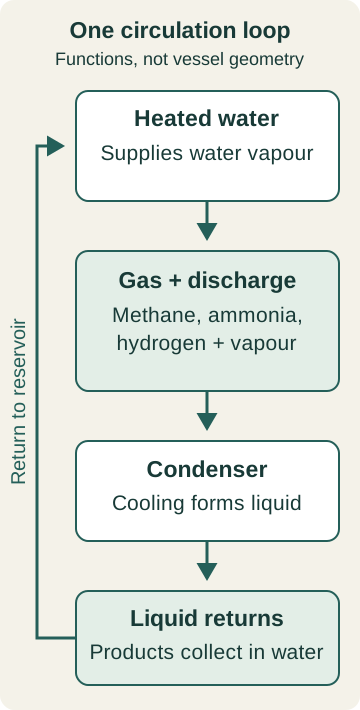
Read the loop as a way to maintain conditions and collect reaction products. A drawing of circulating water is not evidence that the apparatus reproduced every feature of an ancient ocean and atmosphere.
Why later papers report 22 or 23 amino acids
| Publication | Material examined | Reported result |
|---|---|---|
| 1953: Miller | The original experimental report. | Three firm amino-acid identifications; two additional assignments explicitly less certain. |
| 2008: Johnson and colleagues | Archived 1953–54 samples, including an apparatus that injected steam into the spark region. | 22 amino acids and five amines in the volcanic-apparatus samples. |
| 2011: Parker and colleagues | Archived samples from a different, previously unreported 1958 experiment containing hydrogen sulfide. | 23 amino acids and four amines, including seven sulfur-containing compounds across those categories. |
The 2008 paper and supporting material describe three apparatus configurations, not one interchangeable sample set. Its Table S1 compares their detected products. The authors also caution that extracts from the first apparatus may be incomplete. A smaller count in that comparison cannot cleanly rank every possible apparatus or reaction condition.
The 2011 paper concerns a different gas mixture and different stored residues. Its seven sulfur-containing products comprise six amino acids and one amine. It also identifies possible trace contamination for some amino acids. No saved original procedural blank was available; the blank in Figure 1 is an analytical solvent blank. These limits matter alongside the positive identifications.
The later studies used liquid chromatography and mass spectrometry. Better analytical methods can reveal compounds that an earlier method missed. A result published in 2011 is therefore not a result Miller reported in 1953, even when the physical sample is old. The headline counts also include compounds outside the familiar set of protein amino acids.
Does the atmosphere question invalidate the result?
The 2008 and 2011 papers discuss a central limitation: the strongly reducing gas mixture used in the classic experiment should not simply be assumed to represent the entire early atmosphere. They consider local or temporary reducing environments, including volcanic plumes, as possible settings for related chemistry. Those are environmental hypotheses, not measurements made by the apparatus.
Separate two questions when reading an origin-of-life claim:
- Can a reaction happen under stated conditions? This asks what the experiment produced and how the products were identified.
- Did those conditions and that pathway occur on early Earth? This needs geological and environmental evidence as well as chemistry.
A positive answer to the first does not settle the second. Conversely, questioning a global-atmosphere assumption does not make a measured laboratory product disappear. The useful next step is to specify which conditions are being challenged and which observation would distinguish competing explanations.
Why producing amino acids is not the same as producing life
A molecule list answers a composition question. A claim about a living system would need additional evidence about organization and sustained functions, rather than only more named molecules. For example, identifying a building block does not establish how it becomes part of an inherited, reproducing system.
This distinction also helps compare origin-of-life proposals fairly. A spark-discharge experiment addresses possible chemical feedstocks. An energy-gradient experiment addresses a different part of the problem. Our worked pH-gradient example separates chemical and electrical energy terms and explains what a calculation can establish. Neither type of result, by itself, supplies the entire historical pathway.
A practical way to check the next claim
- Match the sample to the paper. Record both the experiment's date and the analysis date; “Miller's experiment” is too broad.
- Check what was identified. Distinguish a firm identification, a tentative assignment and an undetected compound. They are different outcomes.
- Inspect the comparison. Ask whether blanks, handling, storage and detector sensitivity support the conclusion being drawn.
- Keep the conclusion at the measured scale. Product detection, environmental plausibility and a complete origin-of-life explanation require different evidence.
Our citation-verification guide provides a reusable claim-and-source check. For this topic, reading the original results and figure captions is especially useful: an accurate abstract can still omit qualifications elsewhere in the paper.
Primary references and reading notes
- Miller, S. L. (1953). A Production of Amino Acids Under Possible Primitive Earth Conditions. Science 117, 528–529. DOI and publisher; bibliographic record. Printed results and apparatus figure checked against a scan of the original paper.
- Johnson, A. P., and colleagues (2008). The Miller Volcanic Spark Discharge Experiment. Science 322, 404. DOI; NASA-hosted paper and supporting material, including Table S1.
- Parker, E. T., and colleagues (2011). Primordial synthesis of amines and amino acids in a 1958 Miller H₂S-rich spark discharge experiment. PNAS 108, 5526–5531. DOI; NASA-hosted paper. Results and Figure 1 distinguish potential trace contamination and the available blank.
- Parker, E. T., and colleagues (2014). Conducting Miller-Urey Experiments. Journal of Visualized Experiments 83, e51039. DOI; publisher's article. The introduction and apparatus description were checked; this page does not rely on the subscription video.
The schematic and explanatory comparisons are original Ithy material. They are not experimental data or reproductions of the papers' figures.