
Unraveling the Mystery of the 1857-Dated U.S. Cent: A Comprehensive Guide
Deciphering Design Elements, Historical Context, and Key Diagnostics for Collectors
Key Highlights of the 1857-Dated Cent
- Transitional Era: The 1857 cent marks a pivotal moment in U.S. coinage, transitioning from the large cent to the smaller, copper-nickel Flying Eagle cent, which was then swiftly succeeded by the Indian Head cent.
- "1857 Over 2858" Misconception: The user's query about an "1857 over 2858 Indian Head Cent" refers to a misconception. No such coin exists. The Indian Head Cent series began in 1859, following the short-lived Flying Eagle Cent (1856-1858). The "1857" date applies to a Flying Eagle Cent, while "2858" is likely a misinterpretation or confusion with other numismatic terms or varieties.
- Diagnostic Focus: Understanding the diagnostics for the 1857 Flying Eagle Cent involves examining the eagle's features, the "ONE CENT" wreath on the reverse, and looking for potential die varieties or errors common to this transitional period.
The query regarding an "1857 over 2858 Indian Head Cent" points to a common area of confusion for coin collectors, particularly those new to the intricacies of U.S. coinage. It's crucial to clarify that there is no legitimate U.S. cent with an "1857 over 2858" date, nor an "Indian Head Cent" specifically dated "1857." The Indian Head Cent series officially began in 1859, replacing the short-lived Flying Eagle Cent. The year 1857 is indeed significant, but it pertains to the introduction of the first small cent, the Flying Eagle Cent, which ushered in a new era of U.S. coinage after the discontinuation of the larger copper cents.
A Historical Glimpse: The Evolution of U.S. Cents (1793-1909)
From Large Cents to the Beloved Indian Heads
The history of U.S. one-cent coins is a fascinating narrative of economic shifts, technological advancements, and design evolution. From 1793 to 1857, the United States Mint produced large cents, which were substantial copper coins, comparable in size to a modern half-dollar. These coins were designed to contain a copper value close to their face value, reflecting the public's expectation that coinage should have intrinsic metal worth. However, the discovery of gold in California in the mid-19th century led to significant inflation, causing the price of copper to rise. This made the production of large cents increasingly unprofitable for the Mint.
The Emergence of Small Cents: The Flying Eagle Era
In response to these economic pressures, the Coinage Act of 1857 authorized a new, smaller cent. This marked a significant departure from the previous large copper cents. The new small cent, known as the Flying Eagle Cent, was composed of 88% copper and 12% nickel, making it the first U.S. coin to utilize a copper-nickel alloy. These new cents were the same diameter as modern pennies (19 mm) but were somewhat thicker and heavier than subsequent Lincoln cents. The Flying Eagle Cent was designed by James Longacre, featuring an eagle in flight on the obverse and the words "ONE CENT" within a wreath on the reverse. While pattern coins were struck in limited numbers in 1856, the Flying Eagle Cent was issued for general circulation in 1857 and 1858. The 1857 Flying Eagle Cent was notably the first small cent issued for circulation and was coined in huge numbers for the period, due to significant public and collector interest.
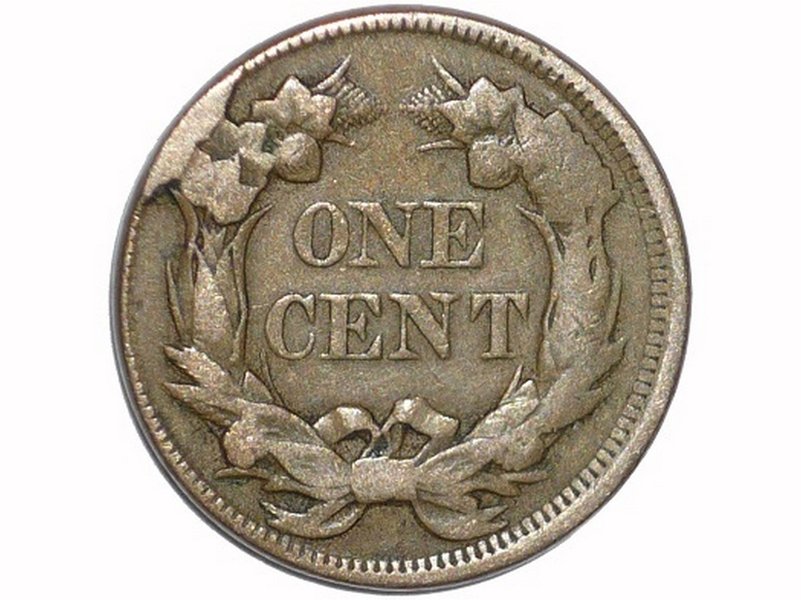
Reverse of an 1857 Flying Eagle Cent, illustrating the wreath design surrounding "ONE CENT."
The Dawn of the Indian Head Cent
Despite its initial popularity, the Flying Eagle Cent proved challenging to strike effectively due to the tough copper-nickel alloy and the opposing high points of the design (the eagle's head and the wreath). This difficulty led to its swift replacement. In 1859, the Indian Head Cent was introduced, also designed by James B. Longacre. This iconic coin featured a bust of Lady Liberty wearing a stylized Native American headdress on the obverse, a design that would remain largely unchanged throughout its 50-year production run (1859-1909). The reverse of the 1859 Indian Head Cent initially featured a laurel wreath, which was changed in 1860 to an oak wreath with a Union Shield at the top, creating the Type 2 Indian Head Cent.
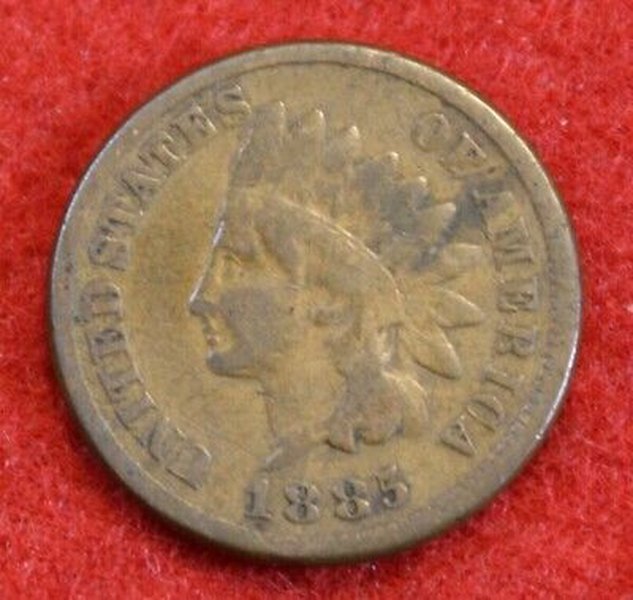
An 1885 Indian Head Cent, a later example of the iconic design.
Addressing the "1857 Over 2858 Indian Head Cent" Misconception
Clarifying Dates and Designs
The phrase "1857 over 2858 Indian Head Cent" is not a recognized numismatic description. As established, the Indian Head Cent series commenced in 1859. Therefore, an "1857 Indian Head Cent" would inherently be a misattribution or a counterfeit. The "2858" portion of the date is also highly unusual and does not correspond to any known U.S. coinage error or variety. It's plausible that this number is a transcription error, a misreading of a faint or damaged date, or confusion with a non-numismatic context.
Given the historical timeline, the "1857" date would pertain to a Flying Eagle Cent. It is common for collectors to look for varieties or errors in coins, including overdates, but an "1857 over 2858" would be an anomaly not found in any official records or established numismatic literature.
Diagnostics for the 1857 Flying Eagle Cent
Identifying Key Features and Potential Varieties
Since the user's query specifically mentions "1857," and given that this year is tied to the Flying Eagle Cent, understanding its diagnostics is paramount. The 1857 Flying Eagle Cent is a significant coin, being the first year of widespread circulation for the small cent.
Obverse Diagnostics: The Flying Eagle
- Eagle's Head and Tail: A common characteristic of Flying Eagle Cents, especially the 1857 issue, is weakness in the strike, particularly on the eagle's head and tail. This is because these features were opposite the wreath on the reverse, causing competition for metal flow within the die cavity during striking. Collectors should look for a clear, well-defined eagle, as a strong strike adds to the coin's appeal and value.
- Date Numerals: Examine the numerals "1857" closely. On genuine coins, the digits should appear even and well-formed. Counterfeits often exhibit uneven, distorted, or poorly formed digits. Minor doubling at the bases of the first two digits in the date can sometimes be observed, which might indicate a die variety or a transfer counterfeit.
- Protruding Bubbles/Die Breaks: Occasionally, genuine errors like a "protruding bubble" below the eagle's head can be found. These are typically smooth, rounded shapes resulting from die breaks or imperfections, and they can add to the coin's uniqueness for variety collectors.
Reverse Diagnostics: The Wreath
- Wreath Details: The reverse features the words "ONE CENT" inside an agricultural wreath. Look for clear definition in the leaves and berries of the wreath. Similar to the eagle's features on the obverse, the wreath can sometimes exhibit weakness in strike due to the coin's design and alloy.
- Lettering: The lettering "ONE CENT" should be sharp and clear. Any irregularities, such as uneven or strange-looking letters, could be a sign of a counterfeit, especially on the 1877 Indian Head Cent, which is often faked. While not directly an 1857 issue, the principles of inspecting lettering for authenticity apply across series.
Composition and Weight
- Alloy: The 1857 Flying Eagle Cent is composed of 88% copper and 12% nickel. This copper-nickel alloy gives the coin a slightly paler or silvery tone compared to the later bronze Indian Head Cents (post-1864).
- Weight: The Flying Eagle Cent, though smaller than the large cent, was thicker and heavier than later small cents, weighing 4.67 grams.
Common Errors and Varieties (1857 Flying Eagle Cent)
While the "1857 over 2858" is not a known error, the 1857 Flying Eagle Cent does have known varieties and potential errors. These include:
- Repunched Dates: Minor variations in the date from the repunching of dies.
- Die Breaks/Cracks: Visible lines or raised areas on the coin caused by cracks in the die.
- Off-Center Strikes: Coins struck slightly off-center, a common mint error for the era.
The Rarity and Value of 1857 Cents
The 1857 Flying Eagle Cent is considered a historically significant coin due to its pioneering role as the first small cent circulated. While millions were minted, leading to them being relatively easy to find in circulated condition, uncirculated pieces are more valuable. Proof examples of the 1856 Flying Eagle Cent are particularly scarce. Circulated 1857 Flying Eagle Cents can range in value, with uncirculated pieces commanding significantly higher prices. The value also depends heavily on the coin's condition and the presence of any rare varieties.
Understanding Coin Grading and Condition for 1857 Cents
Factors Influencing Value
The condition of a coin, often referred to as its "grade," is a primary determinant of its value. For copper-nickel cents like the 1857 Flying Eagle, several factors are assessed:
- Wear: The amount of metal loss from circulation. Grades range from Poor (PO-1) where only the date and mintmark are identifiable, to Mint State (MS), indicating no wear.
- Strike: How well the design elements are impressed onto the coin. As noted, Flying Eagle cents often have weak strikes on certain features.
- Luster: The original mint sheen of the coin.
- Color: For copper-based coins, color is crucial. Coins are classified as Brown (BN), Red-Brown (RB), or Red (RD). Red coins, retaining their original copper color, are the most desirable and rare, especially for older cents like the 1857. This often requires the coin to have been kept in rolls or airtight containers.
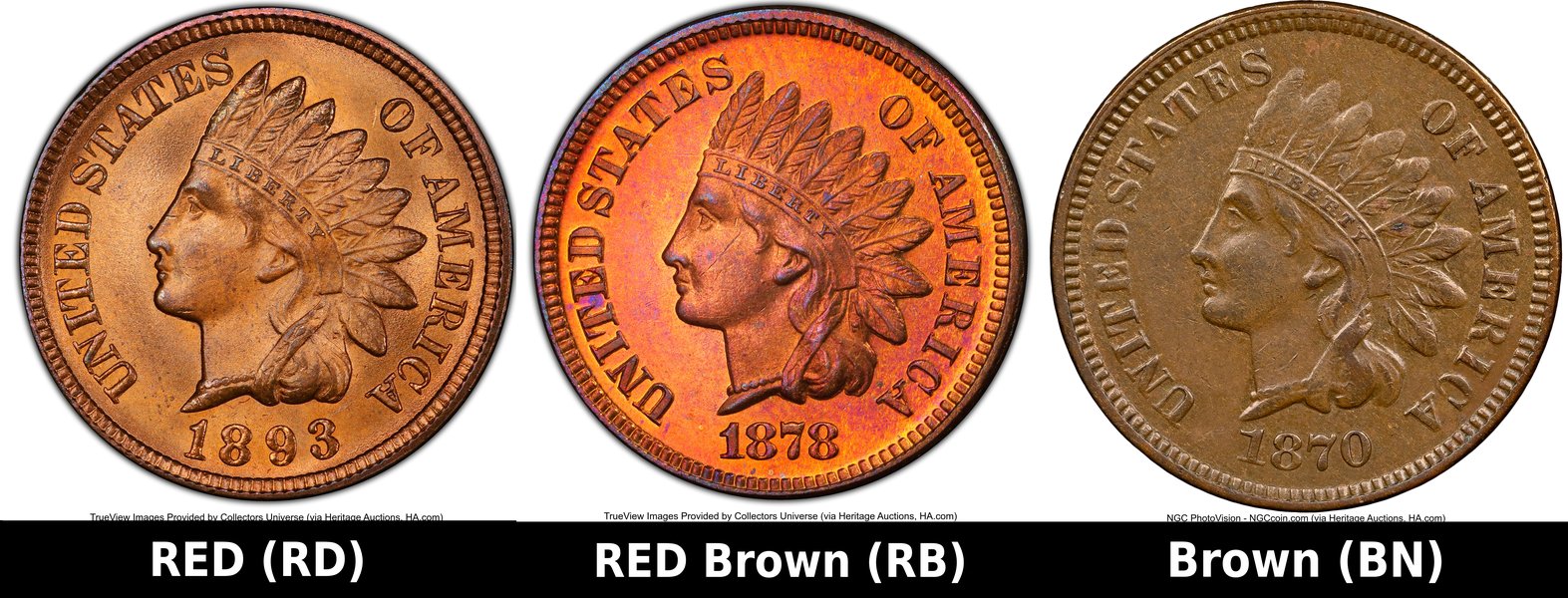
Visual comparison of Red-Brown (RB) and Red (RD) classifications, crucial for valuing copper coins.
Spotting Counterfeits and Altered Coins
Protecting Your Collection
Given the value of older and rarer U.S. cents, counterfeiting is a concern. While an "1857 over 2858" would be an obvious fake due to the non-existent date combination, collectors should be aware of common counterfeit characteristics:
- Date Irregularities: Uneven, distorted, or poorly formed numerals in the date are a strong indicator of a fake. Slight doubling at the bases of the first two digits can also be a sign of a transfer counterfeit.
- Lettering Issues: Odd appearance or weak definition in the lettering of "ONE CENT" or other inscriptions. For the 1877 Indian Head Cent, for example, the "N" in "ONE" and "CENT" often appears weak on genuine coins, while strong "N"s can indicate a fake.
- Missing or Added Mint Marks: While 1857 Flying Eagle Cents and most early Indian Head Cents (until 1908) were struck at the Philadelphia Mint and thus lack a mintmark, later key dates like the 1909-S Indian Head Cent are often faked by adding a "S" mint mark.
- Surface Details: Counterfeits may have a mushy appearance, lack sharp details, or show tooling marks.
Always seek multiple opinions from reputable sources or professional grading services if you question a coin's authenticity. Never attempt to pass off a fake coin as genuine.
This video provides insights into determining the value and rarity of Indian Head Cents, which is relevant for understanding diagnostics and potential value.
Comparative Analysis: Key Attributes of Early U.S. Cents
Distinguishing Features of the Transitional Period
To further illustrate the unique characteristics of the 1857 cent within its historical context, the following table provides a comparative overview of the various cent types circulating or introduced around that period:
| Coin Type | Years of Production | Composition | Diameter (mm) | Weight (grams) | Obverse Design | Reverse Design |
|---|---|---|---|---|---|---|
| Large Cent | 1793-1857 | Pure Copper | 27.5 - 29 (approx.) | 10.89 | Various Liberty designs (e.g., Draped Bust, Braided Hair) | Wreath or Chain surrounding "ONE CENT" |
| Flying Eagle Cent | 1856-1858 | 88% Copper, 12% Nickel | 19 | 4.67 | Flying Eagle | Wreath surrounding "ONE CENT" |
| Indian Head Cent (Type 1) | 1859 | 88% Copper, 12% Nickel | 19 | 4.67 | Lady Liberty in Headdress | Laurel Wreath surrounding "ONE CENT" |
| Indian Head Cent (Type 2) | 1860-1864 | 88% Copper, 12% Nickel | 19 | 4.67 | Lady Liberty in Headdress | Oak Wreath with Shield surrounding "ONE CENT" |
| Indian Head Cent (Bronze) | 1864-1909 | 95% Copper, 5% Tin/Zinc | 19 | 3.11 | Lady Liberty in Headdress | Oak Wreath with Shield surrounding "ONE CENT" |
Assessing the Complexity of Cent Varieties and Errors
A Numismatic Challenge
The world of coin collecting is rich with nuances, especially when it comes to identifying specific varieties and errors. The early small cents, including the 1857 Flying Eagle and the subsequent Indian Head cents, are particularly prone to various production anomalies due to the nascent minting processes and the challenging copper-nickel alloy. While the "1857 over 2858" query is a clear fabrication, understanding the legitimate types of errors and varieties is crucial for collectors.
This radar chart illustrates the perceived rarity and difficulty in acquiring various early U.S. cent types and their notable varieties. It's an opinionated analysis reflecting general market availability and collector demand, rather than precise statistical data. For instance, key date Indian Head Cents like the 1877 are extremely difficult to find, while common date Flying Eagle Cents are relatively accessible.
Frequently Asked Questions (FAQs)
Is there such a coin as an "1857 over 2858 Indian Head Cent"?
What is the significance of the 1857 U.S. Cent?
What are the key diagnostics for a genuine 1857 Flying Eagle Cent?
How can I tell if my 1857 cent is a counterfeit?
What are the most valuable Indian Head Cents?
Recommended Further Exploration
- Explore the comprehensive history of U.S. cent coinage from 1793 to the present day.
- Discover the various known die varieties and errors of the Flying Eagle Cent series.
- Learn about the key dates, mintages, and value determinants for Indian Head Cents.
- Understand advanced techniques for detecting counterfeit U.S. coins across different series.
References
Last updated May 21, 2025