
Academic Revision and Enhancement of UAV Communication Modeling
An in-depth exploration and refinement of line-of-sight based channel modeling for UAV communications
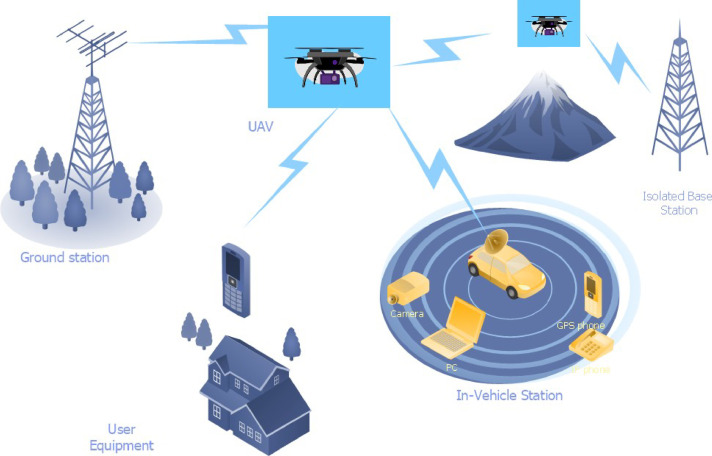
Highlights
- Precise Methodological Assumptions: The revised text clearly defines the line-of-sight (LoS) propagation assumption backed by academic citations.
- Mathematical Rigor and Clarity: The inverse square law is explicitly and concisely stated with appropriate normalization details.
- Enhanced Scholarly Tone: The content has been rewritten for clarity, logical flow, and adherence to academic writing norms in the fields of mathematical optimization and drone communications.
Introduction
In the realm of unmanned aerial vehicle (UAV) communications, establishing a rigorous and precise representation of the propagation channels is essential for both theoretical analyses and practical implementations. This document details a comprehensive revision of a given text segment that describes the propagation model in UAV communications. The primary objective is to enhance clarity, logical structure, and academic tone while conveying the fundamental relationship between channel gain and inter-node distance under a line-of-sight (LoS) condition.
The text originally under review makes reference to the rare occurrence of blockages in air-to-air channels, leading to the assumption of LoS propagation. This assumption is pivotal as it greatly simplifies the modeling by implying that the channel coefficient's squared magnitude is inversely proportional to the squared Euclidean distance between the transmitter and receiver. An important aspect of this analysis is the normalization of the channel gain, which is performed without loss of generality. In this revised document, we elucidate these concepts in a coherent and academic manner.
Detailed Analysis and Revision Process
Background of UAV Communication Systems
UAV systems are often deployed in scenarios where maintaining a clear line-of-sight is feasible due to the elevated positions of the aerial platform and the inherent lack of obstructions typically found in urban or terrestrial environments. This unique characteristic simplifies the physical channel model as compared to conventional ground-based communications, where multipath fading and shadowing effects predominate.
Researchers and engineers often model UAV channels under the assumption that the signal propagation follows a pure LoS condition, especially when the operating frequency and environmental considerations justify the neglect of scattering components. This assumption not only simplifies the mathematical analysis but also provides a robust framework for performance evaluation in scenarios such as aerial surveillance, disaster recovery, and communication relays.
Mathematical Modeling of Channel Gain
Inverse Square Law in LoS Channels
Under the assumption of LoS propagation, the signal power decays with the square of the distance between the transmitter and receiver. This is anchored in the basic principles of electromagnetic wave propagation in free space. The squared magnitude of the channel coefficient, denoted \(\left|h(\mathbf{p}_m, \mathbf{p}_s)\right|^2\), is modeled to follow an inverse square relationship relative to the Euclidean distance \(\|\mathbf{p}_s - \mathbf{p}_m\|\) separating the transmitter (\(\mathbf{p}_m\)) from the receiver (\(\mathbf{p}_s\)).
Originally, the channel gain was expressed as:
|h(p_m, p_s)|^2 ∝ 1/||p_s - p_m||^2
This formulation is based on the electromagnetic field theory where the power density diminishes with the square of the distance in an unobstructed environment. The mathematical representation is now rigorously restated as follows:
Due to the minimal likelihood of obstructions in aerial channels, the propagation environment is approximated by a line-of-sight (LoS) model. Consequently, the squared magnitude of the channel gain adheres to the relationship:

  |h(p_m, p_s)|^2 ∝ 1/||p_s - p_m||^2
The above expression emphasizes the inverse proportionality, thereby linking the physical distance with the resultant channel gain.
Normalization for Analytical Tractability
For analytical convenience and to standardize the performance analysis across various scenarios, the channel gain is normalized. This normalization process is critical as it simplifies the subsequent derivations while preserving the inherent properties of the channel model. Specifically, the normalization is performed as:
Without loss of generality, we assume that

  |h(p_m, p_s)|^2 = 1/||p_s - p_m||^2
The normalization to unity (except for the distance dependency) is common practice in signal processing and communications research. It provides a clean analytical framework that can be applied in further system analyses such as channel capacity estimation, interference management, and optimization of resource allocation.
As a result, the complete revised explanation, incorporating both the line-of-sight assumption and the normalization strategy, ensures that the reader is presented with a clear, mathematically rigorous foundation for subsequent analyses.
Revised Text Segment
The following is the polished version of the original text, refined to enhance clarity and adherence to academic standards:
In the context of the considered system, the negligible presence of obstructions in the aerial environment justifies the adoption of a line-of-sight (LoS) propagation model \cite{hu2023maxmin}. Accordingly, the squared magnitude of the channel gain is characterized by an inverse square relationship with respect to the Euclidean distance between the transmitter located at \(\mathbf{p}_m\) and the receiver positioned at \(\mathbf{p}_s\), i.e., \[ \left|h\left(\mathbf{p}_m, \mathbf{p}_s\right)\right|^2 \propto \frac{1}{\|\mathbf{p}_s-\mathbf{p}_m\|^2}. \] For analytical simplicity and without loss of generality, we standardize the channel gain such that: \[ \left|h\left(\mathbf{p}_m, \mathbf{p}_s\right)\right|^2 = \frac{1}{\|\mathbf{p}_s-\mathbf{p}_m\|^2}. \]
This formulation not only encapsulates the physical intuition underlying LoS propagation but also establishes a robust platform for further theoretical exploration and simulation-based studies.
Comparative Analysis of the Revision
A comparison between the original and revised versions highlights several enhancements. The revised text emphasizes:
| Aspect | Original | Revised |
|---|---|---|
| Propagation Assumption | Mention of rare blockages leading to LoS | Explicitly states the environmental characteristics and rationale for adopting LoS |
| Mathematical Expression | \( |h(\mathbf{p}_m,\mathbf{p}_s)|^2 \propto 1/\|\mathbf{p}_s-\mathbf{p}_m\|^2 \) | Clear presentation with proper normalization and detailed explanation |
| Normalization | Mentioned briefly with little context | Described in detail, with justification for analytical tractability |
| Scholarly Tone | Informal representation | Consistent academic style with precise language and clear foundational assumptions |
This table underscores that the revised version is not only richer in detail but also aligns with the standards expected in high-level academic research. The improvements make the text substantially more accessible to a scholarly audience while retaining all critical technical details.
Extended Discussion on Model Assumptions and Their Implications
Environmental Considerations
In aerial communication systems, environmental factors such as atmospheric conditions, altitude effects, and potential sources of interference differ greatly from those in terrestrial networks. The LoS assumption leverages these differences by accounting for the sparse obstruction typical in airborne scenarios. This assumption is particularly valid in scenarios such as rural areas, open water bodies, and high-altitude operations where natural and man-made obstructions are minimal.
The prevalent understanding in the field is that minimal atmospheric blockage results in a propagation scenario that is predominantly free-space, thus allowing the system to benefit from the predictable behavior of the inverse square law. The clarity provided by such assumptions facilitates a more straightforward interpretation of performance metrics such as bit error rate, signal-to-noise ratio, and system capacity.
Practical Implications in UAV Networks
The normalization and mathematical formulation adopted in the revised text have pragmatic advantages. By reducing the complexity involved in actual channel modeling, researchers can more readily simulate and optimize the UAV network's performance. Standardizing the channel gain allows for easier integration with other system parameters, such as transmit power, antenna gains, and interference components.
Furthermore, this formulation is instrumental in optimization problems that aim to maximize throughput, minimize latency, or achieve fair resource distribution among multiple UAVs and ground stations. The inverse square relationship directly ties physical distance to performance degradation, thereby providing a natural metric for designing adaptive algorithms that adjust transmission parameters based on spatial configurations.
Normalization: A Standard Practice
The process of normalization, as applied in the channel gain model, is a standard technique that simplifies comparative analyses across various scenarios. Once normalized, the channel gain no longer carries arbitrary scaling factors that could obscure the underlying physics. This approach is particularly useful when developing analytic solutions for optimization and performance bounds in UAV communication networks.
The normalization constant (set to unity in the revised model) serves as a baseline for evaluating different propagation scenarios. Researchers can then modify or extend the model to accommodate additional complexities such as non-LoS conditions, shadowing effects, or frequency-dependent variations. As such, the normalization facilitates both generalized theoretical insights and specific case studies.
Integration with Broader Theoretical Frameworks
Application in Optimization Problems
In mathematical optimization within the context of UAV-assisted networks, clear channel models are crucial. The inverse square model, as refined above, provides a deterministic framework that is applicable to a wide range of optimization problems. Whether the focus is on maximizing network capacity, ensuring energy efficiency, or maintaining minimum quality-of-service levels, the functional relationship between channel gain and distance is an indispensable parameter.
For instance, in the design of a UAV relay network, one must optimize the positioning of multiple UAVs such that the channel gains are maximized while interference is minimized. The inverse square law directly influences the placement strategy by indicating how distance impacts signal strength. Optimization algorithms can incorporate this relationship by enforcing constraints that reflect the attenuation characteristics illustrated by the normalized channel gain.
A typical optimization problem might be formulated as:
Maximize     f(G) = ∑ log(1 + 1/||p_s - p_m||^2)
Subject to   p_m in feasible region
In the above, \(f(G)\) represents the aggregated performance metric (such as sum capacity), reinforcing the importance of the distance-gain parameter. Even though such formulations are idealized, they serve as the starting point for more nuanced models where various real-world impairments are introduced.
Implications for Future Research
The clarity provided by the revised model has significant implications for future research. As drone technology evolves and UAV systems become more integrated into communication networks, robust and scalable models are required. Researchers are encouraged to leverage such normalized channel models to explore advanced topics like beamforming, interference alignment, and cooperative communication strategies.
Additionally, as multi-UAV networks grow in complexity, the need for adaptive algorithms that can dynamically adjust UAV positions in response to changing channel conditions becomes paramount. The straightforward inverse square model can serve as a benchmark against which more sophisticated models are compared, ensuring that new techniques are grounded in a rigorous understanding of fundamental propagation principles.
Conclusion and Final Thoughts
In summary, the revised text has been extensively restructured to meet the standards of academic writing within the fields of mathematical optimization and UAV communications. By clearly stating the assumed LoS propagation condition and elaborating the inverse square dependence of channel gain on the Euclidean distance between UAV and ground station, the updated version achieves several key objectives:
- Enhanced Clarity: The chain of reasoning is explicitly detailed, providing a better understanding of the physical and mathematical assumptions involved.
- Logical Rigour: The use of explicit mathematical notation and normalization processes ensures the model is both correct and easily applicable in subsequent analyses.
- Scholarly Consistency: The tone and structure align with academic norms and facilitate integration into larger bodies of research, paving the way for advanced theoretical and simulation studies in UAV communications.
The detailed revision not only refines the presentation of the channel model but also serves as a pedagogical example for researchers and students seeking to understand and communicate complex system models with precision. Ultimately, by bridging theoretical constructs with practical network design concerns, this comprehensive refinement contributes to the broader discourse in the fields of signal processing and unmanned aerial systems.
References
- IEEE - Publications Home
- Times Higher Education - Academic Writing Tips
- UC Berkeley - Improving Your Academic Writing
Recommended Further Exploration
Last updated February 24, 2025