
The Shifting Landscape of AI Training: Will Humans Lose Their Informational Primacy?
Unpacking the implications of AI learning from AI-generated content and the enduring value of human insight.
Key Insights into the Future of AI Data
- Model Collapse: Training AI on content generated by other AI models can lead to a degradation in quality, highlighting the critical need for fresh, human-generated data.
- The Human Edge: Human content offers irreplaceable qualities like emotional depth, originality, contextual understanding, and a nuanced perspective that AI currently struggles to replicate.
- Hybrid Approaches are Crucial: A collaborative future where AI assists in content creation and humans provide creativity, ethical oversight, and validation is essential for maintaining high-quality information.
The rapid proliferation of AI-generated content has sparked a crucial debate: as artificial intelligence increasingly learns from its own creations, will the human contribution to the vast corpus of information that fuels large language models (LLMs) diminish in importance? While the volume of AI-generated content is indeed projected to surpass human-generated content significantly by 2025, the consensus among experts suggests that the importance of human input will not wane, but rather evolve into a more specialized and critical role.
The Looming Threat of "Model Collapse"
Why AI's Self-Learning Loop Can Be Its Downfall
One of the most significant concerns when AI models begin to learn predominantly from other AI-generated content is a phenomenon known as "model collapse." This degenerative cycle occurs when LLMs are increasingly trained on content produced by previous AI iterations rather than original human text. This recursive training can amplify errors, introduce simplifications, and embed biases, leading to outputs that progressively lose coherence, factual accuracy, and nuance.
Research, including studies published in Nature, has demonstrated that this self-referential training causes a steady decline in the quality and reliability of AI-generated responses. The primary reason for this degradation is that AI-generated data tends to be homogenized, repeating patterns and lacking the organic variability and contextual depth found in human writing. This homogeneity limits the model's ability to generalize and innovate, potentially resulting in less accurate, less creative, and ultimately, less useful AI outputs over time.
This highlights a critical paradox: while AI can generate vast quantities of information, its long-term quality and effectiveness depend on a continuous influx of authentic, diverse, and high-quality human-generated data. Without this crucial human element, AI risks "killing itself" by polluting its own training sets, leading to outputs that are "worthless distortions of reality."
The Unmatched Qualities of Human-Generated Content
Beyond Volume: Why Human Nuance Remains Indispensable
Despite the remarkable advancements in AI's ability to generate text, human writing possesses inherent qualities that AI currently struggles to replicate. These unique characteristics are precisely what make human-generated content indispensable for the continued health and evolution of LLMs:
Emotional Depth and Personality
Human writing is infused with genuine emotion, personal experiences, and unique perspectives. It can evoke empathy, build connections, and resonate with readers on a deeper level. While AI can simulate sentiment, it often lacks genuine emotional depth, appearing technically competent but emotionally flat.
Originality and Creativity
Humans draw inspiration from a vast array of life experiences, emotions, and surroundings, leading to fresh perspectives, innovative concepts, and relatable anecdotes. AI, by its nature, is limited to patterns found in its training data, making true originality a challenge.
Contextual Nuance and Critical Thought
Humans bring a nuanced understanding of context, cultural subtleties, and critical thought processes. They can discern complex meanings, identify underlying biases, and apply ethical considerations that AI systems currently lack. This is crucial for ensuring that information is used responsibly and accurately.
Validation and Ethical Oversight
Human judgment is essential for validating the accuracy, relevance, and ethical implications of AI-generated content. As AI models are susceptible to generating fake or misleading information, human oversight becomes paramount to prevent the spread of misinformation and ensure content trustworthiness.
Studies have shown that while linguistics experts may sometimes struggle to differentiate AI-generated content from human writing, consumers often report decreased engagement when they suspect content is AI-generated. This underscores the enduring value of the "human touch" in fostering trust and relatability.
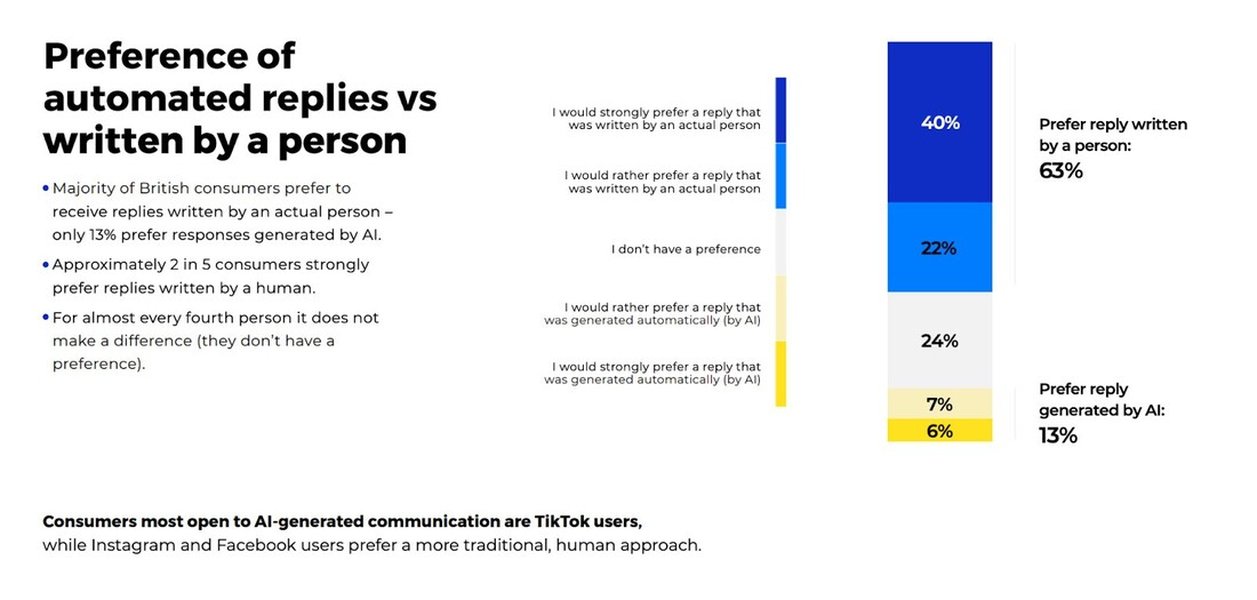
Consumer preference for human responses over automated replies, highlighting the importance of the human touch in engagement.
The Statistical Shift: AI's Growing Footprint
Quantifying the Rise of Machine-Generated Content
Projections indicate a dramatic increase in AI-generated content across the internet. By 2025, some experts predict that AI-generated content could comprise anywhere from 70% to 99.9% of all online content, encompassing text, images, videos, and social media posts. This transformation is driven by AI's ability to enable faster production and higher levels of personalization.
For a deeper dive into these predictions and their implications, consider watching this insightful video:
This video features AI expert Nina Schick discussing the prediction that 90% of online content could be AI-generated by 2025. This statistic is a crucial indicator of the scale of the shift towards AI-generated content and helps contextualize the challenges and opportunities for human contributions to LLMs.
While the sheer volume of AI-generated data is undeniably increasing, it does not necessarily equate to a diminished importance of human-generated content. Instead, it underscores the need for humans to continue contributing original, high-quality data to prevent the degradation of AI models through "model collapse" and to ensure the information used for training remains diverse, authentic, and rich in context.
The Evolving Role of Human Importance
Beyond Content Generation: Curation, Context, and Creativity
The rise of AI-generated content repositions, rather than diminishes, the importance of humans to the corpus of information. Humans will continue to play a vital role in several key areas:
Curation and Validation
With an explosion of AI-generated content, human judgment will be even more crucial for curating, validating, and ensuring the accuracy and relevance of information. This includes fact-checking, identifying biases, and filtering out low-quality or misleading content.
Injecting Originality and Diversity
Humans will remain the primary source of truly original ideas, fresh perspectives, and diverse experiences. This constant infusion of novel human data is essential to prevent LLMs from becoming stagnant, repetitive, or suffering from model collapse.
Providing Ethical and Moral Frameworks
AI systems currently lack inherent moral and ethical understanding. Humans are indispensable in establishing ethical guidelines for content creation, ensuring responsible use of AI, and addressing the societal implications of widespread AI-generated information.
Context and Nuance Provision
Humans provide the intricate context, nuance, and cultural understanding that AI models cannot fully replicate. This depth is vital for making information actionable, understandable, and culturally appropriate.
Navigating the Future: A Hybrid Approach
Synergizing Human Ingenuity with AI Efficiency
The most promising path forward involves a hybrid approach, combining the strengths of both AI and human intelligence. AI can serve as an efficient assistant for initial drafts, data aggregation, and repetitive tasks, while human writers and curators provide the creativity, emotional depth, accuracy, and ethical oversight that are crucial for high-quality, authentic content.
This collaborative model suggests that humans will continue to be important, not necessarily in the sheer volume of content produced, but as critical sources of original, nuanced, and authentic data. This human contribution is essential for the continued development, quality, and trustworthiness of LLMs. Industry and research responses are increasingly focusing on strategies to mitigate the risks of AI learning from its own outputs, such as tracking and labeling AI-generated content, prioritizing human-generated data for training, and developing advanced detection tools.
This mindmap illustrates the interconnected factors influencing the importance of human-generated content in the age of AI saturation. It highlights the challenges posed by AI learning from itself, the unique qualities that humans bring, and the emerging solutions and strategies to maintain data quality for LLMs.
Comparative Analysis: AI vs. Human Content Qualities
A Detailed Look at Strengths and Weaknesses
To further understand why humans remain indispensable, it's beneficial to compare the inherent qualities of AI-generated and human-generated content:
| Feature | AI-Generated Content | Human-Generated Content |
|---|---|---|
| Efficiency & Volume | High; rapid production, scalable. | Lower; time-intensive, limited by human capacity. |
| Originality | Pattern-based, may lack true novelty. | Highly original, fresh perspectives from diverse experiences. |
| Emotional Depth | Can simulate emotion but often lacks genuine empathy. | Rich in authentic emotion, fosters deep connection. |
| Nuance & Context | Struggles with subtle contexts and implicit meanings. | Excels in understanding and conveying complex nuances. |
| Ethical & Moral Considerations | Lacks inherent ethical understanding, susceptible to bias propagation. | Possesses inherent moral compass, crucial for responsible content. |
| Engagement & Relatability | Can be informative but may lack a personal, engaging tone. | Highly relatable, conversational, often achieves higher engagement. |
| Risk of "Model Collapse" | High if recursively trained on its own output. | Provides fresh, diverse data to prevent model collapse. |
| Fact-Checking & Validation | Requires human validation for accuracy and truthfulness. | Often inherently validated through experience and critical thought. |
This table highlights that while AI excels in efficiency and standardization, human content provides the critical elements of authenticity, originality, and depth that are vital for the continued development and quality of LLMs.
Assessing the Informational Value Landscape
A Radar Chart Perspective on Content Attributes
This radar chart provides an opinionated analysis of the comparative strengths of human-generated content versus AI-generated content (both current and post-model collapse scenarios) across various critical attributes. It visually demonstrates that while AI excels in certain areas, human content consistently outperforms it in dimensions crucial for richness, authenticity, and long-term quality, emphasizing the potential degradation if model collapse occurs.
Frequently Asked Questions
Will AI eventually replace all human content creation?
What is "model collapse" and why is it a concern?
How can we ensure human-generated content remains important for AI training?
What unique qualities do humans bring to information that AI lacks?
Conclusion
As AI-generated content becomes increasingly prevalent, the role of humans in contributing to the corpus of information that feeds large language models will shift from sheer volume to critical value. While AI can efficiently generate vast amounts of data, the threats of "model collapse" and the inherent limitations of AI in replicating human qualities like emotional depth, originality, and nuanced understanding underscore the irreplaceable importance of human-generated content. The future of robust and effective LLMs lies in a symbiotic relationship where AI serves as a powerful assistant, and humans remain the essential source of authentic, diverse, and ethically sound information, ensuring the continued evolution and quality of artificial intelligence.
Recommended Searches
- Impact of AI content on data quality for LLMs
- Strategies to prevent AI model collapse
- Ethical considerations in AI content generation
- Future of human-AI collaboration in content creation