
Unlock Your Solo Dev Potential: Building Profitable AI Apps by Adapting Proven Ideas
Your guide to launching an AI SaaS venture by leveraging validated concepts and focusing on execution.
Starting your journey as a solo developer aiming to build and monetize AI-powered applications is an exciting prospect! Your intuition to initially focus on adapting a validated idea is strategically sound. This approach allows you to concentrate on mastering the crucial skills of product development, marketing, user acquisition, and iterating based on feedback – often the real differentiators for success, especially for a solo founder in the burgeoning AI Software as a Service (SaaS) market.
Key Insights for Your AI SaaS Journey
- Focus on Execution Over Novelty: Starting with a validated AI app idea mitigates risk and allows you to hone essential business skills faster. Success often lies in superior execution, marketing, and user engagement, not just a unique concept.
- Niche Down for Impact: Instead of building a general tool, adapt a validated idea for a specific industry or user group. This makes marketing more targeted and allows you to solve a particular pain point deeply, increasing your value proposition.
- Leverage AI APIs for Speed: Utilize readily available AI models through APIs (like OpenAI, Hugging Face) to build your Minimum Viable Product (MVP) quickly. This lets you launch faster, gather feedback sooner, and iterate effectively.
Why Adapting Validated AI Ideas Makes Sense
Choosing to build upon an existing, successful AI application concept offers several advantages for a solo developer:
- Reduced Market Risk: Validated ideas have already demonstrated market demand, significantly lowering the risk of building something nobody wants.
- Faster Time-to-Market: You save time on initial ideation and validation, allowing you to move directly into building, marketing, and refining your product.
- Focus on Growth Skills: It frees up your bandwidth to concentrate on the critical, often challenging, aspects of acquiring users, building marketing funnels, gathering actionable feedback, and achieving product-market fit.
- Learning Product-Market Fit: Working with a concept that has traction provides invaluable experience in understanding user needs and refining a product to meet them effectively.
- Proven Monetization Models: You can often adopt or adapt existing pricing and subscription models that are known to work in the specific niche.
Many successful solo founders, even those reaching unicorn status, started with simple, focused solutions, sometimes improving upon existing ideas or serving a specific niche more effectively.
Promising AI-Powered SaaS Ideas to Adapt (2025)
Validated Concepts Suitable for Solo Developers
Here are several AI-powered SaaS categories with proven market validation, suitable for a solo developer to adapt and build upon. These ideas leverage AI for automation, content creation, data analysis, and productivity enhancement – areas with high demand.
1. Niche AI Content Generation & Optimization Tools
Concept: Develop a tool that uses AI (like GPT models via API) to generate specific types of content (e.g., marketing copy for SaaS landing pages, social media posts for local restaurants, SEO-optimized blog outlines for tech writers) or optimize existing content for readability, tone, or SEO.
Validation: Tools like Jasper and Copy.ai pioneered this space, but numerous successful micro-SaaS businesses thrive by focusing on specific niches or content types. There's constant demand for high-quality content.
Adaptation Angle: Focus on a narrow vertical (e.g., real estate listings, non-profit grant proposals) or a unique feature (e.g., generating content that perfectly matches a specific brand voice guide).
Landing pages are crucial for SaaS user acquisition, often requiring AI-powered content optimization.
2. AI-Powered Customer Interaction Analysis & Automation
Concept: Build an application that connects to customer support channels (email, chat logs, review sites) and uses AI to analyze sentiment, identify trends, summarize conversations, suggest responses, or even automate replies for common queries.
Validation: Businesses are constantly seeking ways to improve customer service efficiency and gain insights from interactions. AI chatbots and sentiment analysis tools are established markets.
Adaptation Angle: Specialize in a specific platform (e.g., analyzing Shopify reviews) or a particular function (e.g., automatically generating positive testimonials from support chats, flagging churn risks based on conversation history).
3. AI Video Repurposing & Snippet Creation
Concept: Create a tool that takes long-form video content (webinars, podcasts, interviews) and uses AI to automatically identify key moments, generate short engaging clips for social media, transcribe the audio, or add subtitles.
Validation: The demand for video content is enormous, and content creators constantly need efficient ways to repurpose material across platforms. Tools like Opus Clip or Pictory show market demand.
Adaptation Angle: Focus on a specific platform's format (e.g., perfectly formatted TikTok/Reels clips), a particular industry's needs (e.g., creating educational snippets from lecture recordings), or enhanced features (e.g., AI-driven suggestions for viral hooks).
4. AI-Driven Data Collection & Simple Visualization
Concept: Develop a SaaS that uses AI to scrape specific data from websites (e.g., competitor pricing, industry news, job postings) and presents it in a clean, easily digestible format (dashboards, reports, alerts).
Validation: Businesses need timely data for decision-making. While complex data platforms exist, there's a market for simpler, niche-focused tools.
Adaptation Angle: Focus on scraping data for a very specific niche (e.g., tracking used car prices in a local region, monitoring competitor feature releases for SaaS companies) or integrating unique AI analysis (e.g., predicting price trends based on scraped data).
5. Automated Workflow Assistants for Specific Tasks
Concept: Build an AI tool that automates a very specific, repetitive business task. Examples include converting customer testimonials into various marketing assets, generating meeting summaries from transcripts, or automating outreach sequences based on triggers.
Validation: Automation is a key driver of SaaS adoption. Tools that save time on mundane tasks are highly valued, especially by small businesses and solopreneurs.
Adaptation Angle: Identify a painful, manual workflow within a specific professional role (e.g., paralegals, freelance writers, e-commerce managers) and build an AI tool to automate it precisely.
Comparing AI SaaS Idea Categories
Choosing the right starting point depends on your skills, interests, and market perception. This radar chart provides a comparative overview of the AI SaaS categories discussed, based on factors relevant to a solo developer. Note that these are qualitative assessments intended to guide your thinking, not precise market data.
Consider factors like your coding comfort level (Technical Difficulty), the potential user base (Market Size), how easy it is to charge users (Monetization Clarity), how many others are doing similar things (Competition Level), how well the business can grow with just you (Scalability), and how quickly you can test the core idea (Validation Ease).
Your Roadmap: From Adaptation to Originality
A Solo Founder's AI SaaS Journey
This mindmap outlines the typical stages you'll go through as a solo founder building an AI SaaS application, starting from adapting a validated idea.
The key is to move through these phases efficiently, constantly learning from user interactions and market responses. Starting with a validated concept accelerates your entry into Phase 2, allowing you to focus precious solo-founder time on gathering feedback and finding traction.
Detailed Look at Potential AI SaaS Ideas
This table provides more detail on the validated AI SaaS ideas discussed earlier, outlining potential target audiences, monetization approaches, and the core AI component you would need to integrate.
| AI SaaS Idea | Description | Potential Target Audience | Monetization Strategy | Core AI Component |
|---|---|---|---|---|
| Niche Content Generator | Generates specific content types (e.g., social posts, ad copy, product descriptions) for a defined industry or use case. | Marketing teams, small businesses, freelancers, content creators in a specific niche. | Subscription tiers (based on usage volume or features), pay-per-use credits. | Large Language Models (LLMs) via API (e.g., GPT-4, Claude) for text generation, fine-tuning for specific styles. |
| Content Optimizer | Analyzes existing text and suggests improvements for SEO, readability, tone, or grammar. | Bloggers, SEO specialists, marketing agencies, corporate communications. | Subscription tiers, potentially a one-time analysis fee for reports. | LLMs for analysis and rewriting, potentially NLP models for specific tasks like keyword density or sentiment analysis. |
| Customer Interaction Analyzer | Processes support tickets, chat logs, or reviews to provide sentiment analysis, topic extraction, and summary reports. | Customer support managers, product managers, small business owners. | Subscription based on volume of data processed or number of connected sources. | NLP models for sentiment analysis, topic modeling, summarization (can use LLM APIs). |
| Automated Support Responder | Suggests or automatically sends replies to common customer queries based on historical data or knowledge base. | E-commerce stores, SaaS companies, businesses with high support volume. | Subscription based on number of automated responses or seats. | Retrieval-Augmented Generation (RAG) systems combining knowledge base search with LLM response generation. |
| Video Clip Generator | Automatically extracts short, engaging clips from longer videos, potentially adding captions or formatting for social media. | Content creators, podcasters, marketers, educators. | Subscription based on processing time or number of videos, potential credit system. | Speech-to-text models, video analysis models (scene detection, highlight identification), LLMs for summarizing/scripting. |
| Niche Data Scraper & Monitor | Scrapes specific public web data for a niche market and presents it through alerts or a dashboard. | Sales teams, market researchers, competitive intelligence analysts, specific industry professionals. | Subscription for access to data feeds, alerts, or dashboard. | Web scraping techniques combined with AI for data cleaning, classification, or anomaly detection (if needed). |
Insights from the Field: AI SaaS for Solo Founders
Hearing directly from others navigating the AI SaaS space can be incredibly valuable. This video discusses specific AI SaaS ideas suitable for solo founders in 2025, offering practical perspectives on opportunities and competition.
The video explores how solo founders can carve out niches even as larger companies integrate AI, emphasizing focus and understanding specific user pain points – aligning perfectly with the strategy of adapting validated ideas for targeted audiences.
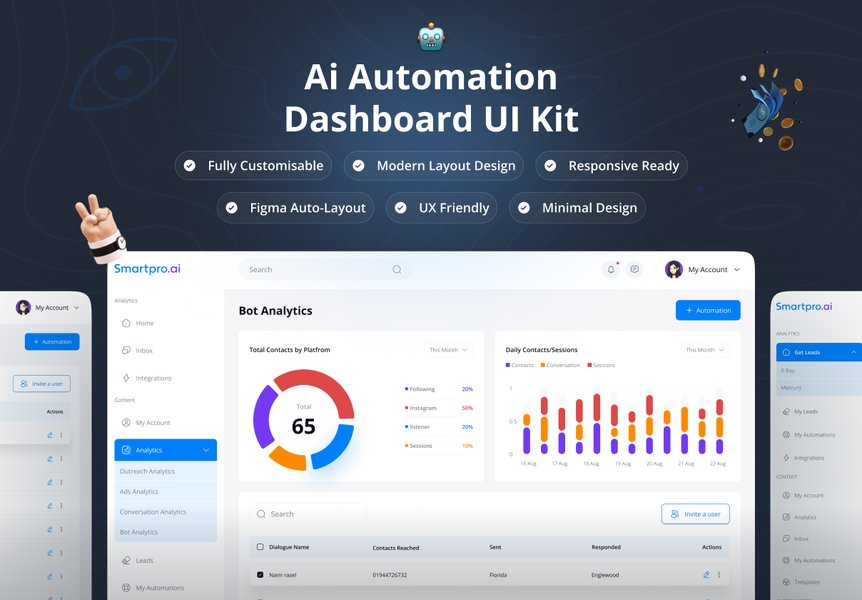
A clean dashboard is essential for presenting AI insights or managing automation tools.
Frequently Asked Questions (FAQ)
How much coding skill is *really* needed to start?
Solid coding fundamentals are essential, especially for backend logic, database management, and integrating APIs securely. However, you don't need to be an AI research scientist. Leveraging existing AI models via APIs (like OpenAI, Anthropic, or specialized services) handles the complex AI part. Focus your coding skills on building a robust, user-friendly application around the AI core. Front-end skills (HTML, CSS, JavaScript frameworks like React/Vue) are also crucial for creating a good user experience. You can supplement with low-code/no-code tools for non-essential parts initially.
How do I find my first users when I'm just copying an idea?
Focus on a specific niche where the original idea might be too general. Engage in online communities where your target niche hangs out (Reddit subreddits, LinkedIn groups, specific forums). Offer early access, discounts, or a generous free tier in exchange for feedback. Launch on platforms like Product Hunt or BetaList. Clearly articulate your specific value proposition – even if the core idea is similar, your focus, pricing, or specific feature tweak might appeal strongly to a subset of users.
Are AI API costs manageable for a solo founder?
They can be, but require careful management. Start with cost-effective models where possible. Implement usage limits, especially during free trials or on lower tiers. Optimize your prompts and workflows to use fewer tokens per task. Monitor your API spending closely. Price your SaaS tiers to comfortably cover the anticipated average AI usage cost per user, plus your margin. As you scale, you might explore fine-tuning smaller models or negotiating volume discounts, but initially, build cost monitoring and limits into your application design.
What if someone else copies my "copied" idea?
Competition is inevitable in SaaS. Your defensibility comes from execution, not just the initial idea. Focus on building a strong relationship with your users, iterating quickly based on their feedback, providing excellent customer support, and building a brand within your niche. Your specific implementation, user experience, marketing angle, and community engagement can differentiate you even if the core functionality is similar to others. Remember, you chose this path to learn execution – that's your competitive advantage!
Recommended Next Steps
Explore these related topics for deeper insights:
- How can I validate a micro-SaaS idea with a minimal budget before building?
- What are the most effective marketing channels for reaching early adopters of AI SaaS tools?
- How should I price my AI-powered SaaS product considering API costs and value provided?
- What are the common technical challenges when integrating AI APIs like OpenAI into a web application for the first time?
References
Last updated May 5, 2025