
Unraveling the Mystery of the 8544 Balloons: A Comprehensive Distribution Analysis
Discover the exact quantities of yellow, red, and blue balloons through a detailed mathematical breakdown.
Key Insights into Balloon Distribution
- Systematic Algebraic Approach: The problem is efficiently solved by defining variables for each balloon color and translating the given conditions into a system of linear equations, a fundamental method for distribution challenges.
- Interconnected Relationships: The quantities of blue and red balloons are directly dependent on the number of yellow balloons, highlighting how a single variable can unlock the entire distribution.
- Precise Numerical Solution: Through substitution and solving for a single variable, the exact numbers for yellow (356), blue (3916), and red (4272) balloons are accurately determined, totaling 8544.
Understanding the precise distribution of items based on stated relationships is a common challenge that often appears in various contexts, from inventory management to mathematical puzzles. In this scenario, we're presented with a total of 8544 balloons, segmented into three colors: yellow, red, and blue. The key to solving this lies in carefully interpreting the relationships between the quantities of each color and setting up a clear mathematical framework. This approach ensures that every condition is met and the final distribution is accurate and verifiable.
Decoding the Balloon Relationships
To accurately determine the number of balloons of each color, we must first establish a clear understanding of the relationships provided. Let's assign variables to each color to simplify the process:
- Y: The number of yellow balloons.
- B: The number of blue balloons.
- R: The number of red balloons.
From the problem statement, we can derive three essential equations:
- Total Number of Balloons: The sum of all balloons is 8544. \[ \text{Y} + \text{B} + \text{R} = 8544 \]
- Blue vs. Yellow Relationship: The blue balloons are 11 times more than the yellow ones. \[ \text{B} = 11 \times \text{Y} \]
- Red vs. Blue and Yellow Relationship: The red balloons are as many as the blue and yellow ones combined. \[ \text{R} = \text{B} + \text{Y} \]
These three equations form a system that can be solved using algebraic substitution, allowing us to find the value of each variable systematically.
The Path to the Solution: Step-by-Step Calculation
With our equations defined, the next step is to substitute the relationships into the total equation to solve for one variable, and then subsequently find the others. This method ensures a logical and verifiable solution.
Step 1: Express all variables in terms of one color (Yellow)
We already have blue balloons (B) expressed in terms of yellow (Y):
\[ \text{B} = 11\text{Y} \]Now, let's express red balloons (R) in terms of yellow (Y) by substituting the value of B into the third equation:
\[ \text{R} = \text{B} + \text{Y} \] \[ \text{R} = (11\text{Y}) + \text{Y} \] \[ \text{R} = 12\text{Y} \]Now, all three quantities (Y, B, and R) are expressed in terms of Y.
Step 2: Substitute into the Total Equation
Substitute the expressions for B and R into the first equation (the total sum):
\[ \text{Y} + \text{B} + \text{R} = 8544 \] \[ \text{Y} + (11\text{Y}) + (12\text{Y}) = 8544 \]Combine the terms involving Y:
\[ (1 + 11 + 12)\text{Y} = 8544 \] \[ 24\text{Y} = 8544 \]Step 3: Solve for the Number of Yellow Balloons (Y)
To find the value of Y, divide the total number of balloons by the combined coefficient of Y:
\[ \text{Y} = \frac{8544}{24} \] \[ \text{Y} = 356 \]So, there are 356 yellow balloons.
Step 4: Calculate the Number of Blue and Red Balloons
Now that we have the number of yellow balloons, we can easily find the number of blue and red balloons:
Number of Blue Balloons (B):
\[ \text{B} = 11\text{Y} \] \[ \text{B} = 11 \times 356 \] \[ \text{B} = 3916 \]Thus, there are 3916 blue balloons.
Number of Red Balloons (R):
\[ \text{R} = 12\text{Y} \quad \text{or} \quad \text{R} = \text{B} + \text{Y} \] Using the first expression: \[ \text{R} = 12 \times 356 \] \[ \text{R} = 4272 \] Using the second expression as a check: \[ \text{R} = 3916 + 356 \] \[ \text{R} = 4272 \]So, there are 4272 red balloons.
Step 5: Verify the Total
Finally, let's verify that our calculated numbers sum up to the given total of 8544 balloons:
\[ \text{Y} + \text{B} + \text{R} = 356 + 3916 + 4272 = 8544 \]The numbers add up correctly, confirming the accuracy of our solution.
Summary of Balloon Distribution
The calculated distribution of balloons adheres perfectly to all the conditions outlined in the problem. This clear breakdown ensures that each color's quantity is precisely determined, reflecting the given relationships.
| Balloon Color | Calculated Quantity | Relationship |
|---|---|---|
| Yellow | 356 | Base quantity |
| Blue | 3916 | 11 times the yellow balloons |
| Red | 4272 | Sum of blue and yellow balloons |
| Total | 8544 | Sum of all balloon colors |
This table provides a concise overview of the results, making it easy to see the exact number of balloons for each color.
Visualizing the Proportions: A Radar Chart Analysis
To further illustrate the distribution, a radar chart can effectively show the proportional relationship between the different balloon colors. This chart visually emphasizes how much larger the blue and red quantities are compared to the yellow balloons, given their multiplicative and additive relationships.
This radar chart vividly displays the distribution of balloon colors, emphasizing the larger quantities of blue and red balloons relative to yellow.
Exploring Related Concepts: A Mindmap of Distribution Problems
Problems involving the distribution of items based on ratios and sums are common in various mathematical and real-world contexts. This mindmap illustrates the interconnectedness of such problems with broader mathematical concepts and practical applications, showing how a simple balloon problem fits into a larger framework of logical reasoning and quantitative analysis.
This mindmap illustrates the logical flow from the problem statement to its solution, connecting it to broader mathematical principles and real-world applications.
Understanding Balloon Arrangements: A Visual Insight
While the problem at hand is purely mathematical, the context of "balloons" often brings to mind vibrant displays and thoughtful arrangements. Many real-world applications of proportional distribution, like the one we just solved, can be seen in creative fields such as event decoration. For example, a balloon arch or garland kit, often featuring red, blue, and yellow balloons, requires careful planning of quantities to achieve a desired aesthetic. The mathematical precision we applied to determine the exact number of each color is crucial in such designs, ensuring visual balance and adherence to specific artistic visions.
Consider how balloon artists might calculate the number of balloons needed for an intricate design. They use ratios and specific counts to ensure patterns emerge, and colors are distributed as intended. This level of detail in planning mirrors the problem-solving process we undertook to determine the quantities of yellow, red, and blue balloons.
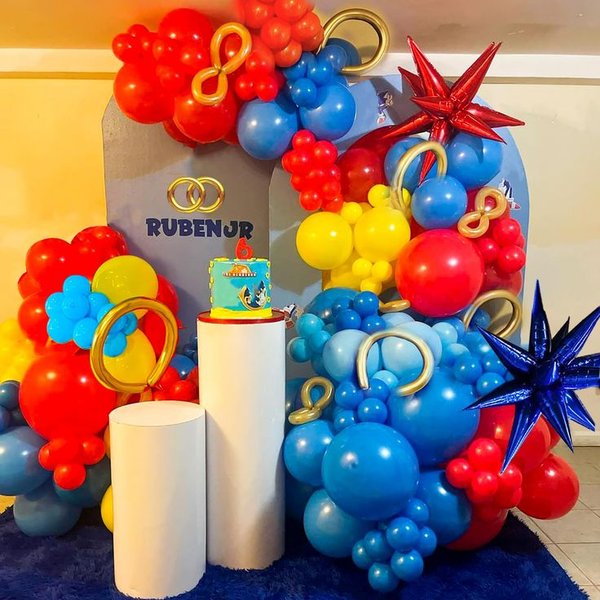
An example of a balloon arch kit featuring red, blue, and yellow balloons, demonstrating practical applications of proportional distribution in party decorations.
Video Deep Dive: The Art and Science of Balloons
While our problem focuses on a numerical distribution, the broader world of balloons encompasses various fascinating aspects, from their physical properties to their use in art and education. The video below, "Learn Numbers with Balloons | D Billions Kids Songs," offers a different, lighthearted perspective on balloons, focusing on learning colors and numbers.
This video, while not directly related to complex algebraic distributions, highlights the fundamental role balloons play in early childhood education. It uses balloons as a visual aid to teach basic concepts like counting and color identification, which are foundational skills for more advanced problem-solving like the one we just tackled. The simple act of categorizing and counting balloons by color in this video parallels the initial steps of our problem, where we assigned variables to different balloon colors. It serves as a reminder that complex mathematical problems often build upon simple, intuitive concepts, making learning both engaging and progressive.
Frequently Asked Questions (FAQ)
What type of mathematical problem is this?
Could this problem be solved without algebra?
What if the total number of balloons was different?
Are there real-world applications for this type of problem?
Conclusion
Through a precise algebraic approach, we have definitively determined the exact number of yellow, red, and blue balloons from a total of 8544, based on the specified relationships. The solution highlights the power of systematic problem-solving, where complex-sounding conditions can be broken down into manageable equations. This exercise not only provides a concrete answer but also demonstrates the elegance and efficiency of mathematical methods in solving distribution challenges, applicable in both theoretical and practical contexts. The calculated quantities are 356 yellow balloons, 3916 blue balloons, and 4272 red balloons, which collectively sum up to the total of 8544 balloons, confirming the accuracy of our findings.
Recommended Further Exploration
- How to solve systems of linear equations by substitution for beginners?
- What are some real-world applications of ratio and proportion problems?
- Can you provide examples of advanced word problems involving multiple variables?
- How do direct and indirect proportionality differ in mathematical problems?


