
Unlock the Secrets of Bitcoin: A Technical Deep Dive Without the Code
Understand how the world's first cryptocurrency actually works, explained in plain English.
Bitcoin can seem complex, often discussed with jargon and code. But at its core, it's a revolutionary system for digital money built on clever concepts rather than impenetrable programming magic. Let's break down how Bitcoin functions on a technical level, focusing on the mechanics you can grasp without ever writing a line of code.
Highlights: Key Bitcoin Concepts
Quick takeaways on how Bitcoin operates:
- Decentralized Digital Cash: Bitcoin allows direct peer-to-peer transactions online without needing banks or governments, operating on a global network of computers.
- The Blockchain Ledger: All transactions are recorded on a massive, shared, and tamper-proof digital record book called the blockchain, ensuring transparency and security.
- Mining & Proof-of-Work: Transactions are verified and new Bitcoins are created through a competitive process called mining, which uses computational power to solve puzzles and secure the network.
What Exactly is Bitcoin? Beyond the Hype
Understanding its fundamental purpose and design.
Bitcoin (often abbreviated as BTC) is the first successful example of a decentralized digital currency. Launched in 2008 by the pseudonymous Satoshi Nakamoto, it was designed to be a form of electronic cash that people could send directly to each other over the internet, anywhere in the world, without intermediaries like banks or payment processors.
Think of it like digital gold or a global online cash system. Its value isn't backed by a physical commodity or a government decree; instead, it relies on cryptographic proof, network consensus, and the underlying technology – the blockchain.
The Blockchain: Bitcoin's Unchangeable Record Book
How a shared ledger ensures trust and transparency.
The foundational technology behind Bitcoin is the blockchain. Imagine a gigantic, shared digital spreadsheet or ledger that is duplicated and distributed across thousands of computers worldwide (these computers are called "nodes"). This ledger contains a record of every single Bitcoin transaction ever made.
Conceptual view of how blockchain links blocks of transactions.
Blocks in the Chain
Transactions aren't added one by one. Instead, they are gathered together into groups called blocks. Think of each block as a page in this global ledger. Once a block is filled with verified transactions, it's added to the end of the existing chain of blocks – hence the name "blockchain."
Linking and Security
Each new block contains a unique digital fingerprint (a "hash") of the data inside it, AND it crucially includes the digital fingerprint of the *previous* block in the chain. This creates a strong, chronological link between all blocks. If someone tried to tamper with the data in an older block, its fingerprint would change, breaking the link to the next block. This discrepancy would be immediately obvious to the entire network, as their copies of the chain wouldn't match the altered one. This linking makes the blockchain extremely secure and effectively immutable (unchangeable) once transactions are confirmed.
Bitcoin Transactions: Sending Digital Value
The journey of a Bitcoin payment from sender to receiver.
Sending Bitcoin is akin to sending a secure digital message containing value. Here's how it works technically, without the coding details:
1. Wallets and Addresses
To use Bitcoin, you need a digital wallet. This isn't a physical wallet, but rather software (on your phone, computer, or a dedicated hardware device) that manages your Bitcoin access. Your wallet generates unique Bitcoin addresses for you. You can think of an address like an email address or a bank account number specifically for receiving Bitcoin. You can safely share your Bitcoin address with others.
2. Keys: Public and Private
Crucially, your wallet also manages your keys:
- Public Key: Derived from your private key, this is used to generate your Bitcoin addresses. It can be shared without compromising your funds.
- Private Key: This is the secret key, like a master password. It mathematically proves you own the Bitcoin associated with your addresses and authorizes you to spend them. Keeping your private key secret and secure is paramount. Losing it means losing access to your Bitcoin forever.
3. Creating and Signing a Transaction
When you want to send Bitcoin, your wallet software creates a transaction message. This message specifies: the amount of Bitcoin to send, the recipient's Bitcoin address, and potentially a transaction fee (to incentivize miners). To prove you authorize this transaction, your wallet uses your private key to create a unique digital signature for that specific transaction. This signature verifies ownership without revealing the private key itself.
4. Broadcasting to the Network
Once signed, the transaction is broadcasted from your wallet to the Bitcoin network – essentially announcing your intent to send funds to many connected computers (nodes).
5. The Mempool: Waiting Room for Transactions
Broadcasted transactions don't instantly become part of the blockchain. They first enter a waiting area called the mempool (memory pool), where they wait to be picked up by miners.
Mining: The Engine Securing Bitcoin
How competition and computation verify transactions and create new coins.
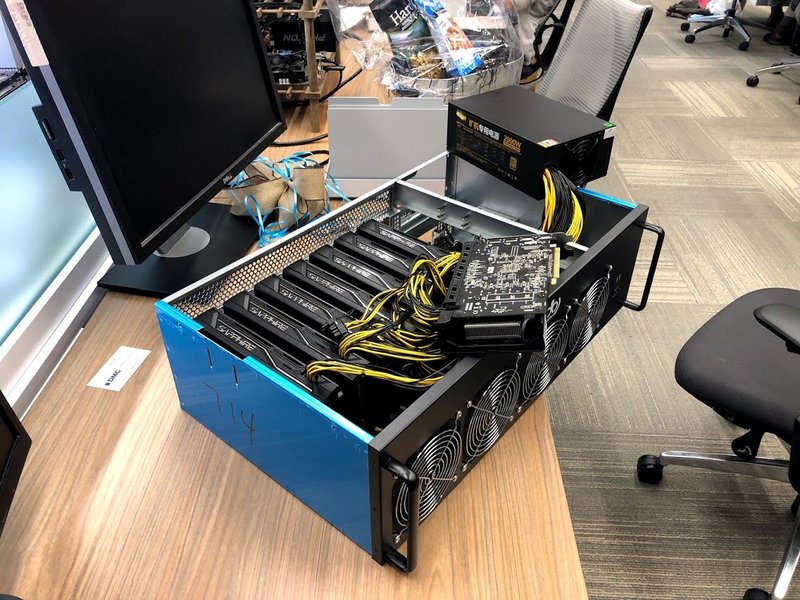
Since there's no central authority like a bank to validate transactions, Bitcoin relies on a decentralized process called mining. Miners are participants in the network (individuals or companies) who use powerful, specialized computers to perform the crucial task of verifying transactions and adding them to the blockchain.
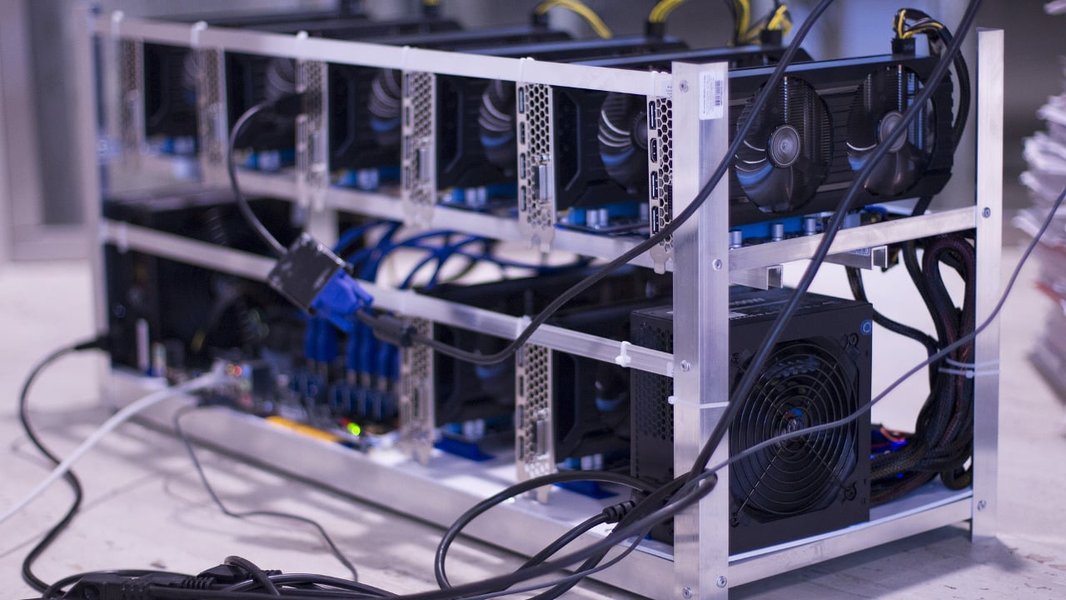
Example of a large-scale Bitcoin mining operation using specialized hardware.
Proof-of-Work (PoW): The Computational Puzzle
Mining employs a mechanism called Proof-of-Work (PoW). Here’s the concept:
- Miners grab pending transactions from the mempool and assemble them into a potential new block.
- To get their block accepted onto the blockchain, they must solve a complex mathematical puzzle. This puzzle involves finding a specific random number (called a "nonce").
- When this nonce is combined with the block's data (transactions, previous block's fingerprint, etc.) and put through a cryptographic hashing function (specifically SHA-256 for Bitcoin), the resulting output (the block's new fingerprint or "hash") must meet certain criteria – typically, it needs to start with a specific number of leading zeros.
- Finding this nonce is incredibly difficult and requires vast amounts of trial-and-error computational guesswork. It's like trying to find a specific grain of sand on a huge beach. The first miner to find a valid nonce "wins" the right to add their block to the chain.
This intense computational effort is the "work" in Proof-of-Work. It serves two main purposes: it makes it prohibitively expensive and difficult for anyone to cheat the system (as they'd need more computing power than a huge portion of the network), and it ensures that new blocks are added at a relatively predictable rate (roughly every 10 minutes on average for Bitcoin).
Block Confirmation and Rewards
When a miner successfully finds a valid nonce and broadcasts their completed block, other nodes on the network quickly verify that the solution is correct and the transactions within the block are valid. If the block checks out, nodes add it to their copy of the blockchain.
As a reward for their effort (which consumes significant electricity and computing resources), the successful miner receives:
- Newly created Bitcoin: This is known as the "block reward." It started at 50 BTC per block and halves approximately every four years (an event called the "halving"). As of the last halving in April 2024, the reward is 3.125 BTC per block. This is how new Bitcoin enters circulation.
- Transaction Fees: Any fees attached to the transactions included in their block.
A transaction is generally considered confirmed and secure after several more blocks (typically 6, equating to about an hour) have been added on top of the block containing it, making it exponentially harder to reverse.
Visualizing Bitcoin's Core Components
A mindmap connecting the key technical concepts.
To help visualize how these pieces fit together, the following mindmap illustrates the interconnected nature of Bitcoin's core technical elements:
Understanding Bitcoin's Characteristics
A comparative look at its key attributes.
Bitcoin possesses several defining characteristics, often compared to traditional financial systems or other digital assets. The radar chart below provides a conceptual visualization of how Bitcoin generally scores on various technical and economic attributes. Note that these are relative assessments and can be subjects of ongoing debate.
This chart highlights Bitcoin's strengths in decentralization, network security (due to PoW and hashing), transparency (public ledger), and immutability. However, it also reflects challenges like transaction speed and scalability (limited transactions per second compared to traditional payment networks) and the significant energy consumption associated with Proof-of-Work mining. Privacy is pseudonymous rather than fully anonymous.
Deeper Dive: Visualizing Bitcoin's Mechanics
An intuitive explanation of the underlying mathematics.
While we've avoided code, understanding the core principles can be enhanced visually. The following video provides an excellent, intuitive explanation of the cryptographic concepts (like hashing and digital signatures) that make Bitcoin work, without requiring a technical background.
This explanation covers how cryptographic hashing creates unique fingerprints for data blocks and how digital signatures, derived from private keys, securely authorize transactions. These are the mathematical tools ensuring that Bitcoin transactions are authentic and the blockchain remains tamper-proof.
Core Components Summary
A quick reference table for Bitcoin's key parts.
This table summarizes the main technical components of the Bitcoin system and their roles:
| Component | Primary Function | Analogy | Key Characteristic |
|---|---|---|---|
| Blockchain | Distributed, public ledger | Shared, unchangeable spreadsheet | Transparency, Immutability |
| Blocks | Containers for transactions | Pages in the ledger | Linked chronologically |
| Nodes | Computers maintaining the network/ledger | Guardians of the record book | Decentralization, Validation |
| Wallets | Manage keys and create transactions | Digital bank account interface | User access point |
| Private Key | Secret code to authorize spending | Master password / PIN | Security, Ownership proof |
| Public Key / Address | Identifier for receiving funds | Email address / Account number | Shareable recipient ID |
| Mining | Verifying transactions, creating blocks, securing network | Competitive puzzle solving / Auditing | Security, New coin issuance |
| Proof-of-Work (PoW) | Mechanism proving computational effort | Digital lottery requiring work | Prevents cheating, Controls block rate |
| Hashing (SHA-256) | Creating unique digital fingerprints | Data summarizer / Fingerprinter | Data integrity, Block linking |
| Consensus Mechanism | Process for network agreement | Majority rule voting | Network integrity, Double-spend prevention |
Security and The Fixed Supply
Why Bitcoin is considered secure and has a limited number of coins.
Decentralization and Consensus
Bitcoin's security stems largely from its decentralized nature. Because the blockchain ledger is stored across thousands of independent nodes worldwide, there's no single point of failure or control. To compromise the network (e.g., to double-spend coins or change past transactions), an attacker would need to gain control of more than 50% of the network's total computing (mining) power – a "51% attack." This is considered practically infeasible due to the immense and globally distributed computational power securing Bitcoin.
The network reaches agreement on the valid transaction history through its consensus mechanism (PoW and the longest chain rule). If conflicting versions of the blockchain emerge, the network automatically favors the chain with the most accumulated Proof-of-Work (usually the longest one), ensuring everyone converges on a single, truthful history.
Cryptography
Advanced cryptographic techniques like SHA-256 hashing and Elliptic Curve Digital Signature Algorithm (ECDSA) ensure the integrity of transactions and the security of user funds (provided private keys are kept safe).
Fixed Supply
A fundamental rule coded into the Bitcoin protocol is its limited supply. There will only ever be a maximum of 21 million Bitcoins created. \[ \text{Total Bitcoin Supply} \le 21,000,000 \] This scarcity is enforced by the halving mechanism, which reduces the rate of new Bitcoin creation over time. This contrasts sharply with traditional fiat currencies, which central banks can print in potentially unlimited quantities.
Frequently Asked Questions (FAQ)
Quick answers to common Bitcoin technical queries.
Is Bitcoin anonymous?
Not entirely. Bitcoin is often described as pseudonymous. While your real-world identity isn't directly linked to your Bitcoin address in the protocol itself, all transactions are public on the blockchain. If your address can be linked to your identity (e.g., through an exchange that requires ID verification), your transaction history associated with that address could potentially be traced.
How long does a Bitcoin transaction take?
New blocks are mined approximately every 10 minutes on average. However, a transaction is typically considered securely confirmed after about 6 blocks have been added on top of the block containing it. This means final confirmation usually takes around 60 minutes. Transactions can sometimes appear faster in wallets (zero-confirmation), but these are less secure until mined into a block and further confirmed.
Can the Bitcoin rules be changed?
Yes, but it's difficult and requires broad consensus among the network participants (developers, miners, nodes, users). Changes are usually proposed through Bitcoin Improvement Proposals (BIPs). Significant changes that aren't universally accepted can lead to "forks," where the blockchain splits into different versions running different rules.
What happens if I lose my private key?
If you lose your private key (or the recovery phrase/seed phrase for your wallet), you lose access to the Bitcoin associated with that key permanently. There is no central authority to appeal to for recovery. This underscores the critical importance of securely backing up your wallet's private key or seed phrase.
Why does mining use so much energy?
The Proof-of-Work (PoW) consensus mechanism requires miners to perform trillions of computations per second to find the correct nonce. This intense computational effort consumes significant amounts of electricity. This energy expenditure is what makes attacking the network prohibitively expensive, thus securing the blockchain. However, the environmental impact of this energy consumption is a major point of criticism and ongoing research into more energy-efficient alternatives (like Proof-of-Stake used by some other cryptocurrencies).
References
Sources used for this explanation:
- How does Bitcoin work? - Bitcoin.org
- What Is Bitcoin And How Does It Work? - Forbes Advisor
- How Does Bitcoin Work? Understanding the Blockchain, Halving & More - Gemini Cryptopedia
- How Bitcoin Works - Investopedia
- How Does Bitcoin Work? - BitPay Blog
- Bitcoin - Wikipedia
- How Does Bitcoin Work? - Blockpit Blog
Recommended Reading
Explore further related topics:
 assets.ctfassets.net
 aws.amazon.com
Last updated April 18, 2025