
Unlocking Automated Bitcoin Trading: Your Guide to Building an Expert Advisor
Transform your Bitcoin trading experience by developing a custom Expert Advisor (EA) for MetaTrader, designed to execute strategies with precision and efficiency.
Key Insights into EA Development for Bitcoin
- Strategic Foundation: A successful Bitcoin EA begins with a meticulously defined trading strategy, incorporating clear entry/exit points, risk management, and market analysis.
- Platform of Choice: MetaTrader 4 (MT4) or MetaTrader 5 (MT5) are the preferred platforms, utilizing MQL4/MQL5 for robust EA development, with Python also a viable alternative for custom bots.
- Rigorous Testing: Extensive backtesting on historical data and thorough optimization are paramount to validate your EA's performance and ensure profitability in live trading.
Building an Expert Advisor (EA) for trading Bitcoin (BTC) involves crafting an automated software program that operates on trading platforms like MetaTrader 4 (MT4) or MetaTrader 5 (MT5). These intelligent tools are designed to execute trades based on predefined rules, eliminating emotional biases and capitalizing on market opportunities around the clock. This comprehensive guide will walk you through the entire process, from conceptualizing your trading strategy to deploying and optimizing your BTC trading EA.

A visual representation of an automated trading system, highlighting the blend of advanced signals and robotic execution that defines an Expert Advisor.
Laying the Groundwork: Defining Your Trading Strategy
The cornerstone of any effective Expert Advisor is a well-articulated trading strategy. This strategy dictates every action your EA will take, from identifying trade opportunities to managing risk. Bitcoin's inherent volatility necessitates a robust and adaptable strategy.
Exploring Popular Bitcoin Trading Strategies
Several established trading strategies can be adapted for Bitcoin EAs:
- Trend Following: This strategy aims to capitalize on the prevailing market direction. EAs utilizing this approach often employ indicators like Moving Averages (MA), Relative Strength Index (RSI), or Moving Average Convergence Divergence (MACD) to identify and follow trends. For instance, an EA might open a buy position when a short-term moving average crosses above a long-term moving average, signaling an upward trend.
- Mean Reversion: This strategy assumes that Bitcoin's price will eventually return to its historical average after a significant deviation. EAs built on mean reversion might buy when prices dip significantly below a moving average and sell when they surge above it.
- Scalping: Characterized by high-frequency trading, scalping involves executing numerous small trades to profit from minor price fluctuations. Scalping EAs typically operate on very short timeframes, such as 1-minute charts, requiring rapid execution and precise entry/exit points.
- Breakout Trading: This strategy focuses on identifying significant support and resistance levels. The EA then executes trades when the price breaks decisively above resistance (for a buy) or below support (for a sell), anticipating a continuation of the newly established momentum.
- Grid Trading: A more sophisticated approach, grid trading involves placing a series of buy and sell orders at predetermined price intervals above and below a set price. While it can leverage volatility, it carries higher risks if not properly managed.
- Arbitrage: This strategy exploits price discrepancies for the same asset across different exchanges. An arbitrage EA would simultaneously buy Bitcoin on an exchange where its price is lower and sell it on another where it's higher, profiting from the differential.
Crucially, every strategy must incorporate clear entry and exit criteria. This includes defining specific conditions under which a trade should be opened or closed, along with mandated Stop-Loss (SL) and Take-Profit (TP) levels to manage potential losses and secure gains.
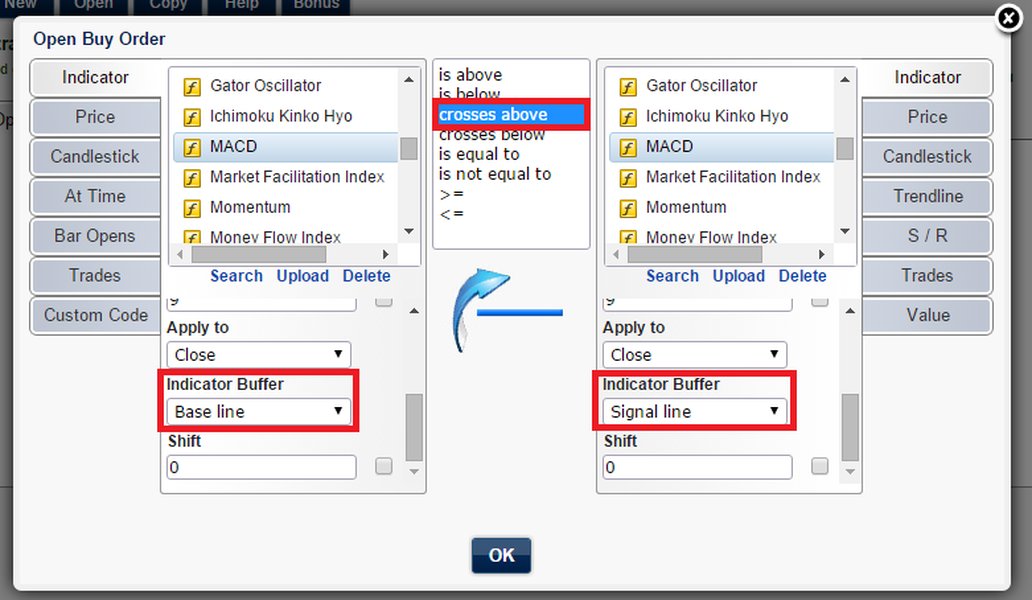
An example of a strategy workspace, illustrating how indicators are used to define trading conditions within an Expert Advisor.
Choosing Your Tools: Platforms and Programming Languages
The choice of development environment and programming language is critical for building a functional EA.
MetaTrader: The Gold Standard for EAs
MetaTrader 4 (MT4) and MetaTrader 5 (MT5) are industry-standard platforms for automated trading. EAs designed for these platforms are typically programmed in MQL4 (for MT4) or MQL5 (for MT5). MetaEditor, the official development environment within MetaTrader, provides the necessary tools for coding, compiling, and debugging your EA.
MQL4 and MQL5 are specifically tailored for algorithmic trading, offering extensive functionalities for accessing market data, placing orders, and managing trades. Many professional EAs, such as the BTC Trend Trading EA and Bitcoin Robot EA V8.3, are built using these languages.
Beyond MetaTrader: Python and Other Options
While MQL is dominant for MetaTrader, other programming languages like Python are popular for developing custom trading bots. Python's rich ecosystem of libraries for data analysis (e.g., Pandas, NumPy) and its ability to integrate with various exchange APIs (e.g., Bybit API, Binance API) make it a versatile choice. You can also use JavaScript for custom bot development.
For those less inclined towards coding, visual strategy builders like EA Studio or FSB Pro allow you to construct trading logics without manual programming, by using a graphical user interface.
Crafting the Code: Step-by-Step EA Development
Once your strategy is defined and your development environment is chosen, the next phase involves translating your strategy into executable code.
Step 1: Initialization and Input Parameters
Begin by defining user-adjustable input parameters for your EA. These parameters allow you to customize and optimize your strategy without modifying the underlying code. Common inputs include:
- Lot size or position sizing
- Default Stop-Loss and Take-Profit levels
- Trading hours or specific timeframes
- Parameters for technical indicators (e.g., periods for Moving Averages, RSI levels)
Step 2: Market Analysis and Indicator Computation
Your EA needs to continuously analyze market data to identify trading signals. This involves integrating and calculating various technical indicators. For example, if your strategy is trend-following:
// Example: Calculate Moving Averages
double fastMA = iMA(Symbol(), Period(), fastMAPeriod, 0, MODE_EMA, PRICE_CLOSE, 0);
double slowMA = iMA(Symbol(), Period(), slowMAPeriod, 0, MODE_EMA, PRICE_CLOSE, 0);

// Example: Calculate RSI
double rsi = iRSI(Symbol(), Period(), rsiPeriod, PRICE_CLOSE, 0);
You'll program the EA to monitor these indicator values and identify specific conditions that align with your strategy's entry and exit rules.
Step 3: Signal Generation and Trade Execution Logic
This is where your strategy's core logic comes to life. Program the conditions for opening buy or sell orders. For instance, a buy signal might be generated when the fast moving average crosses above the slow moving average, and RSI is above 50.
// Example: Buy Signal
if (fastMA > slowMA && Close[1] < Open[1]) // Example for MA crossover
{
    // Check if a buy order can be placed
    if (OrdersTotal() == 0) // Ensure only one order at a time
    {
        // Place buy order with calculated stop loss and take profit
        trade.Buy(lotSize, Symbol(), Ask, stopLossPrice, takeProfitPrice, "My Bitcoin EA Buy");
    }
}

// Example: Sell Signal
else if (fastMA < slowMA && Close[1] > Open[1]) // Example for MA crossover
{
    // Check if a sell order can be placed
    if (OrdersTotal() == 0) // Ensure only one order at a time
    {
        // Place sell order with calculated stop loss and take profit
        trade.Sell(lotSize, Symbol(), Bid, stopLossPrice, takeProfitPrice, "My Bitcoin EA Sell");
    }
}
Implement controls for the maximum number of open trades, and ensure stop-loss and take-profit orders are set with every trade to mitigate risk.
Step 4: Order Management and Risk Controls
Robust risk management is paramount. Your EA should include features such as:
- Fixed Stop-Loss: A predefined price level at which a trade is automatically closed to limit potential losses.
- Trailing Stop-Loss: A stop-loss that automatically adjusts as the price moves favorably, locking in profits while still protecting against reversals.
- Maximum Drawdown Limit: A critical feature that prevents the EA from losing more than a specified percentage of capital.
- Position Sizing: Automatically calculates the appropriate trade size based on your risk tolerance per trade and account equity. Many experts recommend limiting risk to 1-2% of capital per trade.
Step 5: Backtesting and Optimization
Before live deployment, rigorously backtest your EA on historical Bitcoin price data using MetaTrader’s Strategy Tester. This simulation evaluates how your EA would have performed under various past market conditions, providing crucial insights into its profitability, drawdown, and win rate.
Optimization involves fine-tuning your EA's input parameters to achieve the best historical performance. This might involve adjusting indicator periods, stop-loss/take-profit levels, or trade frequency. However, be cautious to avoid "over-optimization," which can lead to an EA that performs well on historical data but poorly in live markets.
Visualizing Your EA's Performance Potential
To provide a clearer picture of what a well-designed Bitcoin trading EA aims to achieve, let's consider a hypothetical performance radar chart. This chart represents key performance indicators (KPIs) and how different strategy focuses might influence them. While these are opinionated analyses rather than hard data, they illustrate the multi-faceted nature of EA optimization.
This radar chart illustrates the trade-offs and strengths typically associated with different EA strategies. A "Scalping EA" might excel in "Trade Frequency" and "Execution Speed" but could have lower scores in "Drawdown Management" if not carefully controlled. Conversely, a "Mean Reversion EA" might prioritize "Drawdown Management" and "Risk Management" with less emphasis on "Trade Frequency." The goal during optimization is to find the right balance of these KPIs for your specific trading objectives and risk tolerance.
Connecting and Deploying Your Expert Advisor
Once your EA is developed and thoroughly tested, the final steps involve connecting it to your chosen trading environment and deploying it for live (or demo) trading.
API Integration and Platform Settings
Your EA will need access to real-time and historical market data to make informed decisions. For MetaTrader, this integration is native. For external bots (e.g., Python-based), this is achieved by connecting to cryptocurrency exchanges like Binance or Bybit via their Application Programming Interfaces (APIs). These APIs allow your bot to pull market data, execute trades, and manage your crypto wallet.
On MetaTrader, ensure "Allow automated trading" and "Allow DLL imports" (if your EA uses external libraries) are enabled in the platform's options. Then, simply attach your compiled EA file to the desired BTC trading chart.
Deployment and Continuous Monitoring
Always begin by deploying your EA on a demo account. This allows you to monitor its performance in real-time market conditions without risking actual capital. Use the platform's logging features for debugging any issues that arise. Once confident, you can transition to a live account. Continuous monitoring of your live EA's performance is crucial, as market conditions are constantly evolving. Be prepared to adjust and refine your strategy as needed.
The Benefits of Automated Bitcoin Trading
Expert Advisors offer significant advantages over manual trading, especially in the fast-paced and 24/7 Bitcoin market:
- Automation and Time-Saving: EAs operate automatically, freeing you from constant market monitoring.
- Elimination of Emotional Bias: Bots adhere strictly to predefined rules, preventing emotional decisions like FOMO (Fear of Missing Out) or panic selling.
- Speed and Efficiency: EAs can execute trades instantly and perform operations far exceeding human capabilities, crucial in volatile markets.
- Continuous Operation: Bitcoin markets never sleep, and EAs can trade continuously, ensuring no opportunities are missed.
- Diversification: EAs enable the simultaneous trading of multiple markets and strategies, diversifying risk and maximizing opportunities.
Key Considerations and Risks
While powerful, building and using a Bitcoin EA comes with considerations and risks:
- Bitcoin's Volatility: While EAs can capitalize on volatility, extreme price swings demand tight risk management and robust strategies.
- No Guarantees: No strategy or EA guarantees profits. Market conditions change, and continuous updates and monitoring are required.
- Risky Strategies: Be extremely cautious with high-risk strategies like Martingale or certain grid systems, as they can lead to substantial losses if not fully understood and managed.
- Broker Compatibility: Ensure your chosen broker supports Bitcoin trading on MetaTrader and allows automated trading.
- Transparency: When acquiring EAs, look for transparent fee structures and clear explanations of their strategies.
Building an Expert Advisor is a methodical process that demands strategic clarity, technical proficiency, and a commitment to rigorous testing and continuous optimization. By following these guidelines, you can create a powerful tool to automate your Bitcoin trading and potentially enhance your profitability.
Decoding the EA Building Journey
Developing an Expert Advisor for Bitcoin trading involves a series of interconnected steps, moving from conceptual strategy to live deployment. This mindmap illustrates the essential components and their relationships within the EA development ecosystem.
This mindmap encapsulates the multifaceted nature of building a Bitcoin EA, illustrating the logical flow from initial concept to deployment and ongoing management. Each node represents a critical aspect, and the branches demonstrate their interdependencies, emphasizing the holistic approach required for success.
Recommended Video: Building a Bitcoin MQL5 Expert Advisor Live From Scratch
To deepen your understanding of the practical aspects of building a Bitcoin EA, especially within the MetaTrader environment, we recommend watching the following video. This tutorial provides a live, step-by-step demonstration of constructing an Expert Advisor from scratch using MQL5. It covers research, setting up a starter template, coding the EA, optimization techniques, and even a glimpse into live trading. This resource is invaluable for visually learning the technical nuances involved in translating strategy into functional code.
A practical demonstration of building a Bitcoin Expert Advisor using MQL5, covering everything from coding to optimization.
A Comparative Overview of EA Development Approaches
Choosing the right path for EA development depends on your programming expertise, desired control, and time commitment. Here's a table comparing different approaches:
| Aspect | MQL4/MQL5 Coding (MetaEditor) | Python/JavaScript (Custom Bot) | No-Code EA Builders (e.g., EA Studio) |
|---|---|---|---|
| Programming Skill Required | High (MQL-specific syntax, C-like) | Moderate to High (Python/JS syntax, libraries) | None to Low (GUI-based logic building) |
| Platform Integration | Native to MetaTrader (MT4/MT5) | External (requires API connection to exchanges/MT5 bridge) | Often integrates with MetaTrader or other platforms |
| Customization & Flexibility | Very High (full control over logic, indicators) | Very High (extensive libraries, complex algorithms) | Moderate (limited by builder's features and templates) |
| Data Access | Native MetaTrader data feeds | API connections to crypto exchanges (Binance, Bybit etc.) | Depends on the builder's integrated data sources |
| Backtesting & Optimization | Built-in Strategy Tester (powerful) | Requires custom coding for backtesting frameworks | Often has built-in backtesting features |
| Complexity for AI/ML Integration | Possible, but more complex (DLL imports) | Easier (rich ML libraries, direct API access) | Limited or non-existent in most builders |
| Typical Use Case | Developing specialized, high-performance EAs for MT platforms | Building highly customized bots, multi-exchange arbitrage, AI integration | Quick prototyping, non-programmers, testing simple ideas |
This table highlights that while MQL offers deep integration with MetaTrader, Python provides broader flexibility for custom bots and AI. No-code builders offer a quick entry point for those without programming expertise.
Frequently Asked Questions About Building a Bitcoin EA
What is an Expert Advisor (EA) for Bitcoin trading?
What programming language is used to build EAs for MetaTrader?
Can I build a Bitcoin EA without knowing how to code?
Why is backtesting important for a Bitcoin EA?
What are the key risk management features an EA should have?
Conclusion: Your Journey to Automated Bitcoin Trading
Building an Expert Advisor for Bitcoin trading is a powerful step towards automating your market participation. From defining a clear strategy rooted in principles like trend following or mean reversion, to selecting the right development environment like MetaTrader with MQL5, every stage is critical. The meticulous process of coding your EA, integrating robust risk management, and rigorously backtesting its performance against historical data ensures its potential for success. While the benefits of automation—such as emotionless execution and continuous operation—are compelling, remember that the volatile nature of Bitcoin demands constant monitoring and strategic adaptability. By embracing a structured approach and continuous learning, you can unlock the full potential of algorithmic trading and navigate the Bitcoin market with precision.
Recommended Further Exploration
- How can advanced MQL5 techniques enhance high-frequency Bitcoin EA development?
- What are the best practices for integrating machine learning models into Bitcoin trading bots?
- What optimization strategies are most effective for Bitcoin EAs in highly volatile market conditions?
- How can common risks in automated Bitcoin trading be understood and effectively mitigated?