
Understanding the Impact of Cellular Parameters on Wound Closure Dynamics
Exploring how migration, proliferation, and adhesion affect simulated wound healing
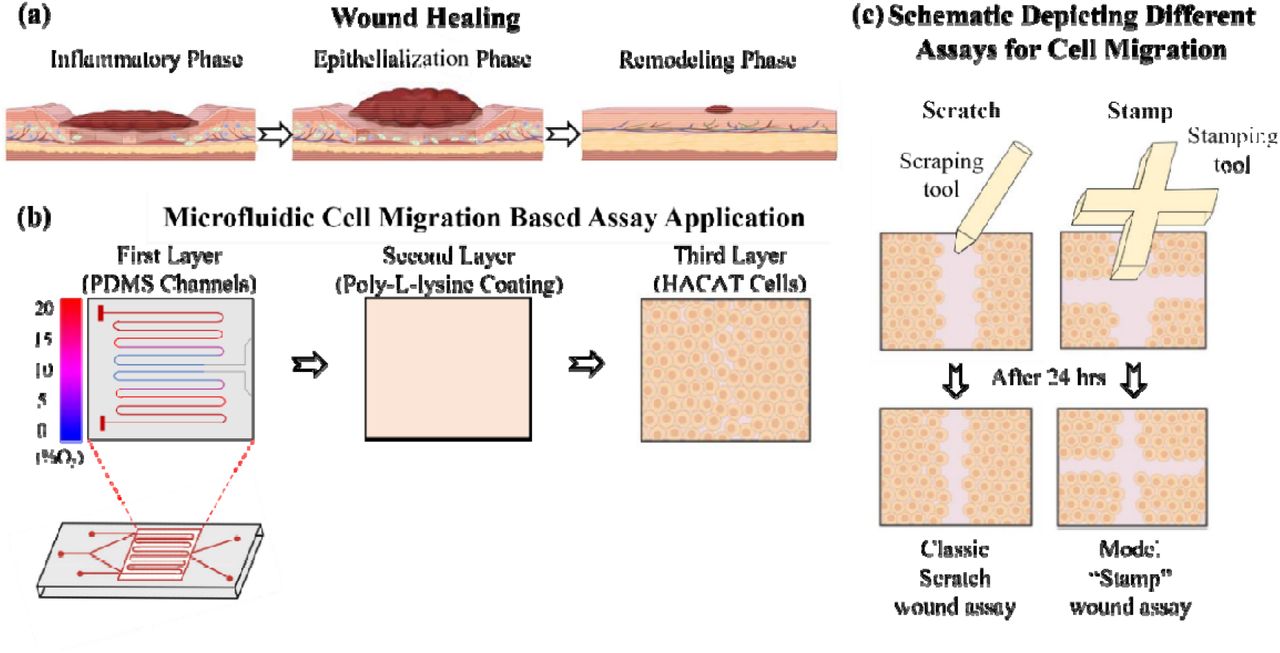
Key Highlights
- Migration Speed: Faster migration accelerates wound closure, closely mimicking experimental observations of efficient cell movement.
- Proliferation Rate: Variations directly influence the number of cells participating in the healing process, critical for tissue regeneration.
- Adhesion Properties: Optimal cell adhesion facilitates effective wound repair; both excessive and insufficient adhesion can hinder the overall healing process.
Introduction to Agent-Based Wound Healing Simulations
The use of agent-based models (ABMs) in computational biology has revolutionized the way researchers study complex biological processes such as wound healing. Platforms like BioDynaMo provide the tools to simulate numerous interconnected cellular processes in silico. In these simulations, individual cells are represented as independent agents that exhibit behaviors such as migration, proliferation, and adhesion. Studying these behaviors through simulated scratch assays—experiments where a gap is created in a confluent cell layer—provides a controlled environment to dissect the roles played by different cellular parameters in wound closure dynamics.
In experimental in vitro scratch assays, a controlled wound is inflicted in a cell monolayer, and the migration of cells into this gap is observed over time. This process is mimicked in simulations by adjusting key cellular parameters. The ability to systematically alter parameters helps highlight the contribution of each factor to wound healing. Moreover, comparing computational outcomes with experimental observations offers a robust method to validate simulation models, thereby enhancing our understanding of wound healing mechanisms in both normal and pathological states.
Impact of Key Cellular Parameters
1. Migration Speed
Simulation Dynamics
In agent-based simulations, migration speed represents the rate at which cells move across the simulated tissue. A higher migration speed leads to a rapid filling of the wound gap. In this model, cells respond to chemotactic signals released by injured tissues and neighboring cells, which enhance their directed movement towards the wound. Increased migration speed results in:
- Faster covering of the gap area, reducing overall wound size in simulation time.
- Enhanced responsiveness to chemotactic gradients, resulting in more efficient coordination among agents.
- A direct correlation between increased speed and reduced healing time in silico, which aligns with experimental data.
The effectiveness of cell migration in closing wounds is a widely reported phenomenon in both simulations and laboratory settings. Computational models demonstrate that even slight increments in migration velocity can significantly affect the wound closure timeline, mirroring observations from in vitro scratch assays where increased cell motility is observed in actively healing tissues.
2. Proliferation Rate
Role in Tissue Regeneration
Proliferation rate defines the frequency at which cells divide to produce new cells. In wound healing simulations, a higher proliferation rate means more cells become available to migrate into and fill the wound area. The implications of varying proliferation rates include:
- Acceleration of Cellular Replenishment: A greater number of cells created through rapid proliferation can quickly populate the wound gap, thereby enhancing the healing process.
- Temporal Reduction in Gap Size: As more cells are produced, the area lacking cells shrinks more rapidly, which is consistent with in vitro experiments where enhanced proliferation is often linked to faster wound closure.
- Potential Complications: While increased proliferation is typically positive, excessive or unregulated cell division may lead to problems such as tissue overgrowth or scarring, suggesting that a balanced proliferation rate is optimal.
In laboratory experiments, methods that stimulate cell division, such as growth factor treatments, often lead to more efficient wound healing. Simulations echo these findings by showing that moderate increases in proliferation result in quicker and more effective repair.
3. Adhesion Properties
Stability Versus Flexibility
Adhesion properties are critical determinants of how cells interact with each other and the surrounding extracellular matrix. In computational models, adhesion governs how strongly individual cells stick either to substrates or other cells. Variations in adhesion properties can lead to:
- Optimal Adhesion: A moderate level of adhesion is essential for maintaining cell positioning and ensuring the effective transduction of mechanical signals. This facilitates coordinated migration and organized tissue formation.
- Excessive Adhesion: If cells are too strongly adhered to their neighbors or the matrix, their mobility can be reduced, leading to slower gap closure. Such conditions might simulate pathological states where wound healing is delayed.
- Weak Adhesion: Conversely, if adhesion is too weak, cells may detach easily during movement, undermining the structural integrity of the healing tissue. This can result in patchy or incomplete wound closure.
Both simulation outcomes and experimental results emphasize that there is an optimal range for cell adhesion. Too little or too much adhesion can detrimentally affect the healing process, making it crucial for models to accurately capture this nuance. In experimental scratch assays, varying the extracellular matrix composition has been shown to affect adhesion and, subsequently, the migration efficiency and wound closure rate.
Comparative Analysis: Computation vs. Experimentation
Computational Advantages
Control and Scalability
One of the significant benefits of using computational simulations like those available through BioDynaMo is the exceptional control over experimental variables. Researchers can precisely adjust parameters such as migration speed, proliferation rate, and adhesion properties, allowing them to:
- Systematically test the influence of each variable without additional experimental noise.
- Observe the emergent behaviors resulting from the interactions among a large number of agents under controlled conditions.
- Rapidly iterate through multiple scenarios, scaling the simulation to encompass millions or even billions of cells, providing insights that would be logistically challenging in a laboratory setting.
Moreover, computational models are instrumental in predicting behaviors, such as collective cell migration or the formation of spatial patterns, that might not be readily apparent in experimental setups. This level of control and scalability allows simulations to generate valuable hypotheses that can later be tested in vitro.
Experimental Correlations
Biological Context and Complexity
While simulations provide detailed insights into specific parameters, experimental observations of skin wound healing offer a broader biological context that includes factors such as:
- Complex Tissue Interactions: In vivo, multiple cell types interact with each other, and processes such as immune response, extracellular matrix remodeling, and angiogenesis play pivotal roles. These factors add layers of complexity that simulations might simplify.
- Variability and Noise: Biological data often contains inherent variability due to the influence of systemic factors or subtle environmental differences, which are sometimes challenging to capture fully in a computational model.
- Validation and Predictive Power: Comparing the outcomes of simulated scratch assays with experimental results helps validate the models. Temporal dynamics (e.g., the time course of wound closure) and spatial patterns (e.g., the distribution of cells within the wound area) observed in the lab can be closely compared with simulation data.
Experimental scratch assays have long served as a standard in vitro method to study cell migration and wound healing. By comparing simulation results with these assays, researchers confirm that the mechanistic insights generated in silico are consistent with biological phenomena. For example, both methods show that increasing migration speed and proliferation leads to more rapid wound closure, while optimal adhesion is necessary for maintaining tissue structure.
Visual Comparative Representation
Simulation vs. Experimental Metrics
The table below outlines a simplified comparison between simulation parameters and their experimental analogs:
| Parameter | Simulation Outcome | Experimental Observation |
|---|---|---|
| Migration Speed | Increased speed leads to quicker closure of the wound gap. | Enhanced cell motility resulting in faster gap filling, observed under chemotactic stimuli. |
| Proliferation Rate | Higher division rates increase cell density, accelerating wound coverage. | Growth factor-induced proliferation correlates with more rapid regeneration of wound sites. |
| Adhesion Properties | Optimal adhesion facilitates coordinated migration; deviations hinder movement. | Modified adhesion through extracellular matrix components affects migration and tissue integrity. |
This table is a concise illustration of how particular cellular parameters manipulated in simulations yield outcomes that are directly comparable to experimental wound healing data. It underscores the utility of computational models in bridging controlled parameter studies with the complex realities of biological systems.
Integrating Insights for Advanced Wound Healing Studies
Multifactorial Approach
Synergistic Effects
In the context of wound healing, no single cellular parameter operates in isolation. Instead, migration speed, proliferation rate, and adhesion properties interact synergistically to drive the repair process. Simulations benefit from the modular design of platforms such as BioDynaMo by enabling researchers to adjust multiple parameters simultaneously. Such an approach helps in understanding complex dynamics such as:
- How a slight increase in migration speed may be more effective when combined with a moderate rise in proliferation rate.
- The role of adhesion-controlled spatial patterning in orchestrating collective cell movement.
- The overall impact on wound closure time and tissue organization arising from balanced cellular behaviors.
By integrating these factors, computational models replicate the multi-layered nature of wound healing observed in experimental studies. Advanced simulations can incorporate intricate rules that mimic environmental cues, enabling researchers to test hypotheses in silico that might be too complex or impractical to evaluate in live systems.
Limitations and Future Directions
Enhancing Model Robustness
Despite the power of agent-based simulations to mimic wound healing, it is important to acknowledge some limitations:
- Simplification of Biological Complexity: While current models provide valuable insights, they often simplify dynamics such as extracellular matrix remodeling or the influence of heterogeneous cell populations.
- Parameter Sensitivity: The outcomes of simulations are highly sensitive to the exact values of cellular parameters. Even minor deviations can lead to significant changes, highlighting the need for accurate parameter estimation.
- Multiscale Integration: Integrating processes at cellular and molecular scales remains a challenge. Future research is needed to bridge these scales effectively within simulation frameworks.
Future directions involve refining the simulation models by incorporating detailed mechanistic insights, such as improved chemotaxis modeling and enhanced representations of cell–extracellular matrix interactions. These efforts will increase the fidelity of computational predictions and facilitate the development of targeted therapeutic strategies.
Conclusions and Final Thoughts
In conclusion, variations in cellular parameters significantly influence wound closure dynamics in BioDynaMo-based simulations. Increased migration speed enhances the rate at which wound gaps are closed, while a higher proliferation rate intensifies the supply of cells needed to fill the wound, both of which are corroborated by experimental observations. Adhesion properties, by dictating the balance between cell attachment and mobility, play a critical role in ensuring coordinated tissue repair.
Computational models provide a valuable platform for conducting controlled studies of these parameters in ways that are difficult to achieve in traditional experimental setups. Although simulations necessarily simplify some aspects of the biological reality, the close correlation between in silico data and experimental outcomes validates the use of such models for probing the mechanisms underlying wound healing. As computational techniques continue to evolve, they will undoubtedly enhance our ability to simulate and predict complex biological processes, thereby enriching our understanding of tissue repair and contributing to the development of innovative therapeutics.
References
- BioDynaMo Official Website - BioDynaMo
- BioDynaMo on CERN Open Source - CERN
-
Computational Modeling of Inflammation and Wound Healing - PMC
- Wound Healing Simulation on GitHub - GitHub
-
Wound Healing Assay Overview - ScienceDirect
Recommended Queries for Deeper Insights
Last updated February 26, 2025