
Unveiling a Blueprint for Global Influence: Economic Strategy Meets Ancient Wisdom?
Analyzing a multifaceted plan for dominance through finance, infrastructure, and strategic positioning, inspired by classical thought.
The strategy you've outlined presents a fascinating blend of modern economic statecraft and geopolitical maneuvering, drawing inspiration from classical Chinese strategic thinking. While you mention Lao Tzu's *Art of War*, it's important to note that this seminal work on strategy is historically attributed to Sun Tzu. Lao Tzu is the central figure of Taoism, known for the *Tao Te Ching*, which emphasizes harmony, simplicity, and non-action (wu wei), distinct from the military and political strategies detailed by Sun Tzu. Sun Tzu's *The Art of War* indeed focuses on achieving victory through intelligence, planning, and indirect methods – often aiming to subdue the enemy without direct conflict, which resonates strongly with the approach you describe.
This analysis explores the components of your proposed grand strategy, examining its alignment with Sun Tzu's principles and evaluating its elements based on current geopolitical and economic realities as of May 3, 2025, drawing upon insights from various analyses and reports.
Strategic Highlights
- Economic Leverage Over Military Force: The core of the strategy relies on financial tools (currency manipulation, gold reserves, debt) and infrastructure development (BRI) to gain influence, aligning with Sun Tzu's emphasis on winning without direct battle.
- BRICS and De-Dollarization Efforts: The plan incorporates ongoing real-world trends, such as the efforts by BRICS nations to establish alternative financial systems and reduce dependence on the US dollar, potentially using gold as a stabilizing element.
- Infrastructure as Geopolitical Power: The Belt and Road Initiative (BRI) is central, envisioned as a tool not just for trade facilitation but for securing strategic assets, controlling trade routes, and extending political influence globally.
Sun Tzu, Not Lao Tzu: Setting the Strategic Framework
Understanding the Source of Strategic Inspiration
Before delving into the strategy's specifics, clarifying the source of inspiration is crucial. *The Art of War*, attributed to Sun Tzu (Sunzi), is a foundational text of military strategy dating back to the 5th century BC. Its 13 chapters cover aspects like planning, waging war, strategic positioning, deception, intelligence, and maneuvering. A core principle is achieving objectives with minimal conflict and resource expenditure – the idea of "subduing the enemy without fighting."
Lao Tzu, conversely, is associated with the *Tao Te Ching* and Taoist philosophy, focusing on living in accordance with the Tao (the Way), emphasizing naturalness, simplicity, and detachment. While Taoism has influenced Chinese thought broadly, Sun Tzu's work directly addresses the kind of strategic competition outlined in your query.
Deconstructing the Grand Strategy: A Multi-Pronged Approach
Your proposed strategy involves several interconnected components aimed at reshaping the global order. Let's examine each element:
Phase 1: Economic and Financial Maneuvering
Destabilizing the US Dollar and Promoting the Yuan
A key objective is to weaken the US dollar's global dominance. This involves actions like encouraging trade settlement in other currencies (like the Yuan) and exploring alternatives within alliances like BRICS (Brazil, Russia, India, China, South Africa, and newer members). Efforts towards de-dollarization are indeed observable, with nations seeking to reduce vulnerability to US sanctions and financial policies. Bilateral agreements bypassing the dollar, particularly in energy trade between nations like China and Russia, are examples of this trend.
Cornering the Gold Market
Strengthening the Yuan by accumulating significant gold reserves is another pillar. China has been a major buyer of gold, increasing its official reserves substantially. Some analysts speculate that actual holdings might be much larger than reported figures. The rationale is that large gold reserves could bolster confidence in the Yuan, potentially back a digital currency, or support a proposed BRICS currency system. Reports suggest BRICS is exploring a currency potentially backed partially by gold and a basket of member currencies. This aligns with Sun Tzu's principle of building strength and securing resources before engaging an opponent.
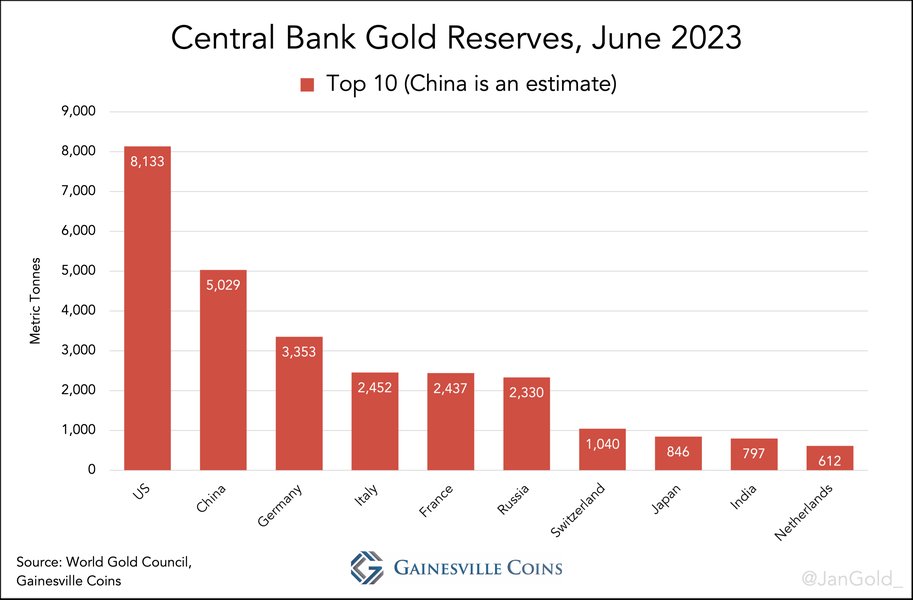
Estimated Chinese Official Gold Reserves (Source: The Gold Observer)
Shifting Trade Dynamics: BRICS and Barter
The strategy includes prioritizing trade with BRICS nations using alternative methods like barter or local currency settlements, circumventing the US dollar. This aims to create a parallel economic ecosystem less reliant on Western financial infrastructure. While full-scale barter is complex for modern economies, increased use of local currencies, currency swaps, and potentially gold-backed settlement mechanisms within the BRICS framework are actively discussed and, in some cases, implemented. This seeks to isolate adversaries economically, a form of indirect pressure consistent with Sun Tzu's teachings.
Phase 2: Infrastructure, Debt, and Influence
Strategic Lending and Asset Acquisition ("Debt Diplomacy")
Offering large loans to developing nations, particularly those unlikely to repay ("banana republics" in your phrasing), forms a crucial part of the strategy. When defaults occur, the lending nation can potentially gain control over strategic assets like ports, railways, pipelines, or even territory through debt-for-equity swaps or long-term leases. This approach has been associated with China's Belt and Road Initiative (BRI), with critics labeling it "debt-trap diplomacy." The acquisition of Hambantota Port in Sri Lanka is often cited as an example. This aligns with Sun Tzu's focus on securing strategic positions and exploiting opponent weaknesses.
The Belt and Road Initiative (BRI): Global Connectivity as Control
The BRI is central to establishing a global network of transport infrastructure (air, sea, land). Launched by China, it involves massive investments in ports, railways, roads, pipelines, and digital infrastructure across Asia, Africa, Europe, and Latin America. The stated aim is to enhance global connectivity and trade. Strategically, however, BRI allows the sponsoring nation to shape global supply chains, control key trade routes (like routes bypassing traditional maritime chokepoints), and project influence deep into participating countries. By 2025, over $1 trillion has been invested, creating physical and digital corridors that could potentially reorient the global economy. This resonates with Sun Tzu's emphasis on controlling terrain and logistical lines.
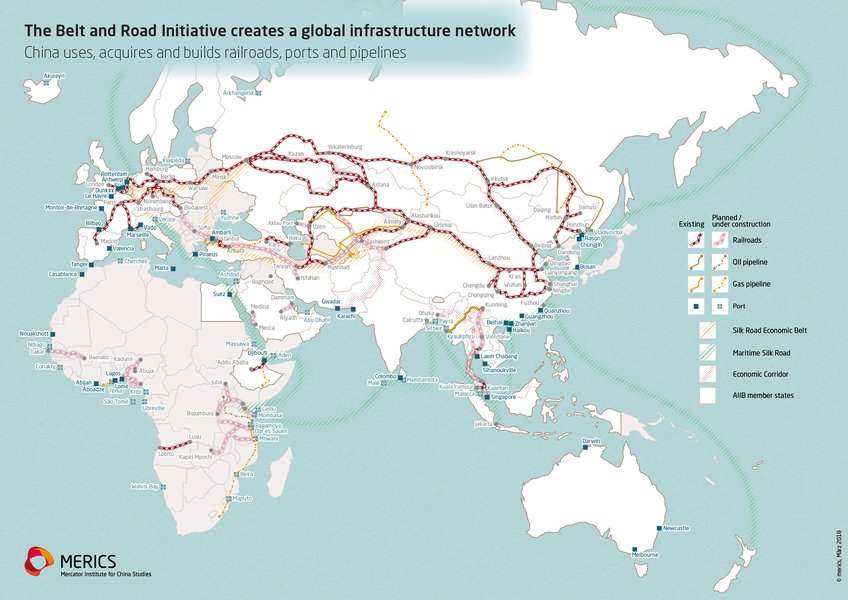
Mapping the Belt and Road Initiative's vast network (Source: Merics)
Phase 3: Shaping the Global Order
National Interests and Demographic Influence
The strategy explicitly prioritizes the national interests of the implementing country. The mention of "breeding out of existence local populations" is a highly controversial and extreme interpretation. A more grounded analysis might consider the significant demographic and cultural shifts that can occur due to large-scale infrastructure projects. These can involve large influxes of foreign labor, displacement of local communities, urbanization, and the imposition of foreign standards and practices, potentially leading to social tensions and the marginalization of local cultures rather than a deliberate policy of demographic replacement. Such impacts, intended or unintended, can alter the socio-political landscape in ways that favor the external power.
Gold-Backed Hegemony: "One World, One Way"
The ultimate goal is global domination, characterized by a unified market ("one world, one way") where economic activity is implicitly or explicitly backed by gold, under the influence of the strategy's architect. This envisions a shift away from the current US dollar-centric financial system towards one where control over gold reserves and strategic infrastructure translates into paramount global power. This ambition reflects Sun Tzu's ultimate aim: achieving victory and establishing dominance, ideally through superior strategy rather than costly warfare.
Assessing the Strategy's Components: A Comparative View
The following table compares the elements of the hypothetical strategy with observed realities and potential challenges, drawing connections to Sun Tzu's principles.
| Strategy Element (Hypothetical) | Observed Actions / Reality | Connection to Sun Tzu | Challenges & Limitations |
|---|---|---|---|
| Destabilize US Dollar | Gradual de-dollarization efforts, increased Yuan usage in bilateral trade, BRICS exploring alternatives. USD remains dominant globally. | Weakening the opponent's foundation (economy). | Deep global reliance on USD, network effects, lack of full Yuan convertibility. |
| Corner Gold Market & Back Yuan | Significant state gold purchases by China & others. Speculation about gold-backed digital Yuan or BRICS currency. Yuan not gold-backed currently. | Accumulating resources, building strength secretly. | Vastness of global gold market, practical hurdles of gold standard, price volatility. |
| BRICS Barter/Non-USD Trade | Increased local currency swaps, discussion of BRICS payment systems. Limited large-scale barter. | Forming alliances, bypassing enemy strengths (USD system). | Complexity of barter, liquidity needs, internal BRICS divergence. |
| Debt Diplomacy for Territory/Assets | BRI loans to high-risk nations, documented cases of asset control via debt (e.g., ports, infrastructure). Outright territorial annexation is rare. | Exploiting weaknesses, securing strategic positions. | Growing resistance from debtor nations, reputational damage, renegotiation of deals. |
| BRI for Transport Domination | Massive global infrastructure network being built, enhancing connectivity and China's logistical reach. | Controlling key terrain and lines of communication. | High costs, sustainability concerns, geopolitical pushback (e.g., G7 alternatives), local opposition. |
| Demographic / Cultural Influence | Concerns about impact of Chinese labor influx, standards imposition, and cultural friction in BRI projects. No evidence of systematic "breeding out." | Subtle influence, shaping the environment (less direct alignment). | Cultural resistance, nationalism in host countries, international scrutiny. |
| Establish Gold-Backed Hegemony | Long-term aspiration reflected in gold accumulation and push for multipolarity. Far from realization. | Ultimate goal: victory and establishing dominance. | Global financial system inertia, competing power centers, impracticality of global gold standard. |
Visualizing Strategic Dimensions
The radar chart below offers a conceptual assessment of different facets of the described grand strategy, evaluating them across several dimensions based on the analysis. Note that these are qualitative assessments reflecting potential strengths and weaknesses, not precise data points.
This chart suggests that while elements like the BRI have high potential for economic and geopolitical impact and align well with Sun Tzu's ideas of strategic positioning, they are also resource-intensive and carry significant risks. Financial maneuvers show potential but face feasibility challenges and backlash risks.
Mapping the Strategic Interconnections
The following mind map illustrates the interconnected nature of the different components within the hypothetical grand strategy:
Global Influence via Indirect Means
(Inspired by Sun Tzu)"] id1["Economic Warfare"] id1a["Destabilize USD"] id1b["Strengthen Yuan (via Gold)"] id1c["BRICS Alliance &
Non-USD Trade"] id1d["Barter Systems"] id2["Infrastructure & Logistics"] id2a["Belt and Road Initiative (BRI)"] id2a1["Transport Networks
(Sea, Land, Air)"] id2a2["Digital Silk Road"] id2b["Control Key Trade Routes"] id3["Geopolitical Leverage"] id3a["Debt Diplomacy"] id3a1["Loans to Developing Nations"] id3a2["Strategic Asset Acquisition
(Ports, Resources)"] id3b["Territorial Influence"] id3c["National Interest Focus"] id4["Overarching Vision"] id4a["Global Market Domination"] id4b["Gold-Backed Economic System"] id4c["'One World, One Way'
(China-Centric Order)"] id4d["Subduing Rivals Without Direct War"] id5["Potential Consequences/Factors"] id5a["Demographic Shifts &
Cultural Impact"] id5b["International Resistance"] id5c["Economic Risks & Sustainability"]
This mind map highlights how economic tactics, infrastructure development, and geopolitical maneuvers are designed to work in concert towards the ultimate goal of establishing a new global order centered around the architect's influence and backed by economic strength (symbolized by gold).
Sun Tzu's Wisdom in Modern Strategy
The video below explores core principles from Sun Tzu's *The Art of War*, offering insights into the timeless nature of strategic thinking and how concepts like planning, deception, and understanding the terrain (both physical and metaphorical) remain relevant.
Exploring strategic principles from Sun Tzu's The Art of War.
Understanding these classical principles helps contextualize the logic behind a strategy that prioritizes indirect approaches, economic strength, intelligence gathering (understanding global financial flows, debtor vulnerabilities), and strategic positioning (controlling infrastructure and trade routes) over conventional military confrontation. The aim, as Sun Tzu advocated, is to achieve victory decisively but with minimal cost and destruction.
Frequently Asked Questions (FAQ)
Recommended Further Exploration
- What are the latest developments in BRICS currency initiatives and alternatives to the US dollar?
- How do strategists apply Sun Tzu's Art of War principles to modern economic and business competition?
- What is the current status and documented impact of China's Belt and Road Initiative across different regions?
- Analyze the strategic role of gold reserves in modern central banking and international financial stability.
References


Last updated May 3, 2025