
Unlocking the Magic of Cinque Terre by Rail: Your Ultimate Guide
Discovering Italy's Coastal Gem with Ease and Efficiency
Cinque Terre, a UNESCO World Heritage site on the stunning Ligurian coastline of Italy, is renowned for its five picturesque fishing villages: Monterosso al Mare, Vernazza, Corniglia, Manarola, and Riomaggiore. These colorful towns, perched precariously on cliffsides overlooking the Mediterranean Sea, offer a unique blend of natural beauty, cultural heritage, and gastronomic delights. While hiking trails connect these villages, and ferries provide breathtaking sea views, the train emerges as the undisputed champion for navigating this captivating region.
Key Travel Insights for Cinque Terre by Train
- Effortless Village Hopping: The Cinque Terre Express train offers frequent and rapid connections between all five villages, making it the most convenient mode of transport.
- Cinque Terre Card: For unlimited train travel and access to paid hiking trails and local buses, the Cinque Terre Treno MS Card is an indispensable tool, offering significant savings and convenience.
- Strategic Base Location: Consider staying in gateway cities like La Spezia or Levanto, which are well-connected by train and offer more accommodation options, to easily access the Cinque Terre villages.
The Unparalleled Convenience of Train Travel in Cinque Terre
Traveling by train in Cinque Terre is not just a good way to see the area; it is widely considered the best and most efficient method. The rugged terrain and narrow, winding roads make car travel impractical and often impossible within the villages themselves. Parking is severely limited and challenging to find, often requiring visitors to park outside the Cinque Terre in larger towns like La Spezia or Levanto and then commute in.
The Cinque Terre Express, a dedicated regional train service, runs frequently between Levanto and La Spezia, stopping at all five villages. This service is available from mid-March to early November, with trains running approximately every 15-20 minutes during peak season. The journey time between each village is remarkably short, often just a few minutes, allowing visitors to quickly hop from one enchanting town to the next.
This radar chart visually compares different modes of transport in Cinque Terre across several key criteria. Train travel excels in efficiency and accessibility, making it the top choice for moving between villages quickly. Hiking offers unparalleled scenic beauty and cost-effectiveness, appealing to active travelers. Ferry/boat travel provides a unique perspective from the sea but is less flexible and can be slower. This chart highlights why combining modes of transport, often anchored by train travel, offers the most comprehensive experience of the region.
The Cinque Terre Express: Your Speedy Connection
The Cinque Terre Express is a regional train service specifically designed to cater to tourists visiting the national park. It connects all five villages—Monterosso al Mare, Vernazza, Corniglia, Manarola, and Riomaggiore—as well as the gateway towns of Levanto and La Spezia. This service operates from approximately 5 AM to 11:30 PM during the high season, offering a high frequency of trains. The short travel times between stations (typically 2-4 minutes) make it incredibly efficient for exploring multiple villages in a single day or over a few days.
While single tickets are available and vary in price (from 5 to 10 euros for adults depending on the season), the most economical and convenient option for most visitors is the Cinque Terre Treno MS Card.
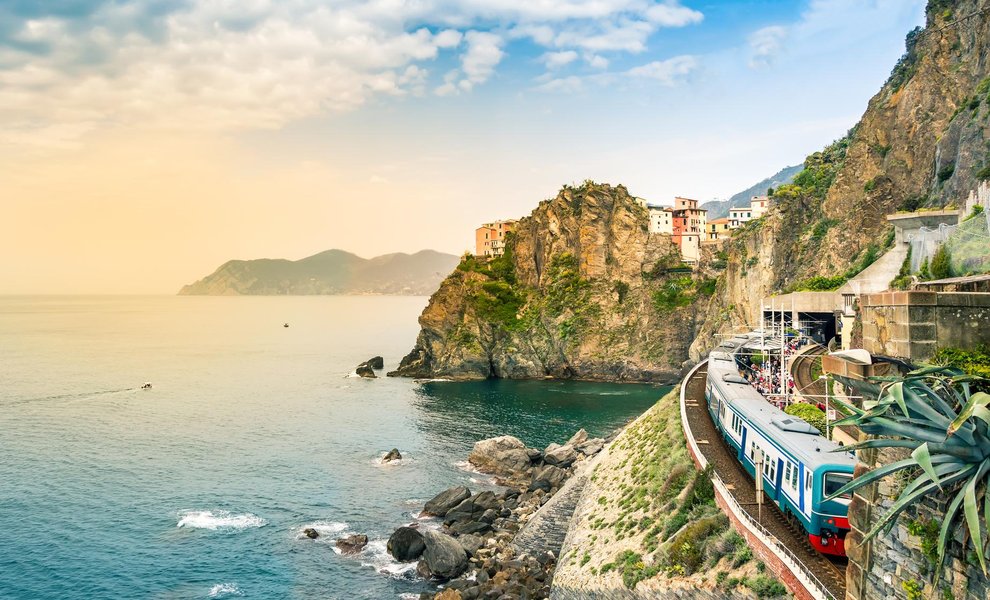
The Cinque Terre Express offers stunning coastal views between the villages.
Understanding the Cinque Terre Card
The Cinque Terre Card is an essential purchase for anyone planning to utilize the train extensively or hike the paid trails. There are two main types:
- Cinque Terre Trekking Card: This card grants access to the paid hiking trails within the national park and allows use of the local park buses.
- Cinque Terre Treno MS Card: This is the most comprehensive option. It includes unlimited train travel on the Levanto - Cinque Terre - La Spezia line (second class regional trains), access to all paid hiking trails (specifically the Monterosso-Vernazza and Vernazza-Corniglia segments, as other paths are generally free), and use of eco-buses within the park. It also provides Wi-Fi access at designated hotspots.
Prices for the Cinque Terre Treno MS Card vary by season (low, medium, or peak), ranging from approximately 14.80 euros for one day in the off-season to 32.50 euros for a multi-day pass in peak season. Children aged 4-11 receive a 50% discount. Purchasing this card often proves more cost-effective than buying individual train tickets, especially if you plan to make more than two or three train journeys or intend to hike the paid trails.
Tickets and cards can be purchased at any train station in Cinque Terre, Levanto, or La Spezia, at the National Park information points, or online via the Trenitalia website or app. Remember to validate paper tickets at the green stamping machines before boarding to avoid hefty fines; digital tickets are automatically validated.
Strategic Planning for Your Cinque Terre Train Journey
Choosing Your Base City
Many visitors opt to stay in one of the five Cinque Terre villages. However, due to limited accommodation and higher prices, especially during peak season, staying in the nearby gateway cities of La Spezia or Levanto is often a more practical choice. Both towns are well-connected by the Cinque Terre Express, offering easy access to the villages within minutes.
- La Spezia: A larger city with more diverse accommodation options, restaurants, and amenities. It serves as a major railway hub with direct connections to Rome, Florence, and Pisa. From La Spezia Centrale, you can hop on the Cinque Terre Express to Riomaggiore (the southernmost village) in about 8-10 minutes.
- Levanto: Located just north of Monterosso al Mare, Levanto is another excellent base. It's a charming town with a beach and offers a slightly less crowded experience than the Cinque Terre villages themselves, while still providing quick train access.
Navigating Train Stations and Timetables
Train stations in Cinque Terre are generally small and well-integrated into the villages. Corniglia's station, however, is located at the bottom of a steep climb, requiring a significant ascent (the Lardarina staircase, with over 300 steps) to reach the village center. An electric shuttle bus, covered by the Cinque Terre Card, provides a convenient alternative for this ascent.
While train schedules are frequent, especially during peak season (March 15 to November 2, 2025, for the Cinque Terre Express), it's always advisable to check the most up-to-date timetables on the Trenitalia website or app. Be aware that train platforms can get very crowded, particularly in summer, so allow extra time for boarding.

Train stations in Cinque Terre can be busy, especially during peak season.
Beyond the Rails: Complementary Modes of Transport
While the train is the backbone of Cinque Terre transportation, combining it with other modes enhances the experience and offers different perspectives of the stunning landscape.
Hiking the Scenic Trails
The network of hiking trails connecting the villages is a primary attraction of Cinque Terre. The most famous is the Sentiero Azzurro (Blue Path), which originally connected all five villages. However, some sections, notably the Via dell'Amore (between Riomaggiore and Manarola), are frequently closed for maintenance due to landslides. The sections between Monterosso, Vernazza, and Corniglia are typically open and require the Cinque Terre Card for access.
Hiking provides breathtaking panoramic views that are not accessible by train or ferry. Even if you plan to hike, the train is invaluable for quickly getting between villages to start or end a trail, or for skipping sections if you're short on time or energy.
This video provides a comprehensive guide to transportation in Cinque Terre, elaborating on how to utilize the train and other modes to explore the region effectively.
This YouTube video offers practical advice on navigating Cinque Terre, emphasizing the ease of train travel and providing insights into the best ways to get around. It's a valuable resource for first-time visitors, demonstrating how to make the most of the train system and offering tips for combining different transport options to experience the unique charm of each village.
Ferry Services for Coastal Views
Ferries operate daily from late March to early November, connecting Monterosso, Vernazza, Manarola, and Riomaggiore (Corniglia does not have a ferry dock due to its cliff-top location). While slower and more expensive than the train, the ferry offers spectacular views of the villages from the sea, showcasing their dramatic cliffside settings. Many visitors enjoy combining a train journey in one direction with a ferry trip in the other to fully appreciate the unique landscape.
Key Considerations for Train Travel
Crowds and Peak Season
Cinque Terre is an incredibly popular destination, especially during the summer months (June-August) and shoulder seasons (April-May, September-October). Trains can become very crowded, with standing room only. If traveling during these times, be prepared for queues at ticket offices and packed carriages. Traveling in the off-season (November to March) offers a quieter experience, though some services and trails might be limited or closed.
Safety and Etiquette
When using the trains, always stand behind the yellow line on the platforms and exercise caution, especially with children, as trains can pass through quickly. Validate paper tickets before boarding to avoid fines, as mentioned earlier.
Comparative Overview of Cinque Terre Transportation Options
Here's a table summarizing the pros and cons of different transportation methods in Cinque Terre:
| Mode of Transport | Pros | Cons | Best For |
|---|---|---|---|
| Train (Cinque Terre Express) | Fast, frequent, connects all villages, efficient, easy to use, ideal for multi-village visits. | Can be crowded in peak season, less scenic than hiking/ferry (from inside), sometimes short platform stops. | Rapid village hopping, day trips, maximizing time, avoiding car travel. |
| Hiking | Most scenic views, immersive experience, free (some trails require Cinque Terre Card), sense of accomplishment. | Requires physical fitness, trails can be challenging/closed, time-consuming, weather-dependent. | Experiencing natural beauty, active travelers, deep exploration of a few villages. |
| Ferry/Boat | Stunning sea views of the coastline and villages, unique perspective, relaxing. | Slower than train, more expensive than train (single tickets), does not stop at Corniglia, weather-dependent. | Panoramic photography, leisurely travel, seeing the full coastal profile. |
| Bus (Local) | Connects train stations to village centers (especially Corniglia), useful for reaching higher areas, included with Cinque Terre Card. | Limited routes, mainly for internal village movement, not for inter-village travel. | Accessing Corniglia village center from station, reaching sanctuaries above villages. |
| Car | Offers flexibility outside Cinque Terre region. | Highly discouraged within villages (narrow roads, no parking), expensive parking in gateway towns. | Driving to La Spezia/Levanto, then switching to train. Not for inter-village travel. |
Frequently Asked Questions
Is the train the only way to get around Cinque Terre?
Do I need to buy a special ticket for the Cinque Terre train?
How often do the trains run in Cinque Terre?
Can I use my regular Italian train ticket in Cinque Terre?
Are the trains crowded in Cinque Terre?
Conclusion
Taking the train in Cinque Terre is not just a good way to see the area; it is, without a doubt, the most practical, efficient, and recommended method for exploring the five iconic villages. Its speed and frequency allow visitors to maximize their time, effortlessly hopping from one charming town to the next. While hiking offers incredible views and the ferry provides a unique coastal perspective, the train serves as the essential backbone of transportation, enabling a comprehensive and enjoyable experience of this extraordinary Italian Riviera gem. For a seamless visit, investing in a Cinque Terre Treno MS Card is a smart decision, granting both unlimited train travel and access to the park's renowned hiking trails.
Recommended Further Exploration
- When is the best time to visit Cinque Terre to avoid the largest crowds?
- What are the difficulty levels and typical closures of Cinque Terre's hiking trails?
- What is the most efficient way to travel to Cinque Terre from Florence by train?
- What are the unique highlights and features of each of the five Cinque Terre villages?