
Unlocking the Code: Your Blueprint to Consistent Trading Profitability
Journey from sporadic wins to sustainable success by mastering strategy, risk, and mindset in the financial markets.
Achieving consistent profitability in trading is a formidable challenge, yet it is an attainable goal for those who approach the markets with a blend of strategic acumen, unwavering discipline, and a commitment to continuous self-improvement. While the allure of quick profits can be strong, sustainable success is built on a foundation of sound principles and meticulous execution. Estimates suggest that only a small percentage, around 10-15%, of traders achieve long-term consistent profitability, underscoring the importance of a dedicated and informed approach.
Essential Pillars for Trading Success: Highlights
- Strategic Foundation: Develop a clear, thoroughly backtested trading plan with unambiguous entry and exit rules, tailored to a trading style that aligns with your personality and time availability.
- Ironclad Risk Management: Prioritize the preservation of your trading capital by strictly adhering to rules such as risking only a small percentage (typically 1-2%) of your capital per trade and consistently utilizing stop-loss orders.
- Disciplined Execution & Mindset Mastery: Cultivate profound emotional control, patience, and an unwavering commitment to your trading plan, especially during inevitable periods of market volatility or drawdowns.
Crafting Your Winning Trading Blueprint
The very first step towards consistent profitability is the development of a comprehensive and personalized trading plan. This plan is not merely a set of loose guidelines but a detailed roadmap that dictates your actions in the market, effectively removing guesswork and emotional interference from your trading decisions. Treat your trading as a serious business venture, not a speculative gamble.

A well-organized trading environment can support a disciplined approach.
Defining Your Trading Style and Objectives
Before placing a single trade, you must define your trading style. Common styles include:
- Scalping: Making numerous small trades throughout the day to capture tiny price movements (e.g., 5-10 pips in Forex). This requires intense focus and fast execution.
- Day Trading: Opening and closing positions within the same trading day, avoiding overnight risk. This style suits traders who can dedicate several hours during market open.
- Swing Trading: Holding positions for several days to weeks to capture larger market swings or "swings" in price. This is suitable for those who cannot monitor markets intraday.
- Position Trading: Holding positions for weeks, months, or even years, focusing on long-term trends.
Your choice should align with your personality, risk tolerance, capital, and the amount of time you can dedicate to trading. Alongside your style, establish clear financial objectives and understand your risk tolerance. How much are you willing to lose on a single trade, or in a single day/week?
Strategy Selection and Backtesting
Once your style is defined, select a trading strategy with clear, objective rules for entry and exit. Popular strategies include trend following, momentum trading, range trading, or news-based trading. Crucially, any strategy must be rigorously backtested using historical data to verify its potential profitability and understand its characteristics (e.g., maximum drawdown, win rate). This historical analysis helps build confidence in the strategy's edge.
Specific Entry and Exit Rules
Your trading plan must detail the exact conditions that trigger an entry into a trade and the criteria for exiting – both for taking profits and cutting losses. These rules might be based on technical indicators (like moving averages, RSI, MACD), chart patterns, price action signals, or fundamental analysis. The key is that they are unambiguous and consistently applied.
The Indispensable Shield: Mastering Risk Management
Effective risk management is arguably the most critical factor distinguishing consistently profitable traders from the rest. Without it, even the best trading strategy can lead to ruin. The primary goal of risk management is capital preservation; you must protect your trading capital to stay in the game long enough for your edge to play out.
The 1-2% Rule
A cornerstone of risk management is limiting the capital risked on any single trade. Most professional traders advocate risking no more than 1% to 2% of their trading account balance on a single trade. For example, with a $10,000 account, a 1% risk means not losing more than $100 if that trade goes against you. This ensures that a series of losses won't cripple your account.
The Power of Stop-Loss Orders
A stop-loss order is an instruction placed with your broker to close out a trade at a predetermined price level if the market moves against your position. Always use stop-loss orders. They are your primary defense against significant losses and help remove emotion from the decision to cut a losing trade.
Favorable Risk-Reward Ratio
Consistently profitable traders aim for trades where the potential profit is significantly greater than the potential loss. A common target is a risk-reward ratio of 1:2 or higher, meaning for every $1 risked, you aim to make at least $2. This allows you to be profitable even if you win less than 50% of your trades. For instance, if you risk $100 per trade and aim for $200 profit, even with a 40% win rate over 10 trades (4 wins = +$800, 6 losses = -$600), you would still be profitable (+$200).
Prudent Position Sizing
Position sizing refers to determining the appropriate number of units (shares, lots, contracts) to trade based on your account size and the pre-defined risk per trade (e.g., the 1-2% rule). It's calculated by dividing the dollar amount you're willing to risk by the distance to your stop-loss in pips or points.
Comparative Risk Management Approaches
The table below illustrates different risk management profiles. Consistently profitable traders typically operate within conservative to moderate frameworks, avoiding aggressive approaches that can lead to rapid capital depletion.
| Feature | Conservative Approach | Moderate Approach | Aggressive Approach (High Risk) |
|---|---|---|---|
| Risk per Trade | 0.5% - 1% of capital | 1% - 2% of capital | Greater than 2% of capital |
| Stop-Loss Placement | Tighter, based on volatility | Standard, based on strategy rules | Wider, or sometimes absent |
| Target Risk-Reward Ratio | 1:2.5 or higher | 1:2 or higher | 1:1.5 or sometimes lower |
| Maximum Tolerable Account Drawdown | Typically under 10-15% | Typically under 20-25% | Can exceed 30-50%+ |
| Position Sizing Logic | Strict Fixed Fractional | Fixed Fractional | Often Variable, potential for Martingale-like tactics |
Note: Aggressive approaches are generally not recommended for sustainable, consistent profitability.
Conquering the Inner Game: The Psychology of Profitability
Trading is as much a psychological game as it is an analytical one. The ability to manage your emotions—particularly fear and greed—is crucial for consistent success. Many traders fail not because their strategies are flawed, but because their psychological state leads to poor decision-making.
Emotional Control: Taming Fear and Greed
Fear can cause you to exit winning trades too early or avoid taking valid setups after a loss. Greed can lead to overtrading, taking excessive risks, or holding onto winning trades for too long until they turn into losers. Developing emotional detachment from individual trade outcomes is key. Focus on the process and long-term probabilities, not the result of any single trade.
Patience and Discipline
Patience is required to wait for high-probability trade setups that align with your plan, rather than forcing trades out of boredom or a desire for action. Discipline is the unwavering commitment to follow your trading plan and risk management rules, even when it's uncomfortable or when faced with a string of losses. This is often cited as the most challenging aspect of trading.
Accepting Uncertainty and Losses
Losses are an unavoidable part of trading. No strategy is 100% accurate. The sooner you accept this and view losses as a business expense or the cost of finding winning opportunities, the better you'll be able to handle them emotionally. Don't let a loss lead to "revenge trading" or deviating from your plan.
Mindfulness and Self-Awareness
Practice mindfulness to stay present and objective during trading. Be aware of your emotional state and thought patterns. If you feel stressed, anxious, or overly euphoric, it might be best to step away from the markets temporarily to avoid making emotionally charged decisions.
The Cornerstone of Success: Discipline and Consistent Execution
Discipline is the bridge between your trading plan and actual profitability. It's about consistently doing what you know you should do, according to your plan, trade after trade, day after day.
Adherence to the Trading Plan
The most common pitfall for traders is deviating from their well-thought-out trading plan. This often happens after a few losses (leading to fear) or a few wins (leading to overconfidence). Discipline means sticking to your entry, exit, and risk management rules without exception.
Consistency in Application
Focus on trading the same markets, timeframes, and setups that your plan is designed for. Constantly switching between strategies, markets, or indicators prevents you from gaining true expertise and understanding the nuances of your chosen approach. Consistency in execution allows your statistical edge to manifest over time.
Establishing a Trading Routine
A structured daily routine can significantly enhance discipline. This might include:
- Pre-market analysis: Reviewing overnight news, economic calendars, and key chart levels.
- During market hours: Executing trades according to your plan, managing open positions.
- Post-market review: Journaling trades, analyzing performance, and preparing for the next day.
The radar chart above illustrates a conceptual comparison of key attributes between novice, developing, and consistently profitable traders. Profitable traders exhibit higher levels across all dimensions, particularly in risk management, discipline, and emotional control.
Evolving with the Markets: The Path of Continuous Learning
The financial markets are dynamic and ever-changing. Strategies that worked in the past may become less effective over time. Therefore, a commitment to continuous learning and adaptation is essential for long-term success.
Staying Informed and Educated
Keep abreast of market news, economic trends, and geopolitical events that can impact the assets you trade. Regularly read books, articles, and research papers on trading strategies, market psychology, and risk management. Consider joining trading communities or forums to exchange ideas (with caution).
Reviewing and Refining Strategies
Regularly review the performance of your trading strategies (insights from your trading journal are invaluable here). Are they still performing as expected? Do market conditions suggest a need for adjustment? This doesn't mean constantly changing your core strategy, but rather making data-driven refinements to improve its efficacy or adapt it to evolving market behavior.
Leveraging Technology and Tools
Utilize charting software, analytical tools, and trading platforms effectively. Many platforms offer features for backtesting, strategy optimization, and real-time alerts that can enhance your trading process. However, avoid "analysis paralysis" by overcomplicating your setup with too many indicators or tools.
Your Mirror to Mastery: The Power of a Trading Journal
A detailed trading journal is one of the most powerful tools for self-improvement and achieving consistency. It provides an objective record of your trading activities, allowing you to identify patterns, learn from mistakes, and reinforce good habits.
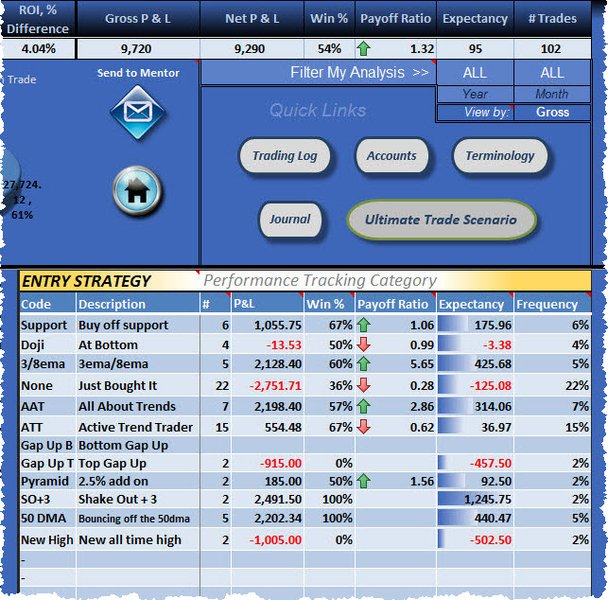
A trading journal helps track performance and identify areas for improvement.
What to Record
For each trade, your journal should include:
- Date and time of entry and exit
- Asset traded
- Setup or reason for the trade (according to your plan)
- Entry price, stop-loss level, take-profit target
- Position size
- Outcome (profit/loss)
- Screenshots of the chart at entry and exit (optional but helpful)
- Your emotional state and thoughts before, during, and after the trade
Analyzing Your Performance
Regularly (e.g., weekly or monthly) review your journal to analyze your performance. Look for:
- Winning and Losing Patterns: What types of setups are most profitable? What common mistakes lead to losses?
- Adherence to Plan: How often are you deviating from your rules?
- Emotional Impact: Are emotions influencing your decisions?
- Key Metrics: Track your win rate, average win size, average loss size, risk-reward ratio achieved, profit factor, and maximum drawdown.
Visualizing the Path: Interconnected Elements of Trading Success
The journey to becoming a consistently profitable trader involves mastering several interconnected disciplines. The mindmap below illustrates how these core components work together to form a robust framework for success. Each element supports and reinforces the others, creating a synergistic effect that elevates a trader's performance beyond the sum of individual skills.
This mindmap emphasizes that success isn't about finding a single "holy grail" but about building a holistic approach where strategy, risk control, mental fortitude, disciplined habits, ongoing education, and self-reflection through journaling work in concert.
Insights on Consistency from Trading Experts
Many experienced traders share their insights on achieving consistency. The video below discusses the importance of consistency and discipline as foundational elements for long-term success in the trading world. It delves into strategies and mindsets that help traders stay focused and navigate the complexities of the market to achieve lasting profitability.
This video, titled "Mastering Consistency: The Key to Long-Term Trading Success," reinforces many of the principles discussed, such as the critical role of a disciplined approach and a well-defined strategy. It highlights that consistency isn't just about winning trades but about consistently applying your methodology, managing risk, and learning from both wins and losses over an extended period. Such perspectives from seasoned market participants can provide valuable motivation and practical advice for aspiring traders.
Frequently Asked Questions (FAQ)
What is the single most crucial factor for achieving consistent trading profits?
While multiple factors are vital, unwavering discipline in executing a well-defined trading plan and strict risk management is paramount. Many traders possess potentially profitable strategies but fail due to a lack of consistent discipline in applying their rules or inadequate control over risk, especially during periods of emotional stress or market volatility.
How much of my capital should I realistically risk on a single trade?
Most experienced traders and financial educators recommend risking no more than 1% to 2% of your trading capital on any individual trade. This prudent approach helps protect your account from significant drawdowns, even if you experience a series of losing trades, allowing you to stay in the market long enough for your strategy's edge to materialize.
How long does it typically take to become a consistently profitable trader?
There is no fixed timeline, as the journey varies greatly among individuals. It depends on factors such as dedication, the quality of education, learning speed, prevailing market conditions, and, critically, the ability to master the psychological aspects of trading. For some, it might take several months of intense effort, but more commonly, it can take one to several years of diligent practice, learning from mistakes, and continuous refinement to achieve consistent profitability.
Is it possible to develop a trading strategy that never has losing trades?
No, it is unrealistic and virtually impossible to develop a trading strategy that is 100% accurate and never incurs losses. Losses are an inherent and unavoidable part of trading. The key to consistent profitability lies not in avoiding losses altogether, but in ensuring that your winning trades are, on average, larger or more frequent than your losing trades. This is achieved through a strategy with a positive expectancy, managed by a favorable risk-reward ratio and sound money management.
Recommended Further Exploration
To deepen your understanding, consider exploring these related queries:
- What are the most effective risk management techniques for beginner traders?
- How can I develop a strong trading psychology to avoid emotional decisions?
- Compare different day trading strategies for consistent daily profits.
- What are the best tools and software for backtesting trading strategies?
References
Last updated May 15, 2025