
Unlocking Project Success: A Deep Dive into the Construction Baseline Schedule Review Process
Discover how meticulous upfront planning and review of construction schedules can prevent delays, control costs, and ensure project triumph.
The Baseline Schedule Review is an indispensable business process within the construction industry. It involves a meticulous examination and validation of the initial project schedule, known as the baseline schedule, before project execution commences. This foundational document serves as the project's roadmap, detailing all activities, their durations, sequences, and resource allocations. A robust review ensures this roadmap is accurate, complete, logical, and compliant with all contractual and regulatory obligations, setting the stage for successful project delivery.
Key Highlights of the Baseline Schedule Review
- Foundation for Control: The approved baseline schedule becomes the fixed benchmark against which all project progress, deviations, and changes are measured, enabling effective project monitoring and control.
- Risk Mitigation Powerhouse: A thorough review proactively identifies potential inaccuracies, unrealistic timelines, logical flaws, and resource conflicts, minimizing the risk of costly delays and disputes down the line.
- Ensures Alignment and Compliance: The process validates that the schedule aligns with the entire project scope, contractual milestones, stakeholder expectations, and industry best practices, ensuring comprehensive compliance from the outset.
Understanding the Baseline Schedule
In the realm of construction, a baseline schedule is the original, formally approved project timeline. It encapsulates the defined scope, the logical sequence of all work activities, their estimated durations, and the planned allocation of resources (labor, materials, equipment). This schedule establishes a critical point of reference, enabling project managers and stakeholders to track actual performance, measure variances, and manage changes effectively throughout the project lifecycle. It is more than just a timetable; it's a contractual and management tool that underpins project control and communication.
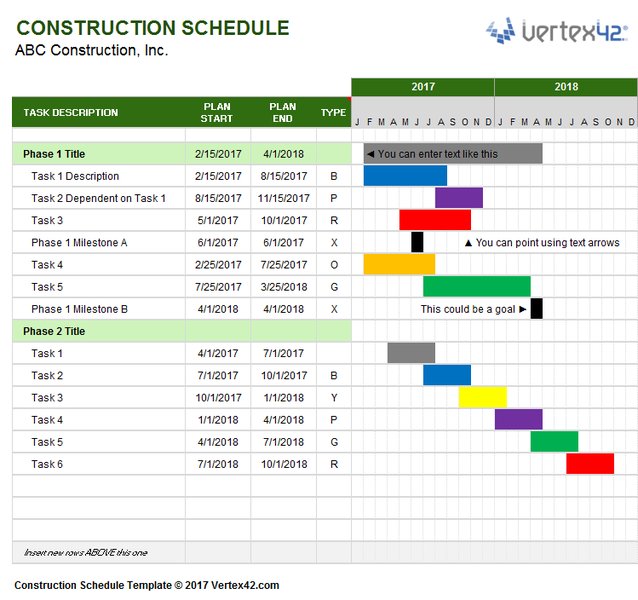
An illustrative example of a construction schedule, showcasing tasks, durations, and timelines.
The Crucial Purpose and Importance of the Review
The primary purpose of conducting a Baseline Schedule Review is to rigorously assess its quality, structural integrity, and overall health before it's set in stone. This meticulous examination serves several vital functions:
- Verification of Completeness and Accuracy: Ensures all project activities, including design, procurement, construction, commissioning, and necessary coordination/review activities by design professionals and owners, are comprehensively captured and accurately represented.
- Validation of Logic and Constructability: Verifies that the dependencies between activities are logical, reflect a feasible and constructible plan, and that the sequence of work is sound. Issues like circular logic (loops) or dangling activities (open ends) are identified.
- Assessment of Durations and Resource Allocation: Scrutinizes the realism of activity durations and ensures that resource plans (labor, equipment, materials) are achievable and adequately allocated, considering availability and lead times.
- Contractual and Regulatory Compliance: Confirms that the schedule aligns with all requirements, obligations, milestones, and deadlines stipulated in the contract documents and relevant regulations.
- Critical Path Identification and Analysis: Validates that the critical path (the sequence of activities determining the project's shortest possible duration) and near-critical paths are correctly identified and reflect true project constraints.
- Risk Identification and Mitigation: Helps detect potential schedule risks, such as unrealistic timelines, omissions, weather dependencies, or insufficient contingency, allowing for proactive mitigation strategies to be incorporated.
- Stakeholder Alignment: Facilitates communication and gathers feedback from all key stakeholders to ensure the schedule aligns with their expectations and the overarching project objectives.
A successfully reviewed and approved baseline schedule forms a robust foundation for project control systems, minimizing ambiguities and reducing the likelihood of disputes, rework, and costly delays during project execution.
Anatomy of the Baseline Schedule Review Process
The Baseline Schedule Review is a structured, often iterative, process. While specifics can vary by organization and project complexity, the typical steps are as follows:
1. Development and Submission of the Baseline Schedule
Contractor's Responsibility
The contractor typically develops the initial baseline schedule. This involves breaking down the project scope into detailed activities, defining logical relationships (dependencies) between them, estimating durations for each activity, and assigning necessary resources. Factors like working calendars (e.g., 5-day vs. 7-day weeks, holidays), potential weather impacts, and procurement lead times must be considered. The schedule is often created using specialized software like Primavera P6 or Microsoft Project and submitted to the owner or their representative (e.g., Construction Manager) within a contractually specified timeframe (e.g., 21-30 days after notice of award/proceed).
2. Initial Compliance and Completeness Check
First Pass Evaluation
Upon receipt, the reviewing party (owner/CM) performs an initial check. This involves verifying that the submission meets basic contractual requirements: format, level of detail, inclusion of key milestones, and adherence to specified scheduling parameters. They also check if the schedule appears to cover the entire project scope as defined in the contract documents.
3. Detailed Technical Review and Analysis
Deep Dive into Schedule Integrity
This is the core of the review process. It involves a thorough examination of several aspects:
- Schedule Logic and Network Analysis: Using Critical Path Method (CPM) principles, reviewers scrutinize activity relationships (finish-to-start, start-to-start, etc.), checking for logical soundness, absence of open ends (activities without predecessors or successors, except start/finish milestones), and avoidance of excessive lags or leads.
- Durations and Resource Reasonableness: Activity durations are assessed for realism based on industry norms, project complexity, and allocated resources. Resource loading is checked for potential overallocation or underutilization.
- Calendar Verification: Ensuring correct calendars are assigned to activities, reflecting planned working days, non-working days, holidays, and any specific shift patterns.
- Constraints Analysis: Reviewing the use of constraints (e.g., "Must Finish On," "Start No Earlier Than") to ensure they are justified and don't unduly distort the schedule logic or critical path. Excessive or unnecessary constraints are a red flag.
- Critical Path Review: Verifying the critical path(s) to ensure they genuinely reflect the driving sequence of work and are not artificially manipulated. Near-critical paths are also examined.
- Float Management: Assessing total float (slack) values. Excessively high float might indicate missing logic, while negative float signals an inability to meet deadlines with the current plan.
- Milestones and Deliverables: Validating the presence, timing, and logical sequencing of all key project milestones and deliverables as per contract.
4. Quality Assurance Checks and Benchmarking
Adherence to Standards
Many reviews incorporate standardized quality checks, such as the Defense Contract Management Agency (DCMA) 14-Point Schedule Assessment or similar industry guidelines (e.g., AACE International Recommended Practices). These provide objective metrics for schedule health concerning logic, durations, constraints, float, and critical path integrity.
The radar chart above illustrates a comparative focus on key quality aspects between an ideally prepared baseline schedule and a typical initial submission, highlighting areas often needing improvement through the review process. Scores are hypothetical, representing emphasis (out of 10).
5. Feedback, Revision, and Resubmission
Iterative Refinement
The reviewer documents all findings, comments, and required corrections. This feedback is formally communicated to the contractor. The contractor then revises the schedule to address these points and resubmits it. This cycle may repeat several times until the schedule is deemed acceptable by the reviewing party. Maintaining meticulous documentation and version control of all schedule submissions and reviews is critical.
6. Formal Approval and Baseline Establishment
Setting the Benchmark
Once the schedule meets all quality, completeness, and compliance requirements, it is formally approved. This approved version becomes the "Baseline Schedule." It is then locked or saved as a fixed reference against which future project progress will be tracked and performance measured. Any subsequent changes to this baseline must typically go through a formal change control process.
7. Post-Review Implementation and Monitoring
Ongoing Project Control
After approval, the baseline schedule serves as the static reference for ongoing project controls. It underpins progress updates, earned value management (EVM), delay analysis, and forecasting. It's not meant to be altered casually; changes require justification and formal approval to maintain its integrity as a performance measurement tool.
Mapping the Baseline Review Ecosystem
The Baseline Schedule Review process involves several interconnected components and stages, ensuring a comprehensive evaluation. The mindmap below provides a visual overview of this ecosystem, from initial inputs to final outputs and guiding principles.
This mindmap illustrates the interconnected elements of the Baseline Schedule Review process in construction.
Essential Tools and Guiding Principles
To ensure a thorough and consistent Baseline Schedule Review, project teams utilize various tools and adhere to established guidelines:
- Review Checklists: Comprehensive checklists are widely used to systematically cover all critical review elements. These checklists ensure that no key aspect is overlooked, covering areas like scope completeness, logical links, duration appropriateness, resource loading, constraints, calendars, and contractual milestones.
- Schedule Quality Analysis Methods: Industry best practices, such as the DCMA 14-Point Schedule Assessment, provide a standardized framework for evaluating schedule health and integrity. Other proprietary tools and methodologies also exist to benchmark schedule quality.
- Contractual Guidelines and Specifications: The project contract itself often dictates specific requirements for schedule development, submission, and review. Adherence to these, as well as owner or client-specific guidelines, is paramount.
- Project Control and Scheduling Software: Software like Oracle Primavera P6, Microsoft Project, Asta Powerproject, and specialized analysis tools (e.g., SmartPM) are instrumental. They help in developing, visualizing, analyzing, and communicating schedule data effectively, and many have built-in quality checking features.
- Industry Standards and Recommended Practices: Organizations like AACE International (Association for the Advancement of Cost Engineering) publish recommended practices and guidelines for schedule development and review, offering valuable insights into best practices for quality, completeness, and critical path analysis.
Expert Insights: Understanding Baseline Schedules in Construction
For a practical overview of what a baseline schedule entails in construction and key considerations during its review, the following video offers valuable insights. It covers the fundamental aspects of baseline schedules, how they are reviewed with the team, and critical items to watch out for, providing context to the detailed review process discussed.
This video discusses "What Is A Baseline Schedule In Construction?" and offers tips for reviewing it.
A Closer Look: Critical Review Items Summary
The table below summarizes some of the critical items examined during a Baseline Schedule Review and their significance in ensuring a robust and reliable project plan. A diligent review of these elements is key to identifying potential flaws before they impact project execution.
| Review Item | Description | Significance |
|---|---|---|
| Completeness of Scope | Ensuring all contractually required work activities, including deliverables, approvals, and milestones, are included. | Prevents scope gaps and ensures all work is planned and accounted for. |
| Logical Dependencies | Verifying that all activities (except project start/end) have appropriate predecessors and successors, and relationships (FS, SS, FF, SF) are correctly used. | Ensures a realistic and constructible sequence of work; incorrect logic distorts the critical path and schedule. |
| Critical Path Validity | Confirming the critical path is logical, continuous, and truly represents the longest path through the network. Checking for artificial manipulation. | The critical path drives project duration; an invalid critical path leads to inaccurate completion forecasts. |
| Activity Durations | Assessing if estimated durations are realistic, based on scope, resources, and productivity, and free from excessive padding or optimism. | Unrealistic durations lead to an unreliable schedule and potential delays. |
| Resource Allocation | Checking if resources (labor, equipment, materials) are assigned appropriately and if there's evidence of overallocation or underutilization. | Ensures resource availability aligns with the plan and prevents bottlenecks or idle resources. |
| Constraints Usage | Reviewing the application of date constraints (e.g., "Must Start On," "Finish No Later Than") to ensure they are justified and minimal. | Overuse of hard constraints can mask true critical path and reduce schedule flexibility. |
| Float Management | Analyzing total float values across activities. Identifying negative float, or excessively high float. | Negative float indicates the schedule already misses deadlines. High float may indicate missing logic. |
| Open Ends | Identifying activities lacking a predecessor (other than the initial activity) or a successor (other than the final activity). | Open ends break the network logic and can lead to an inaccurate critical path calculation. |
| Calendar Assignments | Verifying that appropriate work calendars (reflecting workdays, holidays, shifts) are assigned to activities and resources. | Incorrect calendars lead to inaccurate duration calculations and completion dates. |
| Inclusion of Key Milestones | Ensuring all contractual and key project milestones are present and logically tied into the schedule. | Milestones are crucial for tracking progress and contractual compliance. |
This table highlights key focus areas during the detailed technical review of a construction baseline schedule.
Frequently Asked Questions (FAQ)
What exactly is a "Baseline Schedule" in construction?
A baseline schedule is the original, approved project schedule that outlines all planned activities, their durations, sequences, resource allocations, and key milestones. It serves as a fixed reference point against which actual project progress is measured and controlled throughout the project's lifecycle. It is typically established at the beginning of a project after thorough review and agreement among stakeholders.
Who is primarily responsible for performing the Baseline Schedule Review?
While the contractor is responsible for developing and submitting the baseline schedule, the review is typically undertaken by the project owner, their designated representative (such as a Construction Manager or Project Manager), or a dedicated project controls team. The goal is to provide an objective assessment of the schedule's viability and compliance before it's formally adopted.
What happens if issues or discrepancies are found during the review?
If issues, inaccuracies, logical errors, or non-compliance items are identified, the reviewing party will provide formal feedback to the contractor. The contractor is then required to revise the schedule to address these comments and resubmit it for another review. This iterative process continues until the schedule is deemed acceptable and meets all requirements for approval.
Why is a rigorous Baseline Schedule Review so important for project success?
A rigorous review is crucial because it helps identify and rectify potential problems (like unrealistic timelines, missing scope, or flawed logic) *before* they can impact project execution. This proactive approach minimizes risks of delays, cost overruns, and disputes. It establishes a realistic and reliable plan, fostering better communication, resource management, and overall project control, ultimately contributing significantly to on-time and on-budget project delivery.
Can the baseline schedule be changed after it's approved?
Yes, but changes to an approved baseline schedule (a process known as "re-baselining") should not be taken lightly. They typically require a formal change control process. Re-baselining is usually considered only when there are significant, approved changes to the project scope, or if the project has deviated so substantially from the original plan that the current baseline is no longer a realistic tool for measuring performance. The original baseline is often preserved for historical comparison.
Recommended Further Exploration
- What are the common pitfalls to avoid during a baseline schedule review in construction projects?
- How does the DCMA 14-point assessment contribute to the quality of a baseline schedule review?
- Explain the role of critical path method (CPM) in developing and reviewing construction baseline schedules.
- What is the process for re-baselining a construction schedule and when is it necessary?
References
Last updated May 8, 2025