
Converting 30x104 to Standard Form
Master the essentials of scientific notation with a step-by-step guide
Key Takeaways
- Standard form requires the coefficient to be between 1 and 10.
- Adjusting the decimal point alters the exponent of 10 accordingly.
- Maintaining the original value is essential during conversion.
Understanding Scientific Notation
What is Scientific Notation?
Scientific notation, also known as standard form, is a method of expressing numbers that are too large or too small to be conveniently written in decimal form. It is commonly used in scientific and engineering disciplines to simplify calculations and improve readability. The general format of scientific notation is:
a × 10n, where:
- a is the coefficient, a number greater than or equal to 1 and less than 10.
- n is an integer representing the power of 10.
This format allows for the concise representation of very large or very small numbers by scaling the coefficient accordingly.
Importance of Standard Form
Using scientific notation offers several advantages:
- Clarity: It provides a clear and standardized way to present extremely large or small numbers.
- Efficiency: Simplifies multiplication and division of large numbers by using the properties of exponents.
- Precision: Allows for the expression of numbers with a high degree of precision without cumbersome zeros.
Step-by-Step Conversion
Identifying the Components
To convert the expression 30 × 104 into standard form, we need to ensure that the coefficient is between 1 and 10. Here's how to systematically achieve that:
Step 1: Assess the Coefficient
The given coefficient is 30, which is not within the required range of 1 to 10. To adjust this, we express 30 as:
30 = 3 × 101
Step 2: Rewrite the Expression
Substitute the adjusted coefficient back into the original expression:
30 × 104 = (3 × 101) × 104
Step 3: Combine the Powers of 10
Using the laws of exponents, combine the two powers of 10:
101 × 104 = 101 + 4 = 105
Step 4: Final Expression in Standard Form
Putting it all together, the expression simplifies to:
3 × 10⁵
This is the correct standard form of 30 × 104.
Detailed Explanation
Why the Coefficient Must Be Between 1 and 10
The coefficient in scientific notation is constrained to be between 1 and 10 to ensure a unique representation of numbers. This range simplifies comparison, calculation, and ensures consistency across scientific and mathematical communications.
Adjusting the Exponent When Changing the Coefficient
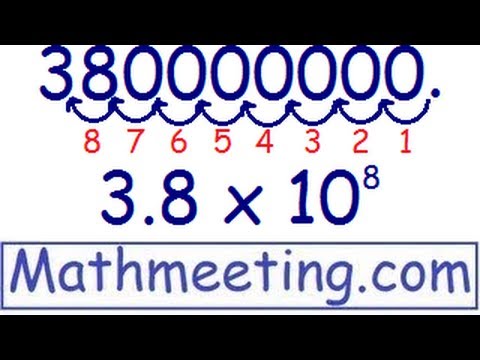
When the coefficient is adjusted by moving the decimal point, the exponent of 10 must be altered to maintain the original value of the expression. Specifically:
- If you move the decimal point to the left (decreasing the coefficient), the exponent increases.
- If you move the decimal point to the right (increasing the coefficient), the exponent decreases.
In our example, moving the decimal point in 30 one place to the left converts it to 3.0, which necessitates an increase in the exponent from 4 to 5 to preserve the overall value.
Ensuring Numerical Consistency
It's crucial that the conversion process does not alter the numerical value of the original expression. The manipulation of the coefficient and exponent must be done in tandem to ensure that the product remains unchanged.
Practical Applications
Engineering and Scientific Calculations
In fields like engineering, physics, and chemistry, scientific notation is indispensable. It allows professionals to handle extremely large or small quantities, such as distances in astronomy or the sizes of molecules, with ease and precision.
Data Representation in Computing
Computers and digital systems often use scientific notation to represent floating-point numbers, enabling efficient storage and computation of a wide range of values.
Financial Modeling
In finance, large sums of money and interest rates can be more manageably represented using scientific notation, simplifying complex financial models and analyses.
Common Mistakes to Avoid
Incorrect Placement of the Decimal Point
A frequent error is misplacing the decimal point, which can lead to an incorrect exponent. Always ensure that the coefficient is adjusted to fall within the 1 to 10 range before finalizing the exponent.
Ignoring the Adjustment of the Exponent
Another common mistake is altering the coefficient without adjusting the exponent accordingly, which disrupts the balance of the original value.
Overlooking Negative Exponents
When dealing with very small numbers, it's essential to correctly apply negative exponents to maintain the value's integrity in scientific notation.
Examples and Practice Problems
Example 1: Converting 45 × 103 to Standard Form
Following the same steps:
- Adjust the coefficient: 45 = 4.5 × 101
- Rewrite the expression: (4.5 × 101) × 103
- Combine exponents: 101 + 3 = 104
- Final standard form: 4.5 × 10⁴
Example 2: Converting 7.8 × 10⁶ to Standard Form
Since the coefficient is already between 1 and 10, the expression is already in standard form:
7.8 × 10⁶
Practice Problem: Convert 120 × 102 to Standard Form
Solution:
- Adjust the coefficient: 120 = 1.2 × 10²
- Rewrite the expression: (1.2 × 102) × 102
- Combine exponents: 102 + 2 = 104
- Final standard form: 1.2 × 10⁴
Conversion Summary Table
| Original Expression | Adjusted Coefficient | New Exponent | Standard Form |
|---|---|---|---|
| 30 × 104 | 3.0 × 101 | 5 | 3.0 × 10⁵ |
| 45 × 103 | 4.5 × 101 | 4 | 4.5 × 10⁴ |
| 120 × 102 | 1.2 × 10² | 4 | 1.2 × 10⁴ |
Advanced Considerations
Handling Negative Exponents
When dealing with very small numbers, negative exponents are used to represent fractions. For example:
0.003 × 10²
To convert this to standard form:
- Express 0.003 as 3.0 × 10⁻³
- Rewrite: (3.0 × 10-3) × 102
- Combine exponents: 10-3 + 2 = 10-1
- Final standard form: 3.0 × 10⁻¹
Non-Integer Exponents
While standard scientific notation typically uses integer exponents, in certain advanced mathematical contexts, non-integer exponents may be used. However, the core principle of maintaining the coefficient between 1 and 10 remains unchanged.
Applications in Logarithms
Scientific notation seamlessly integrates with logarithmic scales, which are foundational in disciplines like acoustics, seismology, and information theory. Understanding scientific notation is crucial for interpreting and manipulating logarithmic data effectively.
Interactive Tools and Resources
Online Calculators
Several online calculators can assist with converting numbers to standard form:
- Tiger Algebra Scientific Notation Converter
- GigaCalculator Standard Form Calculator
- InchCalculator Standard Form Tool
Educational Websites
For in-depth tutorials and practice exercises, consider visiting educational platforms:
Mathematical Software
Software like Mathematica and MATLAB offer built-in functions for handling scientific notation, enabling complex computations and data analysis.
Frequently Asked Questions
Can I use a coefficient greater than 10 in standard form?
No, standard scientific notation requires the coefficient to be between 1 and 10. Using a coefficient outside this range violates the format and can lead to inconsistencies in calculations and communications.
How do I convert a number already in standard form back to its original form?
To convert a number from standard form to its original form, multiply the coefficient by 10 raised to the given exponent. For example, 3 × 10⁵ equals 300,000.
Is scientific notation the same as standard form?
Yes, scientific notation and standard form refer to the same method of expressing numbers using a coefficient and a power of 10.
Conclusion
Converting expressions like 30 × 104 into standard form is a fundamental skill in mathematics and the sciences. By ensuring that the coefficient is within the range of 1 to 10 and appropriately adjusting the exponent, one can convey large or small numbers succinctly and accurately. Mastery of this conversion process facilitates clearer communication, more efficient calculations, and a deeper understanding of numerical relationships in various scientific contexts.
References
Last updated February 13, 2025