
Mastering Scientific Notation and Standard Form
Comprehensive Guide to Understanding, Calculating, and Interpreting Scientific Notation
Key Takeaways
- Scientific notation simplifies the representation of extremely large and small numbers by expressing them as a product of a coefficient and a power of ten.
- Positive exponents in scientific notation indicate very large numbers, while negative exponents signify very small numbers.
- Proficiency in converting between standard form and scientific notation, as well as performing arithmetic operations, is essential for accurate mathematical computations.
Introduction to Scientific Notation
What is Scientific Notation?
Scientific notation, also known as standard form, is a method of expressing numbers that are either extremely large or extremely small in a concise and manageable format. This notation is particularly useful in fields such as science, engineering, and mathematics, where dealing with vast ranges of quantities is common.
The Structure of Scientific Notation
In scientific notation, a number is expressed as the product of two components:
- Coefficient (a): A decimal number between 1 and 10.
- Power of Ten (10^n): An exponent indicating the scale of the number.
The general form is:
a × 10n
Where:
- a is the coefficient, and it must satisfy 1 ≤ |a| < 10.
- n is the exponent, an integer that can be positive, negative, or zero.
Converting Between Standard Form and Scientific Notation
Converting Large Numbers to Scientific Notation
To convert a large number to scientific notation:
- Identify the decimal point in the standard form. For whole numbers, it is assumed to be at the end.
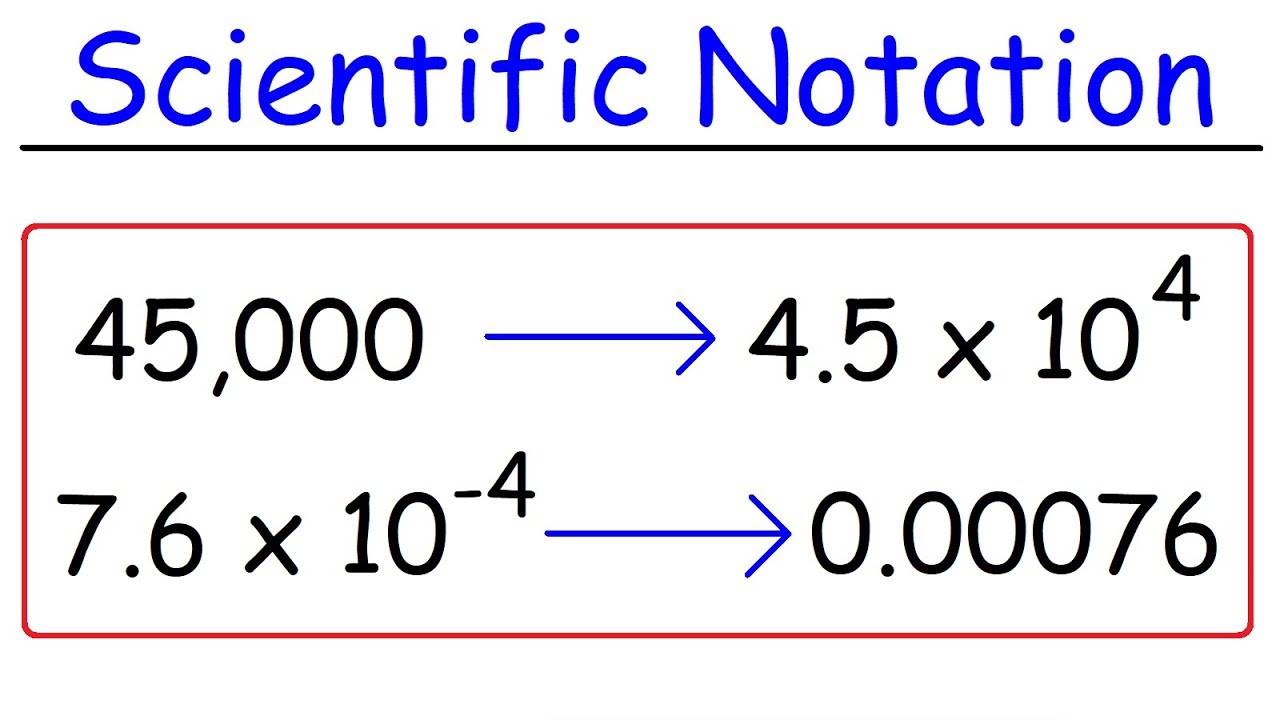
- Move the decimal point to the left until you have a number between 1 and 10. The number of places moved becomes the exponent (n).
- Express the number as a × 10n.
Example: Convert 450,000 to scientific notation.
- Standard form: 450,000.
- Move the decimal 5 places to the left: 4.5.
- Express as 4.5 × 10⁵.
Converting Small Numbers to Scientific Notation
To convert a small number to scientific notation:
- Identify the decimal point in the standard form.
- Move the decimal point to the right until you have a number between 1 and 10. The number of places moved becomes the negative exponent (-n).
- Express the number as a × 10-n.
Example: Convert 0.00072 to scientific notation.
- Standard form: 0.00072.
- Move the decimal 4 places to the right: 7.2.
- Express as 7.2 × 10⁻⁴.
Converting Scientific Notation to Standard Form
To convert scientific notation back to standard form:
- Identify the coefficient (a) and the exponent (n) in the expression a × 10n.
- If the exponent is positive, move the decimal point in the coefficient to the right by n places.
- If the exponent is negative, move the decimal point in the coefficient to the left by |n| places.
- Express the resulting number in standard form.
Example: Convert 3.2 × 10⁻³ to standard form.
- Coefficient: 3.2, Exponent: -3.
- Move the decimal 3 places to the left: 0.0032.
- Standard form: 0.0032.
Arithmetic Operations with Scientific Notation
Multiplication
When multiplying two numbers in scientific notation:
- Multiply the coefficients (a × c).
- Add the exponents (n + m).
- Express the result in scientific notation, ensuring the coefficient is between 1 and 10.
Example: Multiply (2 × 103) by (3 × 104).
- Multiply coefficients: 2 × 3 = 6.
- Add exponents: 3 + 4 = 7.
- Result: 6 × 10⁷.
Division
When dividing two numbers in scientific notation:
- Divide the coefficients (a ÷ c).
- Subtract the exponents (n - m).
- Express the result in scientific notation, ensuring the coefficient is between 1 and 10.
Example: Divide (6 × 105) by (2 × 102).
- Divide coefficients: 6 ÷ 2 = 3.
- Subtract exponents: 5 - 2 = 3.
- Result: 3 × 10³.
Addition and Subtraction
For addition and subtraction, the exponents must be the same:
- Adjust the coefficients so that both numbers have the same exponent.
- Perform the desired operation on the coefficients.
- Express the result in scientific notation.
Example: Add 3.0 × 10⁴ and 2.0 × 10³.
- Adjust 2.0 × 10³ to 0.2 × 10⁴.
- Add coefficients: 3.0 + 0.2 = 3.2.
- Result: 3.2 × 10⁴.
Interpreting the Size of Numbers
Understanding Positive Exponents
Positive exponents in scientific notation indicate that the number is very large. The exponent signifies how many times the coefficient is multiplied by ten.
- Example: 2.5 × 10⁶ equals 2,500,000.
- The higher the positive exponent, the larger the number.
Understanding Negative Exponents
Negative exponents denote that the number is very small. The exponent tells how many times the coefficient is divided by ten.
- Example: 4.5 × 10⁻³ equals 0.0045.
- The more negative the exponent, the smaller the number.
Comparing Number Sizes Using Exponents
The absolute value of the exponent determines the magnitude of the number:
- Larger absolute exponents (whether positive or negative) indicate more extreme sizes.
- For example, 1.0 × 10⁸ is larger than 1.0 × 10⁵, and 1.0 × 10⁻⁸ is smaller than 1.0 × 10⁻⁵.
Practical Applications of Scientific Notation
Real-World Examples
Scientific notation is widely used to simplify the representation and calculation of numbers in various scientific disciplines:
- Astrophysics: The distance from the Earth to the Sun is approximately 1.496 × 10¹¹ meters.
- Particle Physics: The charge of an electron is roughly -1.602 × 10⁻¹⁹ coulombs.
- Chemistry: Avogadro's number, the number of constituent particles in one mole of a substance, is 6.022 × 10²³.
- Environmental Science: The concentration of pollutants is often measured in parts per billion (e.g., 3.5 × 10⁻⁹).
Benefits of Using Scientific Notation
- Clarity: Simplifies the expression of very large or small numbers, making them easier to read and interpret.
- Efficiency: Facilitates easier and more accurate calculations, especially when dealing with exponents.
- Standardization: Provides a uniform way to represent numbers across different disciplines and contexts.
Comprehensive Table of Scientific Notation Rules
| Operation | Rule | Example |
|---|---|---|
| Multiplication | Multiply coefficients and add exponents. | (2 × 103) × (3 × 104) = 6 × 10⁷ |
| Division | Divide coefficients and subtract exponents. | (6 × 10⁵) ÷ (2 × 10²) = 3 × 10³ |
| Addition | Ensure same exponents, then add coefficients. | 3.0 × 10⁴ + 2.0 × 103 = 3.2 × 10⁴ |
| Subtraction | Ensure same exponents, then subtract coefficients. | 5.0 × 10⁶ - 2.0 × 105 = 4.8 × 10⁶ |
| Conversion to Standard Form | Move decimal based on exponent's sign. | 4.5 × 10-3 = 0.0045 |
| Conversion from Standard Form | Move decimal to create a coefficient between 1 and 10. | 0.00072 = 7.2 × 10⁻⁴ |
Success Criteria and Required Tasks
Success Criteria
- Accurate Conversion: Successfully convert numbers between standard form and scientific notation.
- Arithmetic Proficiency: Correctly perform multiplication, division, addition, and subtraction using scientific notation.
- Size Interpretation: Accurately determine whether a number is very large or very small based on its exponent.
- Exponent Understanding: Recognize when exponents are positive or negative and what they signify about the number's magnitude.
Required Tasks
- Conversion Exercises:
- Convert 9200000 to scientific notation.
- Convert 0.00045 to scientific notation.
- Convert 5.67 × 10³ to standard form.
- Convert 8.9 × 10⁻² to standard form.
- Arithmetic Operations:
- Multiply: (4.0 × 102) × (3.0 × 103).
- Divide: (9.0 × 10⁻⁴) ÷ (3.0 × 10²).
- Interpretation Exercises:
-
Determine if 3.4 × 10⁸ is very large or very small, and explain your reasoning.
-
Determine if 6.2 × 10⁻⁵ is very large or very small, and explain your reasoning.
-
Conclusion
Mastering scientific notation and standard form is crucial for efficiently handling and interpreting extremely large and small numbers. By understanding how to convert between forms, perform arithmetic operations, and interpret the magnitude of numbers based on their exponents, one can navigate complex mathematical and scientific challenges with confidence.
References
Last updated February 13, 2025