
Converting Scientific Notation to Standard Form
A Comprehensive Guide to Understanding and Performing Conversions
Key Takeaways
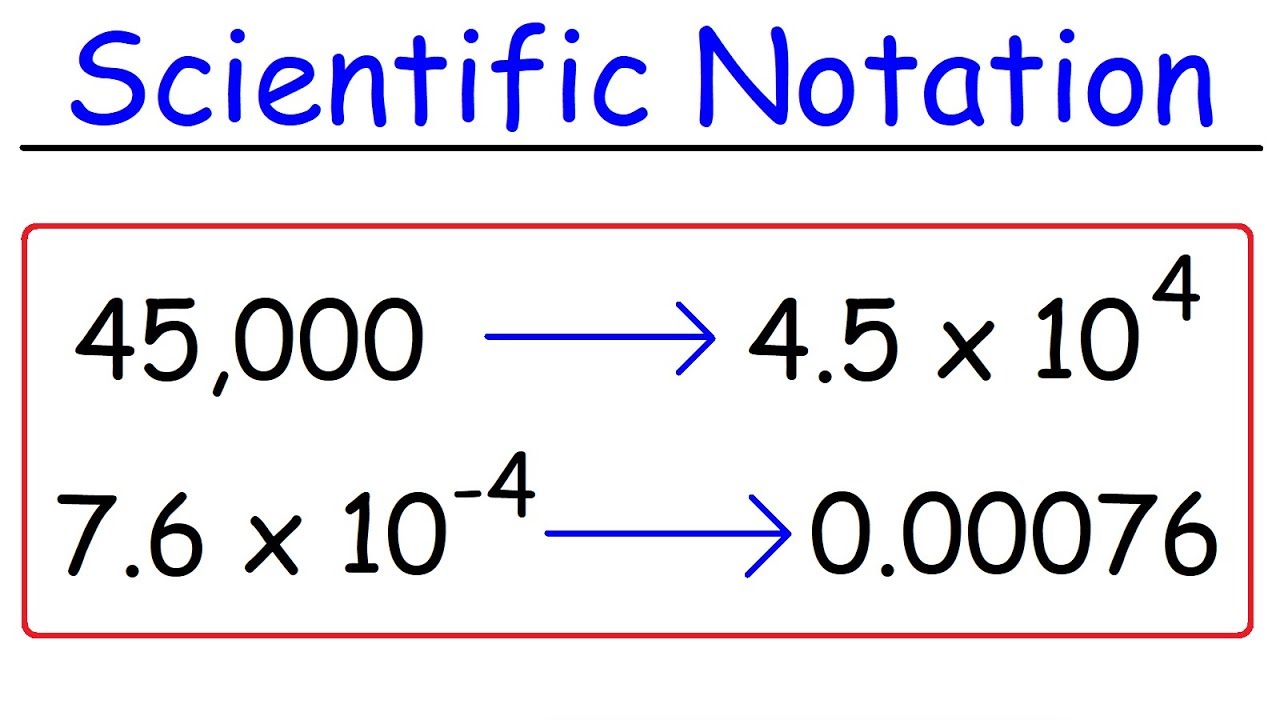
- Understanding Exponents: The exponent in scientific notation dictates the movement of the decimal point to convert to standard form.
- Positive vs. Negative Exponents: Positive exponents move the decimal to the right, while negative exponents move it to the left.
- Step-by-Step Conversion: Following a systematic approach ensures accurate and efficient conversion from scientific to standard form.
Introduction to Scientific Notation
Scientific notation, also known as standard form, is a method of expressing numbers that are too large or too small to be conveniently written in decimal form. It is commonly used in scientific, engineering, and mathematical fields to simplify calculations and clearly present data. The general format of scientific notation is:
a × 10n
Where:
- a is a number greater than or equal to 1 but less than 10.
- n is an integer representing the exponent of 10.
Understanding Exponents in Scientific Notation
Positive Exponents
A positive exponent indicates that the decimal point in the number a should be moved to the right. This results in a larger number. For example:
- 3 × 102 = 300
- 5.4 × 103 = 5,400
Negative Exponents
A negative exponent signals that the decimal point in the number a should be moved to the left, resulting in a smaller number. This is particularly useful for expressing very small quantities. For example:
- 3 × 10-2 = 0.03
- 5.4 × 10-3 = 0.0054
Step-by-Step Conversion Process
Identifying the Components
To convert a number from scientific notation to standard form, first identify the base number (a) and the exponent (n). For instance, in the number 3 × 10⁻³, a is 3, and n is -3.
Determining the Direction of Decimal Movement
If the exponent is positive, move the decimal point in a to the right by n places. If the exponent is negative, move the decimal point to the left by n places.
Executing the Movement
After determining the direction, perform the actual movement of the decimal point. If the number has fewer digits than the number of places to move the decimal, add zeros accordingly.
Finalizing the Standard Form
The number obtained after moving the decimal point is the standard form of the original scientific notation.
Practical Examples
Example a) 3 × 10⁻³
Step 1: Identify the Components
a = 3; n = -3
Step 2: Determine the Direction
Since n is negative, move the decimal point to the left.
Step 3: Move the Decimal Point
Starting with 3.0, move the decimal point 3 places to the left: 0.003
Result
3 × 10-3 = 0.003
Example b) 7 × 10⁻³
Step 1: Identify the Components
a = 7; n = -3
Step 2: Determine the Direction
Since n is negative, move the decimal point to the left.
Step 3: Move the Decimal Point
Starting with 7.0, move the decimal point 3 places to the left: 0.007
Result
7 × 10-3 = 0.007
Example c) 5.4 × 10⁻¹
Step 1: Identify the Components
a = 5.4; n = -1
Step 2: Determine the Direction
Since n is negative, move the decimal point to the left.
Step 3: Move the Decimal Point
Starting with 5.4, move the decimal point 1 place to the left: 0.54
Result
5.4 × 10-1 = 0.54
Comprehensive Conversion Table
| Scientific Notation | Standard Form | Steps |
|---|---|---|
| 3 × 10⁻³ | 0.003 | Move decimal 3 places left |
| 7 × 10⁻³ | 0.007 | Move decimal 3 places left |
| 5.4 × 10⁻¹ | 0.54 | Move decimal 1 place left |
Applications of Scientific Notation
Scientific Research
In disciplines such as physics and chemistry, scientific notation is indispensable for representing extremely large values like the speed of light or minute quantities like atomic sizes.
Engineering
Engineers utilize scientific notation to manage measurements that span vast ranges, ensuring precision and clarity in design specifications and calculations.
Astronomy
Astronomical distances and luminosities are often expressed in scientific notation to handle the immense scales involved, facilitating easier computation and comparison.
Finance
In financial models and analyses, scientific notation helps in expressing large sums and interest rates succinctly, improving readability and accuracy.
Common Mistakes and Tips for Accurate Conversion
Incorrect Decimal Movement
One of the most frequent errors is miscounting the number of places to move the decimal point as dictated by the exponent. Always double-check the exponent's value before proceeding.
Misinterpreting Exponents
Confusing positive and negative exponents leads to incorrect standard forms. Remember:
-
Positive exponent: Move decimal to the right.
-
Negative exponent: Move decimal to the left.
Handling Multi-Digit Movement
When the exponent requires moving the decimal multiple places, ensure that zeros are added if necessary to maintain the correct decimal placement.
Verification
After conversion, it's beneficial to verify the result by expressing the standard form back into scientific notation to ensure consistency and accuracy.
Advanced Considerations
Normalization
Normalization is the process of adjusting the base number a so that it lies within the range of 1 to 10. This ensures a unique representation of every number in scientific notation.
Precision and Significant Figures
When converting, it's crucial to maintain the number of significant figures to preserve the precision of the original number. Rounding may be necessary based on the context of the problem.
Use in Calculations
Scientific notation simplifies multiplication and division of large or small numbers by allowing for the easy handling of exponents, thereby streamlining complex calculations.
Conclusion
Converting numbers from scientific notation to standard form is a fundamental skill in various scientific and mathematical disciplines. By understanding the role of exponents and following a systematic approach, one can accurately perform these conversions. The ability to seamlessly switch between scientific and standard forms enhances numerical comprehension and facilitates complex calculations across multiple fields.
References
Last updated February 13, 2025