
Engineering Materials: Unveiling the Building Blocks of Innovation
A comprehensive exploration of the diverse substances that shape our modern world, from towering skyscrapers to microscopic electronics.
Highlights: Key Insights into Engineering Materials
- Fundamental Role: Engineering materials are selected for their ability to withstand applied loads and environmental conditions, ensuring the safety, durability, and functionality of products and structures.
- Diverse Classifications: The primary categories include metals and alloys, polymers, ceramics, and composites, each offering unique sets of properties suitable for specific applications. Advanced materials like semiconductors and biomaterials are also crucial.
- Property-Driven Selection: The choice of material hinges on a careful balance of mechanical, thermal, electrical, and chemical properties, alongside considerations of cost, manufacturability, and environmental impact.
What Exactly Are Engineering Materials?
Engineering materials are the foundational substances utilized in the design, construction, and manufacturing of virtually all man-made structures, components, and products. Their primary purpose is to reliably perform under specified service conditions, which often involves withstanding mechanical loads (like tension, compression, or impact) without failing through fracture or excessive deformation. They form the bridge between scientific principles and tangible technological advancements, enabling everything from complex machinery to everyday consumer goods. The selection of an appropriate engineering material is a critical decision in the design process, directly influencing a product's performance, lifespan, cost, and even its environmental footprint.

A diverse array of construction materials, showcasing the variety used in civil engineering projects.
Major Classifications of Engineering Materials
Engineering materials are broadly categorized based on their atomic structure, chemical composition, and resultant properties. Understanding these classifications is essential for engineers to make informed choices.
Metals and Alloys
Metals are perhaps the most widely recognized class of engineering materials, prized for their strength, ductility, toughness, and excellent conductivity of heat and electricity. They are often used in alloy form—a mixture of a metal with other metals or non-metallic elements—to enhance specific properties like hardness, corrosion resistance, or strength at high temperatures.
Ferrous Metals
Ferrous metals are those that contain iron as their primary constituent. The most common examples are steel (an alloy of iron and carbon) and cast iron. Steel is exceptionally versatile, used in applications ranging from building frameworks and automotive bodies to cutlery and reinforcement bars. Its properties can be finely tuned through alloying and heat treatment.
Non-Ferrous Metals
Non-ferrous metals do not contain significant amounts of iron. Key examples include aluminum (lightweight, corrosion-resistant), copper (excellent electrical conductivity, good corrosion resistance), titanium (high strength-to-weight ratio, excellent corrosion resistance), and nickel alloys (e.g., Inconel, known for high-temperature strength and corrosion resistance). These materials are vital in aerospace, electrical, and chemical processing industries.
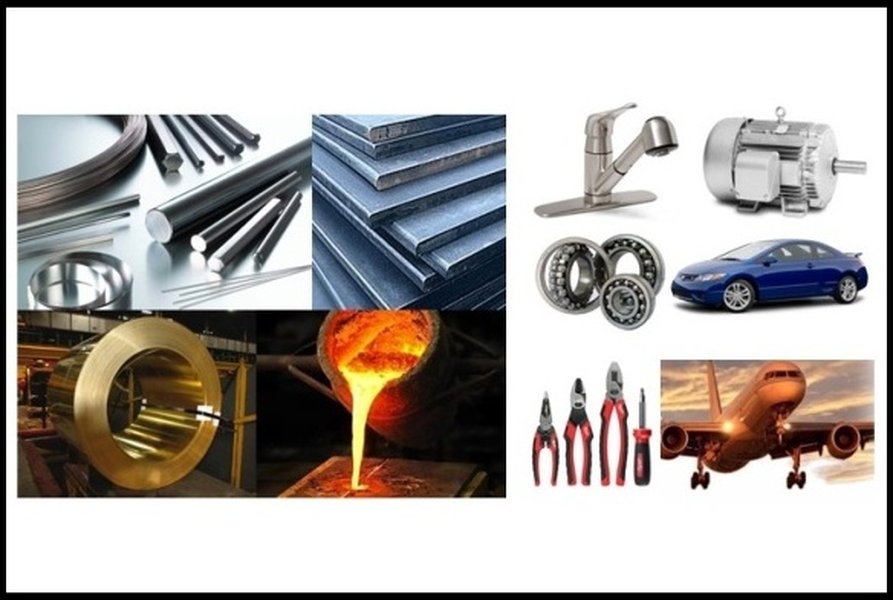
An assortment of metal products, highlighting the diverse applications and forms of engineered metals.
Polymers (Plastics and Elastomers)
Polymers consist of long chains of repeating molecular units called monomers. This category includes a vast array of synthetic and natural materials. They are generally lightweight, corrosion-resistant, and good electrical and thermal insulators. Their properties can vary widely, from rigid and strong to flexible and elastic.
Thermoplastics
Thermoplastics can be repeatedly softened by heating and hardened by cooling, allowing them to be easily molded and reshaped. Common examples include polyethylene (PE, used in packaging), polypropylene (PP, used in containers and fibers), polyvinyl chloride (PVC, used in pipes and window frames), and nylon (used in fibers and engineering components).
Thermosets
Thermosetting polymers, or thermosets, undergo a chemical change when heated, forming a rigid, cross-linked structure that cannot be remelted or reshaped. They generally offer higher strength and thermal stability than thermoplastics. Examples include epoxy resins (adhesives, coatings, composites), phenolic resins (Bakelite, electrical components), and polyurethanes (foams, elastomers).
Elastomers (Rubbers)
Elastomers are polymers that exhibit significant elastic deformation, meaning they can be stretched to large extents and return to their original shape upon removal of the stress. Natural rubber and synthetic rubbers like neoprene and silicone are common examples, used in tires, seals, and shock absorbers.
Ceramics and Glasses
Ceramics are inorganic, non-metallic materials typically formed by the application of heat. They are known for their high hardness, compressive strength, excellent wear resistance, and stability at high temperatures and in corrosive environments. However, they are often brittle and have low tensile strength and fracture toughness. Examples include alumina (aluminum oxide, used in abrasives and insulators), silicon carbide (abrasives, high-temperature components), and zirconia (cutting tools, dental implants). Glasses are amorphous (non-crystalline) ceramics, valued for transparency and chemical inertness.
Composites
Composite materials are engineered by combining two or more distinct constituent materials—often a reinforcing phase (like fibers) embedded within a matrix phase (like a polymer, metal, or ceramic). The goal is to create a new material with synergistic properties that are superior to those of the individual components. For example, fiber-reinforced polymers (e.g., carbon fiber in epoxy, or glass fibers in polyester) offer high strength-to-weight ratios and excellent fatigue resistance, making them ideal for aerospace, automotive, and sporting goods applications. Other composites include metal matrix composites (MMCs) and ceramic matrix composites (CMCs).
Other Important Material Categories
Semiconductors
Semiconductors possess electrical conductivity between that of a conductor (like metals) and an insulator (like ceramics or polymers). Silicon and germanium are prime examples. Their unique ability to control electrical current flow makes them the cornerstone of the electronics industry, crucial for transistors, integrated circuits, and microprocessors.
Biomaterials
Biomaterials are specifically designed to interact with biological systems for medical purposes. They can be metals (e.g., titanium for joint replacements), polymers (e.g., PLLA for biodegradable sutures), ceramics (e.g., hydroxyapatite for bone grafts), or composites. Biocompatibility is a key requirement, meaning they should not cause adverse reactions in the body.
Visualizing Material Properties: A Comparative Radar Chart
The selection of an engineering material is often a trade-off between various desirable properties. The radar chart below offers a visual comparison of key characteristics across the major material classes: Metals, Polymers, Ceramics, and Composites. The values are generalized and represent typical behavior, with higher values indicating greater prominence of that property (Note: For 'Cost', a higher value implies lower cost, i.e., more economical). This helps illustrate why certain materials are chosen for specific applications.
Key Properties Defining Engineering Materials
The utility of an engineering material is defined by its inherent properties. Engineers must thoroughly understand these properties to select the most suitable material for a given application. These properties are broadly grouped as mechanical, thermal, electrical, and chemical.
Mechanical Properties
Mechanical properties describe how a material responds to applied forces or loads. They are critical for structural applications.
- Strength (Yield and Tensile): Yield strength is the stress at which a material begins to deform plastically (permanently). Tensile strength (or ultimate tensile strength) is the maximum stress a material can withstand while being stretched or pulled before necking, which is when the specimen's cross-section starts to significantly contract.
- Hardness: Resistance to localized plastic deformation, such as scratching, abrasion, or indentation.
- Ductility and Malleability: Ductility is a material's ability to deform under tensile stress (e.g., be drawn into a wire). Malleability is its ability to deform under compressive stress (e.g., be hammered or rolled into thin sheets).
- Toughness: The ability of a material to absorb energy and plastically deform before fracturing. It indicates resistance to fracture when a crack (or other stress concentrator) is present.
- Elasticity: The ability of a material to return to its original shape and size after the removal of an applied load. The stiffness or rigidity of a material is described by its elastic modulus (Young's modulus).
- Plasticity: The property of a material to undergo permanent deformation without rupture when subjected to stresses exceeding the yield limit.
- Fatigue Resistance: The ability of a material to withstand cyclic or fluctuating loads without failing.
- Creep Resistance: The tendency of a solid material to move slowly or deform permanently under the influence of persistent mechanical stresses, especially at elevated temperatures.
Thermal Properties
Thermal properties describe how a material responds to heat.
- Thermal Conductivity: The ability of a material to conduct heat. Metals are generally good thermal conductors, while polymers and ceramics are often insulators.
- Thermal Expansion: The tendency of matter to change its shape, area, and volume in response to a change in temperature.
- Specific Heat Capacity: The amount of heat required to raise the temperature of a unit mass of a substance by one degree.
- Melting/Softening Point: The temperature at which a material transitions from a solid to a liquid state (for crystalline materials) or begins to soften significantly (for amorphous materials like many polymers).
Electrical Properties
Electrical properties dictate how a material responds to an electric field.
- Electrical Conductivity/Resistivity: Conductivity measures a material's ability to conduct electric current, while resistivity is its opposition to current flow. Metals are excellent conductors, semiconductors have intermediate conductivity, and ceramics/polymers are typically insulators.
- Dielectric Strength: The maximum electric field strength that an insulating material can withstand without breaking down and becoming conductive.
Chemical Properties
Chemical properties relate to a material's reactivity and stability in various environments.
- Corrosion Resistance: The ability of a material to withstand degradation due to chemical reactions with its environment (e.g., oxidation/rusting). Stainless steels, many polymers, and ceramics exhibit good corrosion resistance.
- Chemical Reactivity: The tendency of a material to undergo chemical change or reaction.
Mapping the Landscape: An Engineering Materials Mindmap
To better understand the interconnectedness of concepts within engineering materials, the following mindmap provides a hierarchical overview. It branches out from the central idea of "Engineering Materials" to cover their definitions, primary classifications, essential properties engineers evaluate, typical areas of application, and crucial factors influencing material selection.
Applications Across Industries
Engineering materials are indispensable across a multitude of sectors, with material choice tailored to specific operational demands.
Civil Engineering and Construction
Forms the bedrock of infrastructure. Concrete (cement, aggregates, water) offers high compressive strength, while steel provides tensile strength, often combined in reinforced concrete. Asphalt, polymers (for insulation, piping), and composites also play vital roles in buildings, bridges, roads, and dams.
Aerospace and Automotive
These industries demand materials with high strength-to-weight ratios, fatigue resistance, and performance under extreme temperatures. Aluminum alloys, titanium alloys, superalloys (like Inconel for jet engines), and advanced composites (like carbon fiber reinforced polymers) are extensively used to improve fuel efficiency and structural integrity.
Electronics and Electrical Engineering
Reliant on materials with specific electrical properties. Copper and aluminum for wiring (high conductivity), silicon for semiconductors (controlled conductivity), and polymers/ceramics for insulation (high resistivity). Miniaturization drives research into novel materials for microelectronic devices.
Biomedical Engineering
Biomaterials like titanium alloys, stainless steel, specialized polymers (e.g., PEEK, UHMWPE), and ceramics (e.g., zirconia, alumina) are used for implants (joints, dental), medical devices, and tissue engineering scaffolds, requiring biocompatibility and specific mechanical properties.
Energy Sector
Materials for power generation (e.g., heat-resistant alloys in turbines, specialized steels in nuclear reactors), energy storage (e.g., lithium-ion battery components), and renewable energy (e.g., silicon for solar cells, composites for wind turbine blades) are critical.
The Critical Role of Material Selection
Choosing the right material is a multifaceted decision process. Engineers must balance:
- Performance Requirements: The material must meet the mechanical, thermal, electrical, and chemical demands of the application.
- Cost: Raw material cost, processing cost, and lifecycle cost are all significant factors.
- Manufacturability: Ease of forming, shaping, joining, and finishing the material.
- Durability and Reliability: How the material performs over time, considering factors like fatigue, creep, and corrosion.
- Environmental Impact: Considerations include resource depletion, energy consumption during production, recyclability, and end-of-life disposal. Sustainability is an increasingly important driver.
- Availability: The material must be readily and reliably sourceable.
Summary Table: Engineering Material Classes
This table provides a concise summary of the main engineering material classes, highlighting their key characteristics and common application areas.
| Material Class | Key Characteristics | Common Applications |
|---|---|---|
| Metals & Alloys | Strong, ductile, conductive (heat & electricity), can be tough, susceptible to corrosion (some types). | Structural components, machinery, vehicles, electrical wiring, tools, pipelines. |
| Polymers | Lightweight, corrosion-resistant, good insulators, generally lower strength & temperature resistance than metals, easily formed. | Packaging, containers, consumer goods, pipes, insulation, medical devices, textiles. |
| Ceramics & Glasses | Hard, brittle, high compressive strength, high-temperature stability, wear-resistant, good insulators, chemically inert. | Insulators, abrasives, cutting tools, engine components, tiles, glassware, fiber optics. |
| Composites | High strength-to-weight ratio, tailored properties, good fatigue and corrosion resistance, often more expensive. | Aerospace components, automotive parts, sporting goods, boat hulls, construction. |
| Semiconductors | Electrical conductivity between conductors and insulators, properties can be precisely controlled. | Transistors, integrated circuits, microprocessors, LEDs, solar cells. |
Emerging Frontiers in Engineering Materials
The field of materials science and engineering is constantly evolving, driven by the need for improved performance, new functionalities, and greater sustainability.
Nanomaterials
Materials engineered at the nanoscale (typically 1-100 nanometers) exhibit unique properties due to quantum effects and high surface area-to-volume ratios. Applications include stronger and lighter composites, more efficient catalysts, advanced drug delivery systems, and improved electronics.
Conceptual image of nanoparticle assembly, representing advancements in nanomaterials.
Smart Materials (Intelligent Materials)
Smart materials can sense changes in their environment (e.g., temperature, light, stress, pH, electric/magnetic field) and respond in a predictable and useful manner. Examples include shape memory alloys (revert to original shape when heated), piezoelectric materials (generate voltage under stress, or deform under voltage), and thermochromic materials (change color with temperature). Applications are found in sensors, actuators, and adaptive structures.
Sustainable Materials and Green Engineering
There's a growing emphasis on developing and using materials that minimize environmental impact throughout their lifecycle. This includes bio-based polymers (derived from renewable resources), biodegradable materials, materials designed for easier recycling, and processes that reduce energy consumption and waste.
This video offers an introduction to engineering materials, covering their basic definition and importance in construction and various engineering fields.
Frequently Asked Questions (FAQ)
What is the primary function of engineering materials?
The primary function of engineering materials is to withstand applied loads and environmental conditions without failure (e.g., breaking or deforming excessively) while enabling a product or structure to perform its intended task effectively, safely, and reliably throughout its design life.
How are engineering materials broadly classified?
Engineering materials are broadly classified into four main categories: Metals and Alloys (e.g., steel, aluminum), Polymers (e.g., plastics, rubbers), Ceramics and Glasses (e.g., alumina, silica glass), and Composites (e.g., carbon fiber reinforced polymers). Other important categories include semiconductors, biomaterials, and nanomaterials.
What are some key mechanical properties engineers consider?
Key mechanical properties include:
- Strength: Ability to resist deformation or fracture (yield strength, tensile strength).
- Hardness: Resistance to surface indentation or scratching.
- Ductility: Ability to deform plastically before fracture.
- Toughness: Ability to absorb energy before fracturing.
- Stiffness (Elastic Modulus): Resistance to elastic deformation.
- Fatigue Resistance: Ability to withstand cyclic loads.
- Creep Resistance: Ability to resist slow deformation under constant stress, especially at high temperatures.
Why are composites often preferred in high-performance applications?
Composites are often preferred in high-performance applications (like aerospace, racing cars, and high-end sports equipment) due to their exceptional strength-to-weight and stiffness-to-weight ratios. They can be tailored to have specific directional properties, offer excellent fatigue resistance, and often provide better corrosion resistance than metals. This allows for lighter structures that can withstand significant stresses.
How is sustainability influencing material selection?
Sustainability is increasingly influencing material selection by encouraging engineers to consider the entire lifecycle of a material. This includes the environmental impact of raw material extraction, energy consumed during manufacturing and processing, product durability and lifespan, and end-of-life options like recyclability or biodegradability. There is a growing trend towards using renewable resources, reducing waste, minimizing toxicity, and designing for a circular economy.
Recommended Further Exploration
- Explore the lifecycle assessment of common engineering materials.
- Investigate the latest breakthroughs in smart materials and their applications in modern technology.
- Compare the manufacturing processes and energy consumption for metals versus polymers.
- Delve into the specific role and impact of nanomaterials in future medical and electronic technologies.
References
 sedyono.files.wordpress.com

Last updated May 7, 2025