
Unlocking Crystal-Clear Real-Time Audio: Mastering ESP32-S3 Bluetooth Performance
Elevate your ESP32-S3 audio projects with targeted Bluetooth optimizations for seamless, low-latency sound.
The ESP32-S3, a powerful System-on-Chip (SoC) from Espressif, offers robust Wi-Fi and Bluetooth 5 (LE) capabilities, making it a popular choice for a wide array of IoT projects, including real-time audio applications. Achieving optimal Bluetooth performance for audio requires a nuanced understanding of its features and careful configuration. This guide delves into specific strategies to maximize throughput, minimize latency, and ensure stable audio streaming or transmission.
Key Optimization Highlights
Core Takeaways for Enhanced Audio Performance
- Leverage Bluetooth 5.0 LE Features: Utilize the 2M PHY for increased data rates and consider LE Coded PHY for extended range in challenging RF environments, balancing throughput needs.
- Fine-Tune Connection Parameters: Critically adjust BLE connection interval, slave latency, and supervision timeout to prioritize low latency and high throughput, essential for real-time audio.
- Hardware and Software Synergy: Combine hardware enhancements like external antennas and high-power mode with software optimizations such as up-to-date SDKs, compiler flags, and efficient audio data handling.
Understanding ESP32-S3 Bluetooth for Real-Time Audio
The ESP32-S3 primarily supports Bluetooth 5 Low Energy (BLE 5.0), which includes features like higher data throughput (up to 2 Mbps PHY) and long-range capabilities (LE Coded PHY). While traditional high-quality audio streaming has often relied on Bluetooth Classic profiles like A2DP (Advanced Audio Distribution Profile), the ESP32-S3's main Bluetooth strength lies in its BLE capabilities. Some ESP32-S3 modules do retain Bluetooth Classic (BR/EDR) support, enabling A2DP. However, the future of audio over Bluetooth Low Energy is geared towards LE Audio, a newer standard designed for low-power audio streaming (part of Bluetooth 5.2 and later specifications).
For real-time audio on the ESP32-S3, optimization strategies will differ slightly depending on whether you're using a custom BLE audio solution, aiming for LE Audio (future compatibility), or utilizing Bluetooth Classic A2DP (if your specific S3 module supports BR/EDR).
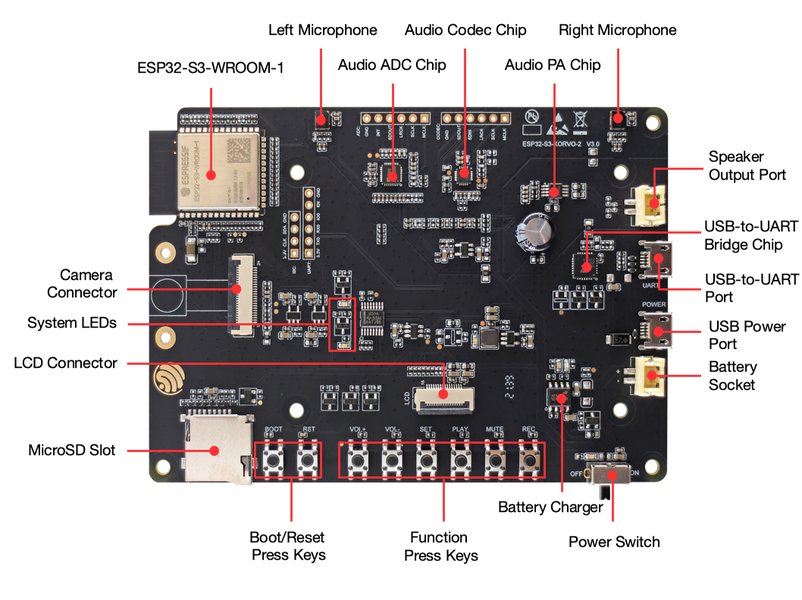
The ESP32-S3-Korvo-2, an audio development board based on ESP32-S3, designed for voice and audio applications.
Core Optimization Strategies
Achieving optimal real-time audio performance involves a multi-faceted approach, touching upon hardware, software, and Bluetooth-specific configurations.
1. Harnessing Bluetooth 5.0 LE Features
Maximizing Data Transfer Capabilities
The ESP32-S3's support for Bluetooth 5.0 LE brings significant advantages for data transmission, crucial for audio applications.
- Enable BLE 2M PHY: The 2 Mbps Physical Layer (PHY) effectively doubles the raw data rate compared to the standard 1M PHY. This increased throughput is vital for streaming higher quality audio or reducing congestion. This can typically be configured in your SDK settings (e.g.,
sdkconfigin ESP-IDF). - Consider LE Coded PHY: For applications where range and connection robustness are more critical than maximum throughput (e.g., audio transmission over longer distances or in noisy RF environments), the LE Coded PHY can be beneficial. It uses Forward Error Correction (FEC) to improve reliability at the cost of data rate and increased latency.
2. Fine-Tuning BLE Connection Parameters
Balancing Latency, Throughput, and Power
The negotiation of connection parameters between the central and peripheral devices profoundly impacts performance.
- Connection Interval: This defines how often devices communicate. For real-time audio, a shorter connection interval (e.g., towards the minimum of 7.5 ms) reduces latency. However, very short intervals increase power consumption.
- Slave Latency: This parameter allows a peripheral to skip a certain number of connection events if it has no data to send, saving power. For real-time audio, slave latency should generally be set to zero to ensure the peripheral listens at every connection event, minimizing delays.
- Supervision Timeout: This is the maximum time between successful communication events before a connection is considered lost. It should be significantly longer than the effective connection interval (considering slave latency) to prevent premature disconnections, but not so long that it delays the detection of a genuinely lost link. A common value is around 400 ms or higher, depending on the application's tolerance for reconnection delays.
3. Hardware Enhancements
Improving Signal Integrity and Range
Physical hardware choices can significantly influence Bluetooth performance.
- High Power Mode: The ESP32-S3 allows adjustment of the Bluetooth transmit (TX) power. Setting it to a higher power mode can improve signal strength, extend range, and enhance connection stability, particularly in environments with interference.
- External Antenna: While many ESP32-S3 modules come with a PCB antenna, using a module with an IPEX/U.FL connector for an external antenna can drastically improve RF performance. A well-chosen external antenna can offer better gain, directivity, and resilience against local interference.
- I2S Interface: For audio input/output, the Inter-IC Sound (I2S) interface is standard. Ensure proper I2S configuration for synchronized audio data transfer between the ESP32-S3 and any external audio codecs (DACs/ADCs). Efficient DMA (Direct Memory Access) usage for I2S transfers minimizes CPU load.
4. Software and Firmware Optimizations
Efficient Code and Resource Management
The software environment plays a critical role in overall system performance.
- Latest ESP-IDF/Arduino Core: Always use the latest stable version of the Espressif IoT Development Framework (ESP-IDF) or the Arduino core for ESP32. These updates often include bug fixes, performance enhancements, and updated Bluetooth stack features.
- Compiler Optimizations: Configure your compiler to optimize for speed (e.g., using the
-O2or-O3flags) rather than size (-Os) or debugging (-Og) if audio performance is paramount. This can be set in the project configuration (e.g.,menuconfigfor ESP-IDF). - Task Prioritization: In a Real-Time Operating System (RTOS) environment like FreeRTOS (used in ESP-IDF), assign higher priorities to Bluetooth stack tasks and audio processing tasks to ensure they are not preempted by less critical operations, preventing glitches or dropouts.
- Memory Management and Buffering: Allocate sufficient RAM for audio buffers (both for Bluetooth transmission/reception and for audio codec processing). Proper buffer sizing helps absorb jitter and prevent underruns/overruns. Be mindful of overall memory usage to avoid out-of-memory issues.
- Audio Frameworks and Libraries: Leverage Espressif's audio development frameworks like ESP-ADF (Audio Development Framework) or community libraries such as
arduino-audio-tools. These often provide optimized routines for audio processing, encoding/decoding (e.g., SBC for A2DP), and handling audio streams efficiently. ESP-Skainet offers capabilities like acoustic echo cancellation (AEC), noise suppression, and voice activity detection. - Minimize Interrupt Latency: Keep Interrupt Service Routines (ISRs) short and efficient. Long ISRs can delay other critical tasks, including Bluetooth communication and audio processing.
5. Selecting the Appropriate Bluetooth Audio Approach
Classic A2DP vs. BLE Audio Solutions
- Bluetooth Classic A2DP (if supported): If your ESP32-S3 module supports Bluetooth Classic (BR/EDR), the A2DP profile is the traditional method for streaming stereo audio. Libraries like
ESP32-A2DPby pschatzmann facilitate this. Optimization here involves managing the SBC codec parameters and ensuring efficient PCM data flow to the I2S interface. - Custom BLE Audio / LE Audio Preparations: For applications leveraging BLE, you might be implementing a custom audio streaming protocol or preparing for the LE Audio standard. Optimizations here focus heavily on the BLE 5.0 features (2M PHY, connection parameters) and efficient data packetization. LE Audio, once fully supported and widely adopted, will offer standardized, power-efficient audio streaming over BLE using codecs like LC3.
Visualizing Optimization Impacts
The following radar chart conceptually illustrates how different optimization factors might influence key performance metrics for real-time audio over Bluetooth. The values are relative and demonstrate trade-offs; for instance, increasing range with Coded PHY might reduce throughput.
This chart helps visualize that different optimization profiles cater to different priorities. For instance, prioritizing low latency and high throughput (blue line) might involve using the 2M PHY and a short connection interval, which could slightly compromise range and power efficiency compared to default settings (red line) or a range-focused setup (green line).
ESP32-S3 Audio Optimization Mindmap
This mindmap provides a hierarchical view of the key areas to consider when optimizing ESP32-S3 Bluetooth performance for real-time audio applications, showing how different components and settings interrelate.
Bluetooth Optimization"] Hardware_Enhancements["Hardware Enhancements"] External_Antenna["External Antenna (IPEX/U.FL)"] High_Power_Mode["Bluetooth High Power Mode"] I2S_Interface["I2S Interface & DMA"] Audio_Codec["External Audio Codec (DAC/ADC)"] BLE_Configuration["BLE Configuration (Bluetooth 5 LE)"] PHY_Selection["PHY Selection"] TwoM_PHY["2M PHY (High Throughput)"] Coded_PHY["LE Coded PHY (Long Range)"] Connection_Parameters["Connection Parameters"] Conn_Interval["Connection Interval (Minimize)"] Slave_Latency["Slave Latency (Set to 0)"] Supervision_Timeout["Supervision Timeout (Balance)"] Software_Firmware["Software & Firmware"] SDK_Toolchain["Latest ESP-IDF / Arduino Core"] Compiler_Flags["Compiler Flags (-O2, -O3)"] Task_Management["RTOS Task Prioritization"] Memory_Buffers["Memory Management & Buffering"] Audio_Libraries["Audio Libraries/Frameworks
(ESP-ADF, Community Libraries)"] Bluetooth_Profile_Strategy["Bluetooth Profile Strategy"] Classic_A2DP["Bluetooth Classic A2DP
(If module supports BR/EDR)"] Custom_BLE_Audio["Custom BLE Audio Protocols"] LE_Audio_Prep["LE Audio (Future Standard)"] Testing_Debugging["Testing & Debugging"] Throughput_Tests["Throughput Measurement"] Latency_Analysis["Latency Analysis"] RF_Environment["RF Environment Assessment"]
The mindmap illustrates that a holistic approach, considering hardware, specific BLE settings, general software practices, the choice of Bluetooth audio protocol, and thorough testing, is necessary for achieving the best results.
Key Optimization Techniques Summary
The following table summarizes crucial optimization techniques, their primary benefits, and potential considerations or trade-offs for real-time audio on the ESP32-S3.
| Optimization Area | Technique | Primary Benefit(s) | Considerations/Trade-offs |
|---|---|---|---|
| Bluetooth PHY | Enable 2M PHY | Higher data throughput | Slightly reduced range compared to 1M PHY; increased power consumption. |
| Bluetooth PHY | Use LE Coded PHY | Increased range and robustness | Reduced data throughput; increased latency. |
| BLE Connection | Shorten Connection Interval | Lower latency | Increased power consumption; potential for more collisions in noisy environments. |
| BLE Connection | Set Slave Latency to 0 | Ensures peripheral listens at every interval, minimizing delay | Increased power consumption for the peripheral. |
| Hardware | Use External Antenna | Improved signal strength, range, and stability | Requires module with U.FL/IPEX connector; cost of antenna. |
| Hardware | Enable High TX Power Mode | Increased range and signal penetration | Increased power consumption; regulatory compliance. |
| Software | Compiler Optimization (-O2/-O3) | Faster code execution | Larger binary size; potentially harder to debug. |
| Software | RTOS Task Prioritization | Ensures audio/Bluetooth tasks get timely CPU access | Requires careful system design to avoid priority inversion or starving lower-priority tasks. |
| Audio Handling | Sufficient Audio Buffering | Absorbs jitter, prevents underruns/overruns | Increased memory usage; adds a small amount of fixed latency. |
| Audio Handling | Use I2S with DMA | Efficient audio data transfer, low CPU overhead | Requires careful configuration of DMA channels and I2S peripheral. |
Practical Demonstration: ESP32 Bluetooth Audio
For those looking to get hands-on, understanding how an ESP32 can function as a Bluetooth audio receiver is a great starting point. The following video provides a tutorial on building a Bluetooth audio receiver using an ESP32, which, while potentially using an older ESP32 model with clear Classic Bluetooth support, demonstrates core concepts applicable to audio handling that can be adapted for ESP32-S3 projects, especially if leveraging its Classic Bluetooth capabilities (if present on the module) or custom BLE solutions.
This tutorial covers connecting an external DAC (Digital-to-Analog Converter) for audio output and the software setup involved. While the ESP32-S3's primary strength is BLE 5.0, the principles of audio data handling and interfacing with audio peripherals are relevant across ESP32 variants.
Frequently Asked Questions (FAQ)
Q: Does the ESP32-S3 natively support A2DP for Bluetooth audio streaming? +
The ESP32-S3 SoC itself is primarily advertised with Bluetooth 5 (LE) capabilities. A2DP is a Bluetooth Classic (BR/EDR) profile. Some ESP32-S3 modules do integrate the necessary BR/EDR radio components, allowing for A2DP support through libraries like ESP32-A2DP. However, not all S3 modules may have this, and the core focus of the S3 chip is BLE. If your module supports BR/EDR, then yes, A2DP can be implemented. Otherwise, for BLE-only S3 variants, audio streaming relies on custom BLE protocols or the emerging LE Audio standards (which require Bluetooth 5.2+ features).
Q: What is the maximum practical Bluetooth LE throughput I can expect on ESP32-S3? +
Under ideal conditions (2M PHY, optimized connection parameters, minimal RF interference, efficient application code), practical BLE throughput on ESP32 variants can reach around 700-800 kbps, and some report even higher bursts. However, real-world performance can be lower due to factors like distance, obstacles, RF interference, processing overhead on the ESP32-S3, and the capabilities of the connected Bluetooth device (e.g., some smartphones might have conservative BLE parameters).
Q: How does compiler optimization level (e.g., -O2) impact real-time audio? +
Compiler optimizations like -O2 (optimize for speed) instruct the compiler to apply various transformations to the code to make it run faster. For real-time audio, faster execution of audio processing algorithms, Bluetooth stack operations, and data handling routines can lead to lower latency and reduced CPU load. This helps prevent audio glitches, dropouts, and allows the system to handle higher data rates more reliably. The trade-off might be a slightly larger code size or increased compilation time.
Q: Can I use Wi-Fi and Bluetooth simultaneously on the ESP32-S3 for an audio application? +
Yes, the ESP32-S3 supports Wi-Fi and Bluetooth coexistence, as they share the same 2.4 GHz radio. Espressif provides coexistence mechanisms to manage radio time-sharing. However, intensive use of both simultaneously can degrade the performance of each, potentially impacting latency and throughput for real-time audio over Bluetooth. If your audio application is highly sensitive, it's best to test thoroughly and potentially prioritize Bluetooth traffic or minimize Wi-Fi activity during critical audio transmission/reception periods.
Recommended Further Exploration
Delve Deeper into Related Topics
- How can I start implementing LE Audio solutions on the ESP32-S3 for low-power audio streaming?
- What are the key Bluetooth performance differences between the ESP32-S3 and older ESP32 models for A2DP audio projects?
- What advanced RF shielding and antenna design techniques can further improve ESP32-S3 Bluetooth stability in noisy environments?
- How can I optimize power consumption for battery-powered ESP32-S3 real-time audio devices using Bluetooth?
References
Sources and Further Reading
Last updated May 7, 2025