
Unlock the Secrets of Algebra: Your Fun Guide to X's and Y's!
Mastering algebra is like learning a new superpower! Let's make it easy and exciting for your 14-year-old.
Algebra might sound like a tough subject, but it's actually a super useful tool that helps us solve all sorts of puzzles and problems, not just in math class but in everyday life too! Think of it as a special language that uses letters and symbols to find missing information. We're going to break down the main rules of algebra step-by-step, with fun examples and tips to make learning them a breeze for a 14-year-old.
Algebra Highlights: The Core Ideas
- Mysterious Letters: Algebra uses letters (like \(x\) or \(y\)) to stand in for numbers you don't know yet. It's like a detective story where you're searching for the value of the mystery letter!
- The Balancing Act: The most important rule in solving equations is to keep them balanced. Whatever you do to one side of an equals sign (=), you must do to the other. Think of it like a seesaw!
- Rule Power: Special rules like the Commutative, Associative, and Distributive properties are like secret codes that help you simplify problems and solve them more easily.
Getting Started: What Exactly IS Algebra?
Variables: The Stars of the Show
In algebra, we use letters to represent numbers that are unknown or can change. These letters are called variables. It's like having a secret box labeled 'c' for candies. You don't know how many candies are in it yet, but 'c' represents that unknown number.
Example:
If you have 7 cookies and your friend gives you some more, but you don't count them yet, you could say your friend gave you 'x' cookies. So, the total number of cookies you have is \(7 + x\).
Expressions vs. Equations: Phrases vs. Sentences
It's important to know the difference between an algebraic expression and an equation.
- An algebraic expression is a combination of variables, numbers, and operation symbols (+, -, ×, ÷), but it doesn't have an equals sign. It's like a mathematical phrase. Example: \(3a + 5\) (read as "three times a number 'a' plus five").
- An equation has an equals sign, showing that two expressions are equal. It's like a complete mathematical sentence. Example: \(3a + 5 = 14\) (read as "three times a number 'a' plus five is equal to fourteen"). Our goal is often to find the value of 'a' that makes this sentence true.
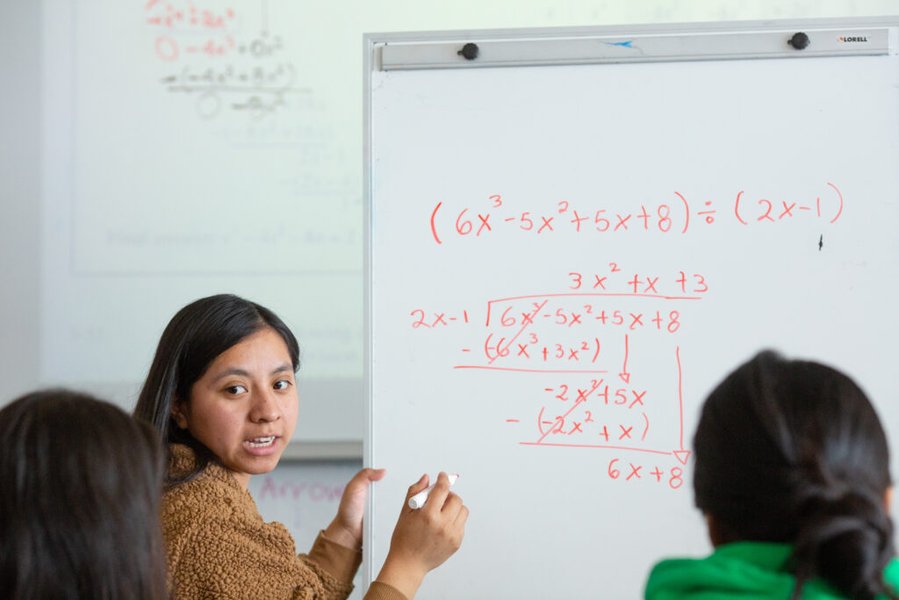
A student engaged in solving algebraic problems.
The Golden Rule of Algebra: Keeping it Balanced!
One of the most crucial rules in algebra is that an equation is like a balanced seesaw. Whatever mathematical operation you perform on one side of the equation, you must perform the exact same operation on the other side to keep it balanced. If you add 5 to one side, you add 5 to the other. If you divide one side by 2, you divide the other side by 2.
Example:
If you have the equation \(x + 3 = 8\):
To find \(x\), you want to get it by itself. So, you subtract 3 from the left side. To keep the seesaw balanced, you must also subtract 3 from the right side:
\(x + 3 - 3 = 8 - 3\)
\(x = 5\)
The Fundamental Rules of Algebra: Your Toolkit
These rules are like the instruction manual for algebra. They help us manipulate and simplify expressions and equations.
1. The Commutative Property: Order Doesn't Matter!
This property tells us that for certain operations, you can swap the order of the numbers, and the result will be the same.
Commutative Property of Addition:
Rule: \(a + b = b + a\)
Example: \(4 + 7 = 11\) is the same as \(7 + 4 = 11\). If you have 4 apples and get 7 more, it's the same total as having 7 apples and getting 4 more.
Fun Tip: Think of it like putting on your socks and shoes. The order matters there! But when adding numbers, it's like having a pile of red candies and a pile of blue candies – it doesn't matter which pile you count first, the total is the same.
Commutative Property of Multiplication:
Rule: \(a \times b = b \times a\) or \(ab = ba\)
Example: \(3 \times 5 = 15\) is the same as \(5 \times 3 = 15\). If you have 3 rows of 5 chairs, that's the same total number of chairs as 5 rows of 3 chairs.
Fun Activity (Switcheroo Game): Give your student 3 red blocks and 4 blue blocks. Ask them to add \(3+4\). Then switch it to \(4+3\). They'll see the total is 7 either way! Try the same with multiplication using small groups of items.
2. The Associative Property: Grouping Doesn't Matter!
This property tells us that when you are only adding or only multiplying three or more numbers, it doesn't matter how you group them with parentheses; the result will be the same.
Associative Property of Addition:
Rule: \((a + b) + c = a + (b + c)\)
Example: \((2 + 3) + 4\) means you first add \(2+3=5\), and then \(5+4=9\). This is the same as \(2 + (3 + 4)\), where you first add \(3+4=7\), and then \(2+7=9\).
Fun Tip: Imagine you're eating three snacks: a cookie, an apple, and a banana. It doesn't matter if you eat the cookie and apple together first, then the banana, or the cookie first, then the apple and banana together. You ate all three!
Associative Property of Multiplication:
Rule: \((a \times b) \times c = a \times (b \times c)\) or \((ab)c = a(bc)\)
Example: \((4 \times 2) \times 5\) means you first multiply \(4 \times 2 = 8\), and then \(8 \times 5 = 40\). This is the same as \(4 \times (2 \times 5)\), where you first multiply \(2 \times 5 = 10\), and then \(4 \times 10 = 40\).
Fun Activity (Group Adventure): Use coins. Say you have 2 pennies, 3 nickels, and 4 dimes. Ask your student to add their values in different groupings, like (value of 2 pennies + value of 3 nickels) + value of 4 dimes, and see if it matches value of 2 pennies + (value of 3 nickels + value of 4 dimes).
3. The Distributive Property: Sharing is Caring!
This rule is super important and helps when you need to multiply a number by a sum or difference inside parentheses. You "distribute" the multiplication to each term inside.
Rule: \(a \times (b + c) = (a \times b) + (a \times c)\) or \(a(b+c) = ab + ac\)
Example: \(3 \times (4 + 5)\). You can solve it two ways:
- Add inside parentheses first: \(3 \times (9) = 27\)
- Or, distribute the 3: \((3 \times 4) + (3 \times 5) = 12 + 15 = 27\)
See? Same answer! This also works for subtraction: \(a(b-c) = ab - ac\)
Fun Tip (Distribute the Loot!): Imagine you have 3 bags, and each bag contains 2 gold coins and 4 silver coins. To find the total number of coins, you can either count the coins in one bag (2+4=6) and then multiply by the number of bags (\(3 \times 6 = 18\)). Or, you can distribute: find the total gold coins (\(3 \times 2 = 6\)) and total silver coins (\(3 \times 4 = 12\)), then add them (\(6+12=18\)).
4. The Identity Properties: Keeping Things the Same
Additive Identity:
Adding zero to any number doesn't change the number.
Rule: \(a + 0 = a\)
Example: \(7 + 0 = 7\). Zero is the "additive identity."
Fun Tip: Zero is like a magic mirror in addition; whatever number looks into it sees itself!
Multiplicative Identity:
Multiplying any number by one doesn't change the number.
Rule: \(a \times 1 = a\)
Example: \(9 \times 1 = 9\). One is the "multiplicative identity."
Fun Tip: One is like a copy machine in multiplication; it just gives you back what you put in.
5. The Inverse Properties: Undoing Operations
Additive Inverse:
Every number 'a' has an additive inverse '-a' (its opposite) such that when you add them, the result is zero (the additive identity).
Rule: \(a + (-a) = 0\)
Example: \(5 + (-5) = 0\). So, -5 is the additive inverse of 5.
Fun Tip: It's like taking 5 steps forward, then 5 steps backward – you end up where you started (at zero)!
Multiplicative Inverse:
Every non-zero number 'a' has a multiplicative inverse \( \frac{1}{a} \) (its reciprocal) such that when you multiply them, the result is one (the multiplicative identity).
Rule: \(a \times \frac{1}{a} = 1\) (for \(a \neq 0\))
Example: \(4 \times \frac{1}{4} = 1\). So, \(\frac{1}{4}\) is the multiplicative inverse of 4.
Fun Tip: If you cut a pizza into 4 slices, then take all 4 of those \(\frac{1}{4}\) slices, you have 1 whole pizza!
Other Key Algebraic Skills
Combining Like Terms: Sorting Your Algebraic Fruit!
Like terms are terms that have the same variable(s) raised to the same power(s). You can add or subtract like terms. Think of it like sorting fruit: you can add apples to apples and bananas to bananas, but you can't directly combine 3 apples and 2 bananas into "5 applebananas."
Example:
In the expression \(2x + 3y + 5x - y\):
- \(2x\) and \(5x\) are like terms. Combine them: \(2x + 5x = (2+5)x = 7x\)
- \(3y\) and \(-y\) (which is \(-1y\)) are like terms. Combine them: \(3y - y = (3-1)y = 2y\)
So, the simplified expression is \(7x + 2y\).
Exponents: Power Up!
An exponent tells you how many times to multiply a base number or variable by itself. It's like a shorthand for repeated multiplication.
Example: \(x^2\) means \(x \times x\). \(2^3\) means \(2 \times 2 \times 2 = 8\).
Fun Analogy: Think of stacking blocks. The base is the block, and the exponent tells you how many blocks are in the stack, all multiplied together.
Solving Equations: Finding the Mystery Value!
The main goal when solving an equation is to find the value of the unknown variable (like \(x\)). This means getting the variable by itself on one side of the equals sign. Remember the golden rule: whatever you do to one side, do to the other!
Step-by-Step Example: Solve \(3x + 5 = 20\)
- Goal: Isolate \(x\).
- Undo addition/subtraction first: To get rid of the '+ 5', subtract 5 from both sides: \[3x + 5 - 5 = 20 - 5\] \[3x = 15\]
- Undo multiplication/division next: \(3x\) means \(3 \times x\). To get rid of the '× 3', divide both sides by 3: \[\frac{3x}{3} = \frac{15}{3}\] \[x = 5\]
So, the mystery value is 5! You can check by plugging it back into the original equation: \(3(5) + 5 = 15 + 5 = 20\). It works!
Evaluating Algebraic Expressions: Plugging in the Numbers
Sometimes, you'll be given an algebraic expression and the value(s) of the variable(s). Your job is to substitute the values and find the result.
Example:
Evaluate \(2a + 3b - c\) when \(a=4\), \(b=2\), and \(c=5\).
- Substitute the values: \(2(4) + 3(2) - 5\)
- Perform multiplication: \(8 + 6 - 5\)
- Perform addition/subtraction from left to right: \(14 - 5 = 9\)
The value of the expression is 9.
Visualizing Algebra Concepts: Importance & Learning Curve
Understanding different algebraic concepts involves varying degrees of importance for foundational knowledge, initial learning difficulty, and perceived fun. The radar chart below offers a visual perspective on these aspects for a 14-year-old learner. "Importance" refers to how critical the concept is for further math studies. "Initial Difficulty" is how challenging it might seem at first. "Real-World Applicability" indicates how directly it can be related to everyday situations. "Fun Factor" shows potential for engagement when taught creatively. "Logical Steps" reflects how much the concept relies on sequential, rule-based thinking.
This chart helps illustrate that while some concepts like "Balancing Equations" and "Solving for x" are highly important and might seem a bit more challenging initially, they also offer a high potential for engagement when taught effectively. Basic properties like Commutative and Associative are generally easier to grasp but are crucial building blocks.
Mapping Out Algebra: A Visual Summary
To see how these ideas connect, let's look at a mind map. This map shows the main branches of basic algebra, from core ideas to the rules and how we use them. It can help a 14-year-old visualize the structure of what they're learning.
Letters for Unknowns"] id1b["Expressions
Math Phrases (e.g., 2x + 3)"] id1c["Equations
Math Sentences with '=' (e.g., 2x + 3 = 7)"] id1d["Balancing Equations
Keep Both Sides Equal!"] id2["Key Rules (Properties)"] id2a["Commutative
Order Doesn't Matter
(a+b=b+a, ab=ba)"] id2b["Associative
Grouping Doesn't Matter
((a+b)+c=a+(b+c))"] id2c["Distributive
Sharing Multiplication
(a(b+c)=ab+ac)"] id2d["Identity
Staying the Same
(a+0=a, a*1=a)"] id2e["Inverse
Undoing Operations
(a+(-a)=0, a*(1/a)=1)"] id3["Working with Algebra"] id3a["Combining Like Terms
(e.g., 3x + 2x = 5x)"] id3b["Solving for the Variable
Isolate 'x'!"] id3c["Evaluating Expressions
Plug in Values"] id3d["Exponents
Repeated Multiplication (x^2)"] id4["Making it Fun!"] id4a["Real-Life Examples
(Budgeting, Cooking)"] id4b["Games & Puzzles"] id4c["Visual Aids & Analogies"]
This mindmap provides a quick overview of the fundamental building blocks of algebra and how they relate to each other, emphasizing that it's all about solving mysteries with clear rules and techniques.
Making Algebra Fun and Engaging!
Learning algebra doesn't have to be a chore. Here are some ways to make it more enjoyable for a 14-year-old:
- Play Math Games: There are many online algebra games, apps, and even card games that can make practicing equations fun. For example, write algebraic expressions on cards (like \(2x + 3\)) and have the student draw a card, then substitute a given value for \(x\) to solve it.
- Use Real-Life Examples: Show how algebra is used in everyday situations. For example:
- Budgeting: If you have $50 to spend (\(T=50\)) and want to buy a game that costs $35 (\(G=35\)), how much money (\(M\)) will you have left? \(T - G = M \Rightarrow 50 - 35 = x\).
- Cooking: If a recipe for 4 people needs 2 cups of flour, how much flour (\(F\)) do you need for 10 people? This involves ratios and proportions, which are algebraic concepts.
- Solve Puzzles: Engage with algebra-based logic puzzles or "mystery number" challenges that require setting up and solving equations.
- Visual Tools: Use diagrams, drawings (like the seesaw for balancing equations), or even colored blocks to represent variables and numbers.
- Celebrate Small Wins: Algebra builds step-by-step. Acknowledge progress and understanding at each stage to keep motivation high.
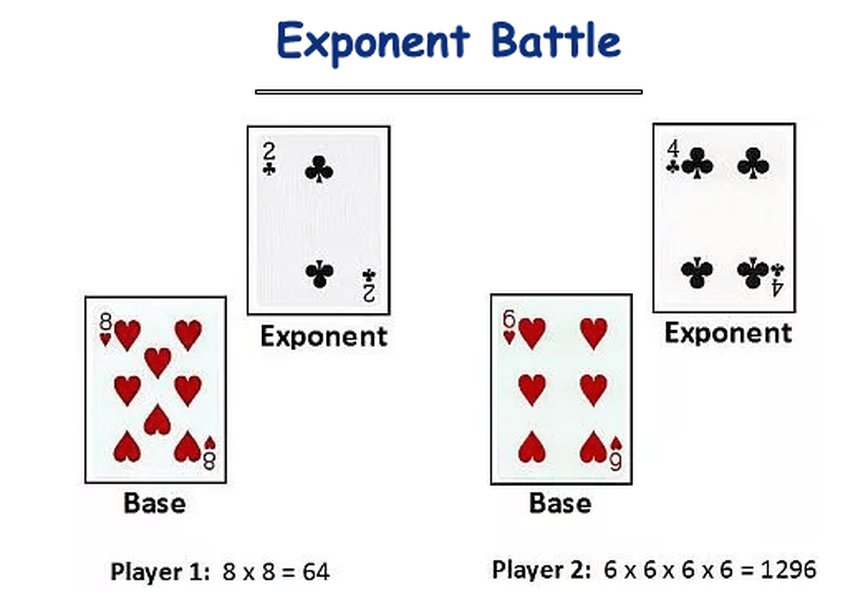
Engaging activities can make learning math, including algebra, more enjoyable.
See Algebra in Action: An Introductory Video
Sometimes, seeing and hearing concepts explained can make a big difference. This video from Math Antics provides a great introduction to what algebra is all about, explaining the concept of unknown values and variables in a clear and engaging way. It's a good starting point to demystify algebra.
This video reinforces the idea that algebra is about working with unknowns and using logical steps to find solutions, much like solving a puzzle.
Summary Table of Algebraic Properties
Here's a quick reference table summarizing the key algebraic properties discussed. This can be a handy cheat sheet!
| Property | Rule (Symbolic) | Example | Analogy/Fun Tip |
|---|---|---|---|
| Commutative (Addition) | \(a + b = b + a\) | \(2 + 9 = 9 + 2 \Rightarrow 11 = 11\) | Counting red then blue candies = Counting blue then red. |
| Commutative (Multiplication) | \(a \times b = b \times a\) | \(3 \times 6 = 6 \times 3 \Rightarrow 18 = 18\) | 3 groups of 6 items = 6 groups of 3 items. |
| Associative (Addition) | \((a + b) + c = a + (b + c)\) | \((1 + 4) + 5 = 1 + (4 + 5) \Rightarrow 10 = 10\) | Grouping friends for a game; total players same. |
| Associative (Multiplication) | \((a \times b) \times c = a \times (b \times c)\) | \((2 \times 3) \times 4 = 2 \times (3 \times 4) \Rightarrow 24 = 24\) | Packing boxes in stages; total items same. |
| Distributive | \(a(b + c) = ab + ac\) | \(5(2 + 3) = (5 \times 2) + (5 \times 3) \Rightarrow 25 = 10 + 15\) | Distributing treats equally to groups. |
| Additive Identity | \(a + 0 = a\) | \(17 + 0 = 17\) | Zero is the "do nothing" number in addition. |
| Multiplicative Identity | \(a \times 1 = a\) | \(23 \times 1 = 23\) | One is the "do nothing" number in multiplication. |
| Additive Inverse | \(a + (-a) = 0\) | \(8 + (-8) = 0\) | Taking steps forward, then same steps backward. |
| Multiplicative Inverse | \(a \times \frac{1}{a} = 1\) (for \(a \neq 0\)) | \(7 \times \frac{1}{7} = 1\) | Dividing something into parts, then taking all parts. |
Frequently Asked Questions (FAQ)
Recommended Further Exploration
To dive deeper and continue the learning journey, consider exploring these related queries:
- How to solve multi-step algebraic equations with examples for teenagers?
- What are some fun algebra games and puzzles for middle school students?
- How is algebra used in computer programming and video game design?
- Explain solving systems of linear equations with fun analogies.
References
The information presented is a synthesis from various educational resources. For further reading and practice, these sites are excellent starting points:
Last updated May 11, 2025