
Step-by-Step Explanation of Fault-Tolerant Topological Qubit Arrays
An in-depth exploration of Majorana-based quantum computing architecture
Highlights
- Incremental Device Roadmap: The paper defines a progressive roadmap from simple devices to scalable quantum computers using topological qubits.
- Measurement-Driven Operations: A paradigm shift from traditional gate-based operations to measurement-based quantum computing enabling enhanced error correction.
- Scalability and Protection: The use of Majorana zero modes (MZMs) in tetrons offers intrinsic topological protection and a path towards error-resilient, large-scale quantum systems.
Introduction and Context
The paper under discussion outlines a comprehensive roadmap aimed at realizing fault-tolerant quantum computation by exploiting topological qubits based on Majorana zero modes. The work primarily focuses on “tetrons” – a specific hardware implementation that capitalizes on the inherent error resilience provided by topological states. The motivation behind this research is to overcome the significant challenge of error correction in quantum computing. By leveraging measurement-based operations, the architecture discussed seeks to minimize the reliance on continuously fine-tuned control pulses, ultimately simplifying the process of quantum error correction.
At the core of the paper is an innovative approach whereby quantum logic operations are performed not through direct gate pulses but via specific sequences of measurements. These measurement protocols facilitate braiding operations and implement Clifford gates in a manner that is naturally resistant to certain types of errors. The device architecture provides a clear evolutionary roadmap: from a simple one-qubit system intended for benchmarking and demonstrating basic quantum operations, through multi-qubit devices that enable entanglement and error detection, all the way to an array capable of full-scale quantum error correction.
Device Roadmap and Architecture
Incremental Development Strategy
The roadmap proposed in the paper is segmented into four major generations of devices. Each generation builds upon the previous one by introducing additional qubit interactions and more sophisticated error correction methodologies. This incremental development is crucial for validating the design principles experimentally before scaling up to a fully fault-tolerant quantum computer.
1. Single-Qubit Tetron Device
The starting point in the roadmap is the single-qubit device. This device is structured to perform measurement-based qubit benchmarking. Its design includes:
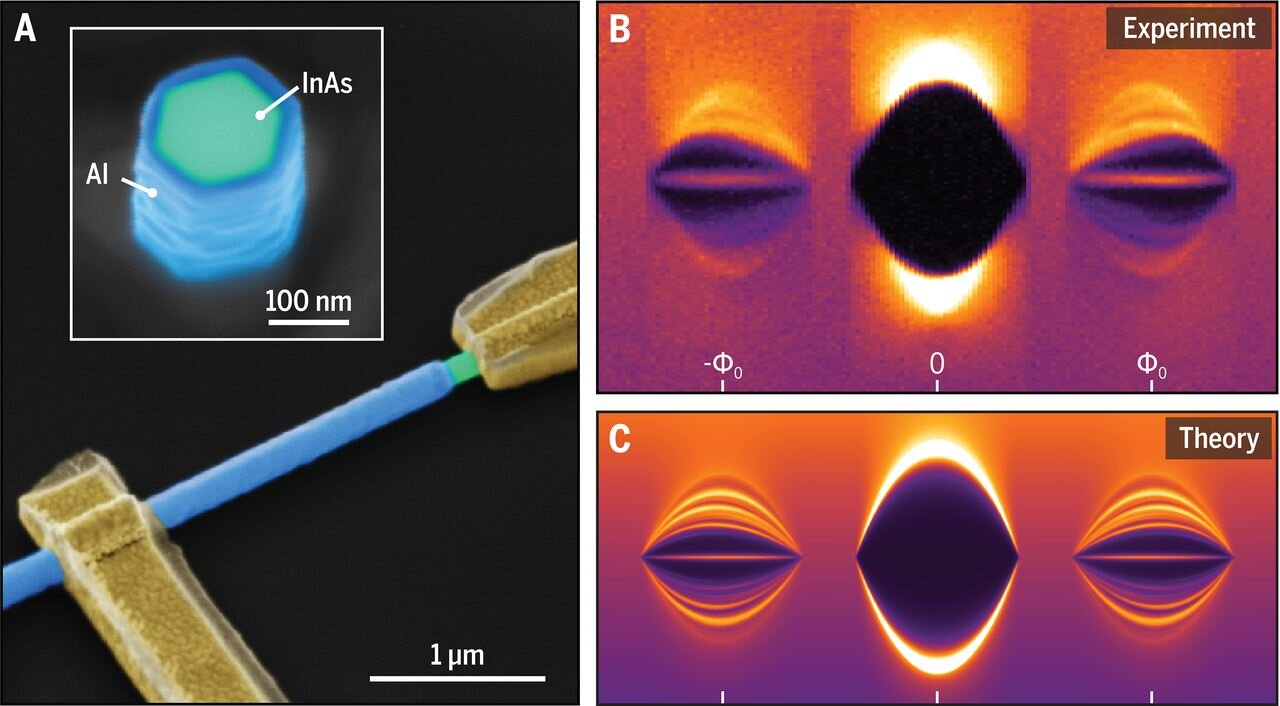
- Architecture: The tetron device features two parallel topological superconducting nanowires that are linked by a trivial superconducting wire. This configuration produces a single island having a specific charging energy necessary for qubit operation.
- Majorana Zero Modes: Each end of the topological wires hosts Majorana zero modes (MZMs), whose non-local properties grant robustness against local noise and decoherence.
- Measurement Capabilities: The device performs measurements in two different Pauli bases, such as the X and Z bases. These dual measurements are critical for benchmarking qubit performance as they allow for the validation of quantum state coherences and error rates.
The significance of starting with a single-qubit system cannot be understated. It provides an ideal platform for understanding the fundamental dynamics of measurement-based operations and serves as a foundational element upon which more complicated devices can be logically constructed.
2. Two-Qubit Device
The next evolutionary stage involves a two-qubit device, which is essential for exploring interactions between qubits and the application of measurement-based braiding transformations. Key aspects include:
- Braiding Operations: Rather than physically moving qubits, braiding operations are executed through carefully orchestrated measurement sequences that effectively exchange the quantum states of the tetrons.
- Clifford Gate Implementation: The two-qubit configuration supports the execution of single-qubit Clifford operations, which are critical for efficient quantum error correction routines. The ability to perform these operations using measurement sequences significantly improves the reliability and fidelity of quantum computation.
- Coherent Linking: In this configuration, the device incorporates a “coherent link” between the tetrons, ensuring the proper timing and synchronization required for reliable measurement-based interactions.
This device validates the foundational concept that measurement sequences can induce reliable and robust quantum operations. By confirming entanglement and verifying the corrective mechanisms in a controlled setting, the two-qubit device provides a bridge between simple qubit systems and more complex quantum error detection protocols.
3. Eight-Qubit Device and Quantum Error Detection
The progression to an eight-qubit system marks a significant step towards robust error detection, an essential milestone for any scalable quantum computer. The design and methodology include:
- Error Detection via Ladder Codes: The eight-qubit device employs a ladder code designed to identify and correct errors in one basis. By performing sequential measurements and checking for consistency, the device can effectively detect anomalies in the quantum computations.
- Logical Qubit Enhancement: In this stage, improvements in two-qubit operations are emphasized, particularly when operations are applied on logical qubits rather than the underlying physical qubits. Logical qubits are encoded states that can absorb and correct errors, making them ideal for fault-tolerant operations.
- Benchmarking with Decay Experiments: The paper outlines a “decay experiment” to compare the decay dynamics of physical qubits to that of logical qubits. In practice, qubits are initialized in predetermined states, subjected to repeated error detection cycles, and then measured to assess the efficacy of error correction protocols.
The eight-qubit system is a crucial testbed for implementing practical aspects of quantum error detection. It highlights both the potential and the challenges associated with executing error correction in a real-world quantum computer.
4. Scalable Topological Qubit Array
The final milestone in the roadmap is the development of a topological qubit array. This stage marks the transition from experimental prototypes to a full-fledged platform capable of utility-scale quantum computation. Key components include:
- Lattice Surgery: To manipulate logical qubits, the proposed array leverages a technique known as lattice surgery. This method allows the merging and splitting of qubit arrays, facilitating logical operations without the need for direct qubit movement.
- Logical Qubit Encodings: The paper discusses the potential use of advanced schemes such as Hastings-Haah Floquet codes and pair-wise measurement-based surface codes. Both of these methods are designed to achieve higher fault tolerance by encoding qubits in ways that are resilient to error propagation.
- Fault Distance Considerations: In scaling the system, emphasis is placed on maintaining a fault distance – the minimal number of errors that could lead to a logical fault – of 7, ensuring that the constructed logical qubits can effectively mitigate the impacts of individual physical qubit failures.
Transitioning to a scalable qubit array involves ensuring that the benefits observed in smaller systems (like topological protection and measurement robustness) are maintained. The roadmap outlines strategies to scale up the underlying architecture so that millions of qubits could, in principle, be incorporated onto a single wafer.
Measurement-Based Operations and Error Correction
Driving Concepts in Fault-Tolerant Quantum Computation
A central concept in this paper is the adoption of measurement-based operations. Unlike the conventional quantum computing approach where individual gates are applied directly, here, quantum logic operations are executed through series of measurements. This shift offers several advantages:
- Reduced Sensitivity to Noise: By relying on digital measurement sequences instead of analog pulse control, the overall system becomes less susceptible to the types of errors that plague physical quantum gates.
- Intrinsic Error Correction: Measurement-based operations can directly incorporate error detection steps within the operational protocol. For instance, performing a measurement in complementary bases naturally provides information about whether deviations—indicative of errors—have occurred.
- Operational Modularity: The approach allows operations to be broken down into discrete, verifiable steps, which can be independently characterized and optimized. Each measurement effectively “projects” the system into a state that is easier to manage under error correction protocols.
Measurement Sequences and Braiding
The concept of braiding in topological quantum computing does not require the physical movement of qubits. Instead, it is achieved through a sequence of clever measurements that cause a virtual exchange of quantum information between pairs of Majorana zero modes. This process induces unitary transformations which correspond to single- or multi-qubit logic operations.
These operations are essential for implementing Clifford gates, a set of operations that, combined with error correction, form a robust computational basis. The measurement sequences are carefully engineered so that the operations are not only coherent but also maintain the topological protection that is key to the system’s fault tolerance.
Technical Innovations and Experimental Considerations
Majorana Zero Modes and Topological Protection
A cornerstone of the tetron device is the hosting of Majorana zero modes at the endpoints of semiconductor-superconductor heterostructures. These exotic quasiparticles are predicted to exhibit non-Abelian statistics, meaning that their exchange (or braiding) leads to transformations that depend on the order in which the exchanges are executed.
The topological nature of these modes implies that the information encoded in them is inherently resistant to local perturbations. This robustness arises because local noise typically cannot affect the overall topological order. Consequently, the logical qubits encoded using these modes benefit from an exponential suppression of certain error types.
Design of the Tetron and Measurement Methodology
The design of the tetron device includes several innovative elements:
- Trivial Superconducting Backbone: This not only helps in consolidating the qubit island but also provides a controlled environment in which the Majorana zero modes can interact.
- Quantum Dots for Interferometric Measurements: Quantum dots are incorporated into the device to facilitate interferometric parity measurements. These measurements are critical in verifying the properties of the Majorana modes, ensuring that the intended topological protection and state fidelity are maintained.
- Digital Sequence Operations: The device capitalizes on a sequence of Pauli measurements to realize computational operations. This digital operation mode fundamentally transforms how braiding and logical operations are implemented by removing the reliance on continuously tuned control fields.
Challenges and Roadmap to Scalability
Despite the promising aspects of the tetron-based topological qubit architecture, several challenges remain:
- Improving Qubit Performance: The physical properties of the devices must be refined to minimize error rates further. This involves optimizing material characteristics and the coherence times of the Majorana modes.
- Error Mitigation Strategies: Strategies such as vacancy mitigation are needed to manage and reduce the likelihood of qubit failures, which become critical as the system scales up.
- Maintaining Topological Robustness Across Large Arrays: Ensuring that millions of qubits can operate in a coherent and fault-resistant manner remains a significant engineering and theoretical challenge.
Comparative Analysis: Logical vs. Physical Qubits
Evaluating System Robustness
A critical part of this roadmap involves comparing the performance of logical qubits—which are composite states built to be resilient against errors—with that of bare physical qubits. This comparison is made through controlled decay experiments that systematically expose qubits to error detection cycles.
The idea is to initialize qubits in a specific state, and then, using a structured sequence of operations and measurements, observe the degradation of their state fidelity. Logical qubits, by design, show improved performance (or slower decay) due to their ability to self-correct, whereas physical qubits tend to exhibit more rapid deterioration because any single error may dramatically affect the state.
Data Analysis: A Tabular Overview
The following table provides a comparative overview of key aspects between physical and logical qubits as developed in the tetron roadmap:
| Aspect | Physical Qubits | Logical Qubits |
|---|---|---|
| Error Rate | High sensitivity to noise; rapid decay | Enhanced error suppression; slower decay |
| Operation Fidelity | Dependent on precise control pulses | Measurement-based operations provide built-in error correction |
| Implementation Complexity | Relatively simple architecture | Complex encoding; needs additional overhead for error correction |
| Scalability | Challenging without error correction techniques | Designed for scalability with topological protection |
Pathways to Practical Quantum Error Correction
Using Lattice Surgery and Advanced Codes
The pinnacle goal of the roadmap is to achieve a scalable quantum error correction system. This is addressed by combining the principles of measurement-based operations with advanced error correction codes:
- Lattice Surgery: This technique allows for the execution of operations across arrays of qubits by appropriately merging and splitting them. Lattice surgery is a powerful way to perform logical operations on encoded qubits and facilitates the transition between different states in a controlled manner.
- Advanced Coding Techniques: The paper discusses the potential implementation of Hastings-Haah Floquet codes and pair-wise measurement-based surface codes. These codes support scalable error correction by uniformly distributing error resilience over a larger qubit array.
- Fault Distance: Maintaining an adequate fault distance (the minimum number of qubit errors required to cause an uncorrectable error) is a careful balancing act between hardware limitations and the sophistication of the error correction algorithm. In this context, a fault distance of 7 is targeted in the roadmap to ensure robust protection.
Experimental Outlook and Future Developments
Towards Utility-Scale Quantum Computers
The roadmap not only lays out the theoretical underpinnings of fault-tolerant topological qubit arrays but also highlights the trajectory towards practical, utility-scale quantum machines. The continuous refinement of device architectures, combined with improved material science and nano-engineering, aims to integrate millions of qubits on a single platform.
Future research will focus on:
- Improving Material Quality: Ensuring the superconducting and semiconducting components of the tetron devices achieve higher purity and uniformity to support robust Majorana modes.
- Optimized Measurement Protocols: Refining the sequence and timing of measurements to further reduce error probabilities and enhance the speed of braiding operations.
- Integration of Multi-Qubit Operations: Scaling from the demonstrated eight-qubit devices to larger arrays where comprehensive quantum error correction can be implemented and maintained.
Real-world Implications and Applications
The development of fault-tolerant quantum computing has profound implications across multiple fields. On the computational side, it promises to revolutionize how we handle complex problems in cryptography, optimization, and simulation of quantum systems. The inherent robustness of topologically protected qubits could pave the way for error rates that are orders of magnitude lower than what conventional architectures can achieve, opening up applications in areas where even small error rates can lead to large inaccuracies.
Additionally, by making quantum computing more reliable, researchers can experiment with algorithms for materials science, drug discovery, and machine learning that were previously beyond reach. The integration of measurement-based operations further simplifies the overall control schemes, reducing the engineering burden and allowing researchers to focus on higher-level algorithmic innovation.
Conclusion
In summary, this paper lays out an ambitious yet carefully structured approach for building a fault-tolerant quantum computer using topological qubit arrays. Starting with a single-qubit device designed for benchmarking and progressively moving through two-qubit and eight-qubit systems to eventually form a scalable array, the roadmap addresses both the challenges and the inherent advantages of Majorana-based qubits. The innovative use of measurement-based operations offers a fresh pathway to implement quantum logic, while the emphasis on topological protection ensures robust performance against noise and errors.
By characterizing the differences between physical and logical qubits and outlining an experimental pathway that includes decay experiments and lattice surgery, the paper provides clear guidance on how to translate theoretical models into practical, reliable quantum hardware. Although challenges remain—chiefly in material quality and the maintenance of error suppression at large scales—the roadmap demonstrates that a systematic, step-by-step development of tetron devices can eventually lead to utility-scale quantum computers capable of solving complex, real-world problems.
References
Recommended Related Queries
Last updated February 20, 2025