
Understanding HCF and LCM: Essential Concepts in Mathematics
Exploring the Highest Common Factor and Least Common Multiple
HCF and LCM are fundamental concepts in mathematics that play a crucial role in number theory and various practical applications. Understanding these concepts, their definitions, methods of calculation, and their relationship is essential for solving a wide range of mathematical problems.
Key Highlights of HCF and LCM
- HCF (Highest Common Factor), also known as GCD (Greatest Common Divisor), is the largest positive integer that divides two or more numbers without leaving a remainder.
- LCM (Least Common Multiple) is the smallest positive integer that is a multiple of two or more given numbers.
- Both HCF and LCM can be calculated using methods like prime factorization and the division method.
Defining HCF and LCM
What is the Highest Common Factor (HCF)?
The Highest Common Factor (HCF) of two or more numbers is the largest number that can divide all of them exactly. It is also commonly referred to as the Greatest Common Divisor (GCD). The HCF is the greatest among all common factors of the given numbers.
Understanding Factors
A factor of a number is a number that divides it evenly, leaving no remainder. For example, the factors of 12 are 1, 2, 3, 4, 6, and 12.
Finding Common Factors and the HCF
Common factors of two or more numbers are the numbers that are factors of all the given numbers. The HCF is the largest of these common factors. For instance, consider the numbers 12 and 18. The factors of 12 are 1, 2, 3, 4, 6, 12. The factors of 18 are 1, 2, 3, 6, 9, 18. The common factors of 12 and 18 are 1, 2, 3, and 6. The highest among these common factors is 6, so the HCF of 12 and 18 is 6.
What is the Least Common Multiple (LCM)?
The Least Common Multiple (LCM) of two or more numbers is the smallest positive integer that is a multiple of all the given numbers. In other words, it is the smallest number that can be divided by each of the given numbers without leaving a remainder.
Understanding Multiples
A multiple of a number is the result of multiplying that number by an integer. For example, the multiples of 3 are 3, 6, 9, 12, 15, 18, and so on.
Finding Common Multiples and the LCM
Common multiples of two or more numbers are the numbers that are multiples of all the given numbers. The LCM is the smallest of these common multiples. For example, consider the numbers 4 and 6. The multiples of 4 are 4, 8, 12, 16, 20, 24, ... The multiples of 6 are 6, 12, 18, 24, 30, ... The common multiples of 4 and 6 are 12, 24, and so on. The smallest common multiple is 12, so the LCM of 4 and 6 is 12.
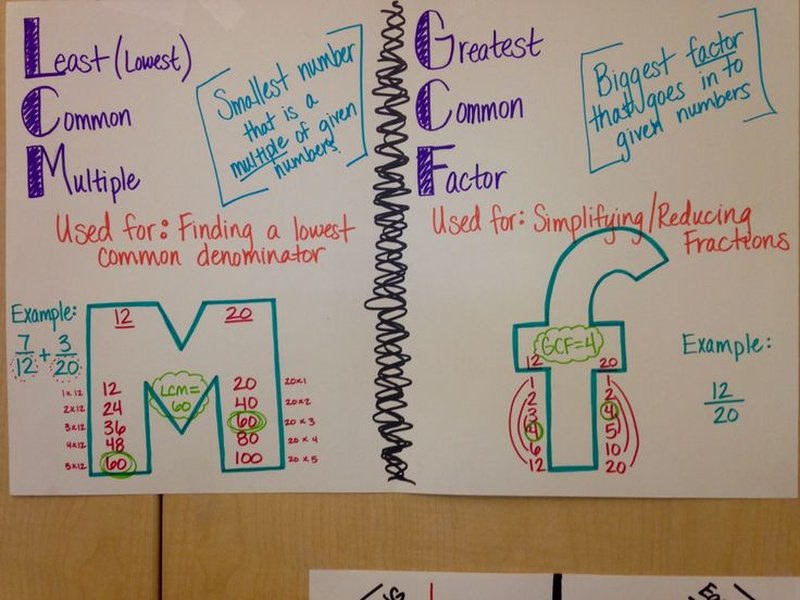
The image below visually represents the concept of LCM and HCF.
Illustrative representation of HCF and LCM concepts.
Methods for Calculating HCF and LCM
There are several methods to find the HCF and LCM of numbers. The two most common and widely taught methods are the Prime Factorization Method and the Division Method.
Prime Factorization Method
The prime factorization method involves expressing each number as a product of its prime factors. This method is effective for finding both HCF and LCM.
Steps for HCF using Prime Factorization:
- Find the prime factorization of each number.
- Identify the common prime factors.
- Multiply the common prime factors, each raised to the lowest power that appears in the prime factorizations.
Example: Finding the HCF of 24 and 36
Prime factors of 24: 2 × 2 × 2 × 3 = 2³ × 3¹
Prime factors of 36: 2 × 2 × 3 × 3 = 2² × 3²

Common prime factors are 2 and 3.
Lowest power of 2 is 2².
Lowest power of 3 is 3¹.

HCF = 2² × 3¹ = 4 × 3 = 12
Steps for LCM using Prime Factorization:
- Find the prime factorization of each number.
- Identify all prime factors that appear in any of the prime factorizations.
- Multiply these prime factors, each raised to the highest power that appears in any of the prime factorizations.
Example: Finding the LCM of 24 and 36
Prime factors of 24: 2³ × 3¹
Prime factors of 36: 2² × 3²

All prime factors are 2 and 3.
Highest power of 2 is 2³.
Highest power of 3 is 3².

LCM = 2³ × 3² = 8 × 9 = 72
Division Method
The division method, also known as the ladder method or short division method, is a more systematic approach, particularly useful for finding the HCF and LCM of multiple numbers simultaneously.
Steps for HCF using Division Method:
- Divide the larger number by the smaller number.
- Take the divisor as the new dividend and the remainder as the new divisor.
- Repeat the process until the remainder is zero.
- The last divisor is the HCF.
Example: Finding the HCF of 24 and 36
36 ÷ 24 = 1 remainder 12
24 ÷ 12 = 2 remainder 0

The last divisor is 12. So, HCF(24, 36) = 12.
Steps for LCM using Division Method:
- Write the numbers in a row separated by commas.
- Divide the numbers by the smallest prime number that divides at least one of the numbers. Write the quotients below the numbers. If a number is not divisible, bring it down as is.
- Repeat the process until all the numbers in the last row are 1.
- Multiply all the divisors to find the LCM.
Example: Finding the LCM of 24 and 36
| Divisor | 24 | 36 |
|---|---|---|
| 2 | 12 | 18 |
| 2 | 6 | 9 |
| 3 | 2 | 3 |
| 2 | 1 | 3 |
| 3 | 1 | 1 |
LCM = 2 × 2 × 3 × 2 × 3 = 72
Relationship Between HCF and LCM
For any two positive integers, there is a significant relationship between their HCF and LCM. The product of the HCF and LCM of two numbers is equal to the product of the two numbers themselves.
\[ \text{HCF}(a, b) \times \text{LCM}(a, b) = a \times b \]This property is very useful in solving problems where either HCF or LCM is given along with the numbers, and the other needs to be found.
Example: For the numbers 24 and 36, we found HCF = 12 and LCM = 72. The product of the numbers is 24 × 36 = 864. The product of their HCF and LCM is 12 × 72 = 864. This verifies the relationship.
Applications of HCF and LCM
HCF and LCM are not just theoretical concepts; they have practical applications in various real-world scenarios.
Applications of HCF:
- Simplifying Fractions: The HCF is used to reduce a fraction to its simplest form by dividing both the numerator and the denominator by their HCF.
- Grouping and Distribution: HCF is used in problems involving dividing items into the largest possible equal groups. For example, finding the largest size of tiles needed to tile a rectangular floor without cutting any tiles.
Applications of LCM:
-
Adding and Subtracting Fractions: The LCM is used to find the least common denominator (LCD) when adding or subtracting fractions with different denominators. The LCD is the LCM of the denominators.
-
Scheduling and Cycles: LCM is used in problems involving events that occur at regular intervals and determining when they will occur simultaneously. For example, finding when two buses will arrive at a stop at the same time if they run on different schedules.
Applications of HCF and LCM in real life.

Further Exploration
To deepen your understanding of HCF and LCM and see more examples and problem-solving techniques, you can explore additional resources. The following video provides a visual explanation of LCM and HCF:
This video from FuseSchool offers a clear explanation of the concepts of HCF and LCM, their definitions, and how to calculate them, which can be very helpful for visual learners.
Frequently Asked Questions (FAQ)
What is the difference between HCF and LCM?
HCF is the largest number that divides the given numbers, while LCM is the smallest number that is divisible by the given numbers. HCF deals with common factors, while LCM deals with common multiples.
Can HCF or LCM be zero?
For positive integers, HCF and LCM are always positive integers. The concepts are typically applied to positive integers. The HCF of any set of numbers including zero is the smallest non-zero number if one exists. The LCM of any set of numbers including zero is zero.
What are coprime numbers?
Coprime numbers (or relatively prime numbers) are two numbers that have no common factors other than 1. The HCF of coprime numbers is always 1, and their LCM is the product of the numbers.
References
Last updated May 3, 2025