
Understanding Helium Tube Trailers vs. ISO Modules
An in-depth exploration of on-site helium supply systems
Key Highlights
- Design and Capacity: Tube trailers support high-pressure gas storage with larger capacities, while ISO modules are standardized for versatile intermodal transport.
- Operational Flexibility: Tube trailers are ideal for high-volume, industrial on-site applications; ISO modules offer easier integration and long-term storage options.
- Filling Process: Tube trailers require a more complex filling process involving gasification, compression, and purification, compared to the relatively straightforward transfer approach used in ISO modules.
Overview of Helium Supply Systems
Helium is an essential commodity used across various industries, including medical imaging, welding, and semiconductor manufacturing. As the demand for helium continues to rise due to its unique physical properties and limited natural availability, efficient supply and storage methods become increasingly important. Two popular systems utilized for transporting and storing helium on-site are helium tube trailers and ISO modules. Both systems serve critical roles, yet they differ in design, capacity, and the nature of their on-site supply process.
Detailed Comparison
Helium Tube Trailers
Design and Structure
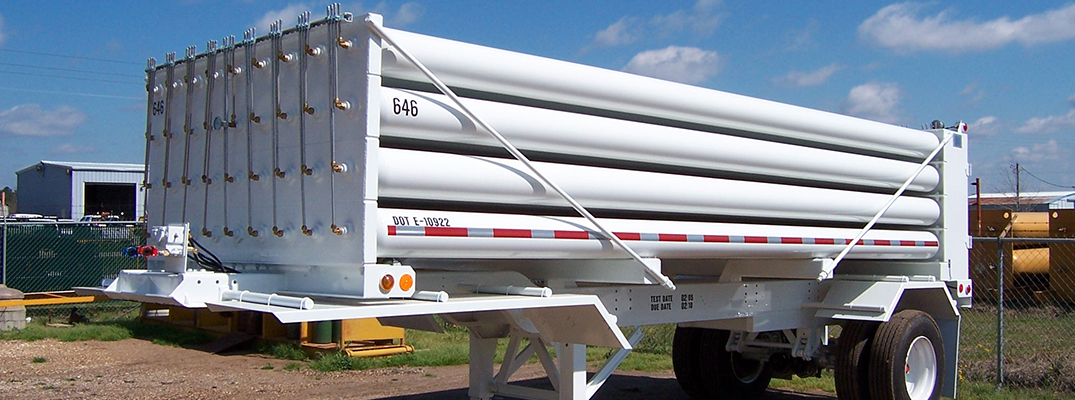
Helium tube trailers are specialized transport units that incorporate high-pressure tubes mounted on a trailer chassis. These trailers are purpose-built for handling compressed gases and have been engineered to support high storage capacities. The tubes, often made of aluminum or steel, are designed to sustain a service pressure that can reach up to \(2,871\ \text{psi}\) at standard temperatures (around 70°F). For instance, some configurations may hold approximately \(180,000\ \text{SCF}\) (standard cubic feet) of helium, making them well-suited for large-scale industrial supply needs.
Capacity and Application
Tube trailers are chosen primarily for high-volume delivery situations. Their design is optimized to enable a direct connection on-site, allowing the ducted helium to be integrated into industrial operations swiftly. This is particularly advantageous for applications such as:
- Industrial manufacturing and processing systems
- Medical imaging devices, like MRI machines
- Large-scale research facilities requiring continuous high-flow delivery
The filling process typically involves a thorough sequence including gasification, compression, and purification. Given the high-pressure environment needed, filling a tube trailer, especially when dealing with the largest tube bundles, may take up to 14 hours. This operational step is critical to ensure that the gas is not only compressed but also reaches the purity standards expected in various sensitive applications.
Operational Efficiency
Once a helium tube trailer reaches the intended site, its operational efficiency is enhanced by enabling direct on-site connection. This minimizes the delay between transport and utilization, ensuring a continuous helium supply. However, regulatory compliance is essential as transporting high-pressure gas imposes stringent safety standards. Adhering to transportation regulations for hazardous materials is a key aspect of the tube trailer system.
ISO Modules
Design and Structure
ISO modules are built using standardized intermodal container dimensions, facilitating seamless transport via road, rail, or sea. These modules are engineered for compatibility within established logistics networks, making them adaptable to a variety of shipping scenarios. Unlike tube trailers, ISO modules are not strictly limited by the need for extremely high pressure. They accommodate both gas and liquid helium supplies, which provides flexibility in how helium can be stored and later transferred.
Capacity and Application
Although ISO modules may not support the extremely high capacities that some tube trailers facilitate, they are extremely valuable for applications that demand a steady on-site inventory. Their design favors integration with existing infrastructure, meaning that ISO modules can often be installed on-site as part of a more permanent storage solution, providing a reliable feed of helium. They are well-suited for:
- Smaller-scale laboratory or production environments
- Applications where space and infrastructure are constrained
- Long-term, steady supply scenarios with intermittent high demand
Operational Efficiency
The filling process for ISO modules is usually more straightforward compared to tube trailers. In many cases, the process involves the direct transfer of helium from a bulk source into the container. This not only simplifies the procedure but also reduces the time required for operational readiness when compared to the more elaborate steps necessary for tube trailers. The standard dimensions and robust design of ISO modules also yield enhanced versatility, as they comply with both transportation and on-site storage regulatory requirements.
Comparative Analysis Table
| Aspect | Helium Tube Trailer | ISO Module |
|---|---|---|
| Design | Consists of multiple high-pressure tubes mounted on a trailer chassis, built for efficient, high-volume gas delivery. | Standardized intermodal container design, compatible with road, rail, and sea transport, suited for integration with existing logistics. |
| Capacity | High capacity, suitable for large industrial applications (up to around 180,000 SCF in some models). | Moderate capacity, designed to support both liquid and gas phases of helium, ideal for steady on-site supply. |
| Operational Efficiency | Allows direct on-site connection for large-scale, immediate supply needs; more complex filling process. | Facilitates easier integration within storage systems with a simpler transfer process, enhancing long-term flexibility. |
| Filling Process | Complex, includes gasification, compression, and purification; can involve lengthy operational procedures (approx. 14 hours). | Simpler and more direct; generally involves transferring helium directly from a bulk supply, suitable for both gas and liquid phases. |
| Applications | Industrial plants, large-scale research facilities, high volume supply lines (e.g., medical and semiconductor manufacturing). | Smaller-scale operations, modular storage needs, limited space setups, and scenarios demanding flexible, intermittent use. |
In-Depth On-Site Supply Process
Deployment and Integration
Helium Tube Trailers On-Site
Upon arrival at the site, helium tube trailers are parked near the facility’s helium demand point. Their design allows for a direct connection to the processing or storage system. This is especially beneficial if the application requires rapid refueling and a high flow of helium. Connecting the tube trailer to the supply system involves specialized fittings that ensure a secure and leak-free transfer of gas.
The process begins in a controlled environment, where the helium stored in the high-pressure tubes is gradually released into the helium utilization system. Due to the high pressure at which the gas is stored, careful monitoring during the offloading process ensures the helium maintains its quality and purity.
ISO Modules On-Site
ISO modules, by contrast, are often integrated as a semi-permanent installation on-site. These modules can be temporarily housed in proximity to the production or usage facilities. Their intermodal design simplifies transport and installation procedures compared to the more specialized tube trailers.
When installed, ISO modules serve as localized storage units. The transfer process, while still closely monitored, is generally less complex. Helium is directly transferred from the bulk supply source into the module with minimal mechanical intervention. This method reduces downtime and enhances the speed with which the helium reaches operational use.
Regulatory Compliance and Safety
Tube Trailers
Due to the high-pressure conditions required for storing helium in tube trailers, adhering to safety and regulatory requirements is paramount. The transportation of these trailers falls under hazardous material guidelines, meaning that strict standards are applied to both the equipment and the operational procedures.
ISO Modules
While ISO modules are also subject to regulatory standards, their design aligns with broader intermodal regulations. This can sometimes result in a simpler compliance process as the modules adhere to dimensions and specifications recognized by international transport and building codes.
Economic and Practical Considerations
Cost Efficiency
Helium Tube Trailers
When large quantities of helium are needed over short periods, tube trailers offer a cost-effective solution due to their high delivery capacity. While the initial setup and filling process might be longer and more technologically demanding, the ability to provide quick and large volume supply can drive operational efficiencies and lower ongoing costs in high-demand scenarios.
ISO Modules
ISO modules, although sometimes slightly more expensive at the outset due to their versatile design, offer long-term savings by providing a modular and scalable solution. Their compatibility with standardized transport systems also reduces the logistical complexity and potential downtime associated with helium transport.
Ultimately, the decision between these systems often hinges on specific project requirements, available infrastructure, and the balance between initial cost and long-term supply reliability.
References
- High Pressure Tubes for Rental, Lease or Purchase - Gas Innovations
- Helium Gas Supply Options - Matheson Gas
- Helium Tube Trailers - Linde Direct
- Analysis of Helium Tube Trailer Filling - Process Insights
- Gas Transportation Tube Trailer / ISO Trailer - PWENT
Recommended Related Queries
Last updated March 14, 2025