
Unlock Seamless Performance: Architecting a High-Load System from API to Web App via PostgreSQL
Discover how to build a robust, scalable system capable of handling massive data flow from public APIs to your users' screens.
Key Architectural Highlights
- Decoupled Ingestion: Employing message queues buffers API data, preventing database overload during peak ingestion and enhancing system resilience.
- Scalable Read Performance: Utilizing PostgreSQL read replicas and load balancing distributes query load, ensuring web application responsiveness even with numerous concurrent users.
- Multi-Layer Caching: Implementing caching at both the backend application level and potentially via a CDN significantly reduces database strain and accelerates data delivery to the frontend.
Designing a system to efficiently fetch data from public APIs, reliably store it in PostgreSQL, and present it through a web application requires a thoughtful architecture, especially when anticipating high user traffic and significant data volume. The challenge lies in building a system that is not only functional but also scalable, resilient, and performant under pressure. This involves carefully layering components, implementing strategies for load distribution, and ensuring data integrity throughout the pipeline.
This document outlines a robust architectural blueprint designed to meet these demands, focusing on decoupling components, optimizing database interactions, and scaling resources effectively.
Architectural Blueprint: From Ingestion to Display
Core System Layers
A multi-layered approach ensures separation of concerns and allows for independent scaling of different parts of the system. The main layers include:
- Data Ingestion Layer: Connects to external APIs, retrieves data, validates/transforms it, and prepares it for storage.
- Data Storage Layer: Persists the data using PostgreSQL, optimized for high availability and read/write performance.
- Backend Application Layer: Provides an API for the frontend, retrieves data from storage, applies business logic, and leverages caching.
- Web Application Layer (Frontend): Renders the user interface, interacts with the backend API, and displays data to the user.
Visualizing the Architecture: A Mindmap Overview
This mindmap illustrates the key components and their relationships within the proposed high-load architecture. It highlights the flow of data from external sources through processing and storage stages to the end-user interface.
(Rate Limiting, Error Handling)"] id1c["Ingestion Orchestrator
(Scheduling, Workflow)"] id1d["Data Transformer/Validator"] id1e["Message Queue (Kafka/RabbitMQ)
(Buffering, Decoupling)"] id2["Data Storage Layer (PostgreSQL)"] id2a["Primary PostgreSQL Instance
(Writes)"] id2b["Read Replicas
(Reads, HA)"] id2c["Replication (Sync/Async)"] id2d["Database Load Balancer
(Read Distribution)"] id2e["Connection Pooler (PgBouncer)"] id2f["Optimized Schema
(Indexing, Partitioning)"] id3["Backend Application Layer"] id3a["API Servers (REST/GraphQL)"] id3b["Load Balancer (Backend)"] id3c["Auto-Scaling Group"] id3d["Caching Layer (Redis/Memcached)"] id3e["Business Logic"] id3f["Data Access Logic"] id4["Web Application Layer (Frontend)"] id4a["User Interface (React/Angular/Vue)"] id4b["Client-Side Caching"] id4c["API Consumption"] id5["Supporting Infrastructure"] id5a["Monitoring & Alerting"] id5b["Centralized Logging"] id5c["Security Measures"] id5d["Backup & Recovery"] id5e["CDN (Static Assets)"]
Deep Dive into System Components
1. Data Ingestion Layer: The Gateway for External Data
This layer is responsible for interacting with external public APIs. Its design is critical for handling potentially high volumes of incoming data and managing interactions with rate-limited external sources.
Key Components:
- API Client Modules: Specialized components designed to communicate with specific public APIs. They handle details like authentication (API keys, OAuth), request formatting, response parsing, pagination, and crucially, respecting API rate limits through intelligent throttling and backoff strategies.
- Ingestion Orchestrator: Manages the scheduling and execution of data fetching tasks. This could range from a simple cron job or scheduled task runner to a sophisticated workflow engine (like Apache Airflow) or serverless functions (like AWS Lambda or Azure Functions). It coordinates which APIs to call, when, and potentially manages parallel fetching.
- Data Transformer/Validator: Raw data from APIs often needs cleaning, transformation (e.g., converting data types, mapping fields to the internal schema), and validation before being stored. This component ensures data consistency and quality.
- Message Queue (Highly Recommended): Services like Apache Kafka or RabbitMQ act as a vital buffer between the API clients and the database ingestion process. API clients publish retrieved data to the queue. This decouples the ingestion rate from the database write capacity, smoothing out bursts of data and improving fault tolerance (if the database is temporarily unavailable, data remains safely in the queue). Worker processes consume messages from the queue at a sustainable pace to write to the database.
Introduction to Data Ingestion concepts, relevant for understanding the first step in the data pipeline.
2. Data Storage Layer: Reliable Persistence with PostgreSQL
At the heart of the system, PostgreSQL stores the ingested data. Configuration and architecture here are crucial for handling high read and write loads while ensuring data availability and integrity.
Key Components & Strategies:
- PostgreSQL Instance(s): One primary instance handles all write operations (inserts, updates, deletes) coming from the ingestion workers (consuming from the message queue).
- Streaming Replication: Setting up one or more read replicas is essential for read scalability and high availability (HA). The primary database streams changes to these replicas.
- Asynchronous Replication: Offers better write performance on the primary but involves a small lag, meaning read replicas might have slightly stale data. Suitable for many web applications.
- Synchronous Replication: Guarantees data is written to at least one replica before a transaction is confirmed on the primary, ensuring zero data loss on replica promotion but potentially impacting write latency.
- Database Load Balancer: Placed in front of the read replicas, it distributes incoming read queries from the backend application layer across the available replicas. This prevents any single replica from becoming a bottleneck and improves overall read throughput.
- Connection Pooling: Tools like PgBouncer or PgCat manage a pool of database connections. This significantly reduces the overhead of establishing new connections for each request from the backend application, crucial under high concurrency.
- Optimized Schema & Indexing: A well-designed database schema with appropriate data types, normalization (or strategic denormalization for read performance), and comprehensive indexing on frequently queried columns is fundamental for performance. Use tools like `EXPLAIN ANALYZE` to identify slow queries and optimize them.
- Table Partitioning/Sharding: For very large tables, partitioning (splitting a table into smaller pieces based on criteria like date ranges or categories) can improve query performance and maintenance. For extreme scale, sharding (distributing data across multiple independent databases) might be considered, though it adds complexity.
- Performance Tuning: Regularly monitor PostgreSQL performance metrics (CPU, memory, I/O waits) and tune configuration parameters (e.g., `shared_buffers`, `work_mem`, `effective_cache_size`, `fillfactor` for update-heavy tables) to optimize resource usage. Addressing disk I/O bottlenecks is particularly important under high load.
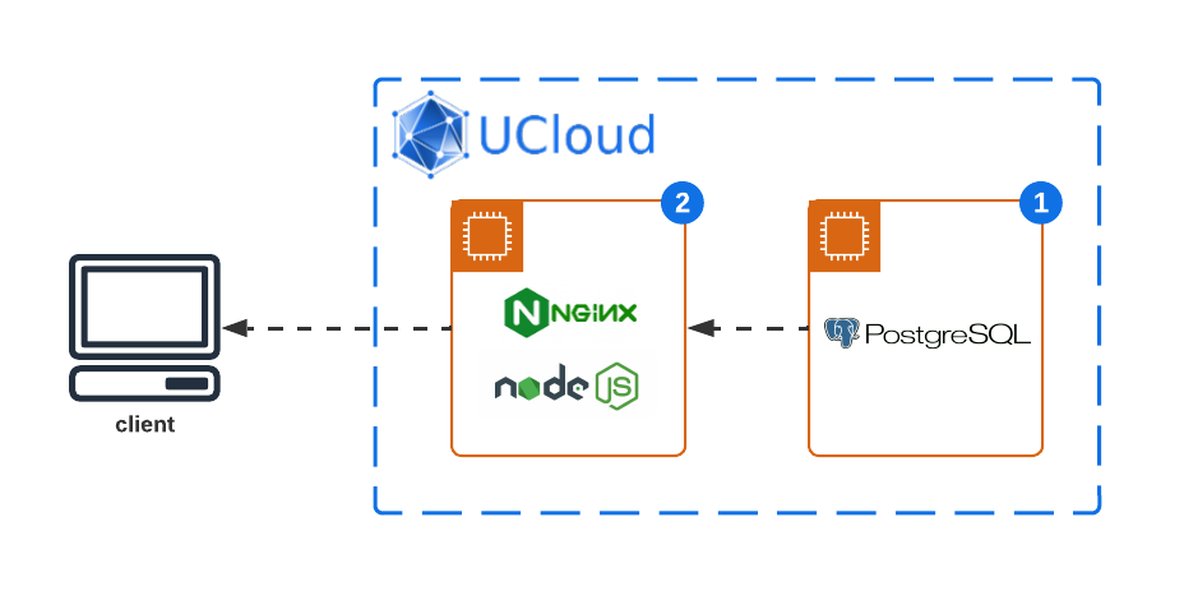
Conceptual diagram illustrating how a backend API layer (like Node.js) interacts with PostgreSQL, often fronted by a proxy like Nginx.
3. Backend Application Layer: The Logic Hub
This layer acts as the intermediary between the frontend and the data storage. It exposes an API for the web application, enforces business rules, and retrieves/formats data.
Key Components & Strategies:
- API Servers: Stateless server instances (e.g., built with Node.js, Python/FastAPI, Java/Spring Boot, ASP.NET Core) that handle incoming requests from the web application. They implement RESTful or GraphQL endpoints.
- Backend Load Balancer: Similar to the database load balancer, this distributes incoming user traffic across multiple instances of the API server, ensuring high availability and scalability.
- Auto-Scaling: Configure the API server deployment (e.g., using Kubernetes HPA or cloud provider auto-scaling groups) to automatically adjust the number of running instances based on metrics like CPU utilization or request count. This handles traffic spikes gracefully.
- Caching Layer: Implementing an in-memory cache (like Redis or Memcached) is critical for performance. Frequently requested data or computed results can be stored in the cache, reducing the number of queries hitting the database (especially the read replicas) and significantly speeding up response times. Strategies include caching database query results, pre-computed aggregates, or even full API responses.
- Data Access Logic: Efficiently queries the PostgreSQL database, preferably directing read operations to the read replicas (via the database load balancer) and write operations (if any initiated by user actions) to the primary instance. ORMs (Object-Relational Mappers) can simplify database interaction.
4. Web Application Layer: The User Interface
This is the frontend layer that users interact with directly in their browsers.
Key Components & Strategies:
- Frontend Framework: Modern JavaScript frameworks like React, Angular, or Vue.js are commonly used to build interactive and responsive user interfaces.
- API Consumption: The frontend makes asynchronous requests to the backend application layer's API to fetch and display data.
- Client-Side Optimization: Techniques like code splitting, lazy loading of components or data, and browser caching improve the perceived performance and responsiveness of the application.
- Content Delivery Network (CDN): Using a CDN (like Cloudflare, AWS CloudFront, Akamai) to serve static assets (HTML, CSS, JavaScript, images) drastically reduces latency for users globally by caching content closer to their geographic location. CDNs can sometimes also cache API responses.
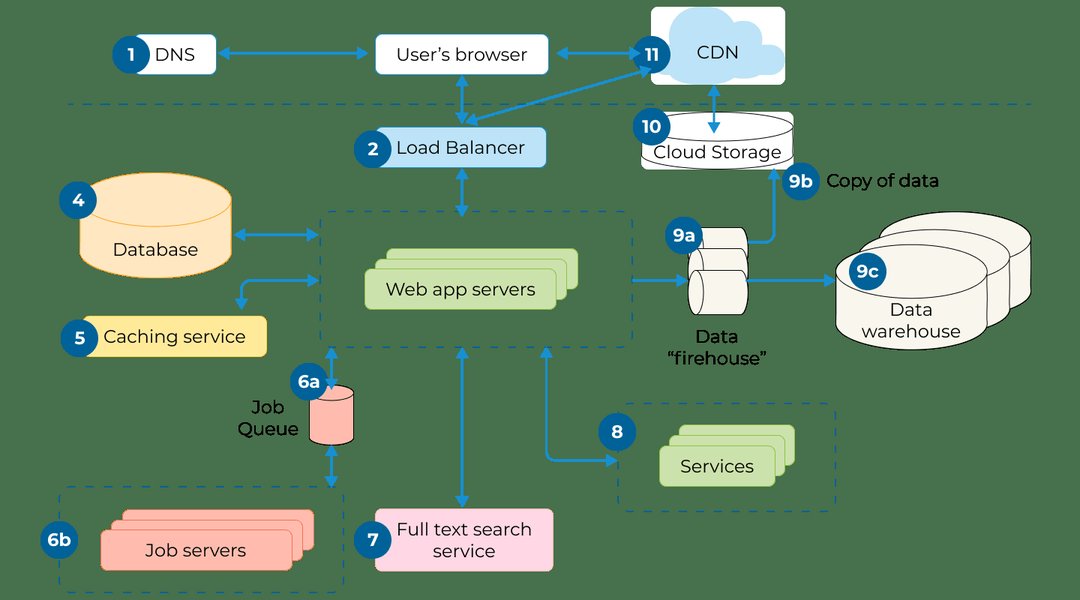
A typical web application architecture showing the flow from user to web server, application server, and database, often including load balancers and CDNs.
Evaluating the Architecture: Key Capabilities
This radar chart provides an opinionated evaluation of the proposed architecture across several critical dimensions. Higher scores indicate stronger capability in that area, achieved through the combined strategies discussed (e.g., replication boosts Availability, load balancing/queues boost Scalability).
Handling High Load: Mitigation Strategies
Successfully managing high load requires specific tactics applied across the architecture. This table summarizes key strategies for each component layer:
| Component Layer | Strategy | Implementation Example | Benefit |
|---|---|---|---|
| Data Ingestion | Decoupling & Buffering | Message Queue (Kafka, RabbitMQ) | Absorbs data bursts, prevents DB overload, allows independent scaling of ingestion/processing. |
| Data Ingestion | Rate Limiting & Backoff | Intelligent API Clients | Respects external API limits, handles transient errors gracefully. |
| Data Ingestion | Parallel Processing | Multiple Worker Instances consuming from Queue | Increases ingestion throughput. |
| Data Storage (PostgreSQL) | Read Scaling | Read Replicas + DB Load Balancer | Distributes read queries, increases read throughput, improves web app responsiveness. |
| Data Storage (PostgreSQL) | Connection Management | Connection Pooler (PgBouncer) | Reduces connection overhead, improves performance under high concurrency. |
| Data Storage (PostgreSQL) | Write Optimization | Performance Tuning (e.g., `fillfactor`), Batch Inserts, Asynchronous Commits (if acceptable) | Improves write throughput on the primary instance. |
| Data Storage (PostgreSQL) | High Availability | Automated Failover (e.g., Patroni, repmgr) | Minimizes downtime if the primary database fails. |
| Backend Application | Horizontal Scaling | Multiple API Server Instances + Load Balancer | Handles high concurrent user requests. |
| Backend Application | Dynamic Scaling | Auto-Scaling Groups (Cloud/Kubernetes) | Adjusts resources automatically based on load, optimizing cost and performance. |
| Backend Application | Caching | In-Memory Cache (Redis, Memcached) | Reduces database load, significantly speeds up responses for frequently accessed data. |
| Web Application (Frontend) | Static Asset Caching | Content Delivery Network (CDN) | Reduces latency for users worldwide, offloads traffic from origin servers. |
| Cross-Cutting | Monitoring & Alerting | Prometheus, Grafana, CloudWatch, Datadog | Provides visibility into system health, enabling proactive issue resolution. |
Supporting Infrastructure & Cross-Cutting Concerns
Beyond the core layers, several supporting elements are vital for a production-ready, high-load system:
- Monitoring and Alerting: Comprehensive monitoring of all components (API ingestion rates, queue depths, database performance metrics like CPU/RAM/IOPS, replica lag, application response times, error rates) is essential. Tools like Prometheus, Grafana, Datadog, or cloud provider services should be used to visualize metrics and trigger alerts on anomalies or threshold breaches.
- Logging: Centralized logging (e.g., using an ELK stack - Elasticsearch, Logstash, Kibana - or cloud-based solutions) aggregates logs from all services, making debugging and tracing requests across the system feasible.
- Security: Security must be implemented at every layer: secure API key management for external APIs, HTTPS for all communication, network security rules (firewalls), database access controls, web application security practices (input validation, authentication, authorization).
- Backup and Recovery: Robust and regularly tested backup and recovery procedures for the PostgreSQL database are non-negotiable. This includes point-in-time recovery (PITR) capabilities to minimize data loss in case of catastrophic failure.
Frequently Asked Questions (FAQ)
Why is a Message Queue recommended for data ingestion?
A message queue (like Kafka or RabbitMQ) acts as a buffer and decouples the data ingestion process (fetching from APIs) from the data storage process (writing to PostgreSQL). This provides several benefits under high load:
- Load Smoothing: It absorbs sudden bursts of data from APIs, preventing the database from being overwhelmed by write requests. Data can be consumed and written to the database at a more controlled, sustainable rate.
- Resilience: If the database is temporarily unavailable or slow, the ingestion process can continue publishing data to the queue. Data is not lost, and processing resumes when the database recovers.
- Scalability: You can independently scale the number of API fetchers (producers) and database writers (consumers) based on the load profile.
- Asynchronous Processing: Allows potentially slow API calls or complex transformations to happen without blocking the main application flow.
How do Read Replicas improve performance?
Read replicas are copies of the primary PostgreSQL database that stay updated through replication. They primarily serve read-only queries. This improves performance and availability in several ways:
- Load Distribution: By directing read traffic (which often constitutes the majority of web application load) to replicas, the primary database is freed up to handle write operations more efficiently.
- Increased Read Throughput: Multiple replicas can handle more concurrent read queries than a single primary server. A load balancer distributes requests among them.
- High Availability (HA): If the primary database fails, a replica can be promoted to become the new primary, minimizing downtime (though this requires careful configuration and potentially automated failover tools like Patroni).
- Reduced Latency: In geographically distributed setups, replicas can be placed closer to users to reduce read latency (though this architecture focuses more on logical separation).
What's the role of Caching in this architecture?
Caching involves storing copies of frequently accessed data in a faster-access location (like server memory or dedicated caching systems like Redis/Memcached) to avoid repeatedly fetching it from the slower primary data source (PostgreSQL). Its roles include:
- Reducing Database Load: Serving requests from the cache significantly reduces the number of read queries hitting the PostgreSQL replicas, lowering resource consumption and potentially costs.
- Improving Response Time: Accessing data from an in-memory cache is much faster than querying a database, leading to quicker API responses and a more responsive web application for the end-user.
- Increasing Throughput: Caching layers can often handle a higher rate of requests than the database itself.
Caching can be implemented at multiple levels: within the backend application, using dedicated caching servers (Redis/Memcached), or even at the edge using a CDN for API responses.
How should API rate limits be handled during ingestion?
Public APIs often impose rate limits (a maximum number of requests allowed within a specific time window) to prevent abuse and ensure fair usage. Handling these gracefully is crucial for reliable data ingestion:
- Respect Limits: Design API clients to be aware of the specific limits of each API they interact with.
- Throttling: Implement mechanisms within the API clients or the orchestrator to limit the rate at which requests are sent, staying below the published limits.
- Exponential Backoff & Retries: When a rate limit error (e.g., HTTP 429 Too Many Requests) is received, the client should wait for a period before retrying. Implement an exponential backoff strategy (wait 1s, then 2s, then 4s, etc.) to avoid hammering the API immediately after being limited.
- Monitoring: Track API usage and error rates (specifically rate limit errors) to adjust throttling parameters if necessary.
- Queueing: The message queue can also help by allowing fetch jobs to be queued if downstream processing or API limits cause temporary backlogs.
Recommended Further Exploration
- How do Kafka and RabbitMQ compare for high-throughput data ingestion scenarios?
- Can you provide a tutorial for implementing PostgreSQL connection pooling with PgBouncer?
- What are effective strategies for caching database queries in a web application backend using Redis?
- How can automated PostgreSQL failover be configured using Patroni for high availability?
References

Last updated May 4, 2025