
The Hidden Language of Forests: How Trees Create a Social Network Underground
Discover the remarkable ways trees communicate, share resources, and support their communities through complex networks that challenge our understanding of plant intelligence
The Social Life of Trees: Key Insights
- Trees form vast underground communication networks using fungal connections that link entire forests together
- Older "mother trees" serve as central hubs in these networks, nurturing younger trees and sharing vital resources
- Trees warn each other about threats using both chemical signals through the air and messages sent through their root networks
The Wood Wide Web: Understanding Forest Communication Networks
Contrary to the perception of trees as silent, solitary organisms competing for resources, scientific research has revealed that forests are bustling communication hubs where trees are constantly exchanging information and resources. This complex social network, often referred to as the "Wood Wide Web," allows trees to support one another, warn of dangers, and create resilient ecosystems that benefit the entire forest community.
Mycorrhizal Networks: Nature's Underground Internet
The primary communication infrastructure of forests lies beneath our feet in the form of mycorrhizal networks. These networks consist of thread-like fungal structures called mycelium that form symbiotic relationships with tree roots. The fungi receive carbohydrates from the trees while helping them access nutrients and water from the soil.
These fungal networks serve as communication conduits, allowing trees to:
- Exchange nutrients, carbon, and water
- Send warning signals about environmental threats
- Support younger or struggling trees in the community
- Transfer information about environmental conditions
The Science Behind Mycorrhizal Associations
The relationship between trees and fungi is a true symbiosis. The fungal networks extend the reach of tree roots by up to 700%, dramatically increasing their ability to absorb water and nutrients. In return, trees provide fungi with carbohydrates produced through photosynthesis—a perfect exchange that has evolved over millions of years.
Research has shown that these networks connect not just individuals of the same species but can link different species of trees throughout a forest. This interspecies communication allows diverse forest ecosystems to function as cohesive units rather than collections of competing individuals.
Chemical Communication: Airborne Messaging Systems
Beyond underground networks, trees also communicate through the air using volatile organic compounds (VOCs). When a tree is under attack from insects or pathogens, it releases specific chemical compounds that:
- Alert neighboring trees to the presence of a threat
- Trigger defensive responses in surrounding trees
- Attract predators that feed on the attacking pests
- Signal the need for increased production of defensive compounds
Chemical Defense Mechanisms in Action
A classic example of this chemical communication occurs when acacia trees are browsed by giraffes. Within minutes of being eaten, the trees increase production of tannins, making their leaves unpalatable. Simultaneously, they release ethylene gas that travels downwind, causing neighboring acacias to preemptively increase their own tannin levels before the giraffes reach them.
Similar responses have been documented in numerous tree species, demonstrating that this form of communication is widespread throughout forest ecosystems and represents a sophisticated defense strategy that benefits the entire community.
Mother Trees: The Wisdom Keepers of the Forest
Large, older trees, often called "mother trees," play a crucial role in forest communication networks. These veteran trees serve as central hubs in the mycorrhizal network, connecting with hundreds of younger trees throughout the forest. Research by forest ecologist Dr. Suzanne Simard has shown that these mother trees recognize their own seedlings and preferentially share resources with them, though they support other young trees as well.
How Mother Trees Support Forest Communities
- Sharing carbon, nutrients, and water with younger trees, especially during times of stress
- Transmitting defense signals about environmental threats
- Redistributing resources throughout the network based on need
- Increasing the survival rate of connected seedlings by up to 400%
- Transferring legacy information to the next generation before dying
This nurturing behavior suggests a form of kin recognition in trees, challenging our understanding of plant intelligence and raising profound questions about the nature of forest communities as superorganisms rather than collections of individual competitors.
This radar chart illustrates the relative capabilities of different tree age groups within forest communication networks, based on scientific research. Mother trees show significantly enhanced abilities across all communication and support functions, while seedlings primarily benefit from the network rather than contributing to it.
Evidence of Tree Communication: Real-World Examples
Coordinated Defense Responses
One of the most compelling examples of tree communication occurs during insect attacks. When trees are infested by leaf-eating insects, they not only produce defensive compounds themselves but also send airborne warning signals that prompt neighboring trees to preemptively increase their own defenses. This coordinated response significantly reduces the damage caused by insect outbreaks across the forest.
Resource Sharing During Stress
Research has shown that during droughts or other stressful conditions, trees connected through mycorrhizal networks will redistribute water and nutrients to support struggling members of the community. This mutual aid system helps maintain forest resilience and increases survival rates during challenging environmental conditions.
Forest Recovery After Disturbance
When older trees are damaged or dying, they often increase the transfer of carbon and nutrients to younger trees in the vicinity. This "legacy effect" helps ensure the continued health of the forest community even after the mother tree's death, essentially passing on resources to the next generation.
Scientific Validation
These communication behaviors have been validated through carefully controlled scientific experiments using techniques such as:
- Radioactive isotope tracking to monitor nutrient movement between trees
- Network analysis to map fungal connections in forest soils
- Chemical analysis of defensive compounds in trees following exposure to warning signals
- Experimental isolation of trees from mycorrhizal networks to observe the effects on growth and survival
Understanding Tree Communication Systems
| Communication Method | Information Shared | Transmission Medium | Response Time | Distance |
|---|---|---|---|---|
| Mycorrhizal Networks | Nutrients, water, carbon, defense signals, stress alerts | Underground fungal connections | Hours to days | Several meters to hundreds of meters |
| Airborne Chemical Signals | Insect attacks, browsing animals, pathogen infections | Volatile organic compounds (VOCs) | Minutes to hours | Up to 100 meters (depending on wind) |
| Electrical Signals | Injury, severe stress, immediate threats | Cell-to-cell transmission via vascular system | Seconds to minutes | Throughout individual tree |
| Root Contact | Growth patterns, space recognition | Direct root interactions | Days to weeks | Immediate vicinity |
Visual Evidence: The Forest Communication Network
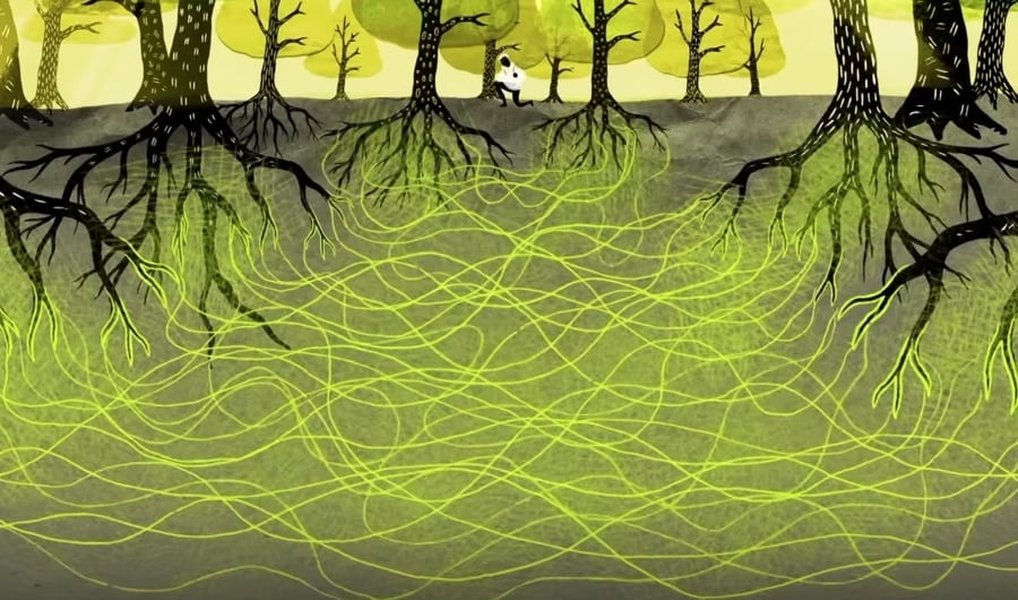
This diagram illustrates how mycorrhizal networks connect trees throughout a forest ecosystem, allowing for the sharing of resources and information. The fungal hyphae extend the effective reach of tree roots and create pathways for communication between individuals.

A more detailed illustration showing how a mother tree supports younger trees in the forest community through connected mycorrhizal networks. Note how resources flow from the larger tree to smaller ones during times of need.
Forest Communication: A Mindmap Overview
This mindmap provides a visual overview of the complex communication systems used by trees, including both underground and aboveground methods, key roles within the network, and the ecological benefits of these interactions.
Video Explanation: The Wood Wide Web
In this acclaimed TED Talk, forest ecologist Suzanne Simard explains her groundbreaking research on how trees talk to each other through underground fungal networks. Her 30+ years of research in Canadian forests has revolutionized our understanding of forest ecosystems as complex social communities rather than collections of individual competitors.
Ecological Significance of Tree Communication
Enhanced Forest Resilience
The communication networks within forests contribute significantly to ecosystem resilience. By sharing resources and information, forest communities can better withstand environmental stressors such as drought, disease, and climate change. This collective response capability helps maintain biodiversity and ecosystem functions even under challenging conditions.
Support for Biodiversity
The mycorrhizal networks that connect trees also support numerous other species, from fungi and bacteria to plants and animals. These interconnected webs create habitat niches and resource flows that maintain diverse ecological communities, with old-growth forests showing particularly complex and extensive networks.
Implications for Forest Management
Understanding tree communication has profound implications for forest management practices. Clear-cutting, for example, doesn't just remove trees but destroys entire communication networks that may have taken decades or centuries to develop. Sustainable forestry approaches that preserve mother trees and maintain network connectivity are increasingly recognized as essential for forest health.
Practical Applications
This knowledge is already informing innovative approaches to forest restoration and management, including:
- Retention of mother trees during selective harvesting
- Protection of mycorrhizal network integrity during forestry operations
- Use of nurse trees to help establish reforestation projects
- Promotion of mixed-species forests to enhance communication diversity
- Soil management practices that support healthy fungal communities
Frequently Asked Questions
References
- Exploring How and Why Trees 'Talk' to Each Other - Yale Environment 360
- Trees Talk To Each Other. 'Mother Tree' Ecologist Hears Lessons For People, Too - NPR
- How Do Trees Communicate? - One Tree Planted
- The Whispering Trees - Smithsonian Magazine
-
Do Trees Really Support Each Other Through a Network of Fungi? - Scientific American
- Wood Wide Web: Trees' Social Networks Are Mapped - BBC
- Research - Suzanne Simard: Mother Tree Project
Recommended Topics
Last updated April 3, 2025