
Unlock Global Trade: Your Comprehensive Guide to Understanding HS Codes
Navigate international commerce with confidence by mastering the Harmonized System for product classification.
Essential Insights into HS Codes
- Universal Standard: HS Codes are a 6-digit global standard managed by the World Customs Organization (WCO), crucial for classifying over 98% of internationally traded goods.
- Critical for Compliance: Accurate HS Code usage is vital for determining tariffs, taxes, and ensuring compliance with trade regulations, thereby avoiding costly penalties and delays.
- National Variations Exist: While the first six digits are universal, many countries, like the U.S. with its Harmonized Tariff Schedule (HTS), extend codes (to 8-10 digits) for more specific national requirements.
Unveiling the Harmonized System: What is an HS Code?
The Harmonized System (HS) code is an internationally standardized numerical method of classifying traded products. Developed and maintained by the World Customs Organization (WCO), it serves as a universal "language" for international trade, used by over 200 countries and economies worldwide. Think of it as an essential passport for goods crossing international borders.
The Global Standard for Trade
At its core, the HS code system is designed to ensure uniformity in the classification of goods globally. This standardization is fundamental for customs authorities to identify products consistently, irrespective of the origin or destination country. Approximately 98% of all merchandise in international trade is classified in terms of the HS.
Core Purpose: Facilitating Global Commerce
The primary purposes of HS codes are multifaceted and critical for the smooth flow of international commerce:
- Tariff Application: Customs authorities use HS codes to determine the correct import and export duties, taxes (like VAT or GST), and other levies applicable to specific products.
- Trade Statistics: Governments and international organizations rely on HS codes to collect and analyze trade statistics, enabling them to monitor trade flows, formulate economic policies, and conduct market research.
- Regulatory Compliance: HS codes help enforce national and international regulations, including import/export controls, safety standards, environmental protection measures, and quotas.
- Trade Negotiations: They provide a common basis for trade negotiations and the implementation of trade agreements, such as Free Trade Agreements (FTAs).
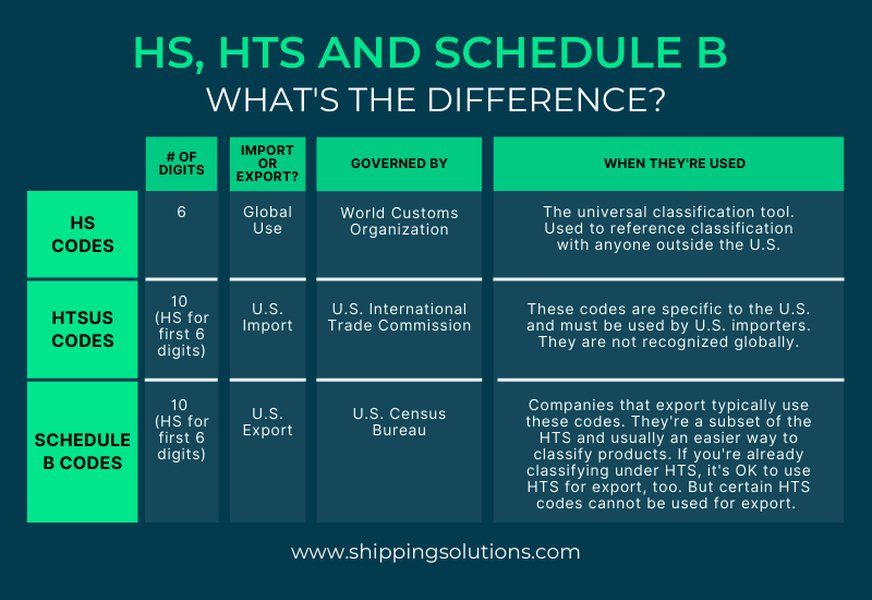
Visual illustrating the relationship between HS Codes, HTS Codes (U.S. Imports), and Schedule B Codes (U.S. Exports).
Decoding the Numbers: The Structure of HS Codes
The Harmonized System is organized logically and hierarchically. The HS nomenclature is divided into 21 Sections, which are subdivided into 99 Chapters. The 99 HS Chapters are further subdivided into Headings and Subheadings.
The International 6-Digit Framework
The standard international HS code consists of six digits. These six digits provide a specific classification for a product and are recognized globally. The structure is as follows:
- First 2 digits (Chapter): Identify the chapter in which the goods are classified. Chapters represent broad categories of products (e.g., Chapter 04 for "Dairy produce; birds' eggs; natural honey...").
- Next 2 digits (Heading): These form a 4-digit heading, which is a more specific category within that chapter (e.g., 0406 for "Cheese and curd").
- Final 2 digits (Subheading): These complete the 6-digit subheading, offering an even more detailed classification (e.g., 0406.10 for "Fresh (unripened or uncured) cheese, including whey cheese, and curd").
National Adaptations: Extending the Code
While the 6-digit HS code is internationally standardized, individual countries or customs unions often require more detailed classifications for their own tariff and statistical needs. They achieve this by adding further digits to the initial 6-digit HS code.
- Harmonized Tariff Schedule (HTS) Codes: In the United States, for example, import classifications are based on the Harmonized Tariff Schedule of the United States (HTSUS). HTS codes are typically 8 to 10 digits long. The first six digits are the international HS code, while the additional digits provide further U.S.-specific detail for duty rates and statistical categories.
- Other National Codes: Similar extensions exist in other countries and economic blocs (e.g., the Combined Nomenclature - CN - in the European Union, which is an 8-digit code).
It is crucial for traders to use the correct full national code for the country of import or export.
Why HS Codes Matter: The Backbone of International Trade
The accurate application of HS codes is not merely an administrative formality; it is fundamental to successful and compliant international trade operations. Incorrect classification can lead to significant problems.
Accurate Tariff and Tax Application
HS codes directly determine the duties and taxes levied on goods. An incorrect code can result in overpayment (eroding profits) or underpayment (leading to penalties and legal action from customs authorities).
Ensuring Trade Compliance and Avoiding Penalties
Using the correct HS code ensures compliance with a myriad of trade regulations. This includes adherence to import/export licenses, quotas, anti-dumping duties, and sanitary or phytosanitary requirements. Errors can lead to shipment delays, customs detentions, fines, seizure of goods, or even criminal charges in severe cases.
Vital for Trade Statistics and Policy
Governments rely on data collected via HS codes to compile accurate trade statistics. This information is essential for understanding trade balances, identifying market trends, negotiating trade agreements, and formulating national economic and trade policies.
Streamlining Logistics and Supply Chains
Logistics providers, freight forwarders, and customs brokers use HS codes to prepare shipping documentation, manage customs clearance processes, and ensure the efficient movement of goods across borders. Correct codes facilitate smoother, faster, and more predictable supply chains.
HS Codes in Action: A Visual Overview
To better understand the interconnected elements of the Harmonized System, the mindmap below illustrates its core components, purpose, and significance in global trade. It highlights the hierarchical structure, the role of the WCO, and the practical implications for businesses involved in international commerce.
The Criticality of HS Codes: A Multi-Stakeholder Perspective
The Harmonized System's impact extends across various entities involved in international trade. The radar chart below illustrates the perceived importance of different aspects of HS codes for key stakeholders. The scale ranges from 3 (Moderately Important) to 10 (Critically Important), highlighting how different priorities (like accuracy, tariff determination, statistical value, compliance burden, and operational impact) resonate across customs authorities, importers, exporters, logistics providers, governments, and the WCO itself.
Navigating the System: Finding and Using HS Codes
Determining the correct HS code for a product is a critical step for importers and exporters. Several resources are available to assist in this process.
Key Resources for HS Code Lookup
- Official Government Customs Websites: Most countries provide online tools or access to their national tariff schedules. For instance, the U.S. International Trade Commission (USITC) publishes the official Harmonized Tariff Schedule (HTS) on its website (hts.usitc.gov).
- Online HS Code Finders: Numerous commercial websites and platforms offer HS code lookup tools. These often allow searching by product description or keywords. Examples include tools provided by logistics companies, trade data providers (like Trade Atlas, Freightos), and customs clearance services.
- Customs Brokers and Consultants: For complex products or when in doubt, consulting with a customs broker or a trade consultant is advisable. They possess expertise in classification.
- AI-Powered Tools: Emerging AI-driven tools can assist in HS code classification by analyzing detailed product descriptions, though verification is still recommended.
- U.S. Customs Rulings Online Search System (CROSS): This U.S. Customs and Border Protection database contains binding rulings on specific products, which can be a valuable resource for complex classifications.
Staying Current: The Importance of Updates (2025 Revisions)
The Harmonized System is not static. The WCO reviews and amends the HS nomenclature approximately every five years to reflect changes in technology, trade patterns, and the emergence of new products. The most recent major set of WCO amendments took effect on January 1, 2022. Countries then incorporate these changes into their national tariff schedules.
For example, the Harmonized Tariff Schedule of the United States (HTS) is updated regularly to reflect these WCO changes, as well as other domestic legislative actions. The 2025 HTS is the current version importers to the U.S. must use. It's crucial for traders to always use the most current version of the relevant tariff schedule to ensure compliance.
Beyond the Basics: HS, HTS, and Schedule B Codes Explained
While "HS Code" is a general term, you might encounter related terms like "HTS Code" and "Schedule B Code," especially in the context of U.S. trade. The table below clarifies their distinctions:
| Feature | HS Code (Harmonized System) | HTS Code (Harmonized Tariff Schedule - USA Import) | Schedule B Code (USA Export) |
|---|---|---|---|
| Issuing Body | World Customs Organization (WCO) | U.S. International Trade Commission (USITC) | U.S. Census Bureau |
| Digits | 6 (International Standard) | 8-10 (Builds on the 6-digit HS) | 10 (Builds on the 6-digit HS) |
| Primary Use | Global product classification, basis for national tariffs | U.S. import duties, taxes, statistics, and trade regulations | U.S. export statistics and export control regulations |
| Scope | International (over 200 countries) | Specific to goods imported into the U.S. | Specific to goods exported from the U.S. |
| Mandatory For | International shipments globally (as a base) | All goods imported into the United States | Goods exported from the U.S. valued over $2,500 per Schedule B number, or requiring an export license |
Visual Guide: Understanding HS, HTS, and Schedule B
The nuances between HS, HTS, and Schedule B codes can be complex. The following video provides a clear explanation of these different classification systems, particularly focusing on their application in the context of U.S. trade. It details how they relate to each other and why it's important to use the correct code for your specific trade activity (importing vs. exporting).
This video helps to visually and audibly reinforce the differences and specific uses of these critical trade classification tools, ensuring traders are better equipped to navigate the complexities of international commerce, especially when dealing with the United States.
Frequently Asked Questions (FAQ) about HS Codes
What happens if I use the wrong HS code?
Using an incorrect HS code can lead to a range of serious consequences, including:
- Shipment Delays: Customs authorities may hold your goods for inspection or reclassification.
- Fines and Penalties: Significant financial penalties can be imposed for misclassification.
- Seizure of Goods: In some cases, especially for repeated or deliberate errors, goods may be confiscated.
- Incorrect Duty/Tax Assessment: You might overpay or underpay duties and taxes, the latter leading to future liabilities and interest.
- Legal Issues: Persistent non-compliance can result in legal action.
- Damage to Business Reputation: Frequent issues with customs can harm your standing with authorities and trading partners.
How often are HS codes updated?
The World Customs Organization (WCO) reviews and amends the international Harmonized System nomenclature approximately every five years. The most recent major global update took effect on January 1, 2022. Individual countries then update their national tariff schedules (like the U.S. HTS) to incorporate these WCO amendments and any other national changes. National schedules, such as the HTS, may be updated more frequently, often annually (e.g., the 2025 HTS is currently in force as of May 2025).
Can one product have multiple HS codes?
Generally, a specific, clearly defined product should have only one correct HS code at the 6-digit international level. However, classification can become complex for:
- Products with multiple components or materials.
- Goods that could potentially fit into more than one classification based on their function or composition.
- Kits or sets containing multiple distinct articles.
Who is responsible for assigning the HS code?
The ultimate responsibility for declaring the correct HS code on customs documentation lies with the importer (for imports) or the exporter (for exports). While customs brokers, freight forwarders, or consultants can provide assistance and expertise in determining the appropriate code, the legal liability for accuracy rests with the trader whose name appears on the declaration.
Are HS codes the same in every country?
The first six digits of an HS code are standardized internationally under the WCO's Harmonized System and are used by more than 200 member countries and economies. This ensures a common basis for classification worldwide. However, countries are permitted to add further digits to the 6-digit HS code to create more detailed national subdivisions for their own tariff or statistical purposes. For example, the U.S. uses 8 or 10-digit HTS codes for imports, and the EU uses 8-digit CN codes. Therefore, while the 6-digit root is common, the complete national code used for customs declarations can vary from country to country beyond the sixth digit.
Explore Further
Delve deeper into related topics to expand your understanding of international trade compliance:
- How do I correctly classify products using HTS codes for U.S. imports?
- What are the General Interpretative Rules (GIRs) for HS classification and how do they work?
- What are the common consequences and penalties for HS code misclassification in international shipping?
- How do Free Trade Agreements (FTAs) affect tariff rates associated with specific HS codes?
References
 help.shopify.com

Last updated May 8, 2025