
Ibn Rushd (Averroes): Unveiling the Philosopher Who Bridged Faith and Reason
Discover the profound thought of the Andalusian polymath who harmonized Aristotelian logic with Islamic theology.
Often known in the West as Averroes, Abu al-Walid Muhammad ibn Ahmad ibn Rushd (1126–1198 CE) was a towering figure in Islamic philosophy, jurisprudence, medicine, and science from Al-Andalus (Muslim Spain). His intellectual project centered on demonstrating the fundamental harmony between philosophy (particularly the rational system of Aristotle) and Islamic revelation. He believed that both paths, when correctly understood, lead to the same truth. His extensive commentaries on Aristotle were instrumental in reintroducing the Greek philosopher's works to medieval Europe, sparking intellectual revolutions and earning him the title "The Commentator."
Before diving deep, it's important to note the query mentioned "Ien Rushids," which appears to be a misspelling of Ibn Rushd.
Key Insights into Ibn Rushd's Philosophy
- Harmony of Truths: Ibn Rushd famously argued that truth obtained through philosophy (reason) cannot contradict truth found in revelation (faith), as both ultimately originate from God.
- Champion of Aristotle: He sought to purify Aristotelian philosophy from Neoplatonic interpretations prevalent among earlier Islamic thinkers, presenting what he believed was Aristotle's authentic thought.
- Defender of Philosophy: In response to theological critiques (notably from Al-Ghazali), Ibn Rushd vigorously defended the legitimacy and necessity of philosophical inquiry within Islam, especially for the intellectual elite capable of understanding demonstrative proofs.
Defining Ibn Rushd's Thought: An Overview
The Quest for Harmony
Ibn Rushd's philosophy emerged during a vibrant but contentious period in the Islamic intellectual tradition. While figures like Al-Farabi and Avicenna (Ibn Sina) had integrated Greek philosophy, particularly Neoplatonism, into Islamic thought, others like Al-Ghazali launched powerful critiques against philosophy, arguing it led to heresy. Ibn Rushd positioned himself as a staunch defender of the philosophical path, specifically championing Aristotelianism.
His core conviction was that the study of philosophy, using logic and reason, was not only permitted by Islamic law (Sharia) but, for those intellectually equipped, a religious obligation. He believed the Quran itself encourages reflection on creation, which necessitates understanding the world through rational inquiry. His primary aim was to demonstrate that Aristotelian philosophy, properly understood, provided the most robust framework for this understanding and was fully compatible with Islamic doctrines.
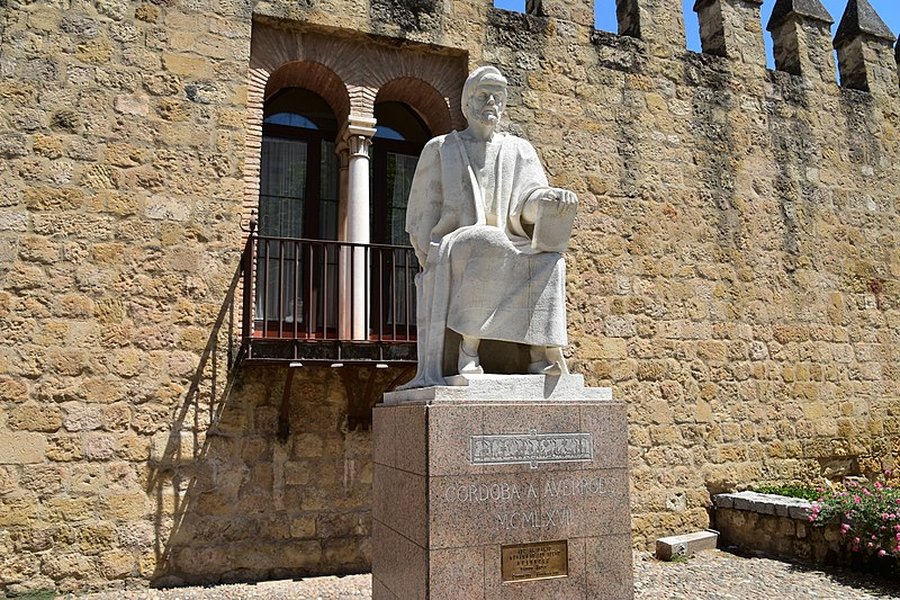
Statue commemorating Ibn Rushd in his birthplace, Cordoba, Spain, reflecting his enduring legacy.
His method involved writing meticulous commentaries on Aristotle's works, ranging from short summaries to detailed line-by-line analyses. These commentaries became crucial texts not only in the Islamic world but also in Latin Christendom and Jewish philosophy, preserving and transmitting Aristotelian thought during a time when many original Greek texts were lost to the West.
Exploring the Core Philosophical Domains
a) Metaphysics: Understanding Reality and the Divine
Aristotle Meets Islamic Monotheism
Ibn Rushd's metaphysics is deeply rooted in Aristotle's study of "being qua being." He sought to understand the fundamental nature of reality, existence, and God, primarily through his detailed analysis of Aristotle's *Metaphysics*. A central task was reconciling Aristotelian concepts, such as the eternity of the world and the nature of the First Cause (or Unmoved Mover), with the tenets of Islamic theology, particularly the absolute oneness (Tawhid) and creative power of God.
Unlike Avicenna, who incorporated Neoplatonic ideas like emanationism, Ibn Rushd aimed for a purer Aristotelianism. He engaged critically with concepts like substance, potentiality, and actuality. He defended the idea of the world's eternity against the Ash'ari theological view of creation *ex nihilo* (from nothing) at a specific point in time. For Ibn Rushd, an eternal creation did not contradict God's power but rather reflected God's eternal and unchanging nature and will. God, as the First Cause, eternally sustains the universe through necessary causal chains, rejecting the occasionalism of theologians like Al-Ghazali, who argued God directly intervenes to create every event.
Example and Citation: God as the First Cause
In his commentary on Aristotle's *Metaphysics*, particularly Book Lambda (Lām), Ibn Rushd elaborates on the concept of God as the ultimate Unmoved Mover, the primary cause of the eternal motion of the celestial spheres. He aligns this Aristotelian concept with the Islamic understanding of Allah as the necessary, eternal, and unique First Cause of all existence. He argues that divine attributes like knowledge and power are necessary aspects of God's essence, affirmed through rational analysis (See: *Ibn Rushd's Metaphysics: A Translation with Introduction of Ibn Rushd's Commentary on Aristotle's Metaphysics, Book Lām*). His arguments against Al-Ghazali on creation and causality are famously articulated in *Tahāfut al-Tahāfut* (*The Incoherence of the Incoherence*).
Synthesis for Understanding
Think of Ibn Rushd's metaphysics as building a rational bridge. On one side, you have the observable, structured universe operating according to natural laws (Aristotle's physics and metaphysics). On the other side, you have the absolute, eternal God of Islam. Ibn Rushd uses Aristotelian logic to show how this structured universe is eternally dependent on God as its ultimate cause and sustainer. It suggests a cosmos where scientific understanding and faith in a creator are not mutually exclusive but intrinsically linked, with God's perfection reflected in the rational order of His creation.
b) Epistemology: Paths to Knowledge
Reason, Revelation, and Levels of Understanding
Ibn Rushd's epistemology addresses how humans acquire knowledge and the relationship between reason ('aql) and revelation (shar'). His seminal work on this topic is *Faṣl al-Maqāl* (*The Decisive Treatise, Determining the Nature of the Connection between Religion and Philosophy*). Here, he argues that philosophy and the Islamic Sharia are not in conflict; rather, they represent different paths to the same truth, suited to different intellectual capacities.
He proposed a hierarchy of understanding and interpretation:
- Rhetorical Assent: The masses, who understand truth through stories, parables, and the literal interpretation of scripture.
- Dialectical Assent: Theologians (mutakallimūn), who use dialectical arguments (based on probable premises) to defend faith but may fall into error if they delve too deeply into interpretation without philosophical rigor.
- Demonstrative Assent: Philosophers (the elite), who are capable of rigorous logical deduction and scientific proof (burhān). They can grasp the deeper, allegorical meanings of scripture when the literal sense seems to contradict demonstrated truths.
He contended that when a demonstrated philosophical truth appears to conflict with the literal meaning of scripture, the scripture must be interpreted allegorically (ta'wīl) by those qualified (the philosophers). This allegorical interpretation, however, should not be shared with the masses, who might misunderstand it and lose their faith.
Example and Citation: The Decisive Treatise
In *The Decisive Treatise*, Ibn Rushd explicitly argues that "the Law commands the study of beings." He cites Quranic verses encouraging reflection on creation as evidence that Islam mandates philosophical inquiry for those capable. He asserts, "Truth does not oppose truth but accords with it and bears witness to it" (Averroes, *On the Harmony of Religions and Philosophy*). This work directly defends philosophy against charges of heresy, arguing that the Sharia itself supports rational investigation.
Synthesis for Understanding
Imagine knowledge as a mountain peak representing ultimate truth. Ibn Rushd suggests there are different paths to reach it. Some people take a well-trodden path using faith and scripture's plain meaning (rhetoric). Others use theological debate, carving a slightly steeper path (dialectics). The philosophers, however, use the tools of logic and demonstration to climb the most direct, albeit challenging, route. All paths aim for the same summit. This framework allows science (philosophy) and religion to coexist, validating different ways of knowing while privileging rational demonstration for achieving the deepest understanding.
c) Political Philosophy: The Just and Virtuous State
Plato's Republic in an Islamic Context
Ibn Rushd's political thought is most clearly expressed in his commentary on Plato's *Republic*. Lacking access to Aristotle's *Politics*, he used Plato's work as a framework to discuss the ideal state, law, justice, and the role of the ruler, adapting it to his Islamic context.
He agreed with Plato on the importance of a virtuous city ruled by philosopher-kings (or those guided by philosophical wisdom). However, he integrated this with the Islamic concept of the Sharia as the divine law guiding the community. For Ibn Rushd, the ideal state is one governed by a law that facilitates the happiness and virtue of all its citizens. While philosophy reveals the highest truths for the elite, the Sharia provides practical guidance for everyone, ensuring social cohesion and moral order.
Notably, Ibn Rushd criticized Plato for, in his view, neglecting the well-being and path to happiness for the "third estate" (the common people or artisans). He argued that the Islamic Sharia is superior because it provides guidance and ensures a share of happiness for all classes of believers, not just the guardians and rulers (See: Britannica, "Averroës - Contents and significance of works"). The philosopher's role in the state, according to Ibn Rushd, includes interpreting the law rationally and advising rulers to ensure governance aligns with both divine intent and philosophical wisdom.
Example and Citation: Commentary on Plato's Republic
In his *Commentary on Plato's Republic*, Ibn Rushd discusses the necessary qualifications for the ideal ruler, emphasizing intellectual virtue and the ability to understand both divine law and philosophical principles. He adapts Plato's classes (guardians, auxiliaries, producers) but insists that Islamic law provides a framework for the flourishing of all (Averroes, *Commentary on Plato's Republic*). His assertion that "religion is for all three classes" underscores his belief in the universality of Islamic law's guidance.
Synthesis for Understanding
Ibn Rushd envisions the ideal society like a well-run ship. The captain (ruler) needs the wisdom of a philosopher (or guidance from one) to navigate using the stars (reason and philosophy). However, the ship's code of conduct, ensuring everyone works together and reaches the destination safely, is the divine law (Sharia). Unlike Plato's focus primarily on the ruling class, Ibn Rushd emphasizes that this divine law cares for the well-being of every single person on board, making it a more just and comprehensive guide for the journey towards collective happiness.
Emphasis in Ibn Rushd's Philosophy: A Comparative View
The following chart provides a visual representation of the relative emphasis Ibn Rushd placed on different philosophical domains compared to his primary influence, Aristotle, and another major Islamic philosopher, Avicenna. The values are illustrative, reflecting scholarly consensus on their main concerns rather than precise quantitative measures.
This chart highlights Ibn Rushd's strong focus on metaphysics and epistemology, driven by his engagement with Aristotle and his defense of philosophy. His work in ethics and political philosophy is significant, particularly his commentaries, while aesthetics received considerably less direct attention compared to other areas.
d) Aesthetics: The Study of Beauty
An Understated Dimension
Explicit discussions of aesthetics (the philosophy of beauty and art) are not a prominent feature of Ibn Rushd's surviving works. His primary focus was on logic, metaphysics, epistemology, ethics, and law. While he commented extensively on Aristotle's *Poetics*, this was often treated more in the context of logic and rhetoric than aesthetics as a distinct field concerned with beauty itself.
However, one might infer an implicit aesthetic sensibility connected to his broader philosophy. His emphasis on rational order, harmony (between faith and reason, within the cosmos), and the perfection of divine creation could suggest an appreciation for beauty as a reflection of truth and intelligible form. The harmony and balance he sought in knowledge systems might extend to an appreciation for proportion, order, and fitness-for-purpose in both natural and man-made objects.
Example and Citation: Indirect Connections
While no specific treatise on beauty exists, his commentary on Aristotle's *De Anima* (*On the Soul*), which explores the intellect's role in perception and understanding, touches upon how the mind apprehends forms, which could indirectly relate to the perception of beauty (Averroes, *Commentary on Aristotle's De Anima*). The available sources (e.g., IEP, Stanford Encyclopedia) primarily focus on his other contributions, indicating aesthetics was not a central theme.
Synthesis for Understanding
Think of Ibn Rushd's view on beauty as possibly being like appreciating a finely crafted mathematical proof or a perfectly functioning machine. While he didn't write much about art or scenic vistas, his deep value for rational structure and harmony suggests he would likely find beauty in things that clearly exhibit order, purpose, and intellectual coherence, seeing them as reflections of the divine wisdom embedded in creation.
e) Ethics: The Pursuit of Happiness and Virtue
Aristotle's Ethics in an Islamic Framework
Ibn Rushd's ethical thought is heavily influenced by Aristotle, particularly the *Nicomachean Ethics*, which he commented upon. He adopted the Aristotelian view that the ultimate goal of human life is happiness (eudaimonia, or *sa'ada* in Arabic), which is achieved through living a life of virtue, guided by reason.
He believed that virtues are means between extremes, cultivated through habit and rational choice. Importantly, he integrated this framework with Islamic principles. While philosophers could understand and pursue virtue through rational reflection, the Sharia provided the essential moral guidance for the entire community, outlining rules and practices that promote human flourishing and happiness, even for those unable to engage in philosophical reasoning.
He argued against the Ash'arite view that moral values (good and evil) are determined solely by divine command. Ibn Rushd maintained that actions possess inherent moral qualities that reason can discern – for example, justice is intrinsically good, and lying is intrinsically bad – although revelation provides crucial confirmation and specific laws. He saw ethics as grounded in human nature and the rational order of the cosmos, ultimately reflecting divine wisdom.
Example and Citation: Virtue and Happiness
In his commentary on Aristotle's *Nicomachean Ethics*, Ibn Rushd discusses the intellectual and moral virtues necessary for achieving the highest form of happiness, which involves contemplation of truth (Ibn Rushd, *Commentary on Aristotle's Nicomachean Ethics*). Furthermore, his commentary on Plato's *Republic* links political structures to the ethical goal of achieving varying degrees of happiness for different classes within society, guided by the Sharia (See: Britannica, "Averroës - Contents and significance of works").
Synthesis for Understanding
Ibn Rushd's ethics is like having both a detailed map (philosophy/reason) and a reliable compass (Sharia/revelation) for navigating life towards happiness. Reason helps understand the terrain of virtues and vices, showing the path of moderation. The Sharia provides clear directions and rules accessible to everyone, ensuring all can journey towards a fulfilling life. Both tools work together, guiding individuals to act virtuously and achieve well-being, grounded in both human nature and divine guidance.
Mindmap: Key Aspects of Ibn Rushd's Philosophy
This mindmap provides a visual summary of the interconnected areas of Ibn Rushd's thought, highlighting his central concerns and contributions.
Reconciling Faith & Reason"] id1["Metaphysics"] id1a["Aristotelian Focus"] id1b["Eternity of the World"] id1c["God as First Cause / Unmoved Mover"] id1d["Critique of Ash'ari Occasionalism"] id2["Epistemology"] id2a["Harmony of Philosophy & Sharia (Fasl al-Maqal)"] id2b["Truth does not contradict Truth"] id2c["Levels of Understanding:
Demonstrative (Philosophers)
Dialectical (Theologians)
Rhetorical (Masses)"] id2d["Allegorical Interpretation (Ta'wil)"] id3["Political Philosophy"] id3a["Commentary on Plato's Republic"] id3b["Ideal State & Virtuous Ruler"] id3c["Role of Sharia for All Classes"] id3d["Justice & Happiness as Goals"] id4["Ethics"] id4a["Based on Aristotle's Nicomachean Ethics"] id4b["Happiness (Sa'ada) as Ultimate Goal"] id4c["Virtue as Mean"] id4d["Rational Basis for Morality + Sharia Guidance"] id5["Influence"] id5a["'The Commentator' on Aristotle"] id5b["Major Impact on European Scholasticism"] id5c["Defense of Philosophy in Islam"] id5d["Bridge between Greek, Islamic, & Western Thought"] id6["Aesthetics"] id6a["Not a Primary Focus"] id6b["Implicit link to Harmony, Order, Reason"]
Ibn Rushd vs. Al-Ghazali: A Philosophical Contrast
Understanding Ibn Rushd often involves comparing his views with those of Abu Hamid Al-Ghazali (c. 1058–1111), whose critique of philosophy in *Tahāfut al-Falāsifa* (*The Incoherence of the Philosophers*) prompted Ibn Rushd's famous rebuttal, *Tahāfut al-Tahāfut* (*The Incoherence of the Incoherence*). This table highlights key differences:
| Topic | Ibn Rushd's View (Averroes) | Al-Ghazali's View |
|---|---|---|
| Relationship between Philosophy & Religion | Harmonious; philosophy (reason) and religion (revelation) are complementary paths to the same truth. Philosophy is necessary for the elite. | Potentially conflicting; philosophy can lead to heresy. Revelation and spiritual experience are superior paths to truth. Critiqued specific philosophical doctrines as incompatible with Islam. |
| Eternity of the World | Argued for the world's eternity as compatible with God's eternal nature and continuous creation. Followed Aristotle. | Rejected the world's eternity, affirming creation *ex nihilo* (from nothing) at a specific time by God's will. |
| Causality | Defended natural causality; God created a world with inherent causal powers (secondary causes). Effects follow necessarily from their causes as part of God's ordered system. | Advocated occasionalism; denied necessary connections between natural causes and effects. God is the only true cause, directly creating events moment by moment. (e.g., Fire doesn't burn cotton; God creates the burning when fire touches cotton). |
| God's Knowledge | God knows universals in a universal way, compatible with Aristotelian metaphysics. Debated whether God knows particulars *as particulars*. | God knows all particulars directly and comprehensively, including future contingent events. |
| Bodily Resurrection | Interpreted scriptural accounts allegorically for philosophers, focusing on spiritual immortality; affirmed literal belief for the masses. Accused by Al-Ghazali of denying it. | Strongly affirmed literal bodily resurrection as a core tenet of faith. |
Introduction to Ibn Rushd (Averroes) Video
For a concise and insightful introduction to Ibn Rushd's life, context, and key philosophical ideas, this discussion featuring Professor Peter Adamson, a leading expert on philosophy in the Islamic world, is highly recommended. It provides context on his role as a commentator on Aristotle and his efforts to reconcile philosophy with Islamic theology.
The video delves into why Ibn Rushd was so significant, particularly his defense of philosophical reasoning against theological attacks and his immense influence on later European thought, which paved the way for the Renaissance and Enlightenment by reintroducing Aristotle to the West.
Frequently Asked Questions (FAQ)
Why is Ibn Rushd called Averroes?
"Averroes" is the Latinized version of "Ibn Rushd." During the Middle Ages, his works were primarily translated into Latin for European scholars, and his name was adapted to fit Latin conventions. This became the standard way he was referred to in Western philosophical tradition for centuries.
What was Ibn Rushd's most important contribution?
While he made significant contributions across many fields, his most lasting impact came from his extensive commentaries on Aristotle. These works were crucial in preserving Aristotle's philosophy and transmitting it to medieval Europe, profoundly influencing thinkers like Thomas Aquinas and shaping the course of Western Scholasticism and the Renaissance. His defense of the harmony between faith and reason (*Fasl al-Maqal*) is also considered a landmark work.
Did Ibn Rushd believe philosophy was superior to religion?
No, Ibn Rushd did not argue that philosophy was superior to religion. He believed they were different paths to the *same* truth. He held that philosophy, using demonstrative reason, offered the deepest *understanding* of truth for those intellectually capable. However, he affirmed that revelation (the Sharia) provided the necessary and sufficient truth for all believers, ensuring salvation and societal order. His goal was harmony, not hierarchy in terms of ultimate truth.
Was Ibn Rushd's philosophy widely accepted in the Islamic world?
Ibn Rushd faced significant opposition from conservative theological circles (particularly Ash'arites) during his lifetime and afterwards. His rationalist approach and interpretations sometimes clashed with prevailing orthodox views. While respected for his legal and medical expertise, his philosophical works had a more limited, though persistent, influence within the mainstream Islamic world compared to figures like Al-Ghazali or Avicenna. However, his impact on Jewish philosophy and especially on Latin Christian philosophy was immense and transformative.
References
- Ibn Rushd [Averroes] - Stanford Encyclopedia of Philosophy
- Ibn Rushd (Averroes) - Internet Encyclopedia of Philosophy
- Averroës - Contents and significance of works - Britannica
- Averroes - Wikipedia
- Ibn Rushd's Metaphysics: Commentary on Aristotle's Metaphysics, Book Lām - Muslim Philosophy
- Translation of Ibn Rushd's Commentary on Aristotle's Metaphysics - Archive.org
Recommended Reading

Last updated April 12, 2025