
Unlocking Kanzi-CPP for Linux Kernel Decompression: A Deep Dive into a Complex Integration
Exploring the intricate path to leveraging Kanzi-CPP's power within the Linux kernel's early boot sequence.
Essential Insights: The Core Takeaways
- Fundamental Mismatch: Integrating
kanzi-cpp, a C++11 library, into the Linux kernel's C-based, resource-constrained early boot environment is a significant challenge requiring substantial code adaptation. - Porting is Key: The core decompression logic of
kanzi-cppwould need to be ported to C, stripped of C++-specific features (like exceptions, RTTI, STL) and multithreading, to function within the kernel. - Kernel Internals Expertise: Success demands deep knowledge of Linux kernel internals, boot procedures, memory management, and the kernel build system (Kbuild/Kconfig).
The Ambitious Goal: Kanzi-CPP Meets the Linux Kernel
The kanzi-cpp project is a modern, high-performance lossless data compression library written in C++. It offers various advanced compression algorithms and is known for its efficiency, particularly with multithreading. Your interest lies in utilizing kanzi-cpp for a very specific and critical task: decompressing the Linux kernel image in memory just before it begins execution. This is a role currently fulfilled by well-established decompressors like gzip, xz, lz4, or zstd, which are tightly integrated into the kernel's boot process.
The Linux kernel (often a vmlinuz file) is typically compressed to save space. During boot, a small, self-contained decompressor stub, embedded within the kernel image itself or executed by the bootloader, unpacks the main kernel code into memory. Integrating a new decompressor like kanzi-cpp into this delicate, early-stage process is a complex undertaking.
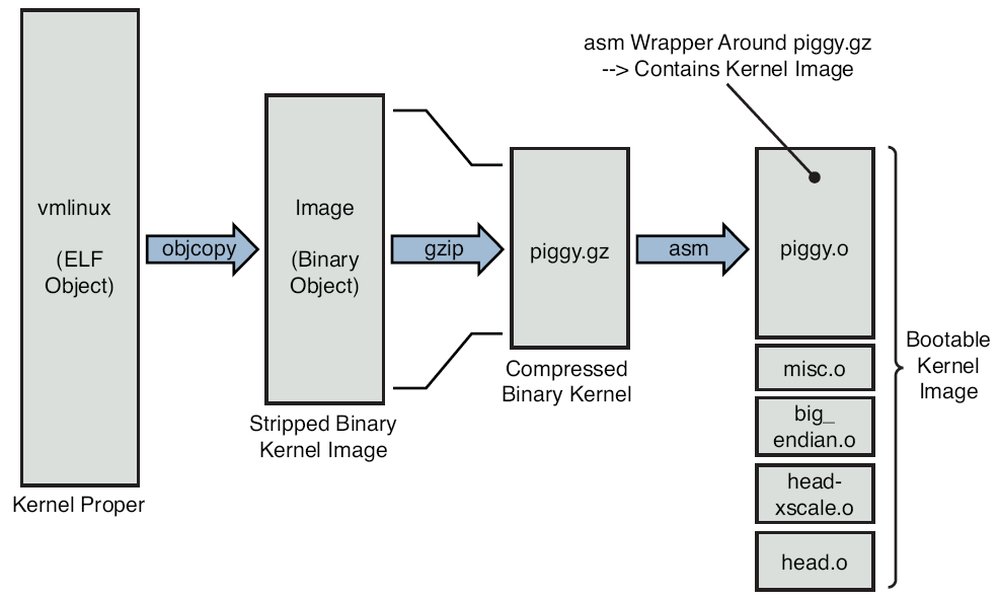
A visual representation of a compressed Linux kernel file, often named vmlinuz.
Core Challenges: Bridging the Gap
Several fundamental challenges arise when considering the integration of kanzi-cpp into the Linux kernel's boot-time decompression mechanism.
The C++ vs. C Divide: Kernel's Native Tongue
Language Barrier
The Linux kernel is predominantly written in C. The early boot environment, where decompression occurs, is particularly spartan and does not natively support C++ runtime features. kanzi-cpp, being a C++11 (and newer) library, relies on features like classes, templates, exceptions, RTTI (Run-Time Type Information), and the C++ Standard Library (STL). These are generally unavailable or actively discouraged in kernel code, especially in the critical early boot path.
Kernel Compatibility for C++ Code
While there have been experimental efforts to allow C++ in kernel modules, these come with significant caveats, such as disabling exceptions and RTTI, and avoiding the STL. Such support is typically for driver modules, not for the extremely sensitive and minimalistic early boot decompression code. Compiler flags like -fno-builtin, -nostdlib, -fno-rtti, and -fno-exceptions are often required.
The Austere World of Early Boot
Resource Scarcity
The kernel decompression routine runs very early in the boot sequence. At this stage, system resources are severely limited:
- Minimal Stack Space: Large stack allocations are not feasible.
- No User-Space Libraries: Standard C libraries (libc) or C++ standard libraries are not available.
- Limited Kernel Services: Only the most basic kernel functionalities are active. Dynamic memory allocation must use kernel-specific functions (like
kmalloc), which themselves might be restricted or different in this early phase (e.g.,kcmalloc,kcfreementioned in C++ kernel projects).
Single-Threaded Execution
One of kanzi-cpp's strengths is its multithreading capability for enhanced performance. However, the early kernel boot environment is strictly single-threaded. Any multithreading logic from kanzi-cpp would be unusable and would need to be removed or redesigned for sequential execution.
Kanzi-CPP Features vs. Kernel Decompressor Needs
Kernel decompressors must be small, fast, and incredibly robust. They are often hand-optimized C or even assembly code. kanzi-cpp, with its rich feature set and multiple algorithm support, is inherently more complex and potentially larger than typical kernel decompressors, even if only the decompression part is considered.
A Roadmap to Integration: A Challenging Endeavor
Integrating kanzi-cpp requires a methodical approach, focusing on adapting its core logic to fit the kernel's constraints. This is not a plug-and-play operation but a significant development effort.
Step 1: Adapting Kanzi-CPP Decompression Core for the Kernel
Porting Decompression Logic to C
The most critical step is to extract the specific Kanzi decompression algorithm(s) you intend to use and port them from C++ to plain C. This involves:
- Rewriting C++ classes and structures as C structs and functions.
- Replacing C++ Standard Library usage (e.g.,
std::vector,std::string) with C equivalents or custom, simple data structures. - Eliminating C++ features like templates, exceptions, RTTI, and operator overloading. Error handling must be done via return codes or other C-idiomatic mechanisms.
- Even though
kanzi-cppprovides a C API (api/libapi.hpp), this API likely still links against the C++ compiled library. For kernel integration, the underlying *implementation* of the decompression logic needs to be C-based or compatible with kernel C.
Stripping Dependencies and Optimizing for Size
The ported C code must be:
- Self-contained: Minimize external dependencies.
- Single-threaded: Remove all multithreading logic.
- Memory-efficient: Use minimal dynamic memory, and any allocation must be adapted to the kernel's early allocators. Static allocation might be preferred where possible.
- Optimized for size and speed: The resulting decompressor needs to be compact and execute quickly to avoid significantly slowing down boot times.
Step 2: Kernel Source Modification
Creating the Kanzi Decompression Stub
A new decompression stub for Kanzi needs to be created within the kernel source tree, typically in a directory like arch/<architecture>/boot/compressed/ or lib/decompress_kanzi.c. This stub will implement the standard interface expected by the kernel's decompression framework. It usually involves a function similar to do_decompress() that takes a compressed input buffer, its size, an output buffer, and its expected size.
A conceptual C function for this might look like:
  /*
   * Conceptual Kanzi decompression function for the kernel.
   * This is a simplified example. Actual implementation would be complex.
   */
  #include <linux/kernel.h> /* For printk, etc., if needed, but likely minimal */
  #include <linux/types.h>  /* For size_t, etc. */
  /* #include "kanzi_c_decompressor.h" // Your ported Kanzi C header */

  /*
   * Assuming 'kanzi_c_decompress' is the entry point to your ported
   * C-based Kanzi decompression logic.
   *
   * input_data: Pointer to the compressed kernel image.
   * input_len: Length of the compressed data.
   * output_data: Pointer to the memory area for the decompressed kernel.
   * output_len_ptr: Pointer to a variable holding the size of the output buffer,
   *                 and to be filled with the actual decompressed size.
   *
   * Returns 0 on success, non-zero on error.
   */
  static int decompress_kanzi(unsigned char *input_data, long input_len,
                              unsigned char *output_data, long *output_len_ptr)
  {
      /*
       * Placeholder for the actual Kanzi C decompression logic.
       * This would involve:
       * 1. Initializing the Kanzi C decompressor state.
       * 2. Calling the core Kanzi C decompression routines with input_data and output_data.
       * 3. Handling any errors returned by the Kanzi C routines.
       * 4. Updating *output_len_ptr with the actual decompressed size.
       */
      printk(KERN_INFO "Attempting Kanzi decompression...\n");

      /* Example: Call your ported Kanzi C function */
      /*
      long actual_decompressed_size = 0;
      int result = your_kanzi_c_decompress_function(input_data, input_len,
                                                    output_data, *output_len_ptr,
                                                    &actual_decompressed_size);
      if (result == 0) { // Success
          *output_len_ptr = actual_decompressed_size;
          printk(KERN_INFO "Kanzi decompression successful.\n");
          return 0;
      } else { // Error
          printk(KERN_ERR "Kanzi decompression failed. Error code: %d\n", result);
          return -1; // Or a more specific error code
      }
      */

      /* For now, a dummy implementation */
      if (input_len > *output_len_ptr) {
          printk(KERN_ERR "Kanzi: Output buffer too small.\n");
          return -1; /* Indicate error */
      }
      /* memcpy(output_data, input_data, input_len); // This would be actual decompression */
      /* *output_len_ptr = input_len; // Update with actual decompressed size */

      printk(KERN_WARNING "Kanzi decompression stub called but not fully implemented.\n");
      return -1; /* Indicate failure until properly implemented */
  }

  /*
   * This function would then be registered or called by the kernel's
   * generic decompression framework, similar to do_decompress() in
   * lib/decompress.c or architecture-specific boot code.
   */
Integrating with the Kernel's Boot Flow
The kernel's boot code needs to be modified to:
- Recognize a Kanzi-compressed kernel image (e.g., via a specific magic number at the start of the image).
- Invoke your Kanzi decompression stub when such an image is detected.
arch/<architecture>/boot/compressed/misc.c or lib/decompress.c.
Step 3: Build System and Configuration
Kbuild and Kconfig Adjustments
The kernel's build system (Kbuild) and configuration system (Kconfig) need to be updated:
- Kconfig: Add a new configuration option (e.g.,
CONFIG_KERNEL_KANZIorCONFIG_DECOMPRESS_KANZI) to allow users to enable Kanzi decompression when compiling the kernel. This would be similar to existing options likeCONFIG_KERNEL_GZIP,CONFIG_KERNEL_XZ. - Makefile/Kbuild files: Modify Makefiles to compile your Kanzi C decompression source files and link them into the kernel image when the corresponding Kconfig option is enabled. This includes specifying appropriate compiler flags for the kernel environment.
Compiling the Kernel with Kanzi Support
Once the build system is modified, you would configure your kernel build to enable Kanzi decompression and compile the kernel. The output would be a kernel image (e.g., vmlinuz) that includes your Kanzi decompressor stub.
Step 4: Kernel Image Preparation and Boot
Compressing the Kernel with Kanzi
After compiling the uncompressed kernel (e.g., vmlinux), you would need to compress it using a Kanzi compression tool that employs the exact algorithm and settings your in-kernel decompressor expects. This compressed image would then be used for booting.
Bootloader Considerations
The bootloader (e.g., GRUB) loads the compressed kernel image into memory. While the decompression itself is handled by the stub within the kernel image, the bootloader must correctly load the entire Kanzi-compressed image. No specific Kanzi awareness is strictly needed in the bootloader if the kernel image handles its own decompression entirely, but header information might need to be compatible.
Step 5: Testing and Validation
Thorough testing is paramount:
- Boot Success: Ensure the kernel boots correctly on various hardware.
- Decompression Integrity: Verify that the kernel is decompressed without corruption. Checksums, if supported by your ported Kanzi logic and integrated into the image format, would be beneficial.
- Performance: Measure boot time impact. The decompression must be fast enough not to cause unacceptable delays.
- Error Handling: Test failure scenarios (e.g., corrupted image) to ensure the system behaves predictably (e.g., displays an error message) rather than crashing silently.
Visualizing the Integration Landscape
To better understand the components and relationships involved in this integration, the following mindmap outlines the key areas of concern and development.
Comparative Analysis: Kanzi vs. Established Decompressors
If kanzi-cpp's decompression logic were successfully ported and integrated, how might it compare to existing kernel decompressors? The following radar chart offers a speculative comparison across several factors. Note that "Kanzi (Ported)" values are estimates, as actual performance would depend heavily on the quality of the port and the specific Kanzi algorithm chosen.
This chart highlights that while a ported Kanzi might offer competitive compression ratios, its primary challenges would be the immense integration complexity and the lack of established maturity within the kernel ecosystem compared to battle-tested decompressors like Gzip or XZ.
Feature Comparison: Kanzi Original vs. Kernel Requirements
The table below contrasts the features of the original kanzi-cpp library with the typical requirements for a decompressor operating in the Linux kernel's early boot environment, and what a "Ported Kanzi" would need to achieve.
| Feature | Kanzi-CPP (Original) | Required for Kernel Early Boot | Ported Kanzi Decompressor Goal |
|---|---|---|---|
| Primary Language | C++ (C++11 and newer) | C (or highly restricted C++) | Pure C |
| Standard Library Usage | Relies on C++ Standard Library (STL) | No STL, minimal/no libc | No STL, self-contained or kernel APIs only |
| Exceptions & RTTI | May use exceptions for error handling; RTTI possible | Not allowed | No exceptions (error codes); No RTTI |
| Multithreading | Supported for performance | Not supported (single-threaded environment) | Single-threaded implementation |
| Memory Management | Standard C++ dynamic allocation (new/delete) | Kernel-specific, limited allocators; often static | Careful memory management, adaptable to kernel allocators or static |
| Code Size & Complexity | Moderate to high, supports multiple algorithms | Minimal, highly optimized | Minimized for selected algorithm(s), highly optimized |
| Robustness | Generally robust for user-space applications | Extremely high robustness required (boot critical) | Extremely high robustness, extensive error checking |
Visualizing Kernel Unpacking: Insights from Android
While not directly about kanzi-cpp or desktop Linux kernel compilation, the following video discusses unpacking Android boot images, which involves extracting a kernel (often a zImage - a compressed kernel) and a RAM disk. This provides some conceptual parallels to the process of handling compressed kernel data during system startup, illustrating the general domain of kernel image manipulation.
Understanding how compressed kernel components are handled in different environments can offer a broader perspective on the challenges and techniques involved in boot-time decompression.
Potential Hurdles and Important Considerations
Beyond the technical implementation, several other factors warrant careful consideration:
Performance Implications
Even if successfully ported, the performance of the Kanzi decompressor in the kernel environment is crucial.
- Decompression Speed: It must be fast enough not to significantly degrade boot times. This might require extensive optimization of the ported C code.
- Memory Footprint: The decompressor itself and its working memory requirements must be minimal.
Maintenance Overhead
Integrating a custom decompressor adds a maintenance burden.
- Kernel Upgrades: The custom code will need to be maintained and potentially adapted for new kernel versions and changes in the kernel's decompression framework.
- Kanzi Updates: If the
kanzi-cpplibrary evolves, porting these changes to the C version in the kernel would be an ongoing task.
Licensing Compatibility
The kanzi-cpp library is typically available under permissive licenses like MIT. The Linux kernel is licensed under GPLv2. While MIT is generally GPL-compatible, ensuring all aspects of the integration and any derived code comply with the GPL is essential.
Is Kanzi the Right Fit? Considering Alternatives
Given the significant challenges, it's worth evaluating if the potential benefits of using Kanzi for kernel decompression (e.g., possibly better compression ratios for certain data types than gzip or xz, depending on the chosen Kanzi algorithm) outweigh the development and maintenance costs.
Existing decompressors like zstd are already well-integrated into the kernel for use cases like initramfs compression and offer an excellent balance of speed and compression ratio. zstd is written in C and designed with embedding in mind, making its integration path far smoother than that for a C++ library like kanzi-cpp.
Unless kanzi-cpp offers a truly compelling, unique advantage for kernel image compression that cannot be met by existing C-based solutions, the effort required for its integration might be disproportionately high.
Frequently Asked Questions (FAQ)
Why can't kanzi-cpp be used directly in the Linux kernel's early boot process?
The Linux kernel's early boot environment is extremely restricted. It's primarily C-based and lacks the C++ runtime, standard C++ library (STL), and support for C++ features like exceptions and RTTI. kanzi-cpp, being a C++11 library, relies on these features. Furthermore, the early boot stage is single-threaded, while kanzi-cpp can utilize multithreading. These fundamental incompatibilities prevent direct use.
What are the potential benefits of using `kanzi-cpp` for kernel decompression if successfully integrated?
Potentially, `kanzi-cpp` could offer different compression ratio versus speed trade-offs compared to existing kernel decompressors. Depending on the specific algorithm chosen from Kanzi's suite and how well it's ported and optimized, it might achieve higher compression ratios for the kernel image. However, realizing these benefits would depend heavily on the success and efficiency of the porting effort.
How does this compare to integrating a decompressor like `zstd`?
Integrating `zstd` is significantly simpler. `zstd` is written in C, designed for high performance, and its decompressor is very small and embeddable. It's already widely used within the kernel ecosystem (e.g., for `initramfs`, filesystem compression). The development effort and risk for integrating `zstd` are much lower than for porting and integrating a C++ library like `kanzi-cpp`.
What specific skills are essential for attempting such a kernel modification?
This task requires advanced skills in:
- Low-level C programming.
- Linux kernel internals (boot process, memory management, build system).
- Assembly language (for understanding existing decompressors and boot code).
- Compression algorithms (to effectively port and optimize Kanzi's logic).
- Debugging in restricted environments.
- Proficiency in C++ (to understand the source `kanzi-cpp` code for porting).
Is the multithreading capability of `kanzi-cpp` usable during kernel boot decompression?
No. The Linux kernel's early boot decompression phase occurs in a single-threaded environment before the scheduler and full SMP (Symmetric Multiprocessing) support are initialized. Any multithreading features from `kanzi-cpp` would need to be removed or adapted for sequential execution in the ported C version.
Recommended Further Exploration
- What are the detailed steps and common pitfalls when porting a C++ library to C for use within the Linux kernel?
- Could you explain the anatomy of existing Linux kernel decompression stubs like those for Gzip or XZ?
- How does Zstandard (zstd) compare to XZ in terms of compression ratio and decompression speed specifically for Linux kernel images?
- What are the specific challenges and limitations of using C++ in Linux kernel modules beyond typical driver development, especially in core subsystems?
References
 pic.huodongjia.com
Last updated May 14, 2025