
Unlocking Nature's Arsenal: Integrating Biological Control into Modern Pest Management
A comprehensive university lecture on leveraging natural enemies for sustainable pest solutions, today, Wednesday, 2025-05-07.
Lecture Highlights: Key Insights
- Biological control is a cornerstone of Integrated Pest Management (IPM), offering an ecological approach to managing pest populations by utilizing natural enemies.
- Effective integration involves a multi-faceted strategy, combining classical, augmentative, and conservation biological control methods with compatible cultural, physical, and judicious chemical tactics.
- Successful biological control programs require thorough ecological understanding, continuous monitoring, and careful planning to maximize benefits while minimizing potential risks.
The Evolving Landscape of Pest Management
Traditional pest management has often relied heavily on synthetic pesticides. However, this approach has led to significant challenges, including the development of pesticide resistance in pest populations, outbreaks of secondary pests, detrimental effects on non-target organisms (including beneficial insects and pollinators), and broader environmental and human health concerns. These issues underscore the critical need for more sustainable, ecologically sound pest management strategies.
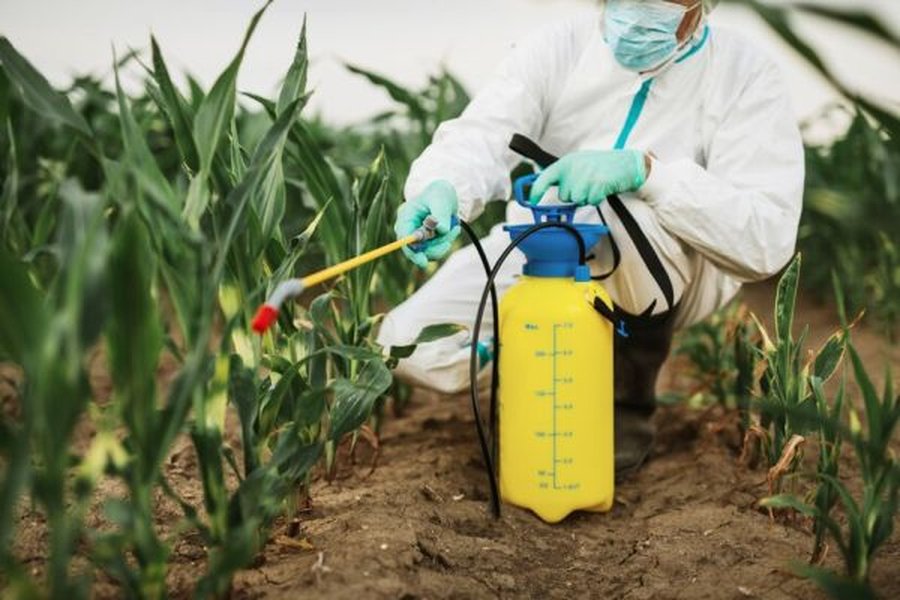
Visual representing the holistic approach of Integrated Pest Management.
Introducing Integrated Pest Management (IPM)
Integrated Pest Management (IPM) emerges as a comprehensive, ecosystem-based strategy. The Food and Agriculture Organization (FAO) describes IPM as a long-term crop protection approach that prevents and combats pest infestations by building on ecosystem services, such as pest predation, while protecting others, like pollination. It's not merely a set of practices but a complex decision-making process that utilizes all appropriate pest management options, including the judicious use of pesticides when necessary.
Core Principles of IPM:
- Monitoring and Identification: Regular observation and accurate identification of pests and their natural enemies.
- Action Thresholds: Establishing levels at which pest populations or environmental conditions indicate that pest control action must be taken.
- Prevention: Utilizing practices that prevent pests from becoming a threat, such as crop rotation, resistant varieties, and sanitation.
- Integration of Controls: Employing a combination of control methods, including cultural, physical, biological, and (as a last resort) chemical tactics.
- Evaluation: Assessing the effectiveness and risks of control methods.
IPM aims to manage pests effectively, economically, and with minimal risk to human health and the environment.
Biological Control: Nature's Defense Mechanism
Biological control (biocontrol) is a vital component of IPM that involves the use of living organisms—natural enemies—to suppress pest populations. These natural enemies can include predators, parasitoids, pathogens, and competitors. The goal is to reduce pest populations to levels where they no longer cause significant economic or ecological damage, often with minimal human intervention once established.
Historical Roots of Biological Control
The concept of using one organism to control another is not new. One of the most celebrated early successes was the introduction of the Vedalia beetle (Rodolia cardinalis) from Australia to California in the 1880s to control the cottony cushion scale (Icerya purchasi), which was devastating citrus groves. This landmark case demonstrated the potential of classical biological control and paved the way for future research and application.
Types of Biological Control Agents
The "beneficials" or biocontrol agents employed fall into several categories:
- Predators: These are typically free-living organisms that consume many prey individuals during their lifetime. Examples include lady beetles and lacewings feeding on aphids, or predatory mites attacking spider mites.
- Parasitoids: These are insects whose larvae develop by feeding on or in a single host insect, eventually killing it. Many species of wasps and some flies are parasitoids. For example, certain wasp species lay their eggs inside caterpillars or aphids.
- Pathogens: These are disease-causing microorganisms, including bacteria, fungi, viruses, and nematodes, that infect and kill pests. A well-known example is Bacillus thuringiensis (Bt), a bacterium that produces toxins lethal to specific groups of insects.
- Herbivores: For weed biological control, specific insects or pathogens that feed on or infect target weed species are used.
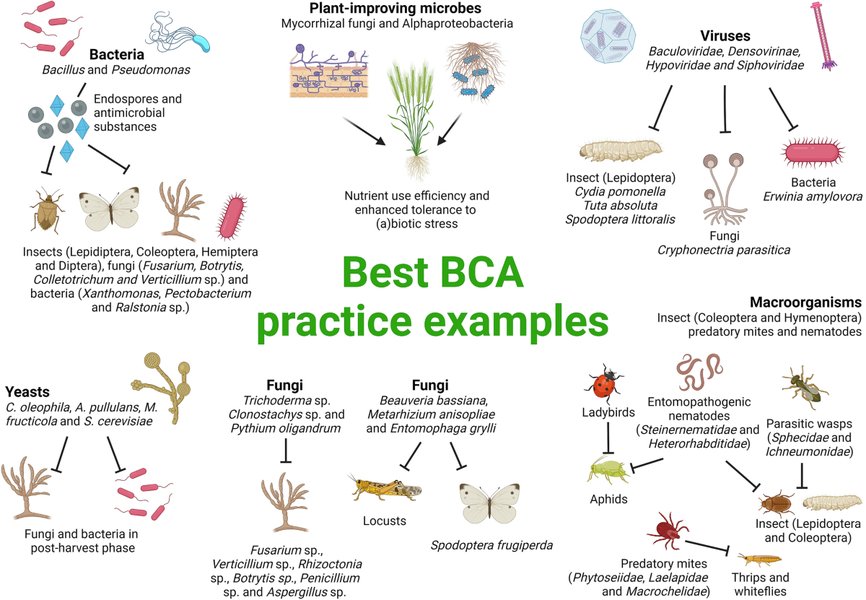
Illustrative examples of different types of biological control agents and their interactions with pests.
Strategies in Biological Control
There are three primary strategies for implementing biological control:
1. Classical Biological Control (Importation)
This strategy is typically used against invasive or exotic pests. It involves identifying, importing, and releasing natural enemies from the pest's native range into the area where the pest has become problematic. The goal is for the natural enemy to establish a permanent, self-sustaining population that provides long-term control. Modern classical biocontrol programs involve rigorous testing to ensure host specificity and avoid negative impacts on non-target organisms.
- Example: The control of Kariba weed (Salvinia molesta) by the Salvinia weevil (Cyrtobagous salviniae).
2. Augmentative Biological Control (Inductive/Periodic Release)
Augmentation involves supplementing the populations of existing or introduced natural enemies by periodically releasing individuals reared in insectaries. This approach is used when natural enemy populations are absent, too low, or arrive too late to provide effective control on their own.
- Inoculative Releases: Small numbers of natural enemies are released early in the season to reproduce and build up populations over time, providing control throughout the crop cycle.
- Inundative Releases: Large numbers of natural enemies are released for immediate, short-term knockdown of pest populations, similar to a pesticide application but using living organisms. Example: releasing Trichogramma wasps to parasitize moth eggs.
3. Conservation Biological Control (Habitat Manipulation)
This strategy focuses on enhancing the effectiveness and survival of naturally occurring or established natural enemies. It involves modifying farming practices or the environment to provide essential resources like food (nectar, pollen, alternative prey), shelter, and overwintering sites, and to reduce factors that harm beneficials, such as broad-spectrum pesticide applications.
- Examples: Planting insectary strips or cover crops, adopting no-till farming, or creating beetle banks.
The choice of strategy depends on the specific pest, crop, environment, and available resources. The following table provides a comparative overview of these three main biological control strategies:
| Characteristic | Classical Biological Control | Augmentative Biological Control | Conservation Biological Control |
|---|---|---|---|
| Primary Goal | Permanent establishment of natural enemies for long-term pest suppression, typically for exotic pests. | Temporary increase in natural enemy populations for immediate or seasonal pest control. | Enhance survival and efficacy of existing resident natural enemies. |
| Approach | Introduction of exotic natural enemies from the pest's native range. | Periodic release of commercially reared or collected natural enemies. | Modification of habitat and agricultural practices to favor natural enemies. |
| Timeframe for Effect | Long-term, self-sustaining control (can take years to establish). | Short to medium-term (immediate knockdown or seasonal control). | Medium to long-term, continuous benefit. |
| Cost Profile | High initial research and importation costs, low long-term costs once established. | Moderate to high recurring costs for purchasing and releasing agents. | Low to moderate costs for habitat modifications; can be labor-intensive initially. |
| Human Intervention | Intensive during introduction and establishment phase; minimal thereafter. | Regular, active intervention for releases. | Initial setup of habitat modifications; ongoing compatible management practices. |
| Example | Vedalia beetle for cottony cushion scale. | Release of predatory mites for spider mite control in greenhouses. | Planting cover crops to provide nectar and pollen for beneficial insects. |
This table highlights how each strategy offers unique benefits and is suited to different pest management scenarios, emphasizing the need for careful consideration when integrating them into an IPM program.
Integrating Biological Control with Other IPM Tactics
Biological control is most effective when integrated with other compatible IPM tactics. A holistic approach ensures that different control methods support rather than hinder each other.
Combining with Cultural Controls
Cultural practices can significantly enhance biological control. Examples include:
- Crop Rotation: Disrupts pest cycles and can reduce pest pressure, allowing natural enemies to be more effective.
- Sanitation: Removing crop debris can eliminate overwintering sites for pests, reducing their initial populations.
- Resistant Varieties: Planting crop varieties that are less susceptible to pests can slow pest population growth, giving natural enemies a better chance.
- Habitat Provision: As discussed in conservation biological control, providing diverse habitats supports beneficial insect populations.
Combining with Physical/Mechanical Controls
Physical methods can complement biological control efforts:
- Traps: Mass trapping can reduce pest numbers, easing the burden on natural enemies. Pheromone traps can be used for monitoring or mating disruption.
- Barriers and Exclusion: Netting or screens can prevent pests from entering greenhouses or specific crop areas, protecting the work of released biocontrol agents within.
- Tillage: Strategic tillage can expose soil-dwelling pests to predators or desiccation, though no-till or reduced tillage is often favored for conserving ground-dwelling beneficials.
Integrating with Chemical Controls (Judicious Use)
While a primary goal of biocontrol is to reduce pesticide reliance, chemical controls may sometimes be necessary. When integrating, the following principles are crucial:
- Use as a Last Resort: Pesticides should only be applied when monitoring indicates they are needed to prevent economic damage and other methods are insufficient.
- Selectivity: Choose selective pesticides that target the pest while minimizing harm to natural enemies, pollinators, and other non-target organisms. Avoid broad-spectrum, persistent pesticides.
- Timing and Placement: Apply pesticides at times when beneficials are least active (e.g., specific time of day or life stage). Use spot treatments or targeted applications rather than blanket sprays.
- Residue Awareness: Consider the residual effects of pesticides on subsequently released or immigrating natural enemies.
This video, "IPM: Biological Control," highlights the crucial role biological control plays within a garden's Integrated Pest Management plan, offering practical insights into its application.
Comparative Analysis of Pest Control Approaches
Understanding the relative strengths and weaknesses of different pest control methods is crucial for effective IPM. The radar chart below offers a visual comparison of Classical Biological Control, Augmentative Biological Control, Conservation Biological Control, Broad-Spectrum Chemical Control, and Selective Chemical Control across several key performance indicators. This is an opinionated analysis based on general characteristics, and specific outcomes can vary widely depending on the context.
This chart illustrates that biological control methods, particularly classical and conservation, tend to excel in long-term effectiveness, environmental safety, and specificity, though they may act slower. Chemical controls offer rapid knockdown but often score lower on environmental safety and long-term sustainability, especially broad-spectrum options. Augmentative biocontrol and selective chemicals can offer a balance in certain scenarios.
Visualizing the IPM Framework
To better understand how biological control fits within the broader IPM strategy, the following mindmap illustrates the interconnected components of an Integrated Pest Management program. It shows IPM as a central concept with various management tactics branching out, highlighting the integral role of biological control and its different strategies.
e.g., Vedalia Beetle"] id2cb["Augmentative (Releases)
e.g., Predatory Mites, Trichogramma"] id2cba["Inoculative Release"] id2cbb["Inundative Release"] id2cc["Conservation (Habitat Manipulation)
e.g., Insectary Plants, Cover Crops"] id2cd["Types of Agents
Predators, Parasitoids, Pathogens"] id2d["Chemical Controls (Judicious Use)"] id2da["Selective Pesticides"] id2db["Biopesticides (e.g., Bt)"] id2dc["Reduced-Risk Pesticides"] id2dd["Timing & Application Method"] id2e["Genetic Controls"] id2ea["Host Plant Resistance"] id2eb["Sterile Insect Technique"] id3["Supporting Elements"] id3a["Ecological Understanding"] id3b["Economic Considerations"] id3c["Environmental Protection"] id3d["Education & Training"]
This mindmap emphasizes that IPM is not reliant on a single tactic but rather a synergistic combination of approaches tailored to specific agroecosystems. Biological control is a key branch, further dividing into its core strategies and types of agents, all contributing to the overarching goal of sustainable pest suppression.
Practical Considerations for Implementing Biological Control
Advantages of Biological Control
- Environmental Safety: Significantly reduces reliance on synthetic pesticides, minimizing harm to non-target organisms, water quality, and overall ecosystem health.
- Sustainability: Can provide long-term pest suppression, especially classical and conservation methods, contributing to sustainable agricultural systems.
- Reduced Pesticide Resistance: Diversifying control tactics with biocontrol helps slow the development of pesticide resistance in pest populations.
- Cost-Effectiveness: While initial investment for classical biocontrol can be high, established agents can provide control at very low ongoing cost. Conservation biocontrol often relies on low-cost habitat modifications.
- Specificity: Many biocontrol agents are highly specific to their target pest, reducing risks to other organisms.
- Public Acceptance: There is growing consumer demand for food produced with fewer pesticides, making biocontrol an attractive option.
Challenges and Disadvantages of Biological Control
- Slower Action: Biological control agents may take longer to reduce pest populations compared to the rapid knockdown of chemical pesticides.
- Requires Ecological Knowledge: Successful implementation demands a good understanding of the pest, natural enemy, and crop ecosystem.
- Variability and Unpredictability: The effectiveness of biocontrol agents can be influenced by environmental conditions (temperature, humidity), making outcomes sometimes less predictable.
- Non-Target Effects: While rare with modern, rigorously tested agents, there is a potential risk of introduced classical biocontrol agents impacting non-target native species. This necessitates thorough pre-introduction assessment.
- Cost and Availability: Augmentative biocontrol can be costly due to the need to purchase and release agents. Availability of specific agents can also be a limitation.
- Integration Complexity: Coordinating biological control with other management practices, especially chemical controls, requires careful planning.
Monitoring and Decision-Making
Effective biological control relies on robust monitoring programs:
- Pest and Natural Enemy Identification: Accurate identification is fundamental.
- Population Assessment: Regular scouting to determine pest and natural enemy population densities.
- Action Thresholds: Using established thresholds to decide when interventions are necessary, considering the impact of natural enemies.
- Evaluating Effectiveness: Assessing whether biocontrol agents are successfully reducing pest populations and damage.
- Technology: Advanced tools like remote sensing (e.g., satellite imagery from platforms like EOSDA Crop Monitoring), AI algorithms, and weather analytics can support monitoring and decision-making in IPM.
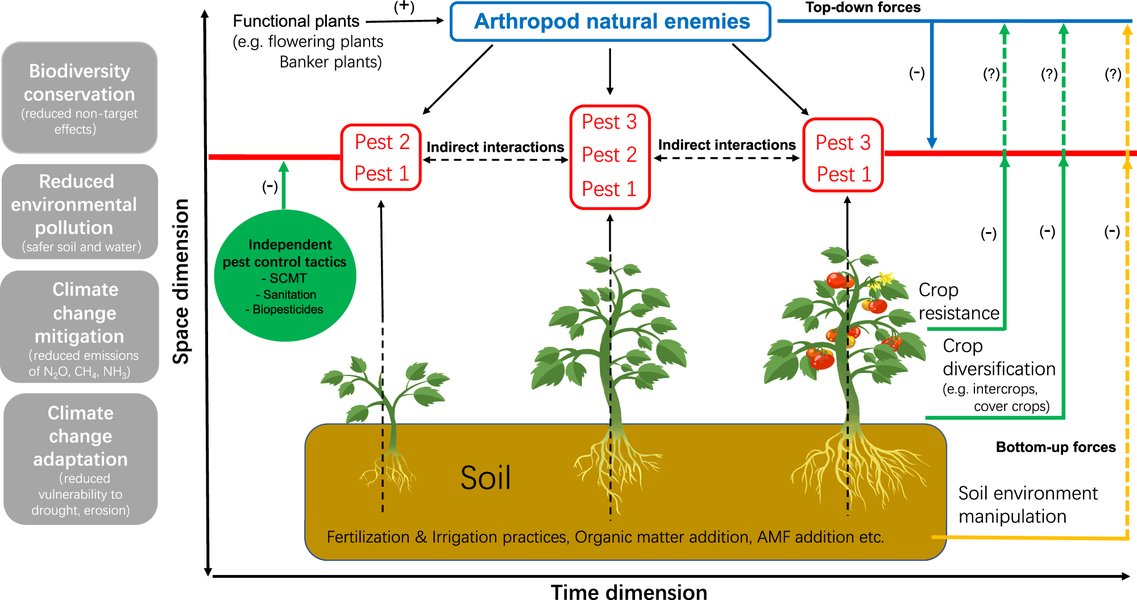
A conceptual framework illustrating factors influencing the adoption of environmentally friendly pest management strategies, including biological control.
Economic and Regulatory Aspects
The economics of biological control vary. Classical biocontrol can have very favorable long-term cost-benefit ratios. Augmentative control costs are more comparable to insecticides but can be offset by reduced environmental externalities. Regulatory oversight, particularly for classical biocontrol introductions, is crucial to ensure safety and efficacy, involving rigorous testing for non-target effects.
The Future of Integrated Biological Control
The field of biological control is continually evolving. Future directions include:
- New Agent Discovery: Ongoing research to find and evaluate new predators, parasitoids, and pathogens.
- Technological Advancements: Improved mass-rearing techniques, formulation, and delivery systems for biocontrol agents. Molecular biology tools are being used for strain improvement and identification.
- Enhanced Integration Strategies: Better understanding of how to combine biocontrol with other innovative tools like semiochemicals (pheromones), precision agriculture, and AI-driven decision support systems.
- Climate Change Adaptation: Research into how climate change will affect pest-natural enemy interactions and adapting biocontrol strategies accordingly.
- Ecosystem-Based Approaches: Greater emphasis on designing agricultural landscapes that inherently support biodiversity and natural pest regulation.
Frequently Asked Questions (FAQ)
What is the main difference between biological control and using pesticides?
Biological control uses living organisms (natural enemies) to manage pests, aiming for a self-regulating system or targeted releases. Pesticides are chemical substances designed to kill or repel pests, often providing rapid but potentially non-selective control with environmental and resistance concerns.
Is biological control always safe for the environment?
Generally, biological control is considered more environmentally friendly than broad-spectrum pesticides. However, classical biological control (introducing new species) requires rigorous testing to ensure the agent is host-specific and will not harm non-target native species. Augmentative and conservation methods using native or well-established agents typically pose lower risks.
How long does it take for biological control to work?
The timeframe varies. Augmentative releases (especially inundative) can show effects relatively quickly, sometimes within days or weeks. Classical biological control can take several years for the natural enemy population to establish and exert significant control. Conservation biological control builds up effectiveness over time as habitats mature and natural enemy populations increase.
Can biological control completely eradicate a pest?
The goal of most biological control programs is not eradication but rather long-term suppression of the pest population to below an economic or ecological injury level. Eradication is rare and usually only feasible in very specific, contained situations. A predator-prey or parasitoid-host relationship typically involves a balance where both populations persist at lower levels.
Where can I find biological control agents?
Many biological control agents for augmentative release can be purchased from commercial insectaries. Local extension offices or agricultural advisors can often provide lists of suppliers. For conservation biological control, the focus is on creating favorable conditions for native natural enemies already present in the environment.
Recommended Further Exploration
- How can farmers effectively monitor natural enemy populations in their fields?
- What are the economic benefits of implementing long-term conservation biological control programs?
- Explore successful case studies of classical biological control against invasive weeds.
- How does climate change impact the effectiveness of biological control agents?
References
Last updated May 7, 2025