
Unlock the Quantum Realm: How These Revolutionary Machines are Reshaping Our Future
Explore the mind-bending principles and groundbreaking advances of quantum computers, especially the key developments happening in 2025.
Quantum computing represents a paradigm shift in computation, moving beyond the classical bits of 0s and 1s into the strange and powerful realm of quantum mechanics. Unlike traditional computers, quantum machines harness phenomena like superposition and entanglement to process information in fundamentally new ways, promising to solve problems currently intractable for even the most powerful supercomputers. As we navigate 2025, designated the International Year of Quantum Science and Technology by the United Nations, the pace of innovation is accelerating, bringing us closer to realizing the transformative potential of this technology.
Key Insights into Quantum Computing
- Beyond Binary: Quantum computers use qubits, which can represent 0, 1, or both simultaneously (superposition), enabling massive parallel processing capabilities.
- 2025: A Pivotal Year: Significant breakthroughs are occurring in qubit stability (e.g., topological qubits), scalability (aiming for thousands of qubits), and error correction, pushing the boundaries of practical quantum computation.
- Transformative Applications: Potential impacts span drug discovery, materials science, financial modeling, cryptography (necessitating post-quantum encryption), and optimization problems across industries.
Understanding the Quantum Engine: How Does It Work?
Quantum computers operate based on counter-intuitive principles of quantum physics. Understanding these core concepts is key to appreciating their power and potential.
Visual explanation of quantum computing basics. Video by IBM.
The Quantum Bit (Qubit)
The fundamental unit of quantum information is the qubit. Unlike a classical bit, which must be either a 0 or a 1, a qubit can exist in a state of 0, 1, or a combination of both simultaneously. This property is known as superposition.
Superposition in Action
Imagine a spinning coin. While it's spinning, it's neither heads nor tails – it's in a superposition of both states. Only when it lands (or when we measure a qubit) does it settle into a definite state (0 or 1). This ability allows quantum computers to explore a vast number of possibilities concurrently. An n-qubit quantum computer can represent 2n states simultaneously, offering an exponential advantage over classical computers for certain tasks.
Entanglement: The "Spooky" Connection
Entanglement is another uniquely quantum phenomenon where two or more qubits become linked in such a way that their fates are intertwined, regardless of the physical distance separating them. Measuring the state of one entangled qubit instantly influences the state of the others. Albert Einstein famously called this "spooky action at a distance." This interconnectedness allows for powerful correlations and information processing capabilities within a quantum computer.
Quantum Gates and Circuits
Similar to how classical computers use logic gates (like AND, OR, NOT) to manipulate bits, quantum computers use quantum gates to manipulate qubits. These gates perform specific operations that alter the quantum state of one or more qubits, exploiting superposition and entanglement. A sequence of quantum gates applied to a set of qubits forms a quantum circuit, which executes a quantum algorithm.
Measurement and Decoherence
The final step in a quantum computation is measurement. When a qubit's state is measured, its superposition collapses into a definite classical state (either 0 or 1). Quantum algorithms are cleverly designed to increase the probability that the measurement yields the correct answer to the problem being solved.
The Fragility of Quantum States
Maintaining the delicate quantum states of qubits (superposition and entanglement) is extremely challenging. Qubits are highly sensitive to environmental factors like temperature fluctuations, vibrations, and electromagnetic fields. Any interaction with the outside world can cause the quantum state to decay, a process called decoherence, which introduces errors into the computation. This fragility necessitates sophisticated shielding, often involving extremely low temperatures (near absolute zero) and complex error correction techniques.
Potential Applications: Where Quantum Excels
Quantum computers are not intended to replace classical computers for everyday tasks like browsing the web or word processing. Instead, they are designed to tackle specific types of complex problems that are currently intractable.
Cryptography and Security
One of the most discussed applications is breaking current encryption standards. Algorithms like Shor's algorithm, run on a sufficiently powerful quantum computer, could theoretically factor large numbers exponentially faster than classical computers, rendering many widely used encryption methods (like RSA) insecure. This threat drives the urgent development of post-quantum cryptography (PQC) – new encryption methods resistant to quantum attacks.
Materials Science and Drug Discovery
Simulating the behavior of molecules and materials at the quantum level is incredibly complex for classical computers due to the exponential scaling of interactions. Quantum computers, operating on the same quantum principles, are naturally suited for these simulations. This could revolutionize drug discovery by accurately modeling molecular interactions, accelerate the design of novel materials with desired properties (e.g., for better batteries, catalysts, or superconductors), and advance fundamental chemistry research.
Complex Optimization Problems
Many industries face challenging optimization problems – finding the best solution from a vast number of possibilities. Examples include optimizing logistics and supply chains, financial portfolio management, traffic flow, and designing complex systems. Quantum algorithms, including techniques like quantum annealing, may offer more efficient ways to find optimal or near-optimal solutions for these problems.
Artificial Intelligence and Machine Learning
Quantum computing could enhance certain machine learning algorithms. Quantum machine learning (QML) explores how quantum algorithms might speed up data analysis, pattern recognition, and model training, potentially leading to more powerful AI systems for specific tasks.
Mapping the Quantum Landscape
This mindmap provides a visual overview of the core concepts, technologies, applications, and challenges associated with quantum computing.
(0, 1, or both)"] id1c["Entanglement
(Linked states)"] id1d["Interference"] id2["How it Works"] id2a["Quantum Gates"] id2b["Quantum Circuits"] id2c["Measurement
(Collapse to 0 or 1)"] id2d["Decoherence
(Error Source)"] id3["Key Applications"] id3a["Cryptography
(Code Breaking & PQC)"] id3b["Science & Materials
(Simulation, Drug Discovery)"] id3c["Optimization
(Logistics, Finance)"] id3d["Artificial Intelligence
(QML)"] id4["Hardware Technologies (2025)"] id4a["Superconducting Circuits"] id4b["Trapped Ions"] id4c["Photonic Systems"] id4d["Topological Qubits"] id4e["Neutral Atoms"] id4f["Silicon Spin Qubits"] id4g["Diamond Defects"] id4h["Quantum Annealing"] id5["Major Challenges"] id5a["Scalability
(More reliable qubits)"] id5b["Error Correction
(Fault Tolerance)"] id5c["Qubit Fidelity & Coherence"] id5d["Algorithm Development"] id5e["Skills Gap"]
Breakthroughs and Milestones in 2025
The year 2025 is proving to be highly significant for quantum computing, marked by notable advancements across various fronts, substantial investment, and increasing focus on practical applications.
Pushing the Qubit Frontier
Topological Qubits Emerge
A major highlight is the advancement in topological quantum computing. Microsoft, in collaboration with UC Santa Barbara, unveiled "Majorana 1," an eight-qubit processor based on topological qubits. These qubits utilize a novel state of matter (topological superconductors) and are theorized to be inherently more stable and resistant to environmental noise compared to other qubit types. This breakthrough could potentially accelerate the path towards building large-scale, fault-tolerant quantum computers capable of tackling complex scientific problems.
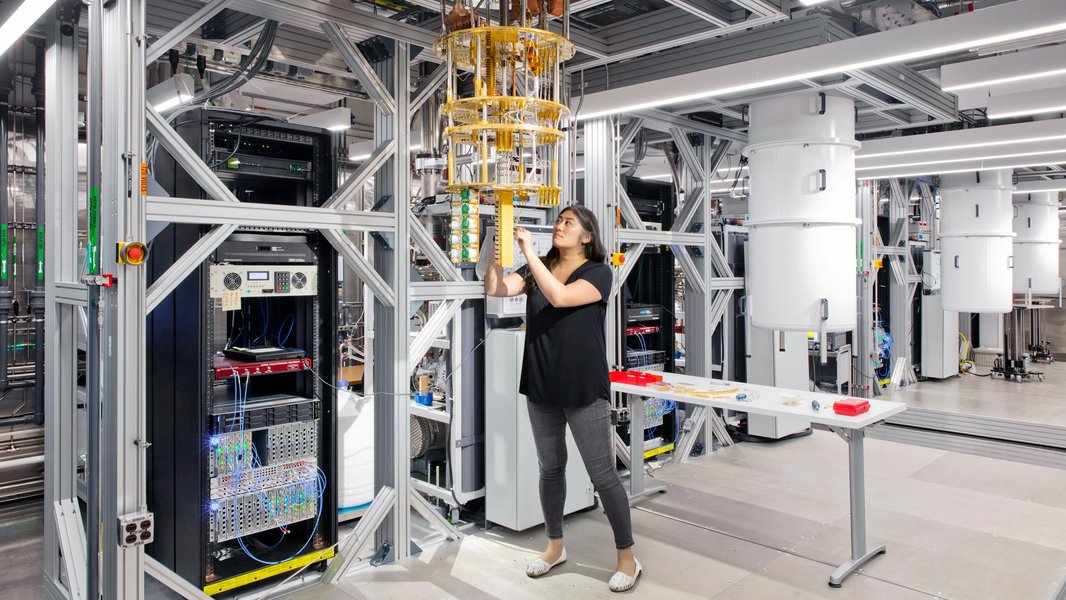
Inside a quantum computing lab, showcasing the complex cryogenic hardware needed to operate superconducting qubits. Image courtesy of IBM Research.
Scaling Up Qubit Count and Connectivity
Companies continue to push the limits of qubit numbers. IBM has ambitious plans to unveil its first "quantum-centric supercomputer" in 2025, aiming to connect multiple processor chips to exceed 4,000 qubits. Xanadu introduced "Aurora" in early 2025, described as the world's first scalable, networked, and modular quantum computer, focusing on photonic technology. The goal is not just more qubits, but also better connectivity and quality.
Tackling Errors and Enhancing Fidelity
Advances in Quantum Error Correction (QEC)
Building useful quantum computers hinges on effectively managing errors caused by decoherence. Significant progress is being made in Quantum Error Correction (QEC). In February 2025, AWS unveiled a prototype chip called "Ocelot," specifically designed to improve QEC efficiency by up to 90%. Furthermore, researchers at MIT demonstrated strong light-matter coupling in a quantum circuit, potentially enabling much faster readout and operations (nanoseconds), reducing the window for errors to accumulate and advancing towards fault-tolerant systems.
Improving Qubit Fidelity
The quality or "fidelity" of qubits – their ability to maintain their quantum state and perform operations accurately – is paramount. Continuous improvements in qubit fidelity are crucial for executing complex quantum algorithms reliably.
Demonstrating Quantum Advantage
In March 2025, D-Wave announced a significant milestone by demonstrating "quantum supremacy" (or quantum advantage) using its Advantage system (featuring over 5,000 qubits) on a specific, useful, real-world optimization problem, suggesting practical benefits are emerging for certain applications, particularly with annealing-based systems.
Diverse Technological Approaches
The field remains diverse, with multiple competing technologies being actively developed and benchmarked. These include superconducting circuits (currently dominant), trapped ions, photonic systems, silicon-spin qubits, neutral atoms, topological qubits, diamond defects, and quantum annealers. Each approach has unique strengths and weaknesses regarding scalability, coherence times, gate speeds, and connectivity.
Comparing Quantum Computing Approaches
Different physical systems are used to create qubits, each with its own profile of advantages and disadvantages. This radar chart provides a comparative overview (based on general consensus and ongoing research trends) of some leading approaches across key metrics. Higher values generally indicate better performance, except for 'Error Correction Difficulty' where lower is better. Note that this is a rapidly evolving field, and relative strengths can change with new breakthroughs.
Key Players and Milestones (2025)
Several companies and research institutions are at the forefront of quantum computing development. Here's a summary of some key activities reported in 2025:
| Organization | Key 2025 Milestone / Activity | Technology Focus (Primary) |
|---|---|---|
| IBM | Plan to unveil >4,000 qubit quantum-centric supercomputer; $150B investment announced (partially for quantum). | Superconducting Circuits |
| Microsoft / UC Santa Barbara | Unveiled Majorana 1 (8-qubit topological processor). Focus on stable qubits. | Topological Qubits |
| Google Quantum AI | Continued development of superconducting processors (e.g., Sycamore lineage), focusing on error correction. | Superconducting Circuits |
| AWS (Amazon Web Services) | Unveiled Ocelot prototype chip focused on improving QEC by up to 90%. | Various (via Braket partners), including Superconducting |
| D-Wave Systems | Demonstrated quantum supremacy/advantage on a real-world problem with >5,000 qubit Advantage system. | Quantum Annealing |
| Xanadu | Launched Aurora, described as a scalable, networked, modular quantum computer. | Photonics |
| IonQ | Leading developer of trapped-ion quantum computers, focusing on high fidelity and connectivity. | Trapped Ions |
| MIT Researchers | Demonstrated strong light-matter coupling for faster readout/operations towards fault tolerance. | Fundamental Research (various platforms) |
| DARPA | Launched Quantum Benchmarking Initiative, selecting ~20 companies to develop industrially useful systems. | Technology Agnostic (Benchmarking Focus) |
Overcoming the Hurdles: Challenges Ahead
Despite rapid progress, significant challenges must be overcome before quantum computers become widespread and reliable tools.
Scalability and Qubit Quality
Building machines with a large number of high-quality, stable, and well-connected qubits remains a primary engineering challenge. Increasing qubit count often comes at the cost of increased error rates or decreased coherence times.
Error Correction and Fault Tolerance
Quantum states are incredibly fragile (decoherence). Developing robust quantum error correction (QEC) codes and implementing them effectively to create "logical qubits" (which are more stable than physical qubits) is essential for fault-tolerant quantum computation capable of running long, complex algorithms.
Algorithm Development
Discovering new quantum algorithms that offer significant speedups over classical methods for practical problems is an ongoing area of research. While algorithms like Shor's (factoring) and Grover's (search) are well-known, identifying more commercially relevant applications requires further breakthroughs.
The Skills Gap
There is a growing need for trained professionals – physicists, engineers, computer scientists, and algorithm developers – who understand quantum mechanics and can build, program, and utilize quantum computers. Bridging this skills gap is crucial for the ecosystem's growth.
Hardware Development and Access
Building and maintaining quantum hardware is extremely complex and expensive, often requiring specialized infrastructure like cryogenic cooling. Making quantum resources accessible (e.g., via cloud platforms) is vital for broader research and development.
Frequently Asked Questions
What is a quantum computer fundamentally?
A quantum computer is a type of computer that uses principles from quantum mechanics, like superposition and entanglement, to perform calculations. Instead of classical bits (0 or 1), it uses quantum bits (qubits) that can be 0, 1, or both simultaneously, allowing it to tackle certain complex problems much faster than classical computers.
How is it different from the computer I use every day?
Classical computers (like your laptop or phone) use bits, which are always either 0 or 1. They process information sequentially. Quantum computers use qubits, leveraging superposition and entanglement to explore many possibilities at once (quantum parallelism). They are specialized tools designed for specific, complex computations, not for general tasks like email or gaming.
What are superposition and entanglement?
Superposition allows a qubit to represent a combination of 0 and 1 simultaneously, like a spinning coin before it lands. Entanglement links two or more qubits so they share the same fate, even when separated by distance – measuring one instantly affects the others. These properties are key to quantum computation's power.
What kinds of problems can quantum computers solve?
They show promise for problems involving complex simulations (like designing new drugs or materials), optimization (like logistics or finance), breaking certain types of encryption (leading to the need for post-quantum cryptography), and potentially accelerating aspects of artificial intelligence.
Can quantum computers break today's encryption?
Theoretically, yes. A sufficiently large and fault-tolerant quantum computer running Shor's algorithm could break many public-key cryptosystems currently used to secure online communications and data (like RSA and ECC). While such machines don't exist yet, the threat is significant enough that researchers are actively developing and standardizing quantum-resistant encryption (post-quantum cryptography).
Are quantum computers commercially available now?
You can't buy a quantum computer for your home. However, current quantum processors (often called Noisy Intermediate-Scale Quantum or NISQ devices) are accessible to researchers and businesses through cloud platforms offered by companies like IBM, Google, AWS, Microsoft Azure Quantum, IonQ, and others. These systems are still experimental and primarily used for research and exploring specific applications.
What are the biggest hurdles for quantum computing?
Major challenges include building systems with many stable, high-quality qubits (scalability), significantly reducing error rates (decoherence) through quantum error correction to achieve fault tolerance, discovering more useful quantum algorithms, and training a workforce skilled in quantum technologies.
Recommended Further Exploration
- How does quantum error correction actually protect fragile qubits?
- What are the detailed pros and cons of superconducting versus trapped ion quantum computers?
- Explore the methods being developed for post-quantum cryptography to secure future data.
- Discover specific examples of how companies are currently experimenting with quantum algorithms.
References
 aws.amazon.com
Last updated May 4, 2025