
Quantum Computing: Unlocking the Next Frontier of Calculation
An in-depth exploration of how quantum mechanics is reshaping the world of computation, its current progress, and its transformative potential.
Key Insights into Quantum Computing
- Fundamental Shift: Quantum computing utilizes qubits, capable of superposition (being 0 and 1 simultaneously) and entanglement (interconnected states), to perform calculations impossible for classical computers.
- Transformative Applications: It promises breakthroughs in drug discovery, materials science, complex optimization, AI, finance, and cryptography, tackling problems currently beyond our reach.
- Developing Landscape: While still in its early stages, with significant challenges in scalability, error correction, and qubit stability, rapid advancements are being made by tech giants, startups, and research institutions worldwide.
Understanding the Quantum Realm: Core Concepts
Quantum computing is a revolutionary field that harnesses the peculiar principles of quantum mechanics to process information. Unlike classical computers that rely on bits representing either a 0 or a 1, quantum computers use quantum bits, or "qubits." These qubits are the cornerstone of quantum computation, enabling capabilities far beyond their classical counterparts.
A conceptual representation of quantum computing hardware, illustrating its complexity.
Qubits: The Heart of Quantum Power
A qubit is the basic unit of quantum information. Its power stems from several quantum mechanical phenomena:
Superposition
Superposition allows a qubit to exist in multiple states simultaneously – a combination of 0 and 1. Imagine a spinning coin; until it lands, it's neither heads nor tails but a probabilistic mix of both. Similarly, a qubit can represent both 0 and 1 at the same time, and even varying degrees of each. This enables quantum computers to explore a vast number of possibilities in parallel. For example, \(n\) qubits can represent \(2^n\) states simultaneously, leading to an exponential increase in computational capacity.
Entanglement
Entanglement is a unique quantum correlation where multiple qubits become linked in such a way that their fates are intertwined, regardless of the physical distance separating them. If you measure the state of one entangled qubit, you instantaneously know the state of the other(s), even if they are light-years apart. Albert Einstein famously called this "spooky action at a distance." Entanglement is a crucial resource that allows quantum algorithms to achieve speedups over classical ones by creating complex, correlated states.
Interference
Quantum interference is another key principle. Similar to how waves can interfere constructively (amplifying each other) or destructively (canceling each other out), the quantum states in a computation can interfere. Quantum algorithms are designed to leverage interference to amplify the probability of measuring the correct answer while suppressing the probabilities of incorrect ones.
Quantum Gates
Analogous to logic gates in classical computing, quantum gates are operations that manipulate the quantum states of qubits. These gates can put qubits into superposition, entangle them, or perform other transformations necessary to execute quantum algorithms. Examples include Hadamard gates for creating superposition and CNOT gates for conditional operations that can create entanglement.
Measurement and the Heisenberg Uncertainty Principle
Measuring a qubit is a critical but delicate process. When a qubit in superposition is measured, its quantum state "collapses" into a definite classical state (either 0 or 1). This act of measurement can irrevocably alter the quantum state, a concept related to the Heisenberg Uncertainty Principle. This means that extracting information from a quantum computation is not always straightforward and must be carefully designed into the algorithm.
How Quantum Computers Operate
A quantum computation typically involves three main steps:
- Initialization: Qubits are prepared in a well-defined initial state, often the ground state (all qubits as '0').
- Quantum Operations: A sequence of quantum gates is applied to the qubits. These operations manipulate the qubits' states, creating superposition and entanglement to explore the problem space according to a specific quantum algorithm (e.g., Shor's algorithm for factoring or Grover's algorithm for search).
- Measurement: The final state of the qubits is measured. This collapses their superposition into classical bits, providing the result of the computation. Due to the probabilistic nature of quantum mechanics, algorithms are often run multiple times to determine the most likely outcome.
Maintaining the delicate quantum states of qubits requires sophisticated hardware and extreme operating conditions, such as near-absolute zero temperatures and shielding from environmental noise (like vibrations, electromagnetic fields, and heat), to preserve their coherence (the ability to maintain quantum properties).
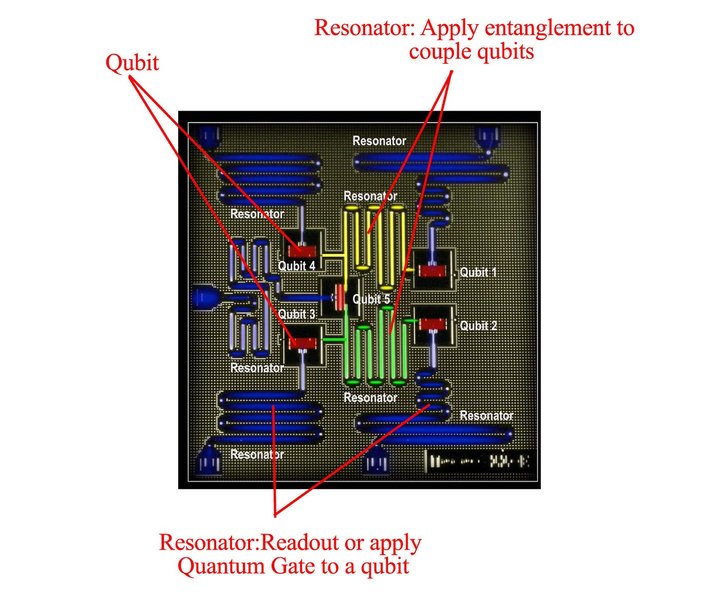
Conceptual layout of a superconducting qubit circuit, a common approach in building quantum processors.
Classical vs. Quantum Computing: A Comparative Look
The fundamental differences between classical and quantum computing dictate their respective strengths and weaknesses. The table below highlights some key distinctions:
| Feature | Classical Computing | Quantum Computing |
|---|---|---|
| Basic Unit of Information | Bit | Qubit (Quantum Bit) |
| Information State | Represents either 0 or 1 | Can represent 0, 1, or a superposition of both |
| Parallelism | Processes tasks sequentially (or limited parallel processing) | Massively parallel processing due to superposition and entanglement |
| Data Storage (n units) | Stores one of \(2^n\) values | Can represent all \(2^n\) values simultaneously |
| Key Principles | Boolean algebra, deterministic logic | Quantum mechanics (superposition, entanglement, interference) |
| Primary Problem Types | Everyday tasks, large-scale data processing, well-defined algorithms | Complex simulations (e.g., molecular modeling), optimization, factoring large numbers, searching unsorted databases |
| Error Handling | Relatively robust error correction | Highly sensitive to noise; error correction is a major challenge (quantum error correction codes are complex) |
While quantum computers are not expected to replace classical computers for all tasks, they offer a new paradigm for solving specific types of problems that are currently intractable.
The Quantum Computing Ecosystem: Key Players and Initiatives
The development of quantum computing is a global effort involving large technology corporations, specialized startups, academic institutions, and government agencies.
Technology Giants Leading the Charge
Several multinational tech companies are investing heavily in quantum R&D:
- Google Quantum AI: Known for achieving "quantum supremacy" with its Sycamore processor (and later Willow), Google is focused on building fault-tolerant quantum computers and developing quantum algorithms, particularly for AI and simulations.
- IBM: A pioneer in the field, IBM offers cloud access to its quantum processors through IBM Quantum Experience. They are actively developing increasingly powerful quantum chips and fostering a global quantum community.
- Microsoft: Through its Azure Quantum platform, Microsoft is developing a full-stack quantum ecosystem, including hardware (exploring topological qubits), software, and cloud services, aiming for scalable quantum supercomputing.
- Amazon Web Services (AWS): AWS provides access to various quantum hardware providers through Amazon Braket, enabling researchers and developers to experiment with different quantum technologies.
- Intel: Intel is also pursuing quantum computing, focusing on silicon-based spin qubits, which could leverage existing semiconductor manufacturing expertise.
Specialized Companies and Startups
A vibrant ecosystem of startups is pushing the boundaries of quantum technology:
- IonQ: A pure-play quantum computing company focusing on trapped-ion quantum computers, accessible via the cloud. They have partnerships with major cloud providers.
- Rigetti Computing: Develops superconducting qubit-based quantum computers and provides cloud access through its Quantum Cloud Services platform.
- D-Wave Systems: Specializes in quantum annealing computers, designed for optimization problems. Their systems are used by companies for practical applications.
- Quantum Computing Inc. (QCi): Focuses on accessible and affordable quantum solutions, developing entropy quantum computers and integrated photonics technology.
- PsiQuantum: Aims to build a utility-scale, fault-tolerant quantum computer based on photonic qubits.
- Alice & Bob: A Paris-based startup focused on developing self-correcting superconducting qubits to tackle error correction challenges.
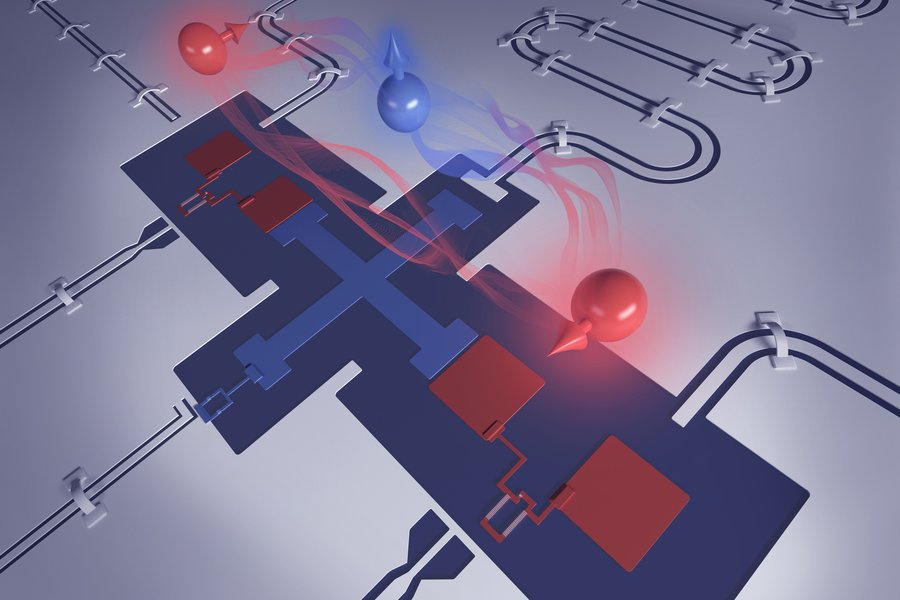
An image of a fluxonium qubit developed at MIT, showcasing the intricate hardware involved in quantum computing.
Research Institutions and Government Programs
Universities like UC Santa Barbara are at the forefront of fundamental quantum research, often collaborating with industry leaders. Government initiatives, such as DARPA's Quantum Benchmarking Initiative (QBI) and the Underexplored Systems for Utility-Scale Quantum Computing (US2QC) program in the U.S., are funding research to accelerate the development of practical quantum computers, aiming for utility-scale operation potentially by 2030-2033.
Mapping the Quantum Landscape
The field of quantum computing is multifaceted, encompassing fundamental principles, diverse technological approaches, a growing ecosystem of players, numerous potential applications, and significant ongoing challenges. The mindmap below provides a visual overview of these interconnected aspects.
(Google, IBM, Microsoft, Amazon)"] id2_2["Specialized Startups
(IonQ, Rigetti, D-Wave, QCi, PsiQuantum)"] id2_3["Research Institutions
(e.g., UC Santa Barbara)"] id2_4["Government Initiatives
(e.g., DARPA QBI)"] id3["Potential Applications"] id3_1["Drug Discovery & Materials Science
(Molecular Simulation)"] id3_2["Optimization Problems
(Logistics, Finance, Energy)"] id3_3["Artificial Intelligence & Machine Learning
(Enhanced Algorithms)"] id3_4["Cryptography & Cybersecurity
(Code Breaking, Quantum-Safe Crypto)"] id3_5["Financial Modeling
(Risk Analysis, Trading)"] id3_6["Environmental Modeling
(Climate Change Simulation)"] id4["Current Challenges"] id4_1["Qubit Scalability"] id4_2["Error Correction & Fault Tolerance"] id4_3["Qubit Coherence & Stability"] id4_4["Hardware Development"] id4_5["Algorithm Development"] id4_6["Demonstrating Practical Quantum Advantage"] id5["Qubit Technologies"] id5_1["Superconducting Qubits"] id5_2["Trapped Ion Qubits"] id5_3["Photonic Qubits"] id5_4["Neutral Atom Qubits"] id5_5["Semiconductor Spin Qubits"]
This mindmap illustrates how fundamental quantum principles underpin various technological efforts and potential applications, while also highlighting the hurdles that need to be overcome for widespread adoption.
Comparing Qubit Technologies: A Radar Chart Analysis
Different physical systems are being explored to create stable and scalable qubits. Each approach has its own set of advantages and disadvantages. The radar chart below provides a comparative overview of some leading qubit technologies based on key performance metrics. These scores are qualitative and represent general trends and potential rather than precise, universally agreed-upon values, as the field is rapidly evolving.
Key Metrics Explained:
- Scalability: The potential to increase the number of qubits in a system.
- Coherence Time: How long a qubit can maintain its quantum state before decohering due to environmental noise. Longer coherence times are better.
- Gate Fidelity: The accuracy with which quantum operations (gates) can be performed on qubits. Higher fidelity means fewer errors.
- Connectivity: The ability for qubits to interact with each other. Higher connectivity allows for more complex algorithms.
- Current Maturity: The overall stage of development and practical implementation of the technology.
Transformative Applications of Quantum Computing
While still largely in the research and development phase, quantum computing holds the promise of revolutionizing numerous fields:
Drug Discovery and Materials Science
Quantum computers can simulate molecular structures and interactions with unprecedented accuracy. This could dramatically accelerate the discovery and design of new drugs by modeling how potential drug candidates interact with proteins and other biological targets, aiding in treatments for diseases like cancer or Alzheimer's. Similarly, they can help design novel materials with specific properties (e.g., better catalysts, more efficient solar cells, or room-temperature superconductors).
Optimization Problems
Many real-world problems involve finding the best solution from a vast number of possibilities. Quantum computers are well-suited for such optimization tasks in logistics (e.g., optimizing delivery routes), finance (e.g., portfolio optimization, minimizing risk), manufacturing (e.g., scheduling complex production processes), and energy grid management.
Artificial Intelligence and Machine Learning
Quantum machine learning algorithms could enhance AI capabilities by processing and analyzing large datasets more efficiently, improving pattern recognition, and optimizing complex models. This could lead to breakthroughs in areas like natural language processing, computer vision, and personalized medicine.
Cryptography and Cybersecurity
One of the most talked-about applications is in cryptography. Shor's algorithm, for example, could theoretically break many widely used encryption methods (like RSA) that rely on the difficulty of factoring large numbers. This dual-edged sword means quantum computers could undermine current cybersecurity while also enabling new, ultra-secure "quantum cryptography" methods like Quantum Key Distribution (QKD).
Financial Modeling
The finance industry could benefit significantly from quantum computing for more accurate risk analysis, derivative pricing, algorithmic trading strategies, and improved fraud detection by efficiently processing complex financial models and vast amounts of market data.
Environmental Modeling
Quantum computers could create more accurate and detailed models for climate change, weather forecasting, and other complex environmental systems, leading to better predictions and mitigation strategies.
Current State, Challenges, and Future Outlook
As of May 16, 2025, quantum computing is still in its nascent stages. While "quantum supremacy" or "quantum advantage" has been demonstrated for specific, contrived tasks by companies like Google, practical, fault-tolerant quantum computers capable of outperforming classical supercomputers on real-world problems are yet to be realized. The field faces several significant hurdles:
Key Challenges
- Qubit Stability (Coherence): Qubits are extremely sensitive to their environment (noise, temperature fluctuations, vibrations). Maintaining their quantum states (coherence) for long enough to perform complex calculations is a major engineering challenge. Decoherence leads to errors in computation.
- Error Correction: Due to their fragility, qubits are prone to errors. Developing effective quantum error correction codes that can detect and fix these errors without destroying the quantum information is crucial but highly complex. Current systems are often referred to as Noisy Intermediate-Scale Quantum (NISQ) devices.
- Scalability: Building quantum computers with a large number of high-quality, well-connected qubits is difficult. Increasing qubit count often exacerbates issues with noise, control, and connectivity.
- Hardware Development: Manufacturing and controlling quantum hardware requires cutting-edge technology and often extreme conditions (e.g., cryogenic temperatures for superconducting qubits).
- Algorithm Development: Discovering new quantum algorithms that offer significant speedups over classical algorithms for a wider range of practical problems is an ongoing research area.
- Software and Programming Tools: Creating user-friendly software development kits (SDKs) and programming languages to make quantum computers accessible to a broader range of scientists and engineers is essential.
Future Prospects
Despite the challenges, the pace of innovation is rapid. Significant investments from governments and private companies are driving progress. Many experts anticipate that within the next decade (possibly by 2030-2035), we may see the emergence of fault-tolerant quantum computers capable of solving problems of practical significance that are beyond the reach of even the most powerful classical supercomputers. Early applications are likely to be in specialized areas like materials science, drug discovery, and financial modeling. The journey towards widespread quantum computing will be gradual, with hybrid classical-quantum approaches likely to be common in the interim.
This video, "A Beginner's Guide to Quantum Computing" by Dr. Talia Gershon from IBM Research, provides an accessible introduction to the fundamental concepts of quantum computing, explaining its potential and the science behind it. It's a great starting point for understanding why this technology is so different from classical computing and what makes it powerful.
Frequently Asked Questions (FAQ)
What is the main difference between a bit and a qubit?
A classical bit can only be in one of two states: 0 or 1. A qubit, however, can be in a state of 0, 1, or a superposition of both simultaneously. This means a qubit can hold much more information than a classical bit. Furthermore, multiple qubits can be entangled, allowing for complex correlations that are not possible with classical bits.
Will quantum computers replace classical computers?
No, quantum computers are not expected to replace classical computers. Classical computers are excellent for many everyday tasks like web browsing, word processing, and running most existing software. Quantum computers are specialized devices designed to solve specific types of complex problems that are intractable for classical computers. It's more likely they will work in conjunction with classical computers, perhaps as co-processors or accessible via the cloud for specific tasks.
How far away are practical quantum computers?
This is a subject of ongoing debate and research. While current quantum devices (NISQ era) can perform some calculations beyond classical reach, they are not yet fault-tolerant or broadly practical for most real-world problems. Estimates vary, but many experts believe that fault-tolerant quantum computers capable of solving significant problems might be available within the next 5-15 years. However, specialized applications might see benefits sooner with hybrid quantum-classical approaches.
What is "quantum supremacy" or "quantum advantage"?
"Quantum supremacy" (a term now often replaced by "quantum advantage") refers to the point at which a quantum computer can perform a specific computational task that no classical computer, regardless of its power, could feasibly complete in a reasonable amount of time. Google claimed to have achieved this in 2019 with its Sycamore processor on a specific sampling task. However, demonstrating quantum advantage for practical, useful problems is a more significant and still largely unmet goal.
Why is error correction so important in quantum computing?
Qubits are inherently fragile and prone to errors due to interactions with their environment (decoherence) and imperfections in control mechanisms. These errors can quickly accumulate and corrupt the results of a quantum computation. Quantum error correction (QEC) codes are designed to protect quantum information from these errors by encoding logical qubits into many physical qubits. Without effective error correction, building large-scale, reliable quantum computers capable of complex calculations is impossible.
Recommended Further Exploration
To delve deeper into the fascinating world of quantum computing, consider exploring these related queries:
- What are the different types of qubit technologies and their pros and cons?
- How does Shor's algorithm impact modern cryptography?
- What are the latest breakthroughs in quantum error correction?
- Explore real-world examples of quantum computing in drug discovery.
References
Last updated May 16, 2025