
Is Reality Predictable? Unveiling the Quantum Realm's Inherent Randomness Through Solid Proof
Discover the compelling experimental evidence showing that, at its most fundamental level, the universe operates on chance, not certainty.
The quantum realm, the domain of atoms and subatomic particles, operates under rules that are strikingly different from the classical physics governing our everyday experiences. One of its most profound and mind-bending characteristics is its inherent non-determinism. In simple terms, this means that even if we knew everything about a quantum system's current state, we could not predict with absolute certainty the outcome of a future measurement. Instead, quantum mechanics provides probabilities for various outcomes. This stands in stark contrast to classical determinism, where the present state of a system perfectly dictates its future. Our understanding of this fundamental randomness isn't just theoretical; it's built upon a wealth of empirical evidence from decades of experiments.
Key Experimental Proofs of Quantum Non-Determinism
Highlights of a Random Universe
- Bell's Theorem Violations: Experiments consistently show that correlations between entangled particles defy explanations based on pre-determined properties (local hidden variables), confirming the intrinsic randomness predicted by quantum mechanics.
- Probabilistic Measurement Outcomes: Repeated measurements on identically prepared quantum systems yield different results, distributed according to quantum probabilities, showcasing that outcomes are not fixed beforehand.
- Certified Quantum Randomness: The inherent unpredictability of quantum events is now harnessed to generate truly random numbers, certified to be random by the laws of quantum mechanics itself, providing practical proof of non-determinism.
The Unpredictable Heart of Matter: Empirical Evidence
The assertion that the quantum realm is non-deterministic isn't a philosophical stance but a conclusion driven by rigorous and repeatable experimental observations. Let's delve into the key pieces of evidence that have convinced physicists of this counter-intuitive reality.
The Probabilistic Nature of Quantum Measurements
At the core of quantum mechanics lies the observation that measuring a property of a quantum system, like an electron's position or spin, doesn't reveal a pre-existing value. Instead, the act of measurement itself seems to "force" the system to choose an outcome from a range of possibilities, each with a specific probability.
The Double-Slit Experiment: A Classic Demonstration
Perhaps the most famous illustration of quantum weirdness is the double-slit experiment. When individual particles like electrons or photons are fired one by one towards a barrier with two narrow slits, they behave in an unexpected way. If they were classical particles, we'd expect them to pass through one slit or the other and create two distinct bands on a detector screen behind the barrier. However, what is observed is an interference pattern—a series of alternating bright and dark bands—as if each particle passed through both slits simultaneously, like a wave. Crucially, if we try to detect which slit each particle goes through, the interference pattern vanishes, and we see the two bands expected from classical particles. This suggests that the outcome (where the particle lands) is not predetermined before measurement and is fundamentally probabilistic. The act of observing influences the outcome, highlighting an indeterminacy inherent to the quantum system.
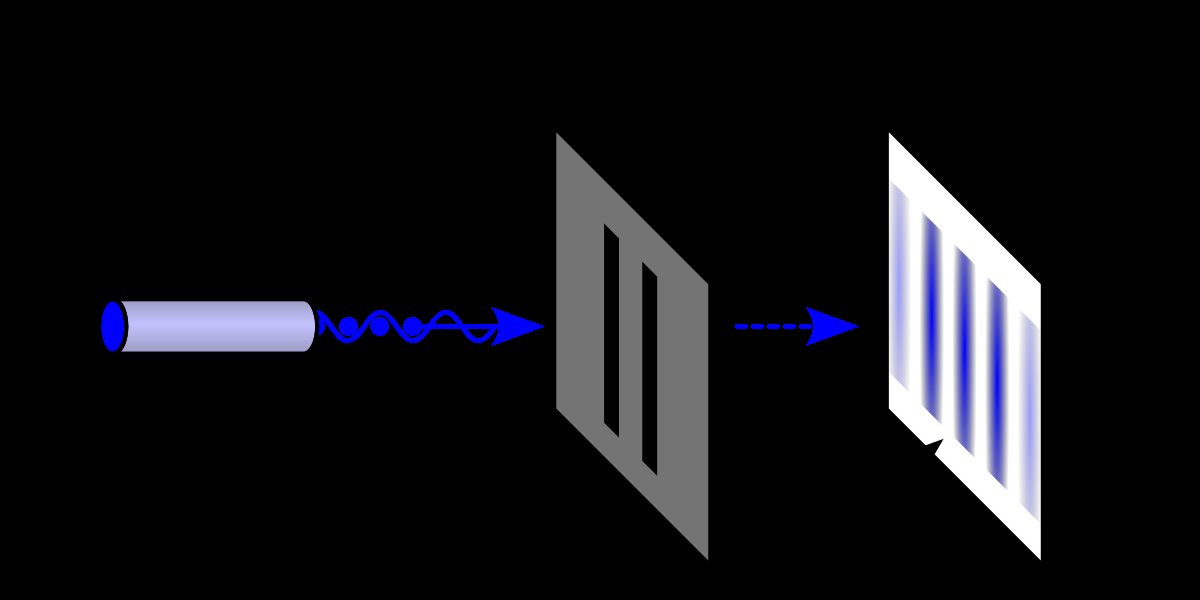
Schematic of the double-slit experiment: particles exhibit wave-like interference, a hallmark of quantum probability.
Bell's Theorem and the Downfall of Local Hidden Variables
For a long time, some physicists, including Albert Einstein, were uncomfortable with the probabilistic nature of quantum mechanics. They suspected that quantum theory was incomplete and that "hidden variables"—unknown underlying factors—might exist that deterministically dictate the outcomes of quantum measurements. If we knew these hidden variables, the apparent randomness would disappear.
Testing Reality: Bell's Inequalities
In the 1960s, physicist John Stewart Bell devised a mathematical framework, known as Bell's theorem, which led to a set of testable predictions called Bell's inequalities. These inequalities set limits on the strength of correlations we could expect to see between measurements on distant particles if the world were governed by local hidden variables (meaning influences are local and properties are predetermined). Quantum mechanics, on the other hand, predicted correlations that would violate these inequalities.
Experimental Verdict: Quantum Mechanics Wins
Starting with the pioneering experiments by Alain Aspect in the 1980s, and refined by numerous increasingly sophisticated "Bell tests" since then, scientists have repeatedly observed violations of Bell's inequalities. These experiments typically involve creating pairs of entangled particles—particles whose fates are interlinked, no matter how far apart they are. Measurements performed on these entangled particles show correlations stronger than any local deterministic theory could allow. This robust experimental evidence strongly supports the conclusion that local hidden variables do not exist and that the randomness observed in quantum mechanics is a fundamental feature of nature, not a result of our ignorance.
This Nobel Prize lecture discusses the groundbreaking experiments by Aspect, Clauser, and Zeilinger using entangled quantum states, providing strong evidence against local realism and supporting quantum non-determinism.
Heisenberg's Uncertainty Principle: A Fundamental Limit
Werner Heisenberg's Uncertainty Principle is another cornerstone of quantum mechanics that points towards non-determinism. It states that there are pairs of complementary properties of a particle, such as its position and momentum (mass times velocity), that cannot both be known with perfect accuracy simultaneously. The more precisely one property is measured, the less precisely the other can be known. This isn't a limitation of our measurement instruments; it's an intrinsic property of quantum systems. If a particle's initial state cannot be perfectly defined in all its aspects, then its future state cannot be perfectly predicted, which is a hallmark of non-determinism.
Quantum Randomness Generation: Practical Proof
The inherent unpredictability of quantum phenomena is not just a theoretical curiosity; it has practical applications. Scientists have developed quantum random number generators (QRNGs) that harness processes like the behavior of photons at a beam splitter or radioactive decay to produce sequences of numbers that are, in principle, truly random. Unlike pseudo-random number generators used in classical computers (which are deterministic algorithms), the randomness from QRNGs is rooted in the fundamental indeterminacy of quantum measurements. Some advanced QRNGs are "device-independent," meaning their randomness can be certified even without fully trusting the internal workings of the generating device, relying directly on the violation of Bell's inequalities. The ability to generate and certify such profound randomness provides compelling empirical evidence for quantum non-determinism.
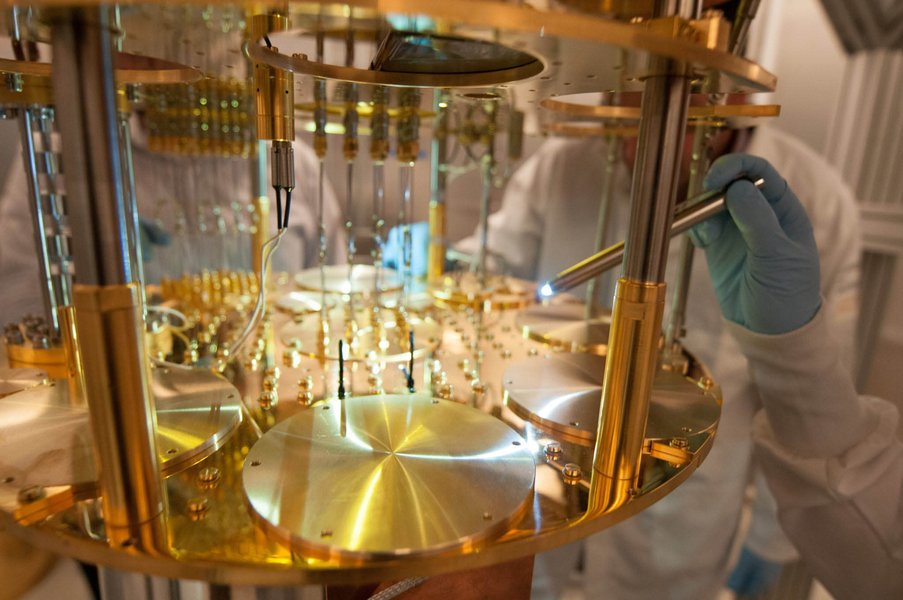
Modern quantum experiments, like those in quantum computing, rely on and demonstrate the principles of quantum mechanics, including its inherent randomness.
Unpredictable Decays: Nature's Dice Roll
The decay of radioactive atoms offers another clear example of quantum non-determinism. For a collection of identical radioactive atoms, we can accurately predict the half-life—the time it takes for half of them to decay. However, for any individual atom, it is impossible to predict the exact moment it will decay. The decay process is inherently probabilistic. This unpredictability of individual quantum events, observed countless times in nuclear physics experiments, further supports the non-deterministic view of the quantum realm.
Visualizing Determinism vs. Non-Determinism
Comparative Attributes of Physical Systems
The following radar chart visually contrasts key characteristics of classical deterministic systems with those of quantum non-deterministic systems. It helps to illustrate how fundamentally different these two descriptions of reality are. The scales are conceptual, representing the degree to which each attribute applies, with higher values indicating a stronger presence or certainty.
As the chart illustrates, classical systems are highly predictable individually, with randomness often stemming from incomplete knowledge. In contrast, quantum systems exhibit fundamental randomness in individual events, and measurement plays a crucial, often disruptive, role. While ensemble behavior in quantum systems can be predicted probabilistically with high accuracy, individual outcomes remain uncertain.
Mapping the Evidence for Quantum Non-Determinism
A Conceptual Overview
This mindmap provides a structured overview of the core concepts and lines of empirical evidence that lead to the conclusion that the quantum realm is non-deterministic. It connects the central idea of non-determinism to its key experimental and theoretical underpinnings.
(Fundamental Unpredictability)"] id1["Empirical Evidence"] id1a["Probabilistic Measurement Outcomes"] id1a1["Double-Slit Experiment
(Wave-particle duality, observer effect)"] id1a2["Identical Systems, Different Outcomes"] id1b["Bell's Theorem & Inequality Violations"] id1b1["Experiments (e.g., Alain Aspect)"] id1b2["Rules out Local Hidden Variables"] id1b3["Confirms Entanglement's Non-Local Correlations"] id1c["Quantum Randomness Generation (QRNGs)"] id1c1["Certified Randomness"] id1c2["Practical Application of Indeterminacy"] id1d["Unpredictable Quantum Events"] id1d1["Radioactive Decay (Individual Atoms)"] id1d2["Photon Behavior at Beam Splitters"] id2["Theoretical Pillars"] id2a["Heisenberg's Uncertainty Principle"] id2a1["Limits on Simultaneous Knowledge
(e.g., position & momentum)"] id2a2["Intrinsic Property, Not Instrumental Limit"] id2b["Standard Interpretation of Quantum Mechanics"] id2b1["Wavefunction Collapse (Probabilistic)"] id3["Implications"] id3a["Rejection of Classical Determinism at Micro-scale"] id3b["Fundamental Role of Probability in Nature"] id3c["Challenges to Notions of Objective Reality Independent of Observation"] id4["Alternative Interpretations (Note: Standard view is non-deterministic based on evidence)"] id4a["Many-Worlds (Deterministic universal wavefunction, branching realities)"] id4b["Bohmian Mechanics (Deterministic but non-local hidden variables)"]
The mindmap illustrates how various experimental findings, such as the probabilistic nature of measurements and the violation of Bell's inequalities, converge to support the idea of fundamental quantum non-determinism. Theoretical concepts like the Uncertainty Principle further reinforce this understanding.
Classical vs. Quantum: A Tale of Two Determinisms
Comparing Predictive Power
The table below contrasts classical physics with quantum mechanics concerning determinism and predictability, highlighting the shift in perspective required when moving from the macroscopic to the microscopic world.
| Feature | Classical Physics (e.g., Newtonian Mechanics) | Quantum Mechanics |
|---|---|---|
| Determinism | Generally deterministic: Given initial conditions, future states are precisely predictable. | Fundamentally non-deterministic for individual measurement outcomes. |
| Predictability of Individual Events | High: Outcomes are certain if all variables are known. | Low: Outcomes are probabilistic; only likelihoods can be predicted. |
| Role of Measurement | Ideally non-intrusive; reveals pre-existing properties. | Often intrusive; actively influences the state and outcome. Measurement "creates" the property. |
| Nature of Randomness | Typically arises from incomplete knowledge of complex systems (epistemic randomness). | Appears to be an inherent, fundamental property of nature (ontological randomness). |
| Hidden Variables | Not generally needed to explain observed determinism. | Local hidden variable theories have been largely ruled out by Bell test experiments. Non-local hidden variable theories exist but are not the standard interpretation. |
| Evolution of the System (Mathematical Description) | Equations of motion (e.g., Newton's laws) are deterministic. | The Schrödinger equation describes the deterministic evolution of the quantum state (wavefunction) between measurements. However, the measurement process itself is probabilistic. |
This comparison underscores that while the mathematical evolution of a quantum system's wavefunction is deterministic, the act of measurement introduces an irreducible element of chance, which is the source of its perceived non-determinism in experimental outcomes.
Interpretations and Ongoing Debates
Are There Ways Around Non-Determinism?
It's important to acknowledge that the interpretation of quantum mechanics is still a subject of discussion among physicists. While the empirical evidence overwhelmingly supports the probabilistic predictions of quantum theory and rules out local deterministic explanations, some interpretations attempt to preserve determinism in different ways:
- Many-Worlds Interpretation: Proposes that the universal wavefunction evolves deterministically, but every quantum measurement causes the universe to split into multiple parallel universes, each corresponding to one possible outcome. In this view, there's no random collapse, but rather all possibilities are realized in different branches.
- Bohmian Mechanics (Pilot-Wave Theory): This is a hidden-variable theory where particles always have definite positions and are guided by a "pilot wave" that evolves according to the Schrödinger equation. It is deterministic but inherently non-local (allowing for instantaneous influences across distances), which is a feature strongly constrained by Bell's theorem.
However, these interpretations, while offering different conceptual frameworks, do not change the experimentally observed probabilistic outcomes of measurements in our experienced reality. The standard, or Copenhagen-like, interpretation, which accepts fundamental non-determinism at the point of measurement, remains the most widely adopted view among physicists due to its direct correspondence with experimental results and its predictive power without invoking unobserved entities like parallel universes or non-local hidden variables that lack direct empirical support distinguishing them from standard quantum mechanics.
Ultimately, the statement "the quantum realm is non-deterministic" is a robust conclusion based on decades of rigorous empirical testing. The inherent unpredictability of individual quantum events is a well-established experimental fact, forming a cornerstone of our current understanding of the fundamental nature of reality.
Frequently Asked Questions (FAQ)
What does "non-deterministic" mean in the context of the quantum realm?
Is quantum randomness just due to our lack of knowledge or limitations in measurement?
How do experiments like Bell tests prove non-determinism?
Does Heisenberg's Uncertainty Principle contribute to the idea of non-determinism?
Are all interpretations of quantum mechanics non-deterministic?
Recommended Further Exploration
Delve Deeper into Quantum Mysteries
- What are the implications of Bell's theorem for our understanding of reality?
- How does quantum entanglement challenge classical physics?
- Can you explain the different interpretations of quantum mechanics in simple terms?
- What are the practical applications of quantum randomness?
References
Sources for This Explanation
Last updated May 21, 2025