
Navigating K-AUM Exclusions: When Trustee-Controlled Assets Avoid Capital Charges
Unpacking the intricate regulatory landscape of K-AUM calculations and the specific conditions for excluding assets advised to trustees.
Key Insights into K-AUM Exclusions for Trustee-Controlled Assets
- K-AUM's Core Purpose: The K-AUM (Assets Under Management) capital requirement primarily targets risks arising from an investment firm's discretionary management or ongoing, MiFID-scoped investment advice, not merely general advisory services.
- Non-Discretionary Advice: If an investment firm provides non-discretionary advice to a trustee, and the trustee retains full control and decision-making authority over the assets, these assets can generally be excluded from the investment firm's K-AUM calculation.
- Avoiding Double Counting: Regulatory bodies like the EBA emphasize preventing double counting of capital requirements. If the trustee, as the primary responsible entity, already accounts for these assets under their own prudential framework, the advising investment firm may exclude them to avoid redundant capital charges.
The question of whether assets under trustee control can be excluded from the K-AUM risk calculation when advice is provided by an investment firm is a critical area within the Investment Firms Regulation (IFR) and Investment Firms Directive (IFD) framework. This issue revolves around the precise definition of "assets under management" for capital requirement purposes, particularly as clarified by the European Banking Authority (EBA) and other regulatory bodies like the Financial Conduct Authority (FCA). The overarching principle is to capture risks associated with significant control or ongoing influence over client assets, while avoiding undue capital burdens or double counting.
Understanding the K-AUM Framework
The K-AUM factor is a cornerstone of the prudential framework for investment firms in the EU. Its primary objective is to capture the risk of potential harm to clients resulting from the incorrect discretionary management of client portfolios or from poor execution and advice within ongoing portfolio management. It also aims to ensure continuity of service for these critical functions. This K-factor is applied to firms that manage or provide ongoing advisory services on assets under their MiFID (Markets in Financial Instruments Directive) permissions.
The calculation of K-AUM is based on the market value of relevant assets. It typically involves a rolling average of the total monthly assets under management, usually measured on the last business day of each of the previous 15 months, excluding the three most recent monthly values. This average is then converted into the entity's functional currency. K-AUM is generally calculated on the first business day of each month. Any negative values are offset, and derivatives positions are included at market value, reflecting the capital deployed from the portfolio to maintain those positions.
The Purpose of K-AUM in Risk Mitigation
K-AUM serves as a prudential measure designed to address specific risks:
- Discretionary Management Risk: It covers situations where an investment firm has the authority to make investment decisions on behalf of clients, posing a direct risk if those decisions are flawed.
- Ongoing Investment Advice Risk: This applies to continuous advisory relationships where the firm's advice significantly influences client portfolio decisions, even if the client retains final approval. The risk here lies in potentially poor or inappropriate advice that leads to client harm.
- Operational Continuity: K-AUM also aims to provide sufficient capital to ensure the ongoing provision of portfolio management and investment advice services, even in challenging circumstances.
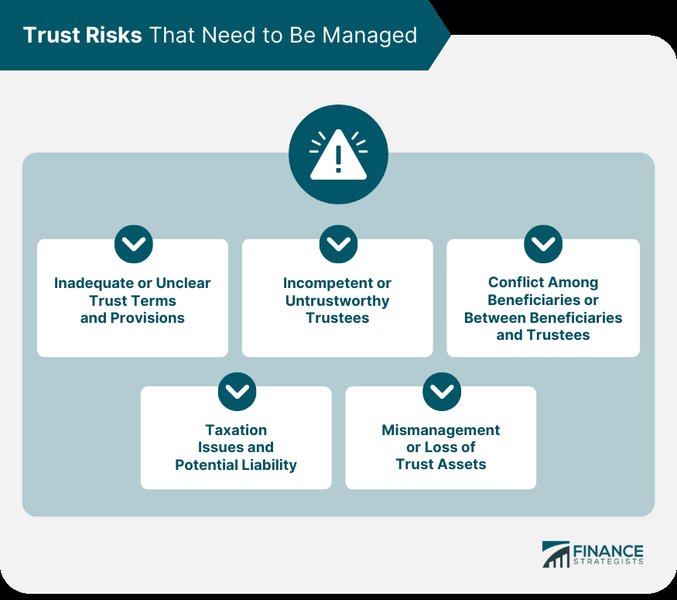
This image illustrates various trust risks, highlighting the complex environment within which trustees operate.
EBA Clarifications and Exclusion Principles
The European Banking Authority (EBA) has provided crucial clarifications regarding the scope of K-AUM, particularly emphasizing the avoidance of double counting and ensuring that capital requirements align with the actual risk exposure. These clarifications are vital for understanding when assets under trustee control can be excluded from an investment firm's K-AUM calculation.
Discretionary vs. Non-Discretionary Advice to Trustees
The distinction between discretionary and non-discretionary advice is paramount. K-AUM primarily focuses on activities where the investment firm has discretionary control over assets or provides ongoing investment advice that directly influences portfolio management decisions. If an investment firm provides advice to a corporate or individual trustee, but the trustee retains full control and discretionary authority over the assets, these assets can generally be excluded from the investment firm's K-AUM calculation. This is because the advising firm is not exercising discretionary management or ongoing advisory services that fall under the direct scope of K-AUM's risk capture.
The EBA's position, as seen in various Q&As and draft Regulatory Technical Standards (RTS), clarifies that K-AUM is designed to mitigate risks arising from "incorrect discretionary management" or "poor execution," not from all forms of advice. Therefore, if the advice provided to the trustee does not grant the investment firm direct discretionary control or ongoing management responsibility that would typically trigger K-AUM, it is plausible to exclude such assets.
The Principle of Avoiding Double Counting
A key principle in the EBA's guidance is to avoid double counting capital requirements for the same level of risk. This is particularly relevant when considering trustee-controlled assets:
- Delegated Management: If a financial entity (like a trustee) formally delegates the management of assets to an investment firm, those assets are generally included in the investment firm's K-AUM. Conversely, the delegating entity (the trustee) would typically exclude these assets from their own equivalent calculations. This prevents the same assets from being subject to capital charges at multiple points in the chain.
- Sub-Delegation Exception: However, an important nuance exists. If the delegating entity has already applied an exclusion for these assets in its own K-AUM calculation, the investment firm to whom the assets are sub-delegated cannot also exclude them. This prevents a situation where the assets are not accounted for in any entity's K-AUM, ensuring prudential coverage. This rule also applies if the delegating entity is a financial entity in a third country applying an equivalent exclusion.
- Advisory-Only vs. Management: If an investment firm merely advises a trustee who retains ultimate control and discretion, and there's no formal delegation of management, then including these assets in the advising firm's K-AUM could lead to inappropriate double counting or an overestimation of the advising firm's risk, especially if the trustee is already prudentially regulated for these assets.
Specific Exclusions and Advisory Arrangements
The EBA has also specified certain types of advisory services that are explicitly excluded from K-AUM calculations:
- Non-Portfolio-Related Advice: Advice to undertakings on capital structure, industrial strategy, mergers, and the purchase of undertakings are typically excluded. These types of advisory services are not considered to pose the same kind of client harm risk that K-AUM is designed to capture, as they do not involve ongoing portfolio management or investment advice.
- Monitoring Activities: When an investment firm provides both investment advice and monitoring activities on a client's assets, and these activities are performed by different firms, all involved firms might need to calculate K-AUM. However, assets related to monitoring activities that solely involve the reception and aggregation of statements on the value of assets managed by other undertakings should not be included in the AUM calculation. This distinguishes passive data aggregation from active, risk-generating advisory services.
- K-CMH Overlap: To prevent double counting across K-factors, cash held by clients that is already included in the calculation of K-CMH (Client Money Held) should not be included in K-AUM. Only cash not covered by K-CMH would be considered for K-AUM.
Practical Application to Trustee-Controlled Assets
For investment firms providing advice to trustees, the core question is whether the nature of the advice triggers the K-AUM requirement. If the investment firm is only providing non-discretionary advice, and the trustee maintains full control and decision-making authority over the assets, then exclusion from K-AUM is often justifiable. This hinges on whether the advice constitutes "ongoing investment advice" under MiFID permissions that would necessitate K-AUM coverage, or if it aligns more with general advisory services where direct client harm from portfolio mismanagement is not the primary risk for the advising firm.

A meeting between a financial advisor and a client, illustrating discussions pertinent to trust banking and wealth management.
The Nuance of "Assets Under Advisement" (AUA) vs. "Assets Under Management" (AUM)
The distinction between AUM and AUA is relevant. AUM typically refers to assets over which the advisor has direct discretionary management and the ability to execute trades. This implies a higher level of control and, consequently, a higher risk of harm if managed incorrectly. AUA, on the other hand, refers to assets where guidance or advice is provided, but the advisor lacks direct trading authority. While some financial institutions may include AUA in their internal AUM reporting, the regulatory definition for K-AUM specifically focuses on the risk of harm from discretionary management or ongoing advice under MiFID.
Therefore, if an investment firm's advice to a trustee does not involve the ability to directly manage or execute trades on the assets, and the trustee maintains full discretionary control, the arrangement might align more with AUA and potentially fall outside the scope of K-AUM. This is particularly true if the advice is not "ongoing MiFID-governed investment advice" that would trigger K-AUM.
Factors Influencing Inclusion or Exclusion
The decision to include or exclude trustee-controlled assets from K-AUM depends on several factors:
- Nature of Advice: Is it one-off transactional advice, or ongoing, continuous advice that directly influences portfolio decisions?
- Discretionary Control: Does the investment firm have any discretionary authority over the assets, or does the trustee retain full control?
- Delegation: Has the trustee formally delegated management of the assets to the investment firm? If so, the assets would typically be included in the investment firm's K-AUM.
- Double Counting Prevention: Is the trustee already accounting for these assets in their own prudential calculations, potentially precluding the investment firm from including them?
- MiFID Scope: Does the advice provided to the trustee fall under the definition of "ongoing investment advice" as regulated by MiFID, which triggers K-AUM?
This radar chart illustrates the perceived influence levels across various dimensions for an investment firm providing advice to a trustee, in the context of K-AUM calculation. Each spoke represents a critical aspect of engagement, with higher values indicating greater influence or involvement. The "Discretionary Control" and "Direct Trading Authority" axes are particularly low, reflecting the scenario where the trustee retains primary control. "Ongoing MiFID Advice" is moderate, indicating that while advice is continuous, it may not reach the threshold for K-AUM if it doesn't involve direct discretionary power. "Risk Exposure to Firm" and "Capital Allocation Impact" are also relatively low, suggesting reduced capital requirements when assets remain under trustee control without direct management.
Navigating the Regulatory Landscape
The regulatory landscape for investment firms under the IFR/IFD is complex, and the precise application of K-AUM rules requires careful consideration of specific facts and circumstances. The EBA and FCA handbooks provide detailed guidance, but firms often need to interpret these in the context of their unique business models and client relationships.
This Mermaid.js mindmap visually represents the key criteria and considerations for excluding assets from K-AUM calculations, particularly when advice is provided to a corporate or individual trustee. It branches out from the central idea of "K-AUM Exclusion Criteria" into categories such as the "Nature of Advice," "Trustee Control," "Regulatory Principles," and specific "EBA/FCA Clarifications." Each node provides a concise concept, illustrating how various factors interrelate to determine whether an exclusion is permissible, emphasizing the importance of non-discretionary advice and the avoidance of double counting.
Comparison of AUM Inclusion Scenarios
To further clarify, the following table summarizes typical scenarios regarding AUM inclusion based on the nature of the relationship between an investment firm and assets under management or advisement:
| Scenario | Investment Firm's Role | Trustee Control | K-AUM Inclusion for Investment Firm | Rationale |
|---|---|---|---|---|
| Direct Discretionary Management | Full discretionary control over assets, executes trades. | N/A (Firm has control) | Included | Direct risk from firm's management; core K-AUM purpose. |
| Ongoing MiFID Investment Advice | Provides continuous, MiFID-scoped advice influencing portfolio decisions. | Trustee retains final approval but heavily reliant on advice. | Included | Ongoing risk of harm from firm's advice, even without full discretion. |
| Advisory to Trustee (Non-Discretionary) | Provides advice to trustee; trustee retains full discretionary control. | Trustee retains full control and execution. | Excluded (Generally) | Firm does not manage or have discretionary control; trustee is decision-maker. |
| Formal Delegation from Trustee | Trustee formally delegates management of assets to the investment firm. | Investment firm manages delegated assets. | Included | Firm assumes management responsibility for delegated assets. |
| Sub-Delegation (Trustee already excludes) | Firm is sub-delegatee, original delegator (trustee) already excluded. | Trustee has excluded, but firm is sub-delegated. | Included | Prevents assets from being completely uncounted in capital requirements. |
| Advice on Corporate Strategy/M&A | Advice on non-portfolio matters (e.g., capital structure). | Trustee manages all assets. | Excluded | Advice does not pose the specific client harm risk K-AUM addresses. |
| Pure Monitoring/Aggregation of Statements | Receives and aggregates statements from other undertakings. | Trustee retains control. | Excluded | No active management or advisory function creating K-AUM risk. |
Conclusion
In summary, assets under the control of a corporate or individual trustee can generally be excluded from an investment firm's K-AUM risk calculation, provided the investment firm is offering only non-discretionary advice. The fundamental determinant is whether the investment firm exercises discretionary control over the assets or provides ongoing investment advice that falls squarely within the scope of MiFID-governed services intended to be captured by K-AUM. The EBA's emphasis on avoiding double counting and focusing K-AUM on direct management or significant ongoing advisory influence supports this potential exclusion. Firms must conduct a thorough assessment of their specific advisory arrangements, the level of control retained by the trustee, and the applicability of EBA and FCA guidelines to ensure accurate K-AUM reporting and compliance with prudential requirements.
Frequently Asked Questions (FAQ)
What is K-AUM?
Can assets advised to a trustee be excluded from K-AUM?
Why does the EBA emphasize avoiding double counting in K-AUM?
What types of advice are explicitly excluded from K-AUM?
What is the difference between AUM and AUA?
Recommended Further Exploration
- Explore EBA guidelines on Investment Firms Regulation K-factors for deeper regulatory insights.
- Understand the FCA MIFIDPRU handbook for specific K-AUM calculation details.
- Investigate the impact of non-discretionary advice on investment firm capital requirements.
- Examine the delegation rules under the Investment Firms Regulation and their implications.