
Unlock Process Excellence: Your Comprehensive Guide to Lean Six Sigma
Master the methodology that merges speed and quality for transformative business results.
Hello HBANE ABDELHAQ, while I cannot directly generate a PDF file with your name and email (a.hbane2470@uca.ac.ma) embedded as a signature due to my nature as an AI assistant, I can provide you with a comprehensive, web-based tutorial on Lean Six Sigma right here. This guide covers the core principles, methodologies, tools, and benefits, drawing from extensive resources. You can explore publicly available Lean Six Sigma PDF tutorials online (some linked in the references) which you might be able to download and personalize using standard PDF editing software.
Essential Insights into Lean Six Sigma
- Synergistic Power: Lean Six Sigma intelligently combines Lean's focus on eliminating waste and improving flow with Six Sigma's emphasis on reducing variation and defects for optimal process performance.
- Structured Problem-Solving: The DMAIC (Define, Measure, Analyze, Improve, Control) framework provides a systematic, data-driven roadmap for tackling process inefficiencies and achieving sustainable improvements.
- Universal Applicability: Originally rooted in manufacturing, Lean Six Sigma principles and tools are now successfully applied across diverse sectors, including services, healthcare, finance, and IT, to enhance quality, reduce costs, and boost customer satisfaction.
Understanding the Foundations: Lean vs. Six Sigma
Lean Six Sigma isn't just one methodology; it's the strategic integration of two powerful approaches to process improvement. Understanding their individual strengths reveals why their combination is so effective.
Lean Principles: The Pursuit of Efficiency
Lean thinking originated from the Toyota Production System and is fundamentally about maximizing customer value while minimizing waste. It focuses on streamlining processes by eliminating activities that don't add value from the customer's perspective.
Key Focus Areas of Lean:
- Waste Elimination (Muda): Identifying and removing the eight common types of waste: Defects, Overproduction, Waiting, Non-utilized Talent, Transportation, Inventory, Motion, and Extra-processing (often remembered by the acronym DOWNTIME).
- Value Stream Mapping: Visualizing the entire process flow, from raw materials to the end customer, to identify bottlenecks and opportunities for improvement.
- Flow Optimization: Ensuring work moves smoothly through the process without interruptions or delays.
- Pull Systems: Producing only what is needed, when it is needed, based on customer demand.
- Continuous Improvement (Kaizen): Fostering a culture where small, incremental improvements are constantly sought and implemented by everyone involved.
Six Sigma Principles: The Drive for Quality
Six Sigma, developed by Motorola, is a data-driven methodology focused on reducing process variation and eliminating defects. The term "Six Sigma" refers to a statistical goal of having fewer than 3.4 defects per million opportunities (DPMO), signifying near-perfect quality.
Key Focus Areas of Six Sigma:
- Variation Reduction: Using statistical tools to understand and minimize inconsistency in process outputs.
- Defect Elimination: Systematically identifying and removing the root causes of errors and defects.
- Data-Driven Decisions: Relying heavily on statistical analysis (like Statistical Process Control, Hypothesis Testing, Design of Experiments) to understand processes and validate improvements.
- Customer Focus (Critical to Quality - CTQs): Defining quality based on customer requirements and expectations.
- Structured Methodology (DMAIC/DMADV): Utilizing rigorous frameworks for problem-solving and process design.
Comparing Lean and Six Sigma Focus Areas
While Lean focuses on speed and efficiency by removing waste, Six Sigma focuses on quality and consistency by reducing variation. The radar chart below illustrates the relative emphasis of each methodology across key process improvement dimensions. Lean Six Sigma aims to leverage the strengths of both.
Radar chart illustrating the relative focus areas of Lean and Six Sigma.
The DMAIC Framework: A Roadmap for Improvement
The most common methodology used in Lean Six Sigma projects is DMAIC. It provides a structured, five-phase approach to problem-solving and process optimization.
Mindmap illustrating the five phases of the DMAIC cycle and key activities within each phase.
Deep Dive into DMAIC Phases
Define Phase
Clearly articulate the problem, define project goals, scope, and identify customer requirements (Critical to Quality - CTQs). Tools like Project Charters and SIPOC (Suppliers, Inputs, Process, Outputs, Customers) diagrams are crucial here.
Measure Phase
Establish a baseline understanding of the current process performance. This involves developing a data collection plan, gathering reliable data, and performing Measurement System Analysis (MSA) to ensure data accuracy.
Analyze Phase
Use the collected data to identify, validate, and prioritize the root causes of the problem or inefficiency. Statistical analysis, process mapping, Fishbone diagrams, Pareto charts, and hypothesis testing are common tools.
Improve Phase
Develop, test, and implement solutions that address the identified root causes. Techniques like brainstorming, Design of Experiments (DOE), and pilot testing help ensure the chosen solutions are effective.
Control Phase
Implement measures to sustain the gains achieved. This includes developing control plans, using Statistical Process Control (SPC) charts, standardizing procedures (SOPs), and establishing monitoring systems.
Getting Started with Lean Six Sigma: Belts and Certification
Lean Six Sigma utilizes a belt system, similar to martial arts, to denote levels of expertise and responsibility within the methodology. Understanding these roles is key to implementing Lean Six Sigma effectively within an organization.
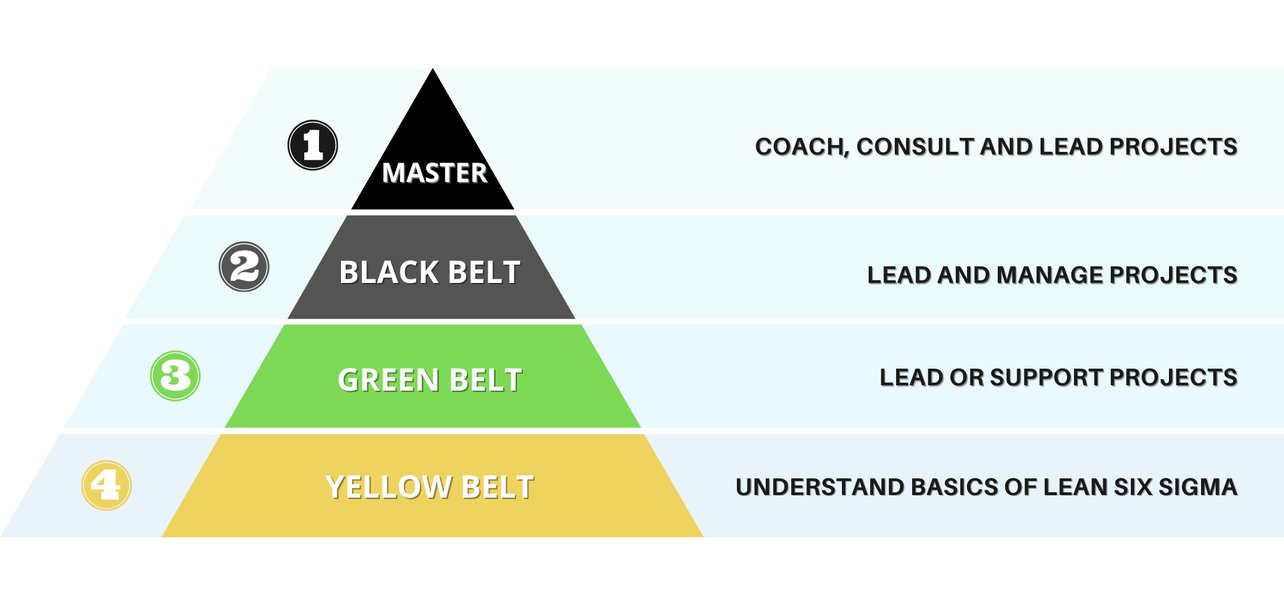
Hierarchy and typical roles associated with Lean Six Sigma Belts.
Lean Six Sigma Belt Levels
The table below summarizes the typical roles and responsibilities associated with each Lean Six Sigma belt level. Training requirements and project involvement increase significantly at higher levels.
| Belt Level | Typical Role & Responsibility | Training Focus | Project Involvement |
|---|---|---|---|
| White Belt | Basic understanding of concepts; supports local improvement activities. | Introduction to LSS concepts and terminology. | May participate on teams or identify localized problems. |
| Yellow Belt | Understands fundamentals; participates as a project team member; gathers data. | Basic LSS principles and tools; DMAIC overview. | Active team member on Green/Black Belt projects. |
| Green Belt | Leads smaller improvement projects within their functional area; applies DMAIC tools. | In-depth DMAIC methodology; core statistical tools; project management. | Leads Green Belt projects; supports Black Belt projects. |
| Black Belt | Leads complex, cross-functional improvement projects; mentors Green Belts; expert in statistical tools. | Advanced statistical analysis; DOE; change management; leadership. | Leads Black Belt projects; coaches Green Belts. |
| Master Black Belt | Trains and mentors Black Belts and Green Belts; develops LSS strategy; manages project portfolio. | Advanced LSS expertise; program deployment strategy; coaching and mentoring skills. | Strategic deployment; program management; mentoring. |
Overview of Lean Six Sigma Belt Levels, Roles, and Training Focus.
Pursuing Certification
Certification typically involves completing formal training, passing an examination, and successfully completing one or more real-world improvement projects demonstrating proficiency in applying the methodology. Various organizations offer training and certification programs, both online and in-person.
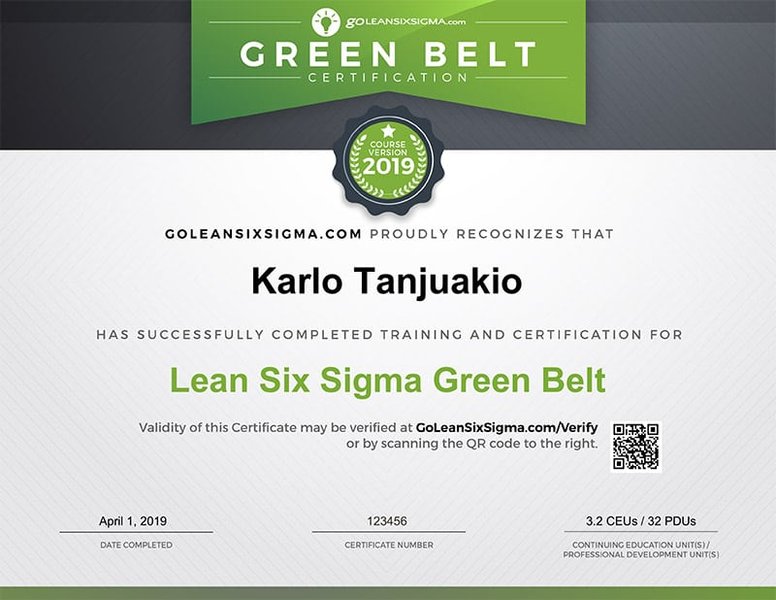
Example of a Lean Six Sigma Green Belt Certification.
Visual Introduction to Lean Six Sigma
For a quick overview of the core concepts discussed, the following video provides a concise explanation of Lean Six Sigma and its benefits.
"Lean Six Sigma In 8 Minutes" video providing a brief introduction to the methodology.
This video touches upon the integration of Lean's waste reduction principles with Six Sigma's defect reduction focus, highlighting the synergy that drives significant process improvements. It serves as a great starting point or refresher on why Lean Six Sigma is a valued approach in modern business.
Frequently Asked Questions (FAQ)
What is the main difference between Lean and Six Sigma?
Lean focuses primarily on eliminating waste (non-value-added activities) and improving process speed and flow. Six Sigma focuses primarily on reducing variation and eliminating defects to improve process quality and consistency. Lean Six Sigma combines both approaches for comprehensive process optimization.
What does DMAIC stand for?
DMAIC is the core framework for Lean Six Sigma improvement projects. It stands for:
- Define: Define the problem, project goals, and customer requirements.
- Measure: Measure the current process performance (baseline).
- Analyze: Analyze data to identify the root causes of defects or inefficiencies.
- Improve: Implement solutions to eliminate root causes and improve the process.
- Control: Control the improved process to sustain the gains.
Do I need a certification to use Lean Six Sigma?
While not strictly necessary to apply the principles, certification (e.g., Green Belt, Black Belt) provides formal validation of your knowledge and skills. It often involves structured training and project work, enhancing your ability to lead improvement initiatives effectively and is often preferred or required by employers for certain roles.
Is Lean Six Sigma only for manufacturing?
No. While Lean Six Sigma has its roots in manufacturing, its principles and tools are highly adaptable and widely used in various sectors, including healthcare, finance, IT, logistics, customer service, government, and more, to improve processes and outcomes.
Where can I find downloadable Lean Six Sigma PDF tutorials?
Several organizations offer free Lean Six Sigma materials. You can often find downloadable PDF guides, manuals, and eBooks on websites dedicated to quality management and process improvement training. Some reputable sources include The Council for Six Sigma Certification (CSSC) and GoLeanSixSigma.com, often providing materials for various belt levels. Check the references section below for some direct links mentioned in the source materials.
Recommended Further Exploration
- Explore a detailed guide to the specific tools used in each phase of the Lean Six Sigma DMAIC cycle.
- Understand the differences in requirements and responsibilities between Lean Six Sigma Green Belt and Black Belt certifications.
- Discover real-world examples of how Lean Six Sigma has been successfully applied in service-based industries.
- Learn strategies for selecting impactful Lean Six Sigma projects within an organization.
References

 cdn.bookey.app
Last updated May 4, 2025