
Unlock the Power of Scala: Your Comprehensive Guide for 2025
Discover the elegant fusion of object-oriented and functional programming with Scala.
Scala, short for "Scalable Language," is a high-level, general-purpose programming language that seamlessly integrates features of object-oriented programming (OOP) and functional programming (FP). Created by Martin Odersky and first released in 2003, Scala runs on the Java Virtual Machine (JVM), offering full interoperability with Java libraries and ecosystems while providing a more concise, expressive, and powerful coding experience. It's designed to grow with demand, making it suitable for everything from small scripts to large-scale enterprise systems.
Key Highlights of Scala
- Multi-Paradigm Powerhouse: Scala elegantly combines the best of object-oriented and functional programming, allowing developers to choose the best paradigm for the task at hand.
- JVM Interoperability & Ecosystem: Runs on the JVM, providing seamless integration with Java code and access to a vast ecosystem of libraries and tools, including extensive use in Big Data with Apache Spark.
- Concise, Expressive, and Type-Safe: Features a strong static type system with advanced capabilities like type inference, generics, and pattern matching, enabling developers to write less boilerplate code that is robust and maintainable.
Delving Deeper: What Makes Scala Unique?
A Blend of Paradigms
Scala stands out by treating functions as first-class citizens (a hallmark of FP) while maintaining a pure object-oriented structure where every value is an object. This hybrid approach offers remarkable flexibility.
Object-Oriented Features
Scala embraces OOP principles. It supports classes, objects, inheritance, and traits (similar to interfaces but allowing implementation). Even primitive types like Int or Boolean are objects, unifying the type system.
Functional Programming Prowess
Scala incorporates key FP concepts:
- Immutability: Encourages the use of immutable data structures, leading to safer concurrent code.
- First-Class Functions: Functions can be passed as arguments, returned from other functions, and assigned to variables.
- Higher-Order Functions: Functions that operate on other functions.
- Pattern Matching: A powerful control structure for decomposing data structures and selecting code paths based on their shape.
- Case Classes: Concise syntax for creating immutable data carriers, often used with pattern matching.
- For-Comprehensions: Elegant syntax for composing operations involving sequences, options, futures, etc.
Conciseness and Readability
Compared to Java, Scala often requires significantly less code to achieve the same result. Features like type inference (where the compiler deduces types automatically), expression-oriented structures (like if returning values), and concise syntax for common patterns contribute to reduced boilerplate and improved developer productivity.
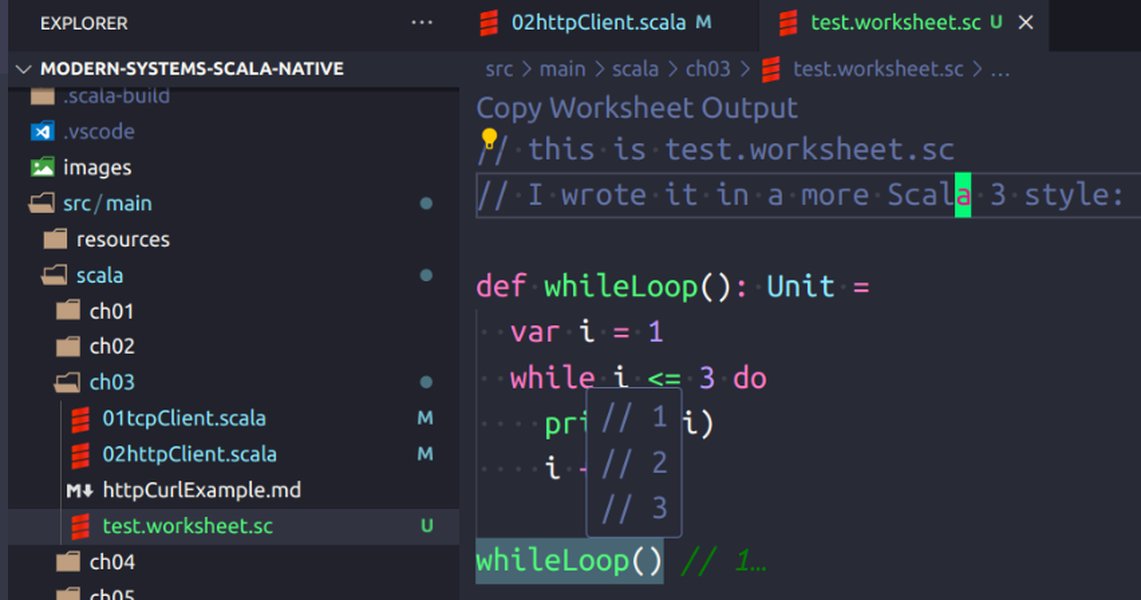
A basic Scala program illustrating its concise syntax.
Static Typing and Safety
Scala features a powerful static type system that catches many errors at compile time, enhancing code robustness. Beyond basic type checking, it supports advanced features like:
- Generics: Parameterized types for writing flexible and reusable code.
- Variance Annotations: Control over subtyping relationships for generic types.
- Higher-Kinded Types: Abstracting over types that abstract over other types (e.g., abstracting over `List`, `Option`, `Future`).
- Type Classes: A pattern for ad-hoc polymorphism, enabling adding new behavior to existing types without modifying them.
Seamless Java Interoperability
Running on the JVM is a major advantage. Scala code compiles to Java bytecode, allowing developers to:
- Use existing Java libraries and frameworks directly within Scala projects.
- Call Scala code from Java projects.
- Leverage the mature tooling, performance, and deployment options of the JVM ecosystem.
Where is Scala Used? Practical Applications
Scala's blend of features makes it well-suited for demanding applications:
- Big Data and Data Engineering: This is arguably Scala's most prominent domain. Apache Spark, a leading big data processing framework, is written primarily in Scala. Its functional features are ideal for processing large datasets efficiently and concisely.
- Web Development & Backend Systems: Frameworks like Play Framework and http4s leverage Scala to build high-performance, scalable web applications and APIs. Its strong typing and concurrency support are beneficial for building robust backend services and microservices.
- Distributed Systems & Concurrency: Libraries like Akka (for actor-based concurrency), Cats Effect, and ZIO provide sophisticated tools for building concurrent, distributed, and resilient systems. Scala's features naturally support writing non-blocking, asynchronous code.
- Financial Services: The finance industry often employs Scala for its performance, type safety, and ability to model complex domains accurately.
- General Purpose Programming: While dominant in specific niches, Scala can also be used for developing desktop applications, tools, and other software on the JVM.
Many prominent tech companies, including Twitter, LinkedIn, Netflix, Airbnb, and Coursera, have successfully used Scala in their production systems, often citing its scalability and developer productivity benefits.
A quick introduction to the Scala programming language (Video Source: YouTube - Fireship).
The Scala Ecosystem and Tooling in 2025
The Scala ecosystem continues to evolve, focusing on language refinement, improved tooling, and a rich set of libraries.
Language Evolution (Scala 3 and Beyond)
Scala 3 introduced significant changes aimed at simplifying the language and making it more principled. Ongoing efforts focus on refining syntax, improving compiler performance, and enhancing developer experience. Recent and upcoming improvements include:
- Improved Syntax: Refinements like the improved 'given' syntax (for context abstractions) and potential introduction of features like Named Tuples aim to make code clearer.
- Focus on Stability: Ensuring stability and backward compatibility where possible, while continuing thoughtful evolution.
- Adaptation: Scala continues to adapt in a landscape where other languages adopt features it pioneered (like pattern matching or lightweight concurrency).
Tooling Enhancements
The build and development tools are constantly improving:
- Scala CLI: Now the official Scala command-line tool, simplifying compiling, running, testing, and packaging Scala code, especially for scripting and smaller projects. Focus is on stability and user experience.
- sbt (Simple Build Tool): The primary build tool for larger Scala projects. The upcoming sbt 2.0 promises improvements like build queries and remote caching.
- IDE Support: Continuous improvements in IntelliJ IDEA (with the Scala plugin) and Visual Studio Code (with Metals) provide better code completion, error highlighting, and refactoring capabilities for Scala 3 features.
- Bloop: A build server that speeds up compilation times by running in the background.
Popular Libraries
A rich ecosystem of libraries supports various programming styles and application domains:
- Functional Programming: Cats, Cats Effect, ZIO provide powerful abstractions for purely functional programming, managing effects, concurrency, and resources.
- JSON Handling: Libraries like Circe, Play JSON, and Json4s are widely used for parsing and generating JSON.
- Data Access: Fetch, Doobie, Slick offer different approaches to database interaction.
- Optics: Monocle provides tools for accessing and modifying nested immutable data structures.
- Testing: ScalaTest, specs2, and ScalaCheck (for property-based testing) are popular choices.
Embarking on Your Scala Journey: Learning Resources
Learning Scala can be a rewarding experience, especially if you appreciate strong typing and functional concepts. While prior programming experience (especially with Java or another statically-typed language) is helpful, it's not strictly required. Around 95% of learners come with some background.
Essential Skills to Cultivate
- Core programming concepts (variables, control flow, functions).
- Object-Oriented principles (classes, objects, inheritance, polymorphism).
- Functional Programming concepts (immutability, pure functions, higher-order functions, pattern matching).
- Understanding of Scala's type system (generics, implicits/givens).
- Familiarity with build tools (sbt, Scala CLI) and common libraries.
- Concurrency fundamentals (especially if using Akka, ZIO, or Cats Effect).
Structuring Your Learning Path
A potential roadmap for learning Scala could involve progressing through fundamentals, object-oriented aspects, functional programming techniques, concurrency, and finally exploring the rich ecosystem and specialized areas like Big Data. This mindmap visualizes such a path:
Evaluating Learning Resources
Choosing the right resources depends on your learning style and goals. The radar chart below provides a subjective evaluation of different resource types based on common criteria:
Note: This chart reflects a general assessment; the best resource depends on individual preferences.
Top Recommended Resources for 2025
- Official Scala Website (scala-lang.org): Essential for documentation, tutorials, API references, and news.
- Coursera Scala Specialization (by Martin Odersky): Widely regarded as the most authoritative online courses, covering fundamentals through advanced FP. (Link)
- Rock the JVM (rockthejvm.com): Offers practical, in-depth courses on Scala, FP (with Cats Effect/ZIO), Spark, and Akka.
- Books:
- "Programming in Scala" (Odersky, Spoon, Venners): The definitive, comprehensive reference.
- "Scala for the Impatient" (Horstmann): A faster-paced introduction focusing on practical usage.
- "Get Programming with Scala" (Sfregola): Hands-on, example-driven approach.
- Free Online Tutorials & Guides:
- Class Central's Best Free Courses List (2025 Guide): Curated list of free resources, including library-specific tutorials (e.g., Circe, ScalaCheck).
- Tutorialspoint (Link): Beginner-friendly introduction to core concepts.
- GeeksforGeeks Scala (Link): Articles covering various Scala topics.
- Scala Exercises (Link): Online platform for practicing Scala and its libraries.
- Community Platforms:
- Scala Users Forum (users.scala-lang.org): Official forum for questions and discussions.
- Reddit (r/scala): Active community for news, help, and discussions.
- Stack Overflow: Q&A site for specific programming problems.
- GitHub (github.com/scala): Explore Scala's source code and related projects.
Scala vs. Java vs. Python: A Quick Comparison
Understanding how Scala compares to other popular languages can help clarify its strengths:
| Feature | Scala | Java | Python |
|---|---|---|---|
| Primary Paradigm(s) | Object-Oriented & Functional | Object-Oriented | Object-Oriented, Imperative, Functional (aspects) |
| Typing | Static (with Type Inference) | Static | Dynamic |
| Conciseness | High | Lower (more boilerplate) | Very High |
| Performance (JVM/Native) | High (JVM) | High (JVM) | Lower (CPython, but libraries in C/C++) |
| Ecosystem | Strong (JVM + Scala-specific) | Very Large (JVM) | Very Large (Data Science, Web, Scripting) |
| Concurrency Support | Excellent (Actors, FP libraries) | Good (Threads, `java.util.concurrent`, Project Loom) | Moderate (GIL limitations for CPU-bound tasks, AsyncIO) |
| Learning Curve | Moderate to Steep (due to FP & advanced types) | Moderate | Gentle |
Community and Events in 2025
The Scala community remains active and vibrant, with regular events and initiatives:
- Scala Days 2025: The premier global Scala conference, scheduled for August 19-21, 2025, in Lausanne, Switzerland. It's a key venue for sharing advancements and best practices. (Announcement)
- The Scala Workshop 2025: An academic and practitioner forum focusing on research, language design, implementation, and applications of Scala. (Workshop Site)
- Google Summer of Code (GSoC): The Scala Center actively participates, mentoring students working on open-source Scala projects, fostering innovation and community growth. (GSoC 2025)
- Local Meetups & Online Events: Various user groups and organizations host smaller events, workshops, and webinars throughout the year. Check the Scala Events Page for listings.
Frequently Asked Questions (FAQ)
Is Scala difficult to learn?
Scala has a reputation for a steeper learning curve compared to languages like Python or even Java, primarily due to its combination of OOP and advanced FP concepts, along with a powerful type system (implicits/givens, higher-kinded types). However, learners can start with the more familiar OOP aspects and gradually incorporate functional features. Resources like Odersky's Coursera courses and "Scala for the Impatient" aim to ease the learning process. Prior experience with static typing or functional programming helps.
Is Scala still relevant in 2025?
Yes, Scala remains highly relevant, particularly in specific niches. Its dominance in the Big Data ecosystem via Apache Spark ensures continued demand. It's also widely used for building scalable backend systems, microservices, and concurrent applications. While other languages are adopting features Scala pioneered, Scala itself continues to evolve (Scala 3, tooling improvements) and offers a unique, powerful combination of features not easily matched elsewhere, especially for complex, type-safe systems.
What are the main differences between Scala 2 and Scala 3?
Scala 3 (Dotty) was a major overhaul aimed at making the language simpler, safer, and more expressive. Key differences include:
- New Syntax: Optional braces (indentation-based syntax), new control syntax.
- Contextual Abstractions: Redesigned implicits using `given` and `using` clauses, making them clearer and more principled.
- Metaprogramming: A completely new metaprogramming system based on `inline`, macros, and compile-time operations.
- Type System Improvements: Union types, intersection types, literal types, opaque type aliases.
- Trait Parameters: Traits can now take constructor parameters.
- Dropped Features: Some complex or unsound features from Scala 2 were removed or deprecated.
Migration from Scala 2 to 3 requires effort, but tools and guides are available.
Can I use Java libraries in my Scala project?
Absolutely. One of Scala's major strengths is its seamless interoperability with Java. Since Scala runs on the JVM and compiles to Java bytecode, you can directly call Java methods, instantiate Java classes, and use Java libraries within your Scala code without any special wrappers or conversions in most cases. Build tools like sbt handle Java dependencies naturally.
Recommended Next Steps
Continue your exploration of Scala with these related topics:
- How do I set up a Scala 3 development environment for beginners?
- What are the key differences between Scala and Kotlin for modern development?
- Can you explain core functional programming concepts in Scala with practical code examples?
- How is Scala specifically used with Apache Spark for big data tasks?
References
Last updated May 5, 2025