
Unlock the Secrets of Matter: Your Comprehensive Guide to Mastering University Chemistry
Embark on a structured journey from foundational concepts to advanced chemical principles, all from scratch.
Highlights
- Build Systematically: Start with core concepts like atoms, bonding, and stoichiometry before advancing to specialized fields like organic or physical chemistry.
- Resource Management is Key: Combine high-quality textbooks, online courses, practice problem sets, and university library resources for a well-rounded approach.
- Active Learning Accelerates Mastery: Prioritize consistent problem-solving, engage with virtual or real lab simulations, and regularly review material to solidify understanding.
Embarking on Your Chemistry Journey
Setting the Stage for Success
Learning university-level chemistry from scratch is an ambitious yet achievable goal. Chemistry, the science of matter and its properties, interactions, and transformations, forms the bedrock of many scientific disciplines. This guide provides a structured, step-by-step approach, drawing on established learning pathways and resources, to help you navigate this fascinating subject from fundamental principles to complex theories.
Step 1: Constructing a Solid Foundation
Mastering the Absolute Basics
Before tackling university-level material, it's crucial to grasp the fundamental concepts typically covered in introductory or high school chemistry. This foundation will make subsequent learning significantly smoother.
Core Concepts to Cover:
- Measurement & Units: Understand SI units, significant figures, scientific notation, and unit conversions. Precision and accuracy are key concepts here.
- Matter Classification: Learn the definitions and differences between elements, compounds, and mixtures.
- Atomic Structure: Explore the components of an atom (protons, neutrons, electrons), isotopes, and the basic layout of the periodic table. Understand electron shells and how they relate to chemical behavior.
- The Periodic Table: Familiarize yourself with its organization, periods, groups, and basic trends (like electronegativity and atomic radius).
- Introduction to Bonding: Get a preliminary understanding of why atoms bond – ionic and covalent bonds are the primary types to know at this stage.
- Basic Stoichiometry: Learn the concept of the mole, molar mass, and how to balance simple chemical equations.
- States of Matter: Understand the characteristics of solids, liquids, and gases, and the basic principles of phase changes.
Utilize resources designed for beginners. Websites like Purdue University's beginner chemistry page, introductory sections of textbooks, or platforms like Khan Academy offer excellent starting points. Dedicate focused time to internalize these basics before moving forward.
Step 2: Gathering Your Learning Arsenal
Choosing the Right Textbooks and Resources
With the basics in hand, it's time to select comprehensive resources suited for university-level general chemistry. A combination of textbooks, online materials, and practice platforms works best.
Key Resource Categories:
- General Chemistry Textbooks: Choose a reputable, widely-used textbook. "Chemistry: The Central Science" by Brown, LeMay, et al., or Nivaldo Tro's "Chemistry: Structure and Properties" are often recommended for self-learners. OpenStax also provides free, peer-reviewed chemistry textbooks.
- Online Courses & Lectures: Supplement your reading with video lectures. Platforms like Coursera, edX, Khan Academy, or university YouTube channels (e.g., MIT OpenCourseWare, UC Irvine) offer full general chemistry courses.
- Practice Problem Resources: Websites like Chemistry Steps offer extensive practice problems, quizzes, and study guides specifically designed for college chemistry topics.
- University Library Resources (if accessible): Explore online university library guides (like those from Yale or UQ). They often list essential databases (e.g., SciFinder, Reaxys for advanced searching), reference works (CRC Handbook of Chemistry and Physics, Lange's Handbook), and specialized journals.
- Visualization Tools: Use molecular modeling software or apps to visualize molecules and reactions in 3D. Interactive periodic table websites are also invaluable.
Organize these resources. Create a study schedule that allocates time for reading, watching lectures, and dedicated problem-solving sessions.
Step 3: Charting Your Course Through Chemistry
A Systematic Topic Progression
University chemistry follows a logical progression, building complexity layer by layer. Following a structured path prevents knowledge gaps and ensures concepts are learned in the right context.
Typical University Chemistry Sequence:
- General Chemistry I: Building on basics, this covers stoichiometry in depth, types of chemical reactions, thermochemistry (energy changes), electronic structure of atoms, periodic trends, detailed chemical bonding (Lewis structures, VSEPR, valence bond theory, molecular orbital theory), and properties of gases.
- General Chemistry II: This typically includes intermolecular forces, properties of liquids and solids, solutions, chemical kinetics (reaction rates), chemical equilibrium, acid-base equilibria (including buffers and titrations), thermodynamics (entropy, Gibbs free energy), and electrochemistry.
- Organic Chemistry: Focuses on the structure, properties, reactions, and synthesis of carbon-containing compounds. This is often a multi-semester sequence.
- Inorganic Chemistry: Studies the properties and reactions of inorganic and organometallic compounds, covering topics like coordination chemistry, main group elements, and transition metals.
- Physical Chemistry: Applies principles of physics to chemical systems. It often involves quantum mechanics, thermodynamics (statistical mechanics), and kinetics in greater mathematical detail.
- Analytical Chemistry: Concerns the separation, identification, and quantification of chemical substances, covering techniques like spectroscopy, chromatography, and electroanalysis.
- Biochemistry (Optional but common): Explores the chemistry of living organisms, focusing on proteins, nucleic acids, carbohydrates, and lipids.
Use a roadmap, like the systematic approaches suggested by educational resources, to guide your study. Focus on mastering general chemistry thoroughly before branching into specialized areas.
Step 4: The Power of Practice
Solidifying Concepts Through Problem-Solving
Chemistry is not a spectator sport; it requires active engagement. Consistent problem-solving is arguably the most critical activity for mastering university-level chemistry.
Effective Problem-Solving Strategies:
- Work Problems Systematically: Solve end-of-chapter problems in your textbook, use online platforms, and seek out additional practice sets.
- Focus on Understanding, Not Memorization: Don't just find the answer; understand the steps, the underlying principles, and why a particular method works. Explain the process to yourself.
- Practice Regularly: Dedicate significant time daily or weekly specifically to problem-solving. Stanford University study tips emphasize doing warm-up problems and engaging in deep practice.
- Analyze Mistakes: When you get a problem wrong, thoroughly analyze where you went astray. Understanding errors is a powerful learning tool.
- Use Guided Examples First: Start with worked examples in the textbook or online to understand the methodology before tackling problems independently.
- Time Yourself Occasionally: As you gain confidence, practice solving problems under timed conditions to simulate exam pressure.
Step 5: Bridging Theory and Practice
Engaging with Laboratory Concepts
University chemistry heavily integrates laboratory work to connect theoretical concepts with practical application, develop technical skills, and foster scientific inquiry. While self-learning makes physical lab access difficult, understanding experimental aspects is still vital.
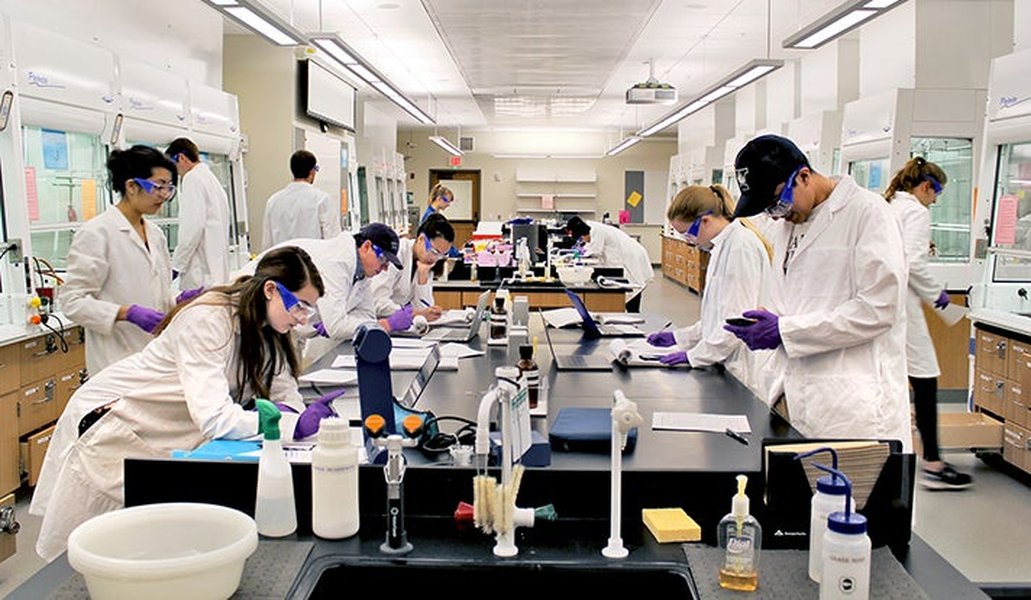
Students gain hands-on experience in university chemistry laboratories.
Simulating the Lab Experience:
- Virtual Labs and Simulations: Many online platforms and university websites offer virtual chemistry labs that simulate experiments like titrations, spectroscopy, or synthesis.
- Video Demonstrations: Watch videos of common laboratory techniques (e.g., distillation, filtration, chromatography, using specific instruments). Many universities and educational channels provide these.
- Focus on Data Analysis: Work through experimental data provided in textbooks or online resources. Practice calculating yields, determining concentrations, and interpreting results.
- Understand Lab Safety: Familiarize yourself with standard laboratory safety protocols, even if you aren't performing experiments yourself.
- Read Experimental Sections: Pay attention to the experimental procedures described in research articles or advanced textbooks to understand how chemistry is done in practice.
While not a perfect substitute for hands-on experience, these approaches help contextualize theoretical knowledge and understand the experimental basis of chemistry.
Visualizing the Chemistry Learning Landscape
Mapping Your Educational Journey
Understanding how different areas of chemistry connect can help structure your learning. This mindmap illustrates the core areas and their relationships, starting from the foundation and branching out into specialized fields typically encountered at the university level.
(Atoms, Elements, Measurement)"] id1b["Periodic Table & Trends"] id1c["Simple Bonding"] id1d["Basic Stoichiometry"] id2["General Chemistry"] id2a["Stoichiometry & Reactions"] id2b["Thermochemistry"] id2c["Atomic Structure & Bonding Theories"] id2d["Gases, Liquids, Solids"] id2e["Solutions"] id2f["Kinetics & Equilibrium"] id2g["Acids & Bases"] id2h["Thermodynamics"] id2i["Electrochemistry"] id3["Specialized Branches"] id3a["Organic Chemistry
(Carbon Compounds, Mechanisms, Synthesis)"] id3b["Inorganic Chemistry
(Non-carbon elements, Coordination Chemistry)"] id3c["Physical Chemistry
(Quantum Mechanics, Thermodynamics, Kinetics)"] id3d["Analytical Chemistry
(Separation, Identification, Quantification)"] id3e["Biochemistry
(Chemistry of Life)"] id4["Essential Skills"] id4a["Problem Solving"] id4b["Conceptual Understanding"] id4c["Laboratory Techniques (Theory/Virtual)"] id4d["Resource Utilization"] id4e["Critical Thinking"]
This map shows how foundational knowledge supports General Chemistry, which in turn serves as the prerequisite for more specialized branches, all while emphasizing the development of essential skills.
Evaluating Key Learning Components
Relative Importance of Study Aspects
Success in learning university chemistry involves balancing different aspects of study. This radar chart provides an opinionated view on the relative importance of various components for a self-learner aiming for comprehensive understanding.
As illustrated, consistent effort and rigorous problem-solving are paramount, closely followed by a deep conceptual understanding and a strong foundation. While direct lab experience might be limited for self-learners, understanding lab principles remains important. Effective use of textbooks and diverse resources supports the entire process.
Curated Learning Resources
A Summary Table for Your Chemistry Toolkit
Navigating the vast array of available resources can be daunting. This table summarizes key types of resources recommended across various learning guides, helping you build a robust toolkit for your self-study journey.
| Resource Type | Examples | Primary Use | Notes |
|---|---|---|---|
| General Chemistry Textbooks | "Chemistry: The Central Science" (Brown, LeMay), "Chemistry: Structure and Properties" (Tro), OpenStax Chemistry | Core theoretical knowledge, structured learning path, initial practice problems. | Choose one main textbook but consult others for different explanations. |
| Online Courses/Lectures | Khan Academy, Coursera, edX, MIT OpenCourseWare, The Organic Chemistry Tutor (YouTube) | Visual/auditory learning, alternative explanations, structured lessons. | Great for supplementing textbook readings. |
| Practice Problem Websites | Chemistry Steps, Chem LibreTexts practice sections, Textbook companion websites | Extensive problem-solving practice, topic-specific drills, quizzes. | Essential for reinforcing concepts and building skills. |
| Reference Works & Databases | CRC Handbook of Chemistry and Physics, NIST Chemistry WebBook, PubChem | Quick lookup of physical constants, properties, spectra, structures. | Useful for specific data needs, less for initial learning. Access may require library affiliation for some databases. |
| Virtual Labs & Simulations | PhET Interactive Simulations, ChemCollective, Labster (paid) | Understanding experimental procedures and concepts without physical equipment. | Helps bridge the gap between theory and practical application. |
| Online Communities | Reddit (r/chemistry, r/chemhelp), Chemistry Stack Exchange | Asking specific questions, discussing concepts, finding peer support. | Verify information; use as a supplement, not a primary source. |
Visual Learning: Introductory Concepts
Getting Started with Video Guidance
Video tutorials can be an excellent way to grasp foundational chemistry concepts visually. This video provides a basic introduction to chemistry, covering essential ideas like the periodic table, elements, and compounds, which aligns well with the initial steps of your learning journey.
Intro to Chemistry, Basic Concepts - Periodic Table, Elements...
This type of overview is beneficial for reinforcing the fundamental building blocks discussed in Step 1. It provides context for understanding matter at the atomic and molecular level, setting the stage for more complex topics like chemical reactions and bonding that are central to university-level chemistry.
Step 6: Reinforce, Review, and Assess
Consolidating Knowledge and Tracking Progress
Learning is an iterative process. Regularly reinforcing what you've learned and assessing your understanding is crucial for long-term retention and identifying areas needing more attention.
Strategies for Consolidation and Assessment:
- Regular Review: Schedule periodic review sessions (e.g., weekly, monthly) to revisit older material. Spaced repetition is highly effective.
- Active Recall: Test yourself frequently without looking at your notes. Use flashcards (physical or digital) for key definitions, formulas, reactions, and periodic trends.
- Summarize Concepts: Write summaries of chapters or key topics in your own words.
- Teach Someone Else: Explaining concepts to others (even hypothetically) is a powerful way to solidify your understanding.
- Self-Assessment: Utilize online quizzes, end-of-chapter tests, and practice exams provided by various resources. Aim for mastery (e.g., 80-90% accuracy) before moving on.
- Seek Feedback: If possible, use online forums or study groups to discuss challenging topics and get feedback on your understanding or problem-solving approaches.
Track your progress. Note topics you find difficult and allocate extra time to them. Adjust your study plan based on your assessment results.
Step 7: Connecting Chemistry to the Real World
Understanding Applications and Career Paths
Understanding how chemistry applies in various fields can provide motivation and context for your studies. University chemistry knowledge opens doors to diverse career paths.
Exploring Relevance:
- Industry Applications: Chemistry is central to pharmaceuticals, materials science, energy production, environmental monitoring, food science, and manufacturing.
- Research Areas: Academic and industrial research spans drug discovery, nanotechnology, catalyst development, sustainable chemistry, and understanding fundamental chemical processes.
- Interdisciplinary Connections: Chemistry underpins biology (biochemistry), geology (geochemistry), environmental science, medicine, and engineering (chemical engineering, materials engineering).
- Career Opportunities: Graduates work as research scientists, analytical chemists, educators, environmental consultants, forensic scientists, patent lawyers, science writers, and more.
Reading popular science articles, industry news, or case studies related to chemical discoveries and applications can make your learning more engaging and meaningful.
Frequently Asked Questions (FAQ)
Addressing Common Concerns
How long does it realistically take to learn university-level chemistry from scratch?
The timeline varies greatly depending on your background, study intensity, and goals. To cover the equivalent of a standard two-semester general chemistry sequence thoroughly, dedicating 10-15 hours per week, could take anywhere from 6 to 12 months. Learning the content equivalent to a full undergraduate major (including organic, physical, inorganic, analytical) would take significantly longer, likely several years of dedicated study.
How important is math for learning chemistry?
Math is essential. General chemistry relies heavily on algebra for stoichiometry, gas laws (e.g., \(PV=nRT\)), equilibrium calculations, kinetics, and thermodynamics. Logarithms are crucial for pH and equilibrium concepts. As you advance, particularly into physical chemistry, calculus becomes increasingly important for understanding rates of change, derivations of thermodynamic principles, and quantum mechanics.
Can I truly learn chemistry without access to a physical lab?
You can learn the theoretical concepts and problem-solving skills very effectively without a physical lab. Understanding experimental design, data interpretation, and safety is also possible through virtual labs, simulations, videos, and textbook descriptions. However, you will miss out on developing practical hands-on skills (like titration technique, glassware handling, synthesis procedures) which are a core component of formal chemistry education and important for many chemistry-related careers. If possible, seek opportunities for hands-on experience later if needed for your goals.
Which branch of chemistry should I focus on after general chemistry?
This depends entirely on your interests and goals. Organic chemistry is often the next step in many curricula and is crucial for life sciences and materials. Physical chemistry provides a deep theoretical underpinning. Analytical chemistry focuses on measurement and techniques vital in industry and research. Inorganic chemistry explores the diverse chemistry of elements beyond carbon. Explore introductory materials for each field to see what resonates most with you.
Recommended Next Steps
Explore Further
- What are the highest-rated textbooks for self-studying general chemistry?
- Where can I find the best online resources for organic chemistry practice problems?
- How can I effectively use virtual labs to supplement my chemistry learning?
- What diverse career paths can I pursue with a strong background in university-level chemistry?
References
Sources Used in This Guide
Last updated May 5, 2025