
Unlocking Lever Mechanics: How a Shift in Distance Rewrites the Force Equation
Delving into the physics of levers to see how altering one point's distance from the pivot impacts the force needed elsewhere.
Understanding how forces and distances interact in a lever system is fundamental to grasping basic physics and engineering principles. Your query touches upon a classic scenario involving a lever used to overcome the resistance of a spring-loaded bolt. Let's explore this intricate dance of physics.
Key Insights at a Glance
- The Law of the Lever: The core principle governing levers is that the torque (rotational force) on one side of the pivot (fulcrum) must balance the torque on the other side for equilibrium or to initiate movement. Torque is calculated as Force × Distance from the pivot.
- Interpreting Your Setup: In your scenario, point A (38 cm from pivot, requiring 64 N) can be considered the point where the spring's load is effectively applied or counteracted. Point B (110 cm from pivot, requiring 22 N) is an alternative point where effort can be applied to achieve the same outcome—opening the bolt.
- The Impact of Change: If the distance from the pivot to point A (the load arm, \(d_A\)) is increased, and assuming the characteristic force associated with the spring's resistance at point A (64 N) remains constant, the load torque increases. Consequently, to overcome this increased load torque with the effort arm at point B (\(d_B\)) remaining unchanged, the force applied at point B (\(F_B\)) would need to increase.
The Fundamental Principle: Torque and the Law of the Lever
A lever is a rigid bar that rotates around a fixed point called a pivot or fulcrum. When a force is applied to the lever at a certain distance from the pivot, it creates a rotational effect known as torque (often denoted by the Greek letter tau, \( \tau \)). The magnitude of torque is calculated by the formula:
\[ \tau = F \times d \]
Where:
- \( F \) is the force applied.
- \( d \) is the perpendicular distance from the pivot to the line of action of the force (also known as the lever arm or moment arm).
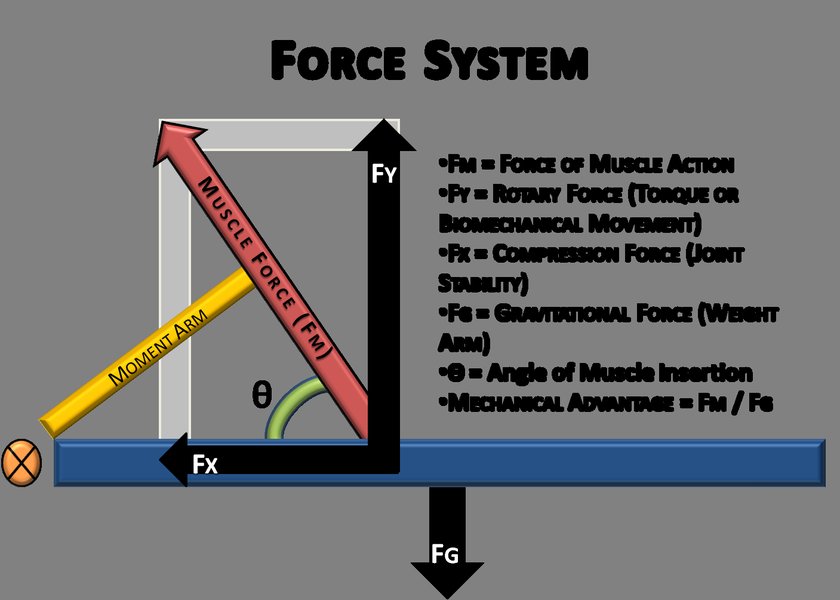
An illustration of forces acting on a lever around a pivot.
For a lever to be in equilibrium, or to just begin to overcome a resistance, the torque applied by the effort must equal the torque exerted by the load. This is often expressed as the "Law of the Lever":
\[ F_e \times d_e = F_l \times d_l \]
Where:
- \( F_e \) is the effort force.
- \( d_e \) is the effort arm (distance from pivot to effort force).
- \( F_l \) is the load force (resistance).
- \( d_l \) is the load arm (distance from pivot to load force).
Analyzing Your Specific Lever System
Let's apply these principles to your setup:
- Pivot: The fixed point around which the lever rotates.
- Point A (Load Point): Located 38 cm from the pivot. The force required *at this point* to open the spring-loaded bolt is 64 N. We can consider this the effective load force (\(F_l\)) and its distance the load arm (\(d_l = d_A = 38 \text{ cm}\)).
- Point B (Effort Point): Located 110 cm from the pivot. The force required *at this point* to open the same bolt is 22 N. This is an effort force (\(F_e\)) applied at an effort arm (\(d_e = d_B = 110 \text{ cm}\)).
Verifying the Initial Torque Balance
The torque required to open the bolt should be consistent, regardless of where the force is applied. Let's check this:
Torque generated if force is applied at Point A:
\[ \tau_A = F_A \times d_A = 64 \text{ N} \times 38 \text{ cm} = 2432 \text{ N·cm} \]
Torque generated if force is applied at Point B:
\[ \tau_B = F_B \times d_B = 22 \text{ N} \times 110 \text{ cm} = 2420 \text{ N·cm} \]
The two torque values (2432 N·cm and 2420 N·cm) are very close. This slight difference could be due to rounding in the provided numbers or measurement precision. This confirms that opening the spring-loaded bolt requires a consistent torque of approximately 2420-2432 N·cm (or 24.2-24.32 N·m). This is the "load torque" that must be overcome.
Impact of Increasing the Distance to Point A
Now, let's consider the core of your question: How would the force applied at Point B (\(F_B\)) need to change if the distance from the pivot to Point A (\(d_A\)) is increased?
We assume the following:
- Point A represents the location where the 64 N load force (from the spring's resistance) effectively acts.
- The magnitude of this load force (\(F_l = 64 \text{ N}\)) remains constant even if its point of application (\(d_A\)) changes. This means the spring mechanism consistently presents a 64 N resistance that needs to be overcome at its point of engagement with the lever.
- Point B remains the effort application point, and its distance from the pivot (\(d_B = 110 \text{ cm}\)) does not change.
The New Scenario
Let the new, increased distance from the pivot to point A be \(d_A'\). The load force is still \(F_l = 64 \text{ N}\). The new load torque (\(\tau_{l_{\text{new}}}\)) will be:
\[ \tau_{l_{\text{new}}} = F_l \times d_A' = 64 \text{ N} \times d_A' \]
To open the bolt, the effort torque applied at Point B must equal this new load torque:
\[ F_{B_{\text{new}}} \times d_B = \tau_{l_{\text{new}}} \]
Substituting the expressions, we get:
\[ F_{B_{\text{new}}} \times 110 \text{ cm} = 64 \text{ N} \times d_A' \]
Solving for the new force required at Point B, \(F_{B_{\text{new}}}\):
\[ F_{B_{\text{new}}} = \frac{64 \text{ N} \times d_A'}{110 \text{ cm}} \]
Since \(d_A'\) is greater than the original \(d_A\) (38 cm), and all other terms (64 N, 110 cm) are positive constants, the new force \(F_{B_{\text{new}}}\) will be greater than the original force \(F_B\) (22 N).
Numerical Example
Let's assume the distance to Point A is increased from 38 cm to 50 cm (so \(d_A' = 50 \text{ cm}\)).
The new force required at Point B would be:
\[ F_{B_{\text{new}}} = \frac{64 \text{ N} \times 50 \text{ cm}}{110 \text{ cm}} = \frac{3200 \text{ N·cm}}{110 \text{ cm}} \approx 29.09 \text{ N} \]
Comparing this to the original force of 22 N required at Point B, we see an increase: \(29.09 \text{ N} > 22 \text{ N}\). Therefore, if the distance from the pivot to point A is increased (while the load force at A and the distance to B remain constant), the force applied at point B would need to increase to open the bolt.
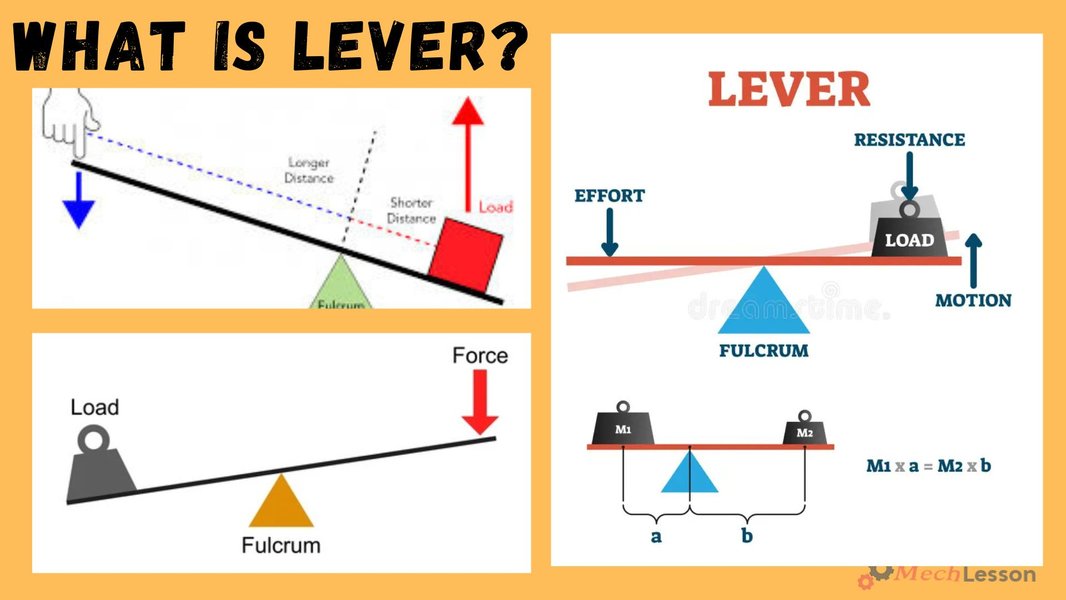
A classic representation of a first-class lever, where the fulcrum is between the effort and the load. Your scenario functions based on these principles.
Comparative Analysis: Initial vs. Changed State
The table below summarizes the parameters in the initial state and the example changed state where the distance to point A is increased. This clearly shows how the required effort force at point B is affected.
| Parameter | Initial State | Changed State (Example: \(d_A\) increased to 50 cm) | Impact |
|---|---|---|---|
| Distance from Pivot to Point A (\(d_A\)) | 38 cm | 50 cm | Increased |
| Effective Load Force at Point A (\(F_A\)) | 64 N | 64 N (assumed constant characteristic of spring) | Constant |
| Load Torque (\(M_L = F_A \times d_A\)) | \(64 \text{ N} \times 38 \text{ cm} = 2432 \text{ N·cm}\) | \(64 \text{ N} \times 50 \text{ cm} = 3200 \text{ N·cm}\) | Increased |
| Distance from Pivot to Point B (\(d_B\)) | 110 cm | 110 cm | Constant |
| Required Effort Force at Point B (\(F_B\)) | \( \approx 22 \text{ N} \) (calculated as \(2432/110 \approx 22.11 \text{ N}\)) | \( \approx 29.09 \text{ N} \) (calculated as \(3200/110\)) | Increased |
| Mechanical Advantage (MA = \(d_B/d_A\)) | \(110/38 \approx 2.89\) | \(110/50 = 2.2\) | Decreased |
A higher mechanical advantage means less effort force is needed to overcome the load. When the load arm (\(d_A\)) increases relative to the effort arm (\(d_B\)), the mechanical advantage decreases, thus requiring more effort force.
Visualizing Lever Dynamics: Impact of Changing Load Arm
This radar chart visually compares key characteristics of the lever system in its original state versus a state where the load arm (distance to Point A) has been increased. The values are represented on a normalized scale (approximately 1 to 5 or direct MA values) for better visual comparison, where a higher "Ease of Opening" score indicates less effort is required.
As depicted, increasing the load arm length (\(d_A\)) leads to a higher required effort force (\(F_B\)), an increased load torque that must be overcome, a lower mechanical advantage, and consequently, makes the bolt harder to open (lower "Ease of Opening" score).
Conceptual Map of the Lever System
This mind map outlines the key concepts involved in your lever scenario and how they relate to each other when analyzing the change in distance to point A.
This mind map illustrates that the change in \(d_A\) directly affects the load torque, which in turn necessitates a change in the effort force at point B if the effort arm \(d_B\) remains constant.
Visualizing Lever Principles in Action
To further understand the relationship between force, distance, and torque in levers, the following video provides an excellent overview of how these simple machines work and the trade-offs involved. It explains the core concepts that underpin the calculations and reasoning discussed above.
Lever Physics (Simple Machine Lesson Problem and Solution) - This video discusses levers as simple machines that trade force for distance, a concept central to your query.
The video explains how levers can be used to multiply force (gain mechanical advantage) by applying a smaller force over a larger distance, or to gain a distance/speed advantage by applying a larger force over a smaller distance. In your case, the lever is used to overcome the resistance of the spring. The balance of torques (\(F \times d\)) on both sides of the pivot is crucial. When you increase the load arm (\(d_A\)) while keeping the load force (\(F_A\)) and effort arm (\(d_B\)) constant, the equation \(F_B \times d_B = F_A \times d_A\) dictates that \(F_B\) must increase to maintain the equality, as demonstrated in our calculations.
Frequently Asked Questions (FAQ)
What exactly is torque?
Torque, also known as moment of force, is the rotational equivalent of linear force. It measures how much a force acting on an object causes that object to rotate. Torque is calculated as the product of the force applied and the perpendicular distance from the pivot point (fulcrum) to the line of action of the force (\(\tau = F \times d\)). Its unit is typically Newton-meters (N·m) or Newton-centimeters (N·cm).
What is the "Law of the Lever"?
The Law of the Lever states that for a lever to be in equilibrium (balanced) or to just begin to move a load, the effort torque must equal the load torque. Mathematically, this is expressed as \(F_e \times d_e = F_l \times d_l\), where \(F_e\) is the effort force, \(d_e\) is the effort arm (distance from pivot to effort), \(F_l\) is the load force, and \(d_l\) is the load arm (distance from pivot to load).
Why does increasing the distance to point A (load arm) necessitate more force at point B (effort point) in this scenario?
If we assume the load force (64 N, the spring's resistance at point A) remains constant, increasing its distance from the pivot (\(d_A\)) results in a larger load torque (\(F_A \times d_A\)). Since the effort arm (\(d_B\)) is unchanged, the effort force (\(F_B\)) must increase to produce an equal effort torque (\(F_B \times d_B\)) to overcome the now larger load torque. This is because the mechanical advantage (\(d_B/d_A\)) decreases when \(d_A\) increases while \(d_B\) is constant.
What would happen if the distance from the pivot to point B (effort arm) was changed instead?
If the effort arm (\(d_B\)) were increased while the load arm (\(d_A\)) and load force (\(F_A\)) remained constant, the effort force (\(F_B\)) required would decrease. This is because a longer effort arm provides a greater mechanical advantage. Conversely, if \(d_B\) were decreased, \(F_B\) would need to increase. The relationship is always governed by \(F_B = (F_A \times d_A) / d_B\).
Recommended Further Exploration
- How is mechanical advantage calculated for different classes of levers?
- What are some real-world examples of first, second, and third-class levers?
- How does friction affect the efficiency of a lever system?
- Explain the concept of work done in the context of using a lever.
References
Last updated May 10, 2025