
The Unsettling Truth: Is Our CO2 Output Fueling Global Warming?
An in-depth look at how human-generated carbon dioxide is unequivocally reshaping our planet's climate.
The question of whether man-made carbon dioxide (CO2) poses a genuine threat to global warming is central to understanding contemporary climate change. Overwhelming scientific evidence confirms that anthropogenic CO2 emissions are not just a contributing factor but a primary driver of the current warming trend. This response delves into the science, evidence, and implications of this critical environmental issue.
Essential Insights: The Core of the CO2 Conundrum
- Unprecedented CO2 Surge: Human activities, primarily since the Industrial Revolution, have increased atmospheric CO2 by approximately 50% in less than 200 years, a rate about 250 times faster than natural increases observed after the last Ice Age.
- The Greenhouse Mechanism Intensified: CO2 is a potent greenhouse gas. While naturally occurring CO2 is vital for a habitable Earth, the excess man-made CO2 traps additional heat, leading to a rise in global temperatures.
- Overwhelming Scientific Agreement: There is a robust consensus among climate scientists, supported by organizations like the Intergovernmental Panel on Climate Change (IPCC), that human CO2 emissions are the dominant cause of warming since the mid-20th century.
The Human Fingerprint: CO2 Levels Then and Now
Understanding the threat of man-made CO2 begins with recognizing its dramatic increase in our atmosphere and the mechanisms by which it influences global temperatures.
The Greenhouse Effect Amplified
How CO2 Warms Our World
Carbon dioxide, though a minor component of the atmosphere (around 0.042% or 420 parts per million), plays a crucial role in regulating Earth's temperature. It acts like the glass in a greenhouse, allowing sunlight to pass through and warm the Earth's surface, but then absorbing and re-radiating some of the outgoing infrared energy (heat). This natural greenhouse effect keeps the planet warm enough for life. However, the substantial increase in CO2 due to human activities has enhanced this effect, trapping more heat and causing the planet to warm beyond its natural equilibrium.
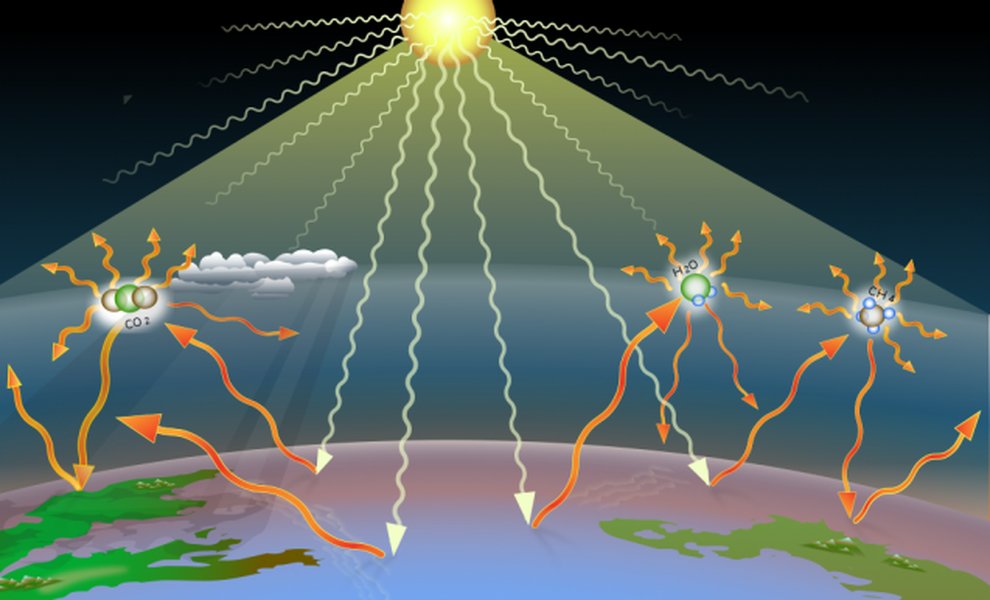
The Greenhouse Effect: Increased CO2 enhances the atmosphere's ability to trap heat.
A Drastic Shift: CO2 Concentrations Through Time
From Stability to Alarming Ascent
For hundreds of thousands of years, atmospheric CO2 levels naturally fluctuated between about 180 ppm during ice ages and 300 ppm during warmer interglacial periods. Before the Industrial Revolution (around 1750), CO2 levels were stable at approximately 280 ppm for about 10,000 years. Since then, human activities have caused a dramatic surge. By 1958, when continuous measurements began at Mauna Loa Observatory, CO2 levels had already reached 315 ppm. Today, they exceed 420 ppm, a concentration not seen in at least 3 million years, when global temperatures were significantly warmer.

Correlation between rising atmospheric CO2 concentrations and global temperature anomalies.
The Unprecedented Rate of Change
The speed of this increase is particularly alarming. The rise in atmospheric CO2 over the last 60 years is about 100 times faster than natural increases observed at the end of the last ice age. Compared to natural sources after the last Ice Age, human activities are increasing CO2 levels roughly 250 times faster. This rapid accumulation overwhelms the natural carbon cycle's ability to absorb the excess.
Identifying the Culprits: Sources of Anthropogenic CO2
The rise in atmospheric CO2 is directly linked to specific human activities that release vast quantities of this greenhouse gas.
The Dominance of Fossil Fuels
The single largest contributor to man-made CO2 emissions is the combustion of fossil fuels—coal, oil, and natural gas. These fuels power our electricity generation, heat our homes, and fuel our transportation systems. Burning these carbon-rich materials releases CO2 that was sequestered underground for millions of years.

Industrial power plants are significant sources of CO2 emissions from fossil fuel combustion.
Land Use Change and Deforestation
Forests are crucial carbon sinks, absorbing CO2 from the atmosphere through photosynthesis. Deforestation, primarily for agriculture, logging, and urbanization, releases this stored carbon back into the atmosphere and reduces the planet's capacity to remove CO2. Changes in land use practices can also lead to CO2 release from soils.
Industrial Processes
Certain industrial processes, beyond energy consumption, are also significant sources of CO2. The production of cement, for example, involves a chemical reaction (calcination) that releases CO2. Steel manufacturing and the production of some chemicals and plastics also contribute to CO2 emissions.
Visualizing Climate Change Drivers: A Comparative Analysis
To better understand the relative impact of different factors on our climate system, the following radar chart illustrates a qualitative comparison of various drivers and their effects. Anthropogenic CO2 consistently shows a high impact across multiple critical areas of climate change, significantly outweighing the recent influence of natural factors like solar activity variation.
This chart visualizes how anthropogenic CO2 is a dominant force driving changes across key components of the Earth's climate system, far exceeding the recent impact of factors like solar variability. Its pervasive influence on atmospheric warming, ocean chemistry, sea levels, weather patterns, and ice stability underscores its significance as a climate threat.
Mapping the CO2 Crisis: Causes, Mechanisms, and Consequences
The following mindmap provides a structured overview of anthropogenic CO2's role in global warming, detailing its sources, the scientific mechanisms at play, the evidence supporting these connections, and the wide-ranging impacts on our planet.
(Energy, Transport, Industry)"] id1b["Deforestation &
Land Use Change"] id1c["Industrial Processes
(e.g., Cement Production)"] id1d["Agricultural Practices"] id2["Mechanism: Enhanced Greenhouse Effect"] id2a["Increased Atmospheric CO2 Concentration"] id2b["Absorption of Infrared Radiation (Heat)"] id2c["Re-radiation of Heat Towards Earth"] id2d["Disruption of Natural Carbon Cycle Balance"] id3["Evidence"] id3a["Rising Global Average Temperatures"] id3b["Ice Core Data (Historical CO2 & Temp Correlation)"] id3c["Direct Atmospheric CO2 Measurements (e.g., Mauna Loa)"] id3d["Isotopic Analysis (Identifying Fossil Fuel Carbon)"] id3e["Scientific Consensus (IPCC Reports)"] id4["Impacts"] id4a["Global Temperature Rise"] id4b["Sea Level Rise (Thermal Expansion & Ice Melt)"] id4c["Ocean Acidification"] id4d["More Frequent/Intense Extreme Weather Events"] id4e["Melting Glaciers & Ice Sheets"] id4f["Ecosystem Disruption & Biodiversity Loss"] id5["Key Metrics"] id5a["CO2 from ~280 ppm (pre-industrial) to >420 ppm (current)"] id5b["Annual Emissions: ~35-37 Billion Tons CO2"] id5c["Global Temp. Increase: ~1.2°C since pre-industrial"]
This mindmap illustrates the interconnectedness of human activities, the resulting CO2 emissions, the physical processes driving warming, the scientific proof, and the profound consequences for the Earth's systems and inhabitants.
The Weight of Numbers: Quantifying Human CO2 Emissions
The Scale of Annual Emissions
Human activities currently release approximately 35 to 37 billion metric tons of CO2 into the atmosphere each year. Fossil fuel combustion alone accounts for the vast majority of this, with emissions growing from about 6 billion tons per year in 1950 to these current staggering levels. This massive influx of CO2 far exceeds the capacity of natural sinks like oceans and forests to absorb it, leading to its continuous accumulation in the atmosphere.

The natural carbon cycle, showing how human emissions disrupt the balance.
Addressing the "Small Percentage" Misconception
A common misconception is that because CO2 constitutes a small percentage of the atmosphere (around 0.042%), its increase cannot significantly impact the climate. However, this argument is misleading. Even in small concentrations, greenhouse gases like CO2 are powerful heat trappers. Scientists have demonstrated the heat-trapping nature of CO2 since the mid-19th century. The crucial point is the *change* in concentration. Human activities are responsible for approximately one-third of the CO2 currently in the atmosphere, representing a 50% increase over pre-industrial levels in less than two centuries. This added CO2 is directly responsible for the observed enhancement of the greenhouse effect.
The Ripple Effect: Observable Consequences of Rising CO2
The increase in atmospheric CO2 and subsequent global warming are not abstract concepts; they have tangible and far-reaching consequences across the globe.
- Global Temperature Rise: The most direct impact is an increase in global average surface temperatures, which has risen by approximately 1.2°C (2.2°F) since the pre-industrial period. Most of this warming has occurred in recent decades.
- Extreme Weather Events: Higher temperatures lead to more energy in the climate system, contributing to more frequent and intense heatwaves, heavy rainfall, droughts, and powerful storms.
- Sea Level Rise: Warming causes ocean water to expand (thermal expansion) and ice sheets and glaciers to melt, both of which contribute to rising sea levels, threatening coastal communities and ecosystems.
- Ocean Acidification: The oceans absorb about 25-30% of the CO2 emitted by human activities. When CO2 dissolves in seawater, it forms carbonic acid, leading to a decrease in ocean pH (acidification). This harms marine organisms with calcium carbonate shells and skeletons, such as corals, shellfish, and some plankton.
- Melting Ice and Snow: Arctic sea ice extent, glaciers, and ice sheets in Greenland and Antarctica are diminishing at an accelerated rate, impacting global sea levels, albedo (reflectivity of Earth's surface), and Arctic ecosystems.
Video Deep Dive: Understanding CO2's Warming Mechanism
To further clarify how carbon dioxide contributes to global warming, the following video provides an accessible explanation of the physical processes involved. It details how CO2 molecules interact with infrared radiation, effectively trapping heat in the atmosphere and driving the observed warming trend. Understanding this fundamental mechanism is key to appreciating the impact of human-induced CO2 emissions.
Video explaining how carbon dioxide causes global warming.
Key Climate Metrics: A Comparative Snapshot
The following table summarizes critical data points illustrating the dramatic changes in atmospheric CO2 and global temperature driven by human activities, contrasting the pre-industrial era with current conditions.
| Metric | Pre-Industrial Era (around 1750) | Current (approx. 2025) | Primary Driver of Change |
|---|---|---|---|
| Atmospheric CO2 Concentration | Approximately 280 parts per million (ppm) | Over 420 ppm | Human emissions from fossil fuels, land use change, and industrial processes |
| Annual Human CO2 Emissions | Negligible | Approximately 35-37 billion metric tons | Burning of fossil fuels, deforestation, cement production |
| Global Average Temperature Anomaly (vs. 1850-1900) | Baseline (considered 0°C anomaly) | Approximately +1.2°C | Enhanced greenhouse effect due to increased anthropogenic greenhouse gases, primarily CO2 |
| Rate of Atmospheric CO2 Increase | Slow, driven by natural cycles over millennia | ~100-250 times faster than natural post-Ice Age increases | Intensive human industrial and agricultural activities |
| Human Contribution to Current Atmospheric CO2 | Minimal direct addition to long-term stable levels | Responsible for the increase from 280 ppm to over 420 ppm (about one-third of total current CO2 is of recent anthropogenic origin) | Cumulative emissions since the start of the Industrial Revolution |
Frequently Asked Questions (FAQ)
How do scientists know that the recent increase in atmospheric CO2 is caused by human activities and not natural sources?
Scientists use several lines of evidence. Firstly, the timing of the CO2 increase directly correlates with the rise in human emissions from fossil fuel burning and land-use change since the Industrial Revolution. Secondly, isotopic analysis of atmospheric CO2 shows a change in the ratio of carbon isotopes (13C/12C and 14C/12C) that is characteristic of burning fossil fuels (which are ancient plant matter, depleted in 13C and devoid of 14C). Thirdly, measurements show oxygen levels in the atmosphere are decreasing at a rate consistent with the amount of oxygen consumed during the combustion of fossil fuels. Natural sources like volcanoes emit far less CO2 annually than human activities, and these emissions are largely balanced by natural absorption processes over long timescales.
Isn't water vapor a more powerful greenhouse gas than CO2? Does this mean CO2 isn't the main problem?
Water vapor is indeed the most abundant greenhouse gas and plays a significant role in Earth's natural greenhouse effect. However, its concentration in the atmosphere is primarily controlled by temperature. Warmer air can hold more moisture. CO2, on the other hand, is a non-condensing greenhouse gas, meaning it remains in the atmosphere for extended periods and acts as a primary driver of temperature change. The increase in CO2 from human activities causes initial warming, which then allows the atmosphere to hold more water vapor. This creates a positive feedback loop, amplifying the warming caused by CO2. So, while water vapor contributes significantly to the total greenhouse effect, CO2 is the main "control knob" for the current human-caused warming trend.
Do volcanoes emit more CO2 than humans?
No, this is a common misconception. On average, human activities emit about 60 to 100 times more CO2 per year than all the world's volcanoes combined. While large volcanic eruptions can release significant amounts of CO2 and other gases, their annual contribution to atmospheric CO2 levels is minor compared to the continuous emissions from burning fossil fuels, industrial processes, and deforestation.
What does "net-zero emissions" mean in the context of CO2?
Net-zero CO2 emissions means achieving a balance where the amount of CO2 humans put into the atmosphere is equal to the amount of CO2 humans remove from it. This involves drastically reducing emissions from all sources (like transitioning to renewable energy and improving energy efficiency) and, for any remaining hard-to-abate emissions, using methods to remove CO2 from the atmosphere (such as reforestation, afforestation, or carbon capture technologies). Reaching net-zero is considered crucial to stabilizing atmospheric CO2 concentrations and limiting further global warming.
Conclusion: An Undeniable Threat Requiring Urgent Action
The scientific evidence is unequivocal: man-made carbon dioxide is a real and significant threat to global warming. The dramatic increase in atmospheric CO2 concentrations since the Industrial Revolution, driven primarily by the burning of fossil fuels, deforestation, and industrial processes, is intensifying the natural greenhouse effect and causing unprecedented changes to our planet's climate. The observed impacts, from rising global temperatures and sea levels to more extreme weather events and ocean acidification, underscore the urgency of addressing this challenge. Mitigating the threat of man-made CO2 requires a global transition towards decarbonized energy systems, sustainable land use, and innovative solutions to reduce and remove atmospheric carbon dioxide.
Recommended Further Exploration
- What are the specific isotopic signatures that prove CO2 increase is anthropogenic?
- How does ocean acidification caused by CO2 impact marine food webs?
- What are the latest projections for global temperature rise under different CO2 emission scenarios?
- Explore the technologies and strategies involved in achieving net-zero CO2 emissions.
References
Last updated May 21, 2025