
Unveiling the Mathematical Elegance of Spirograph Designs
Exploring the Geometry and Equations Behind Mesmerizing Patterns
Key Mathematical Insights
- Curve Generation: Spirographs produce intricate curves known as hypotrochoids and epitrochoids, which are mathematical roulette curves.
- Circle Interaction: The fundamental mechanism involves one circle rolling either inside (hypotrochoid) or outside (epitrochoid) another fixed circle.
- Parameters and Patterns: The resulting pattern is determined by the radii of the fixed and rolling circles, and the position of the pen within the rolling circle.
The Core Mechanism of a Spirograph
At its heart, a Spirograph is a mechanical drawing device that translates the motion of rolling circles into captivating visual patterns. The classic Spirograph toy typically consists of a larger ring or gear with internal or external teeth, and smaller wheels or gears with teeth that mesh with the larger piece. A pen is placed in one of the holes on the smaller wheel. As the smaller wheel is moved along the edge of the larger ring, the pen traces a path, creating the intricate designs we recognize as Spirograph patterns.
This seemingly simple interaction of gears and a pen is underpinned by fascinating mathematical principles. The curves generated are not random doodles but precise mathematical forms known as roulette curves. Specifically, when the smaller circle rolls along the inside of the larger circle, the resulting curve is a hypotrochoid. When it rolls along the outside, it's an epitrochoid.
The beauty of Spirograph patterns lies in their predictability, governed by the relative sizes of the circles and the pen's position. By changing these parameters, an almost infinite variety of designs can be created, from simple loops to complex, multi-petaled figures.
Hypotrochoids and Epitrochoids: The Mathematical Curves
To truly understand the mathematics of a Spirograph, we need to delve into the definitions of hypotrochoids and epitrochoids. These curves are part of a larger family of curves called roulettes, which are traced by a point attached to a curve that rolls without slipping along a fixed curve. In the case of a Spirograph, the fixed curve is the edge of the larger ring (a circle), and the rolling curve is the smaller wheel (another circle).
Hypotrochoids: Rolling Inside
A hypotrochoid is the path traced by a point fixed to a circle of radius \(r\) that rolls without slipping along the inside of a fixed circle of radius \(R\). The position of the tracing point is at a distance \(d\) from the center of the rolling circle.
The parametric equations for a hypotrochoid are given by: \[ x = (R - r) \cos(t) + d \cos\left(\frac{R - r}{r}t\right) \] \[ y = (R - r) \sin(t) - d \sin\left(\frac{R - r}{r}t\right) \] where \(t\) is the angle through which the rolling circle has turned.
The shape of the hypotrochoid depends on the ratio of the radii \(R/r\) and the ratio \(d/r\).
- If \(d = r\), the point is on the circumference of the rolling circle, and the curve is a hypocycloid.
- If \(d < r\), the point is inside the rolling circle, resulting in a "loopy" pattern.
- If \(d > r\), the point is outside the rolling circle, producing a pattern with larger loops or cusps.
Epitrochoids: Rolling Outside
An epitrochoid is similar to a hypotrochoid, but the smaller circle of radius \(r\) rolls without slipping along the outside of a fixed circle of radius \(R\). The tracing point is again at a distance \(d\) from the center of the rolling circle.
The parametric equations for an epitrochoid are: \[ x = (R + r) \cos(t) - d \cos\left(\frac{R + r}{r}t\right) \] \[ y = (R + r) \sin(t) - d \sin\left(\frac{R + r}{r}t\right) \] Again, \(t\) is the angle of rotation of the rolling circle.
The shape of the epitrochoid depends on the ratios \(R/r\) and \(d/r\):
- If \(d = r\), the curve is an epicycloid.
- If \(d < r\), the pattern has inward curves between the "petals."
- If \(d > r\), the loops extend outwards, creating a more star-like shape.
The Influence of Gear Ratios and Pen Position
In a physical Spirograph toy, the radii \(R\) and \(r\) are determined by the number of teeth on the fixed ring and the rolling wheel, respectively. The distance \(d\) is determined by which hole on the rolling wheel the pen is placed in. These three parameters are crucial in determining the final pattern.
Understanding the Impact of Gear Teeth
The number of "petals" or loops in a Spirograph pattern is directly related to the ratio of the number of teeth on the fixed gear (\(N\)) and the rolling gear (\(n\)). The number of cusps or points in a hypotrochoid is given by \(\frac{N}{\text{gcd}(N, n)}\), where \(\text{gcd}(N, n)\) is the greatest common divisor of \(N\) and \(n\). For epitrochoids, the formula is slightly different, but the principle of the ratio of teeth being key remains. The pattern will close and repeat when the rolling wheel has completed enough rotations for the gears to return to their starting relative positions. This happens after a number of rotations of the smaller gear equal to \(\frac{N}{\text{gcd}(N, n)}\) relative to the larger gear.
The Role of the Pen Hole
The position of the pen (\(d\)) within the rolling wheel determines the size and shape of the loops or curves within the overall pattern. Holes closer to the center of the wheel (\(d\) is small relative to \(r\)) will produce smaller, tighter loops. Holes further from the center (\(d\) is large relative to \(r\)) will create larger, more open loops or even cusps.
Connecting Spirograph to Mathematical Concepts
Beyond the specific equations for hypotrochoids and epitrochoids, playing with a Spirograph can provide intuitive understanding of several mathematical concepts:
-
Parametric Equations: The curves are best described using parametric equations, which represent the x and y coordinates of the tracing point as functions of a third parameter (the angle of rotation). This is a fundamental concept in calculus and coordinate geometry.
-
Ratios and Fractions: The relationship between the number of teeth on the gears and the resulting pattern highlights the importance of ratios and fractions in determining the behavior of the system. Understanding least common multiples and greatest common divisors can help predict when a pattern will repeat.
-
Trigonometry: The parametric equations for the curves rely heavily on sine and cosine functions, demonstrating the application of trigonometry in describing circular motion and periodic phenomena.
-
Symmetry and Patterns: Spirograph designs often exhibit rotational symmetry, providing a visual exploration of symmetry principles. The repetition and variation in the patterns can also introduce ideas related to sequences and series.
While young children may not be writing out the complex equations, the act of creating Spirograph art fosters an intuitive grasp of how changing variables (gear size, pen position) affects the outcome, a core concept in mathematical exploration and problem-solving.
Parametric equations of a Spirograph.
Visualizing Spirograph Mathematics
The beauty of Spirograph lies not just in the underlying equations but also in the stunning visual representations of these mathematical principles. Each turn of the wheel and movement of the pen translates into a precise point on the plane, collectively forming the intricate patterns.

A classic Spirograph pattern demonstrating intricate detail.
Different combinations of rings, wheels, and pen holes produce a vast array of designs. Observing these patterns can provide a visual intuition for the mathematical relationships at play. For instance, you can see how changing the pen position changes the size of the inner loops or how different gear ratios result in patterns with varying numbers of "petals."

Complex patterns can be created using multiple gears or advanced Spirograph sets.
Modern digital tools and online Spirograph generators allow for even greater exploration of these mathematical curves, enabling users to precisely control the parameters and instantly visualize the resulting hypotrochoids and epitrochoids without the need for physical gears and pens.
The Historical Context of Spirographs
While the Spirograph toy popularized these curves, the mathematical principles behind them have been studied for centuries. The concept of a point tracing a path while rolling circles were explored by mathematicians long before the toy was invented.
The well-known Spirograph toy was developed by British engineer Denys Fisher in the 1960s, building on earlier drawing machines. His design made the creation of these complex mathematical curves accessible and enjoyable for people of all ages, bridging the gap between mathematics and art.
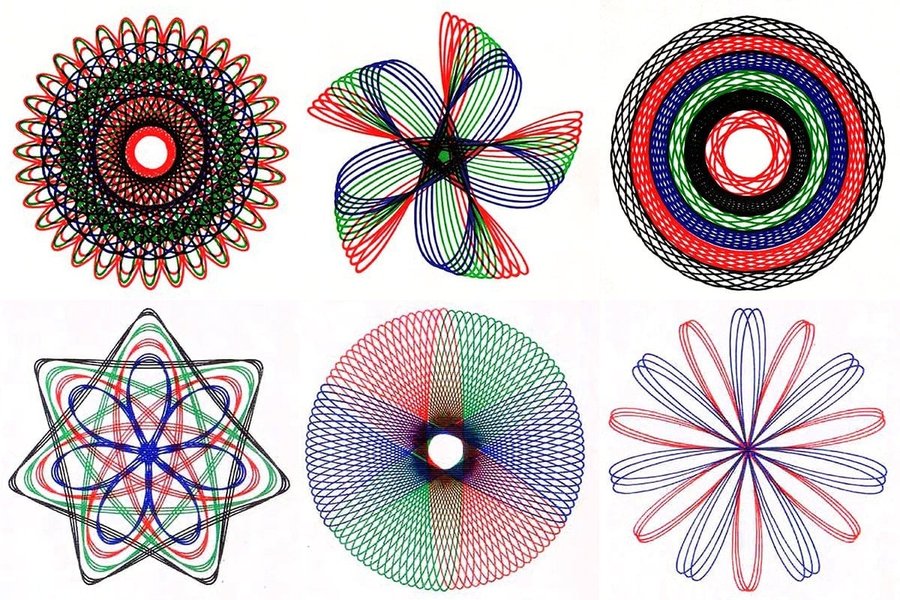
Examples of vintage Spirograph designs.
Historically, drawing machines that generated similar curves were used for practical purposes, such as creating intricate patterns for anti-forgery on banknotes, as these curves were difficult to replicate precisely by hand. The Spirograph transformed these mathematical concepts into a tool for artistic expression and mathematical exploration through play.
Predicting Spirograph Patterns
One of the most engaging aspects of the mathematics of Spirograph is the ability to predict the outcome of a specific combination of gears and pen holes. This involves understanding the relationships between the number of teeth and the resulting number of loops or cusps.
Let \(N\) be the number of teeth on the fixed ring and \(n\) be the number of teeth on the rolling wheel. The number of times the smaller wheel will rotate around the inside or outside of the larger ring before the pattern repeats depends on the ratio \(N/n\). If this ratio is a rational number (which it will be with geared wheels), the pattern will eventually close and repeat. The complexity of the pattern is related to this ratio.
The number of full rotations the smaller wheel makes relative to the larger ring before the pattern repeats is given by \(n / \text{gcd}(N, n)\) for a hypotrochoid and \(n / \text{gcd}(N, n)\) for an epitrochoid. The number of cusps or points is related to \(N / \text{gcd}(N, n)\) for hypotrochoids rolling internally and \(N / \text{gcd}(N, n)\) for epitrochoids rolling externally.
Let's summarize some key relationships in a table:
| Parameter | Description | Influence on Pattern |
|---|---|---|
| Radius of Fixed Circle (R) / Number of Teeth on Fixed Ring (N) | Size of the stationary ring/gear. | Affects the overall size of the pattern and, in ratio with the rolling circle, the number of repetitions before closure. |
| Radius of Rolling Circle (r) / Number of Teeth on Rolling Wheel (n) | Size of the moving wheel/gear. | Influences the size and shape of the loops within the pattern and, in ratio with the fixed circle, the number of rotations before closure. |
| Distance of Pen from Center of Rolling Circle (d) | Which hole on the rolling wheel is used. | Determines whether the loops are internal (d < r), on the circumference (d = r, forming cycloids), or external (d > r). Affects the size and prominence of the loops or cusps. |
By understanding these relationships, one can begin to predict the type of pattern that will emerge from a given Spirograph setup, adding a layer of mathematical discovery to the artistic process.
Frequently Asked Questions about Spirograph Math
What kind of mathematical curves does a Spirograph draw?
A Spirograph draws mathematical curves called hypotrochoids and epitrochoids. These are types of roulette curves generated by the path of a point on a circle rolling inside or outside another circle.
How does the size of the gears affect the Spirograph pattern?
The ratio of the number of teeth on the fixed gear to the number of teeth on the rolling gear is crucial. This ratio determines the number of times the rolling gear must rotate before the pattern repeats and closes, as well as the number of "petals" or cusps in the design.
What is the role of the pen hole in creating Spirograph patterns?
The position of the pen hole, which determines the distance of the pen from the center of the rolling gear, affects the shape and size of the loops or curves within the pattern. Holes closer to the center create smaller loops, while holes further out create larger loops or even cusps.
Can Spirograph patterns be described with equations?
Yes, the curves drawn by a Spirograph can be described using parametric equations involving trigonometric functions (sine and cosine). These equations depend on the radii of the fixed and rolling circles and the distance of the pen from the center of the rolling circle.
Does playing with a Spirograph teach math?
While not always explicit, playing with a Spirograph can help develop mathematical intuition, particularly related to concepts like ratios, symmetry, patterns, and how changing parameters affects an outcome. It provides a hands-on way to visualize geometric principles.
References

Last updated April 23, 2025