
Unraveling the Model Context Protocol (MCP): Connecting AI to the World
A Deep Dive into How MCP Empowers AI Agents with Context and Capabilities
The Model Context Protocol (MCP) is an open standard designed to bridge the gap between Large Language Models (LLMs) and the vast landscape of external data sources, tools, and systems. Think of it as a universal connector, akin to a USB-C port for AI applications, enabling seamless and standardized communication. This allows AI models to move beyond static knowledge and interact dynamically with the real world, unlocking a new era of agentic AI.
Key Insights into MCP
- Standardized Connectivity: MCP provides a uniform way for AI models to access external capabilities and data, overcoming the need for custom integrations for every tool or service.
- Client-Server Architecture: At its core, MCP operates on a client-server model, where AI applications act as clients connecting to servers that expose specific tools and resources.
- Enhanced Context Awareness: By standardizing how context is shared, MCP enables AI agents to maintain and share information across multiple interactions and tasks, leading to more coherent and capable workflows.
Understanding the Architecture of MCP
The Model Context Protocol is built upon a flexible and extensible architecture that facilitates seamless communication between LLM applications and various integrations. It adopts a client-server model, allowing a host application (the LLM or AI agent) to connect to multiple MCP servers. This architecture is designed for interoperability and scalability, enabling AI agents to discover, inspect, and utilize tools and resources provided by these servers in a standardized manner.
Core Components of MCP
The MCP framework is comprised of several key components that interact to enable the flow of context and capabilities between AI models and external systems. These components work together to handle communication, manage resources, and execute actions:
Host Application (LLM/AI Agent)
This is the AI model or application that initiates interactions and utilizes the capabilities exposed through MCP. The host application integrates with an MCP client to communicate with MCP servers. Examples include AI-powered IDEs, chatbots, or custom AI workflows.
MCP Client
The MCP client is a component integrated within the host application. It maintains connections to MCP servers and translates the AI model's requests into the standardized MCP format. The client sends these requests to the appropriate servers and receives responses, which are then relayed back to the host application. The client handles the complexities of the protocol, allowing the AI model to focus on processing information and making decisions.
MCP Server
MCP servers are external applications or services that expose specific tools, resources, and prompts to AI clients. These servers act as wrappers around existing APIs, databases, or other systems, making their capabilities accessible through the standardized MCP interface. A single MCP server can offer multiple tools or access to various resources. MCP servers can be written in any language and can communicate via different transports like standard input/output (stdio), server-sent events (sse), and HTTP.
Tools
Within the MCP framework, "tools" represent the actionable functions or operations that an AI agent can perform by interacting with an MCP server. These can range from reading data from a database or file system to executing commands or interacting with external applications like email or calendar services. The MCP protocol defines how clients can discover the available tools on a server, understand their capabilities, and invoke them with the necessary parameters.
Resources
Resources in MCP refer to read-only data or information that an AI agent can access through an MCP server. This could include files, logs, documentation, or data from databases. Accessing these resources provides the AI with the necessary context to understand the current situation and formulate relevant responses or actions.
Prompts
Prompts, in the context of MCP, are user-controlled or predefined templates that guide the AI in utilizing tools or resources in an optimal manner. These can influence how the AI formulates requests to the MCP server or interprets the results received.
How MCP Enables Communication
The interaction between the components in MCP follows a clear flow, built upon established communication patterns and protocols. This standardized approach ensures interoperability and simplifies the integration process for developers.
Initialization and Handshake
When a host application starts, it typically creates one or more MCP clients. These clients establish connections with configured MCP servers. An initial handshake process occurs where the client and server exchange information about their capabilities and the protocol versions they support. This ensures compatibility and sets the stage for subsequent interactions.
Request-Response Cycle
The core of MCP communication is a request-response cycle. An MCP client sends requests to an MCP server, asking it to perform an action (invoke a tool) or provide information (access a resource). The MCP server processes the request and sends a response back to the client. This response can contain the results of an action, the requested data, or an error message if the request could not be fulfilled.
Transport and Protocol Layers
MCP utilizes different transport layers for communication, including standard input/output (stdio), Server-Sent Events (SSE), and HTTP. Regardless of the transport used, the messages exchanged between clients and servers are formatted using JSON-RPC 2.0. This provides a standardized way to define requests, responses, and error messages.
The protocol layer handles the higher-level communication patterns, such as message framing, linking requests to their corresponding responses, and managing the overall flow of interaction. This layered approach separates the concerns of message content and transport, contributing to the flexibility and extensibility of MCP.
MCP vs. Traditional APIs
While traditional APIs have been the standard for connecting software systems, MCP offers several advantages specifically tailored for the needs of AI agents and LLMs.
| Feature | Traditional APIs | Model Context Protocol (MCP) |
|---|---|---|
| Integration Approach | Requires custom integration code for each API. | Standardized protocol for seamless connection to any MCP-enabled server. |
| Context Management | Often stateless, requiring explicit handling of context across calls. | Designed to maintain and share context across interactions and tools. |
| Tool Discovery | Requires prior knowledge of API endpoints and structures. | Supports standardized tool discovery mechanisms. |
| Flexibility and Extensibility | Integration tied to specific API designs. | Open standard allowing for easy addition of new tools and resources. |
| Agent Collaboration | Limited native support for agent-to-agent communication. | Facilitates context sharing and collaboration among agents. |
The key difference lies in MCP's focus on standardizing the interface for AI interaction, making it much easier for AI agents to discover, understand, and utilize external capabilities without needing bespoke integrations for every service.
The Role of MCP in Agentic AI and Context Sharing
One of the significant benefits of MCP is its ability to facilitate agent collaboration and context sharing. Traditional AI interactions are often stateless, meaning the AI does not retain information from previous interactions. This limits their ability to perform complex, multi-step tasks or collaborate effectively with other agents.
MCP addresses this limitation by providing a standardized way for agents to access and share context. An AI agent can connect to multiple MCP servers, each providing access to different tools and resources. As the agent interacts with these servers to complete a task, the MCP client can help maintain a consistent context, passing relevant information between different tool calls or even between different agents that are part of a collaborative workflow.
For example, imagine an AI agent designed to manage travel arrangements. Using MCP, this agent could connect to a calendar MCP server to check availability, an airline booking MCP server to find flights, and an email MCP server to send confirmations. The MCP client ensures that the context from the calendar check (available dates) is seamlessly passed to the airline booking tool, and the booking details are available for the email tool. If another agent is involved in the process, for instance, an expense reporting agent, MCP could facilitate the sharing of booking details to automatically initiate an expense claim.
While MCP itself defines how context can be sent, it's important to note that it doesn't inherently secure the payload or manage authorization. Security and access control are typically handled at the server level or through supplementary protocols and systems, such as integrating with identity and access management solutions like Auth0.
Visualizing the MCP Ecosystem
To better understand how the components of MCP interact, consider the following diagram which illustrates the client-server architecture and the flow of information:
Visual Representation of MCP Architecture
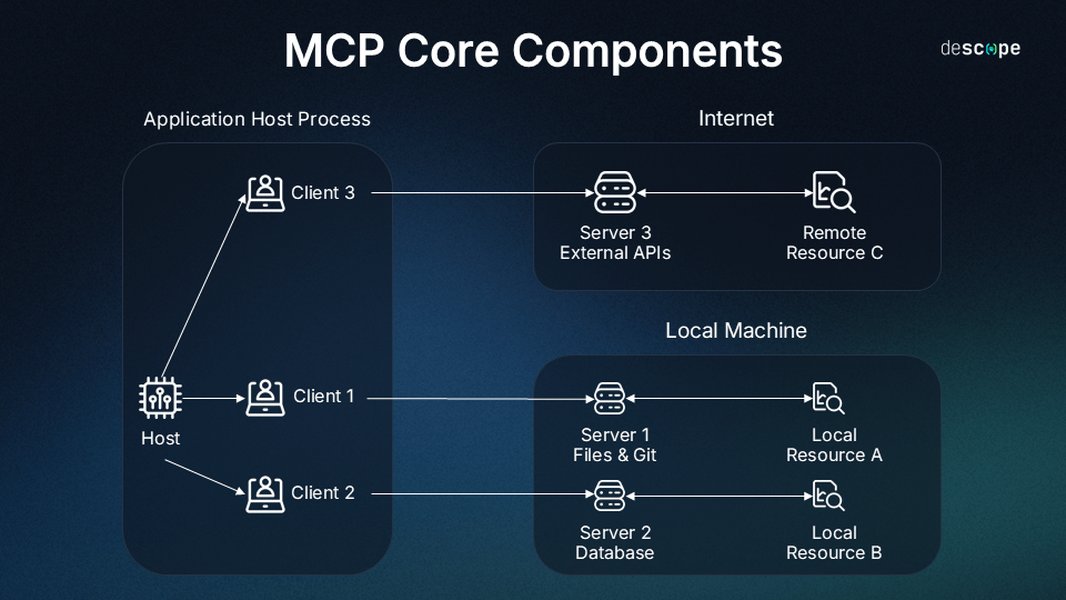
This diagram shows the Host Application (AI/LLM) interacting with the MCP Client. The MCP Client then communicates with various MCP Servers, each providing access to different Tools and Resources. This visual highlights how the MCP Client acts as an intermediary, standardizing the communication between the AI and the external world.
Practical Applications and the Future of MCP
The Model Context Protocol is already being adopted and integrated into various AI-powered applications and platforms, signaling its growing importance in the AI ecosystem.
Examples of MCP in Action
-
AI-Powered IDEs: Tools like Cursor are leveraging MCP to connect with code repositories, documentation, and build systems, allowing AI agents to provide more intelligent code assistance and perform tasks like debugging or refactoring based on real-time project context.
-
Enterprise AI Agents: Platforms like Workato are utilizing MCP to enable enterprise agents to access and interact with a wide range of internal systems, including databases, applications, and workflows, improving automation and efficiency.
-
Copilot Studio: Microsoft's Copilot Studio allows developers to connect their AI copilots to existing knowledge servers and APIs directly through MCP, simplifying the process of providing copilots with access to external data and capabilities.
-
Agent Collaboration: MCP is paving the way for more sophisticated multi-agent systems where different AI agents can collaborate on complex tasks by sharing context and coordinating the use of various tools and resources.
Community and Development
MCP is an open standard, with its development driven by Anthropic and a growing community of developers and organizations. The open-source nature of the protocol encourages collaboration and innovation, leading to the development of SDKs, libraries, and tools that facilitate the creation of MCP clients and servers.
The active development and increasing adoption of MCP suggest that it is well-positioned to become a foundational technology for building more capable, context-aware, and integrated AI systems in the future.
Frequently Asked Questions about MCP
What problem does MCP solve?
MCP solves the challenge of integrating AI models with the vast and diverse landscape of external data sources, tools, and systems. Before MCP, connecting AI to external capabilities often required building custom, one-off integrations for each specific tool or service. MCP provides a standardized protocol that simplifies this process, making it easier for AI agents to access and utilize external resources.
Is MCP a replacement for APIs?
No, MCP is not a direct replacement for APIs. Instead, it can be seen as a layer on top of existing APIs. MCP servers often act as wrappers around traditional APIs, exposing their functionality through the standardized MCP interface. This allows AI agents to interact with these services using a consistent protocol, abstracting away the specific details of individual APIs.
Does MCP handle authentication and authorization?
While MCP defines the protocol for exchanging context and invoking tools, it does not inherently handle authentication and authorization for accessing external resources. Security concerns, such as verifying the identity of the client and ensuring it has the necessary permissions to access a resource or invoke a tool, are typically managed at the MCP server level or through integration with external security systems.
Can MCP be used with any LLM?
MCP is designed to be model-agnostic, meaning it can be used with various LLMs and AI models. The effectiveness of an AI model in utilizing MCP-enabled tools and context may depend on its architecture and training, particularly its ability to perform tool-use and process external information. However, the protocol itself is open and designed for broad compatibility.
References
 aws.amazon.com
Last updated May 14, 2025