
Unlocking Bio-Interfaces: The Power and Precision of PEDOT:PSS Thin Films
An expert review of PEDOT:PSS properties, deposition techniques, and tailored applications for neural and tissue interfaces.
Highlights
- Versatile Bio-Interface Material: PEDOT:PSS stands out in bioelectronics due to its unique blend of tunable electrical conductivity, mechanical flexibility, processability, and crucial biocompatibility.
- Precision Deposition Matters: Techniques like spin coating, inkjet printing, and spray coating offer distinct advantages for fabricating PEDOT:PSS thin films, enabling precise control over thickness and structure tailored to specific device needs.
- Performance Optimization is Key: Post-deposition strategies, including secondary doping (e.g., with DMSO) and thermal or solvent annealing, are critical for maximizing the conductivity, stability, and overall performance of PEDOT:PSS, especially for demanding neural and tissue contact applications.
An Introduction to PEDOT:PSS
Poly(3,4-ethylenedioxythiophene) polystyrene sulfonate, commonly known as PEDOT:PSS, represents a cornerstone material in the field of organic electronics and bioelectronics. It is an aqueous dispersion of two polymers: PEDOT, the conductive component featuring a π-conjugated backbone that facilitates charge transport, and PSS, a polyelectrolyte that acts as a charge-balancing counter-ion and crucially imparts water solubility and processability to the otherwise insoluble PEDOT. This unique combination yields a material with remarkable properties, including good electrical conductivity, high optical transparency in the visible spectrum, excellent mechanical flexibility, and favorable biocompatibility, making it exceptionally well-suited for interfacing with biological systems.
The ability to process PEDOT:PSS from aqueous solutions using various deposition techniques allows for the fabrication of thin, conductive films on diverse substrates, including flexible ones. Its application spectrum is broad, ranging from transparent electrodes in displays and solar cells to antistatic coatings and, significantly, functional layers in biosensors, neural probes, and implantable electronic devices.
Key Properties of PEDOT:PSS
Electrical Conductivity
Tunable Conductance for Diverse Needs
PEDOT:PSS is fundamentally a p-type semiconductor. Its baseline electrical conductivity typically spans a wide range, from approximately 10-4 S/cm to over 103 S/cm. This conductivity is highly dependent on the specific formulation, particularly the ratio of PEDOT to PSS. Generally, a higher proportion of PEDOT enhances conductivity, while a higher PSS content improves processability and film formation but tends to decrease conductivity due to the insulating nature of PSS.
Enhancing Conductivity: Doping and Post-Treatment
A key advantage of PEDOT:PSS is that its conductivity can be significantly boosted—often by several orders of magnitude—through post-deposition treatments or the addition of specific agents to the formulation. This process, sometimes referred to as "secondary doping," involves exposing the film to high-boiling-point polar solvents like dimethyl sulfoxide (DMSO) or ethylene glycol (EG), certain salts, or acids. These treatments are believed to induce morphological changes, such as the removal or rearrangement of excess insulating PSS chains and improved ordering of the conductive PEDOT domains, leading to more efficient charge transport pathways. Adding small percentages (e.g., 1-5%) of DMSO directly to the PEDOT:PSS dispersion before deposition is a common and effective strategy.
Mechanical Properties
Flexibility for Conformable Devices
PEDOT:PSS films exhibit notable mechanical flexibility and even stretchability, which is a critical attribute for applications involving direct contact with soft, dynamic biological tissues like the brain or skin. Unlike rigid inorganic materials, PEDOT:PSS can conform to curved surfaces and withstand mechanical strain without fracturing, reducing the risk of tissue damage and device failure. These properties can be further tailored through formulation adjustments and processing conditions.
Biocompatibility
Interfacing with Biology
PEDOT:PSS generally demonstrates good biocompatibility, meaning it elicits minimal adverse reactions when placed in contact with living cells and tissues. This makes it a prime candidate for implantable devices and skin-worn sensors. However, it's important to note that long-term stability and biocompatibility can sometimes be influenced by the PSS component or residual processing solvents. Environmental factors within the body, such as pH fluctuations and ionic concentrations, can also affect its performance over time. Research continues to explore modifications and alternative formulations (like PEDOT:DBSA) to further enhance long-term stability and biological integration.
Exploring Related Conductive Materials
While PEDOT:PSS is a dominant material, the field of conductive polymers and bioelectronics utilizes several related materials:
- Other PEDOT Formulations: Variations exist, such as PEDOT:DBSA (dodecylbenzenesulfonic acid), which has shown promise for improved stability and biocompatibility in long-term applications. PEDOT can also be synthesized with different counter-ions like tetrafluoroborate (TFB) or composited with materials like carbon nanotubes (CNTs) to enhance specific properties.
- Other Conductive Polymers: Polypyrrole (PPy) and Polyaniline (PANI) are other well-known conductive polymers used in bioelectronics. While they offer conductivity and biocompatibility, PEDOT:PSS often provides superior stability, processability from water, and transparency compared to PANI and PPy in their conductive states.
- Metal Oxides: Transparent conductive oxides like Indium Tin Oxide (ITO) are widely used but are typically brittle. Other oxides, such as Iridium Oxide (IrOx), are used in neural electrodes for their charge injection capabilities, sometimes in conjunction with PEDOT:PSS coatings.
- Metals: Traditional metals like Gold (Au) and Platinum (Pt) are standard electrode materials, offering high conductivity but lacking the flexibility and potentially the electrochemical interface properties of conductive polymers like PEDOT:PSS for certain bio-applications.
Thin Film Deposition Techniques for PEDOT:PSS
The ability to form high-quality thin films is essential for device fabrication. Several methods are commonly employed for PEDOT:PSS deposition:
Spin Coating
This is perhaps the most widely used laboratory technique for producing uniform thin films. A small volume of the PEDOT:PSS dispersion is applied to the center of a substrate, which is then rapidly rotated. Centrifugal force spreads the liquid evenly, and the solvent evaporates, leaving a solid film. Advantages: Simplicity, excellent film uniformity over moderate areas, good control over thickness (via spin speed and solution concentration). Disadvantages: Significant material waste (most solution spins off), less suitable for very large substrates or non-planar surfaces.
Inkjet Printing
This technique uses print heads similar to desktop printers to deposit picoliter-sized droplets of PEDOT:PSS "ink" onto a substrate in precise patterns. Advantages: Digital, data-driven patterning, high material utilization (additive process), suitable for flexible substrates, potential for high resolution and complex geometries, scalability. Disadvantages: Requires careful ink formulation (viscosity, surface tension), potential for "coffee ring" effects, resolution limited by droplet size and spreading.
Spray Coating
In this method, the PEDOT:PSS dispersion is atomized into fine droplets (often using ultrasonic nozzles for better uniformity) and sprayed onto the substrate. Advantages: Suitable for large areas, can coat complex shapes, relatively fast, can be scaled up, suitable for flexible substrates. Disadvantages: Thickness uniformity can be challenging to control precisely compared to spin coating, potential for surface roughness.
Dip Coating
The substrate is immersed into the PEDOT:PSS dispersion and then withdrawn at a controlled speed. Film thickness is influenced by withdrawal speed, solution viscosity, and concentration. Advantages: Simple, low-cost equipment, suitable for coating both sides of a substrate simultaneously, scalable for batch processing. Disadvantages: Thickness control can be less precise than spin coating, potential for meniscus effects at edges.
Electropolymerization
While less common for PEDOT:PSS dispersions (which are pre-polymerized), electropolymerization is used to deposit PEDOT films directly onto conductive substrates from a monomer solution containing EDOT and often PSS or other electrolytes. This allows for coating complex electrode geometries directly. Advantages: Conformal coating of conductive surfaces, precise control over film thickness via charge passed. Disadvantages: Requires a conductive substrate, limited to PEDOT synthesis rather than PSS dispersion deposition.
Optimizing PEDOT:PSS Film Properties
Controlling Film Thickness
Achieving the desired film thickness is critical for device performance. This is controlled by adjusting deposition parameters specific to the chosen method:
- Spin Coating: Primarily controlled by the rotation speed (higher speed = thinner film) and the solution concentration/viscosity (higher concentration = thicker film).
- Inkjet Printing: Determined by droplet volume, ink concentration, number of printing passes, and droplet spacing/overlap.
- Spray Coating: Influenced by nozzle-substrate distance, flow rate, number of passes, and solution concentration.
- Dip Coating: Mainly controlled by the withdrawal speed (faster withdrawal often leads to thicker films, depending on the regime) and solution concentration/viscosity.
Curing and Post-Treatment Strategies
After initial deposition, PEDOT:PSS films often require further treatment to optimize their properties, especially conductivity and stability.
- Thermal Annealing: Heating the film (typically between 100-150°C) after deposition helps remove residual water and solvents, potentially improving film morphology, adhesion, optical transparency, and electrical conductivity through better polymer chain packing.
- Solvent Annealing / Treatment: Exposing the deposited film to solvent vapor (e.g., DMSO, EG) or dipping it in a solvent bath can induce phase segregation between PEDOT and PSS, removing excess PSS and enhancing the connectivity of conductive PEDOT domains, leading to significant conductivity increases.
- Drying Conditions: The rate and temperature of drying during and after deposition can influence the final film morphology and performance. Slow drying is sometimes preferred.
- Humidity Control: Processing in a controlled humidity environment can be important, as water content affects the dispersion properties and final film structure.
- Novel Treatments: Research explores alternative methods, such as specific heat treatments designed to enhance stability and conductivity without requiring potentially toxic crosslinkers, which is advantageous for biomedical applications.
Comparative Analysis of PEDOT:PSS Deposition Techniques
Choosing the right deposition method depends heavily on the specific requirements of the application, such as desired uniformity, required patterning, substrate type, and production scale. The radar chart below provides a qualitative comparison of common techniques based on key performance attributes relevant to thin film fabrication. Scores are assigned on a scale of 1 to 10 (higher is better) based on typical performance, recognizing that optimization can significantly influence outcomes for any given method.
This chart highlights, for example, the strength of spin coating in achieving high uniformity and thickness control in lab settings, while inkjet printing excels in patterning ability and material efficiency. Spray and dip coating offer advantages in scalability and cost-effectiveness for larger areas or batch processes.
Mindmap: Factors Influencing PEDOT:PSS Performance
The overall performance of a PEDOT:PSS film in a specific application is a result of complex interplay between the material's inherent properties, the processing steps used, and the environment in which it operates. This mindmap illustrates the key factors involved:
(Spin, Inkjet, Spray, Dip...)"] ["Film Thickness Control"] ["Curing Conditions
(Temperature, Time)"] ["Post-Treatment
(Annealing, Solvent Exposure)"] ["Secondary Doping
(DMSO, EG, Salts)"] ["Substrate Choice &
Surface Preparation"] ["Formulation
(PEDOT:PSS Ratio, Additives)"] ["Application Context"] ["Device Architecture
(Electrodes, Sensors, OECTs)"] ["Operating Environment
(In Vitro, In Vivo, Ambient)"] ["Interfacing Requirements
(Neural, Skin, Tissue)"] ["Electrical Stimulus/Signal"] ["Exposure to Biofluids
(pH, Ions, Proteins)"]
Understanding these interconnected factors is crucial for designing and fabricating PEDOT:PSS-based devices that meet demanding performance criteria, particularly in the challenging realm of bioelectronics.
Visualizing PEDOT:PSS Structures and Applications
Microscopy and schematic illustrations help visualize the structure and integration of PEDOT:PSS in bioelectronic devices. The images below showcase examples related to film structure and patterning for potential applications.
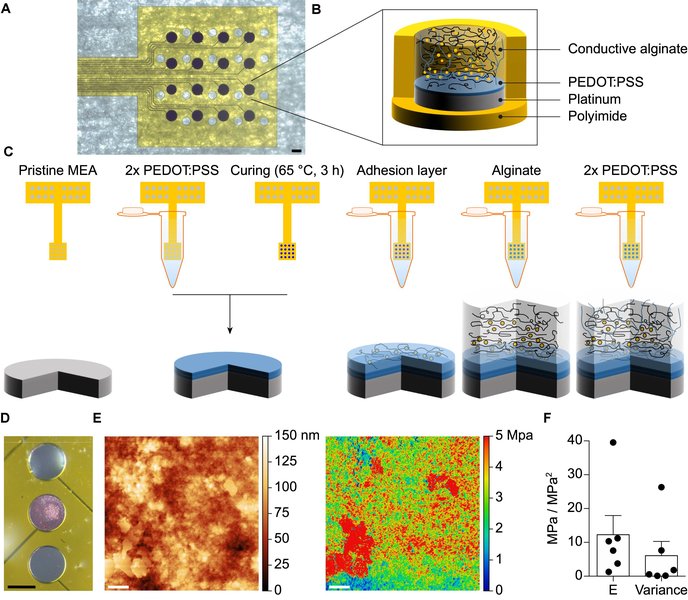

The first image illustrates how PEDOT:PSS can be integrated into composite materials like hydrogels, enhancing conductivity while leveraging the properties of the matrix material (alginate) for biocompatibility and structure. The second image highlights the capability of patterning PEDOT:PSS films, which is crucial for defining electrode shapes and circuits in microfabricated devices like sensors and neural probes.
Demonstrating Precision: Inkjet Printing PEDOT:PSS
Inkjet printing has emerged as a powerful technique for the precise deposition of functional materials like PEDOT:PSS. It allows for the creation of complex patterns and tailored electrode geometries directly onto various substrates, including flexible ones. This method is particularly attractive for prototyping and manufacturing customized bioelectronic devices where accurate placement and minimal material waste are important considerations. The video below provides insight into the process and potential of inkjet-printing PEDOT:PSS electrodes.
This capability to directly write conductive patterns is highly relevant for fabricating microelectrode arrays for neural recording or stimulation, as well as for creating sensors intended for skin contact, where specific layouts are often required.
Deposition Method Recommendations for Bio-Applications
Neural Probe Fabrication
Neural probes demand high performance: excellent biocompatibility, long-term stability in vivo, low electrical impedance for sensitive recording or efficient stimulation, and mechanical flexibility to minimize tissue damage. PEDOT:PSS coatings are often applied to metallic electrode sites (e.g., Pt, Au) on flexible substrates (like Parylene-C or Polyimide) to lower impedance and improve charge transfer.
Suggested Methods:
- Inkjet Printing: Highly recommended for its ability to precisely deposit PEDOT:PSS onto specific microelectrode sites on the probe shaft. This allows for patterned coatings and potentially co-deposition of other functional materials. Subsequent thermal or solvent annealing is crucial for optimizing conductivity and adhesion.
- Spin Coating: Suitable for coating entire probe surfaces or simpler electrode layouts before subsequent patterning/etching steps. Provides good uniformity but lacks the site-specificity of printing. Requires careful optimization for coating pre-fabricated, non-planar probes.
- Electropolymerization: Ideal for conformally coating existing conductive electrode sites with PEDOT (often with PSS in the electrolyte) directly, offering excellent control over thickness and adhesion to the underlying metal.
The choice often depends on the complexity of the probe design and manufacturing workflow. Post-deposition treatments (annealing, doping) are nearly always necessary to achieve optimal electrochemical performance for neural interfacing.
Skin and Tissue Contact Applications
For applications like wearable sensors (ECG, EMG), functional electrical stimulation pads, or interfaces with tissue models, key requirements include good conformal contact, biocompatibility, flexibility, and stable electrical performance under mechanical stress and exposure to sweat or other biofluids.
Suggested Methods:
- Spray Coating: Well-suited for coating larger, potentially flexible substrates uniformly. Its ability to handle non-planar surfaces can be advantageous for wearable applications. Optimization is needed for thickness control and uniformity.
- Inkjet Printing: Excellent for creating patterned electrodes directly onto flexible substrates (e.g., textiles, PET films) for specific sensor layouts. Allows for high design flexibility and efficient material use.
- Spin Coating: Can be used for creating uniform conductive layers on flat, flexible substrates that might later be patterned or integrated into a device.
- Dip Coating: A cost-effective option for coating larger flexible sheets or fibers, though achieving high uniformity and complex patterns can be challenging.
For skin-contact devices, ensuring good adhesion to the substrate and stability under repeated bending or stretching cycles is paramount. Post-treatments remain important for conductivity and durability.
Summary: Deposition Methods and Suitability
The following table summarizes the key characteristics and suitability of the primary PEDOT:PSS deposition methods for bioelectronic applications discussed:
| Method | Key Advantages | Key Disadvantages | Suitability for Neural Probes | Suitability for Skin/Tissue Contact |
|---|---|---|---|---|
| Spin Coating | High uniformity (lab scale), Simple process, Good thickness control | High material waste, Less suitable for large/complex shapes, Primarily planar substrates | Good for uniform base layers or simple designs; requires post-processing for patterning | Suitable for uniform coatings on flat flexible substrates |
| Inkjet Printing | Precise patterning, High material efficiency, Digital control, Good scalability potential | Requires optimized ink formulation, Resolution limits, Potential printing defects (e.g., coffee ring) | Excellent for patterned microelectrodes, site-specific deposition | Excellent for custom sensor layouts on flexible substrates |
| Spray Coating | Suitable for large areas & non-planar shapes, Fast deposition, Scalable | Uniformity/thickness control can be challenging, Potential overspray/roughness | Less common for microelectrodes due to precision limits, potentially useful for larger area coatings | Very suitable for large flexible substrates, wearables |
| Dip Coating | Simple, Low cost, Coats complex shapes/both sides, Scalable (batch) | Thickness control less precise, Meniscus effects, Patterning difficult | Limited suitability due to lack of precision for microelectrodes | Suitable for coating flexible sheets or fibers cost-effectively |
Note: Electropolymerization is highly suitable for coating existing conductive neural electrode sites but is not typically used for depositing PEDOT:PSS dispersions onto insulating substrates.
Frequently Asked Questions (FAQ)
What makes PEDOT:PSS suitable for biological applications? +
PEDOT:PSS offers a combination of properties ideal for bio-interfaces:
- Biocompatibility: Generally well-tolerated by biological tissues.
- Electrical Conductivity: Allows for efficient signal transduction (recording or stimulation).
- Mechanical Flexibility: Enables conformal contact with soft tissues and reduces mechanical mismatch.
- Ionic Conductivity: Facilitates ion exchange at the electrode-electrolyte interface, which is crucial for interacting with biological systems.
- Processability: Can be deposited from aqueous solutions using various techniques onto diverse substrates.
How can the conductivity of PEDOT:PSS be significantly improved? +
Conductivity enhancement, often by orders of magnitude, is typically achieved through:
- Secondary Doping: Adding high-boiling point polar solvents like Dimethyl Sulfoxide (DMSO) or Ethylene Glycol (EG) to the dispersion before deposition, or treating the film with these solvents afterwards.
- Acid Treatment: Exposing the film to acids like sulfuric acid.
- Salt Treatment: Incorporating certain salts into the film.
- Annealing: Both thermal annealing and solvent annealing can improve morphology and remove insulating PSS, boosting conductivity.
Which deposition method is best for complex electrode patterns? +
Inkjet printing is generally the most suitable method for creating complex, high-resolution electrode patterns directly. Its digital, additive nature allows for precise deposition of PEDOT:PSS ink only where needed, enabling intricate designs without subtractive processing steps like etching. Electropolymerization is also excellent for patterning if depositing onto pre-patterned conductive seed layers.
Is PEDOT:PSS stable in biological environments? +
PEDOT:PSS exhibits reasonable stability, but its long-term performance in biological environments (in vivo) can be a concern. Potential issues include:
- Delamination: Loss of adhesion from the substrate.
- PSS Leaching: The PSS component can slowly dissolve or leach out.
- Electrochemical Degradation: Over-oxidation or reduction during electrical stimulation can degrade the polymer.
- Swelling/Mechanical Changes: Absorption of water and ions can alter mechanical and electrical properties.
What controls the thickness of a spin-coated PEDOT:PSS film? +
The final thickness of a spin-coated PEDOT:PSS film is primarily determined by two factors:
- Spin Speed: Higher rotation speeds result in greater centrifugal force, thinning the liquid layer more effectively before it dries, leading to a thinner final film.
- Solution Concentration/Viscosity: More concentrated or viscous solutions resist thinning during spinning and result in thicker films at a given spin speed.
References
- How to Spin Coat PEDOT:PSS - Ossila
- PEDOT:PSS Deposition Methods - Ossila
-
Engineering conductive polymer hydrogels for concurrent overhang 3D printing and endothelial cell culture - PubMed Central (PMC)
- Fabrication and in vivo 2-photon microscopy validation of transparent PEDOT:PSS microelectrode arrays - Nature Microsystems & Nanoengineering
- PEDOT:PSS - Wikipedia
-
PEDOT:PSS-Based Bioelectronic Devices for Recording and Modulation of Electrophysiological Signals - PubMed Central (PMC)
- What's DENATRON (PEDOT/PSS dispersion) - Nagase ChemteX Corporation
Recommended Reading
Last updated April 10, 2025