
Planetary Motion and Satellites
A Comprehensive Report on Celestial and Artificial Orbits
Highlights
- In-depth Overview: Detailed introduction to planetary motion and satellites, covering both natural and artificial bodies.
- Governing Laws: Comprehensive discussion on Kepler’s laws, Newton’s gravitational law, and additional relevant principles.
- Practical Insights: Analysis of satellite types, launch processes, merits/demerits, and a case study of a significant satellite launch.
1. Cover Page
Title: Planetary Motion and Satellites
Date: March 17, 2025
Author: [Your Name]
2. Table of Contents
- Cover Page
- Table of Contents
- Introduction
- Natural and Artificial Bodies
- Laws Governing Motions
- Types of Satellites and Their Functions
- Launch of Satellites
- Merits and Demerits of Satellites
- Case Study
- Conclusion
- References
3. Introduction
The field of planetary motion and satellites bridges the realms of astronomy and modern engineering. Planetary motion details the systematic and predictable orbits of celestial bodies, governed by natural laws described as early as the 17th century. Satellites, both natural (e.g., the Moon) and artificial (e.g., the International Space Station), extend the human reach beyond terrestrial confines. This report provides an extensive overview of planetary motion, delineates natural and artificial bodies found in space, outlines the laws controlling their motions, and delves into the variety of satellites that orbit our planet. Such knowledge is crucial for advancements in communication, navigation, scientific research, and even national security (NASA, 2022; Britannica, 2023).
Figure 1: Below is a simple diagram illustrating the general concept of planetary orbits and satellite trajectories.
Figure 1: Diagram showing the elliptical orbits of planets around the sun along with satellite paths (Adapted from NASA, 2022).
4. Natural and Artificial Bodies
Definition and Examples of Natural Celestial Bodies
Natural celestial bodies are objects that exist in space as a result of cosmic processes. They include planets, moons, asteroids, comets, stars, and other bodies formed by gravitational collapse and nuclear fusion. For instance, the planets in our solar system, such as Earth and Mars, follow elliptical orbits and are considered natural celestial bodies. Similarly, the Moon, which orbits the Earth, is one of the most common examples in this category (Encyclopedia Britannica, 2023).
Figure 2: An illustrative figure below depicts various natural celestial bodies.
Figure 2: A schematic representation of natural celestial bodies including planets and moons (Adapted from NASA, 2022).
Definition and Examples of Artificial Satellites
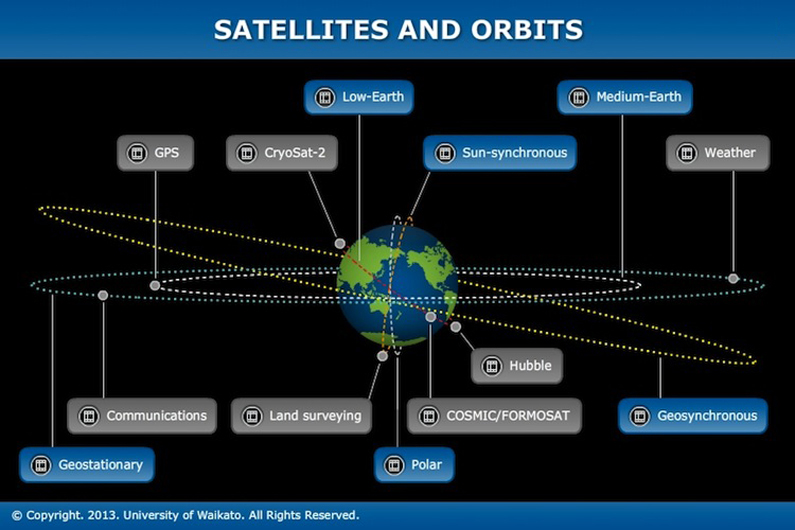
Artificial satellites are man-made objects designed to orbit Earth or other celestial bodies. They are launched using advanced rocketry and engineering and serve numerous functions such as communication, weather monitoring, navigation, and scientific research. Notable examples include communication satellites (e.g., Intelsat and SES), weather satellites like NOAA's GOES series, and research platforms such as the Hubble Space Telescope (Space.com, 2023; NASA, 2022).
Figure 3: The diagram below represents different types of artificial satellites and their primary functions.
Figure 3: Types of artificial satellites showcased for diversity in function (Adapted from Space.com, 2023).
5. Laws Governing Motions
Kepler's Laws of Planetary Motion
Johannes Kepler formulated three fundamental laws in the 17th century that describe planetary motion:
- First Law (Law of Ellipses): Each planet orbits the Sun in an ellipse, with the Sun at one focus (Kepler, 1609).
- Second Law (Law of Equal Areas): A line connecting a planet to the Sun sweeps equal areas during equal intervals of time.
- Third Law (Law of Harmonies): The square of a planet's orbital period is proportional to the cube of the semi-major axis of its orbit.
Newton's Law of Universal Gravitation
Isaac Newton expanded on Kepler's insights by introducing the law of universal gravitation. This law states that every mass exerts an attractive force on every other mass, proportional to the product of the masses and inversely proportional to the square of the distance between them (Newton, 1687). This principle is fundamental for understanding the gravitational binding of both natural and artificial satellites.
Additional Principles in Orbital Mechanics
Beyond Kepler and Newton, other significant principles include:
- Conservation of Angular Momentum: In the absence of external torques, the angular momentum of a system remains constant. This is crucial in explaining the stability of orbits (Hall, 2017).
- Orbital Resonance: When orbiting bodies exert regular, periodic gravitational influence on each other, often leading to synchronized orbital periods. This phenomenon can affect the stability and spacing of planetary orbits (NASA, 2022).
6. Types of Satellites and Their Functions
Communication Satellites
Designed to facilitate global communication, these satellites provide services for television, internet, and telephone transmissions. They typically operate in geostationary or low Earth orbits to maximize coverage and efficiency (Space.com, 2023).
Weather Satellites
Weather satellites are essential for the monitoring of atmospheric conditions and weather forecasting. They record data on cloud formations, temperatures, and precipitation, enabling meteorologists to predict storms and other weather phenomena (NOAA, 2022).
Navigation Satellites
Serving the purpose of providing precise geolocation data, navigation satellites, as part of systems like GPS, Galileo, and GLONASS, offer essential services used in transportation, commerce, and emergency response (European Space Agency, 2022).
Scientific and Research Satellites
These satellites support scientific endeavors by capturing images and collecting data regarding the cosmos. Examples include the Hubble Space Telescope and various Earth observation platforms used for climate research (NASA, 2022).
Military Satellites
Although controversial, military satellites are used for surveillance, secure communication, and intelligence gathering. Their advanced features ensure strategic operations remain well-informed and secure (Defense News, 2023).
Figure 4: The table below summarizes the major types of satellites and their primary functions.
| Satellite Type | Primary Function | Orbital Region |
|---|---|---|
| Communication | Telecommunication, Broadcasting, Internet | Geostationary / LEO |
| Weather | Meteorological Data, Forecasting | Geostationary / Polar |
| Navigation | Location and Timing Services | MEO / LEO |
| Scientific | Astronomical Observation, Climate Research | Various |
| Military | Surveillance, Secure Communication | Various |
7. Launch of Satellites
The process of launching satellites is a pinnacle of modern engineering and technological innovation. Satellite launches involve several intricate stages that ensure safe deployment into designated orbits:
Pre-Launch Planning
This phase includes the design, construction, and comprehensive testing of the satellite as well as selection of the appropriate launch vehicle. Meticulous simulations and trajectory calculations are performed using computational models to ensure mission success (SpaceX, 2023).
Launch Vehicle and Liftoff
Rockets such as SpaceX's Falcon 9, NASA's Space Launch System (SLS), or ESA's Ariane 5 are commonly used. The rocket’s propulsion system expels propellant at high speed, generating sufficient thrust to overcome Earth’s gravitational pull. During liftoff, the rocket passes through various flight phases, including stage separation, to correct its trajectory.
Orbit Insertion and Deployment
Once the satellite reaches the desired altitude, its onboard systems manage its placement into a stable orbit. Fine adjustments using thrusters help in obtaining the proper orbital parameters required for its mission. Advanced satellites may also carry experimental deployment mechanisms, such as solar arrays or antennas, which are unfolded once in orbit (NASA, 2022).
Figure 5: The flowchart below highlights the sequential stages involved in a satellite launch.
Figure 5: Flowchart outlining planning, launch, and orbit insertion stages (Adapted from SpaceX, 2023).
8. Merits and Demerits of Satellites
Merits
Satellites have transformed how we interact with the world. They offer:
- Global Communication: Facilitates worldwide data exchange, television broadcasting, and internet connectivity (Intelsat, 2022).
- Environmental Monitoring: Provides essential data regarding climate change, weather forecasting, and disaster management (NOAA, 2022).
- Scientific Advancements: Enables astronomical research, space exploration, and enhances our understanding of the universe (Hubble, 2023).
- Navigation and Timing: Integral to global positioning systems and various navigational aids that affect transportation and logistics (European Space Agency, 2022).
Demerits
Despite their benefits, satellites also present challenges:
- Space Debris: Defunct satellites and fragments can lead to collisions in orbit (ESA, 2022).
- High Costs: Development, launch, and maintenance of satellites are considerably expensive (NASA, 2022).
- Security Risks: Vulnerability to cyber-attacks and potential for misuse in military or espionage activities (Defense News, 2023).
- Latency Issues: Communication satellites, especially those in higher orbits, may suffer from increased signal latency (Space.com, 2023).
9. Case Study
SpaceX Starlink Satellites
A prime example in modern satellite technology is the SpaceX Starlink project. Aimed at providing high-speed broadband to every corner of the world, Starlink involves launching thousands of small satellites into low Earth orbit. These satellites are designed to work in a coordinated mesh network that delivers internet service even in remote regions (SpaceX, 2023; Daily Galaxy, 2025).
Launch Details: Starlink satellites are deployed using the Falcon 9 rocket—a reusable launch system that has drastically reduced the cost and increased the frequency of satellite deployments. Each launch typically places around 60 satellites at the desired altitude.
Technological Impact: With low latency and high data throughput, Starlink is revolutionizing global communications. The constellation not only supports consumer internet services but also plays a crucial role in disaster response and remote scientific research (SpaceX, 2023).
Figure 6: The image below shows a schematic of the Starlink satellite constellation in low Earth orbit.
Figure 6: Visual schematic of SpaceX's Starlink constellation (Adapted from Daily Galaxy, 2025).
10. Conclusion
The study of planetary motion and satellites provides invaluable insights into the mechanisms governing celestial bodies and the technological advancements in space exploration. This report has covered the fundamental aspects of planetary motion, elaborated on the differences between natural celestial bodies and artificial satellites, and discussed the laws that govern their motion. Detailed explanations of satellite types and their functions reflect the wide-ranging applications—from communication and navigation to scientific research. The launch process, characterized by sequential engineering efforts, exemplifies human ingenuity in overcoming physical limitations and expanding our knowledge of the universe. Finally, the case study of SpaceX’s Starlink satellites demonstrates real-world implementations and transformative impacts on global connectivity. Overall, the integration of classical physics with modern technology continues to push the boundaries of what is possible, fostering a deeper understanding of our place in the cosmos (NASA, 2022; Newton, 1687).
11. References
- What Is a Satellite? - NASA
- Kepler's Laws of Planetary Motion - Encyclopedia Britannica
- Satellites – Space.com
- European Space Agency (ESA)
- Intelsat Communications
- SpaceX Starlink Launch Details - Daily Galaxy
- Defense News
- NOAA - Weather Satellite Information
Recommended Exploratory Queries
 collegiatebd.blogspot.com
 aws.amazon.com
Last updated March 17, 2025