
Unveiling Simple Harmonic Motion: The Physics of Oscillations
Exploring the fundamental principles and real-world examples of repetitive motion
Key Insights into Simple Harmonic Motion
- Defining Characteristic: Simple Harmonic Motion (SHM) is a specific type of periodic motion where the restoring force is directly proportional to the displacement from the equilibrium position and acts towards that position.
- Hooke's Law Connection: The restoring force in SHM is often described by Hooke's Law, \( F = -kx \), highlighting the linear relationship between force and displacement.
- Sinusoidal Nature: The displacement, velocity, and acceleration of an object undergoing SHM can be described by sinusoidal (sine or cosine) functions of time.
What is Simple Harmonic Motion (SHM)?
Simple Harmonic Motion, often abbreviated as SHM, is a fundamental concept in physics that describes a specific type of periodic motion. It's a repetitive movement back and forth through a central, or equilibrium, position. What makes SHM "simple harmonic" is the nature of the force driving this motion: a restoring force that is directly proportional to the displacement from the equilibrium position and always directed towards that equilibrium.
Imagine a system that oscillates, meaning it moves back and forth around a stable point. If the force trying to bring the object back to its starting point (the restoring force) gets stronger the further away the object is moved, and this relationship is linear, then the motion can be described as simple harmonic motion. This type of motion is ubiquitous in the physical world, serving as a model for many oscillating systems when the displacements are relatively small and energy loss is negligible.
The Restoring Force and Equilibrium
The cornerstone of Simple Harmonic Motion is the restoring force. This force is the reason the object returns to its equilibrium position after being displaced. In SHM, this restoring force has two crucial characteristics:
Proportionality to Displacement
The magnitude of the restoring force is directly proportional to the displacement of the object from its equilibrium position. This means if you double the displacement, the restoring force also doubles. This linear relationship is key to the "simple" aspect of SHM.
Direction Towards Equilibrium
The restoring force always acts in the opposite direction to the displacement. If the object is displaced to the right of the equilibrium, the restoring force acts to the left. If it's displaced to the left, the force acts to the right. This ensures the force is always trying to pull or push the object back to the central position.
The equilibrium position itself is a point of stable equilibrium. When the object is at this position, the net force acting on it is zero. However, if displaced, the restoring force immediately acts to bring it back.
Hooke's Law and SHM
A classic example that perfectly illustrates the restoring force in SHM is a mass attached to a spring. When the spring is stretched or compressed from its relaxed length (the equilibrium position), it exerts a force that opposes the displacement. This force is described by Hooke's Law:
\[ F = -kx \]Here, \( F \) is the restoring force, \( x \) is the displacement from the equilibrium position, and \( k \) is the spring constant, a measure of the spring's stiffness. The negative sign indicates that the force is always in the opposite direction of the displacement. This linear relationship between force and displacement is precisely what defines the restoring force in SHM for a spring-mass system.
Characteristics of Simple Harmonic Motion
Beyond the restoring force, SHM exhibits several distinct characteristics:
Periodic Motion
SHM is a type of periodic motion, meaning the motion repeats itself at regular intervals. The time taken for one complete cycle of oscillation is called the period (\( T \)). The frequency (\( f \)) is the number of oscillations per unit time, and is the reciprocal of the period (\( f = 1/T \)).
Sinusoidal Variation
A defining feature of SHM is that the displacement, velocity, and acceleration of the oscillating object vary sinusoidally with time. This means they can be described by sine or cosine functions. This sinusoidal nature is directly linked to the linear restoring force.
Amplitude
The amplitude (\( A \)) of SHM is the maximum displacement of the object from its equilibrium position. In ideal SHM (without damping), the amplitude remains constant over time.
Phase
The phase describes the position of the oscillating object in its cycle at a given time. It's often represented as an angle in the sinusoidal functions describing the motion.
Velocity and Acceleration
In SHM, the velocity of the object is maximum at the equilibrium position and zero at the points of maximum displacement (the turning points). The acceleration is zero at the equilibrium position and maximum at the points of maximum displacement, always directed towards the equilibrium.
The relationship between acceleration and displacement in SHM is given by:
\[ a(t) = -\omega^2 x(t) \]where \( a(t) \) is the acceleration at time \( t \), \( x(t) \) is the displacement at time \( t \), and \( \omega \) is the angular frequency of the oscillation. This equation clearly shows that the acceleration is proportional to the displacement and in the opposite direction, reinforcing the nature of the restoring force.
Examples of Simple Harmonic Motion
Simple Harmonic Motion is not just a theoretical concept; it manifests in numerous real-world phenomena. While ideal SHM assumes no energy loss (damping), many systems approximate SHM for small oscillations.
Mass-Spring System
As discussed earlier, a mass attached to a spring on a frictionless surface is the quintessential example of SHM. When displaced and released, it oscillates back and forth, with the spring providing the restoring force according to Hooke's Law.
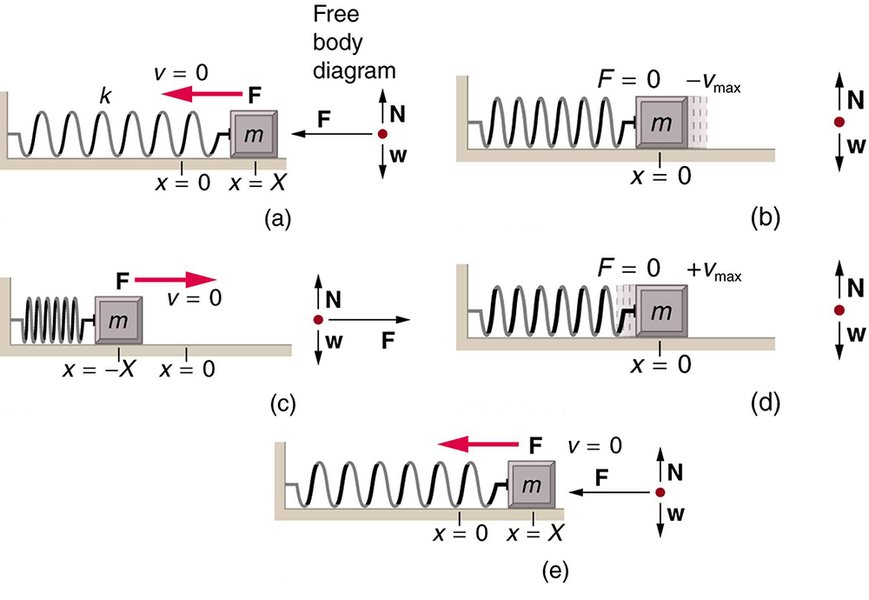
A mass oscillating on a spring, a classic illustration of SHM.
Simple Pendulum (Small Angles)
For small angles of displacement (typically less than 15 degrees), a simple pendulum approximates SHM. The restoring force is the component of gravity acting tangentially to the arc of motion, which is approximately proportional to the displacement for small angles.
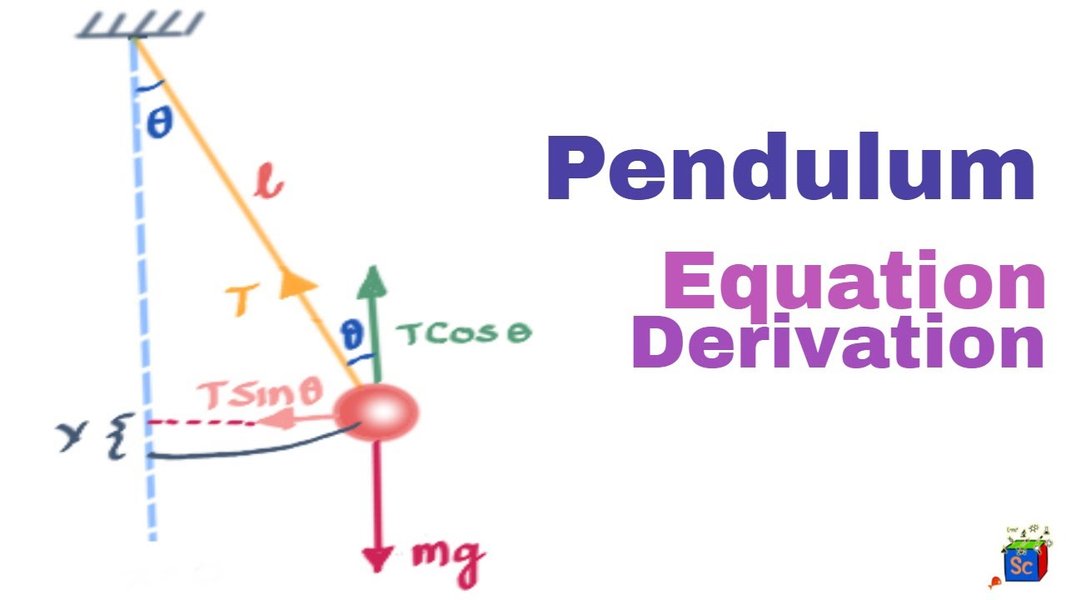
A simple pendulum, demonstrating SHM for small oscillations.
Other Examples
Many other systems exhibit behavior that can be modeled by SHM, including:
- Vibrating strings on musical instruments (guitars, violins, etc.)
- The motion of a swing
- A person bouncing on a diving board
- The vibrations of atoms in a crystal lattice
- The movement of electrons in certain circuits
- The diaphragm in a speaker
These examples highlight the broad applicability of the SHM model in understanding oscillatory phenomena in various fields of physics and engineering.
Oscillatory Motion vs. Simple Harmonic Motion
It's important to distinguish between general oscillatory motion and Simple Harmonic Motion. Oscillatory motion is any motion that repeats back and forth around an equilibrium position. However, SHM is a specific type of oscillatory motion characterized by the linear restoring force proportional to displacement.
All simple harmonic motions are oscillatory and periodic, but not all oscillatory motions are simple harmonic. For example, the motion of a bouncing ball is oscillatory, but the restoring force (gravity and the elastic force of the ball) is not linearly proportional to the displacement in the same way as in SHM.
Mathematical Description of SHM
The motion of an object in SHM can be described mathematically using trigonometric functions. For one-dimensional SHM along the x-axis, the displacement \( x(t) \) at time \( t \) can be given by:
\[ x(t) = A \cos(\omega t + \phi) \]or
\[ x(t) = A \sin(\omega t + \phi) \]where:
- \( A \) is the amplitude
- \( \omega \) is the angular frequency (\( \omega = 2\pi f = 2\pi/T \))
- \( t \) is time
- \( \phi \) is the phase constant, which depends on the initial conditions of the motion
From the displacement equation, we can derive the equations for velocity \( v(t) \) and acceleration \( a(t) \) by taking the first and second derivatives with respect to time:
\[ v(t) = \frac{dx}{dt} = -A\omega \sin(\omega t + \phi) \] \[ a(t) = \frac{dv}{dt} = -A\omega^2 \cos(\omega t + \phi) = -\omega^2 x(t) \]These equations mathematically confirm the sinusoidal nature of displacement, velocity, and acceleration in SHM, and the direct proportionality between acceleration and displacement with a negative sign.
Understanding SHM through a Table
Here's a summary of the key characteristics of Simple Harmonic Motion:
| Characteristic | Description |
|---|---|
| Type of Motion | Periodic and Oscillatory |
| Restoring Force | Proportional to displacement and directed towards equilibrium (satisfies Hooke's Law) |
| Equilibrium Position | Stable equilibrium; net force is zero |
| Displacement, Velocity, Acceleration | Vary sinusoidally with time |
| Amplitude | Maximum displacement from equilibrium |
| Period and Frequency | Constant for a given system (independent of amplitude in ideal SHM) |
Visualizing Simple Harmonic Motion
The sinusoidal nature of SHM can be clearly seen when plotting displacement, velocity, and acceleration as functions of time. These plots are offset in phase from each other.
Displacement is maximum or minimum when velocity is zero, and velocity is maximum or minimum when displacement is zero. Acceleration is always in the opposite direction of displacement.
The relationship between SHM and uniform circular motion can also provide a useful visualization. The projection of an object undergoing uniform circular motion onto one of the diameters of the circle executes simple harmonic motion.
Why is SHM Important?
Simple Harmonic Motion is a fundamental concept in physics because it serves as a powerful model for a wide range of physical phenomena. Its importance stems from several factors:
-
Approximation for Small Oscillations: Many complex oscillating systems behave approximately as simple harmonic oscillators when the displacements from equilibrium are small. This allows us to use the relatively simple mathematical framework of SHM to analyze and predict their behavior.
-
Building Block for More Complex Motions: More complex periodic motions can often be analyzed as a superposition (combination) of simple harmonic motions of different frequencies and amplitudes (Fourier analysis).
-
Understanding Waves: SHM is intimately connected to the study of waves, including sound waves and light waves. The particles in a medium transmitting a wave often undergo simple harmonic motion.
-
Timekeeping: The constant period of SHM, independent of amplitude (in the ideal case), makes it crucial for timekeeping devices like pendulum clocks.
By understanding Simple Harmonic Motion, we gain insight into the behavior of a vast array of physical systems, from the microscopic vibrations of atoms to the macroscopic oscillations of bridges.
Exploring SHM Further (Video)
To gain a deeper visual and conceptual understanding of Simple Harmonic Motion, consider watching the following video which provides an overview of the topic:
This video from Crash Course Physics offers an engaging explanation of the core principles behind Simple Harmonic Motion, including the role of restoring forces and the characteristics of the motion.
FAQ about Simple Harmonic Motion
What is the main condition for Simple Harmonic Motion?
The main condition for Simple Harmonic Motion is that the restoring force acting on the object is directly proportional to its displacement from the equilibrium position and always directed towards the equilibrium position. This is often represented by Hooke's Law, \( F = -kx \).
Is all oscillatory motion Simple Harmonic Motion?
No, not all oscillatory motion is Simple Harmonic Motion. SHM is a specific type of oscillatory motion where the restoring force follows a linear relationship with displacement. While all SHM is oscillatory, not all oscillatory motion is SHM.
What are some common examples of SHM?
Common examples of systems that exhibit or approximate Simple Harmonic Motion include a mass on a spring, a simple pendulum (for small angles), vibrating strings, and the oscillations of atoms in a solid.
How are displacement, velocity, and acceleration related in SHM?
In SHM, displacement, velocity, and acceleration all vary sinusoidally with time. Velocity is the time derivative of displacement, and acceleration is the time derivative of velocity (or the second derivative of displacement). Acceleration is directly proportional to displacement but in the opposite direction.
Does the period of SHM depend on the amplitude?
In ideal Simple Harmonic Motion (without damping), the period and frequency of the oscillation depend only on the properties of the system (like mass and spring constant) and not on the amplitude of the motion.
References
Last updated April 29, 2025