
Unveiling the Rhythmic Dance: What Exactly is Simple Harmonic Motion?
Discover the fundamental physics behind oscillations that shape everything from atoms to pendulums.
Simple Harmonic Motion (SHM) is a foundational concept in physics describing a special kind of repetitive, back-and-forth movement, or oscillation, around a central point of stability, known as the equilibrium position. It's the idealized pattern behind many natural vibrations and waves.
Essential Insights into SHM
- Restoring Force is Key: The defining feature of SHM is a restoring force that is always directed towards the equilibrium position and its strength is directly proportional to the object's displacement from that position.
- Sinusoidal Nature: The position, velocity, and acceleration of an object undergoing SHM can all be described mathematically using sine or cosine functions of time, resulting in smooth, regular oscillations.
- Constant Period: In ideal SHM (without friction or damping), the time it takes to complete one full oscillation (the period) remains constant, regardless of the maximum displacement (amplitude).
The Core Principle: The Restoring Force
Imagine stretching or compressing a spring attached to a block on a frictionless surface. The spring exerts a force trying to return the block to its resting (equilibrium) position. The further you pull or push the block, the stronger this force becomes. This is the essence of the restoring force in SHM.
Hooke's Law: Quantifying the Force
This relationship between the restoring force (\(F\)) and the displacement (\(x\)) from equilibrium is mathematically described by Hooke's Law:
\[ F = -kx \]Where:
- \( F \) is the restoring force exerted by the system (e.g., the spring).
- \( x \) is the displacement of the object from its equilibrium position.
- \( k \) is a positive constant called the force constant (or spring constant for a spring system), indicating the stiffness of the system. A higher \( k \) means a stiffer spring and a stronger restoring force for a given displacement.
- The negative sign (-) is crucial. It signifies that the restoring force always acts in the direction opposite to the displacement. If the object is displaced to the right (\( +x \)), the force pushes it left (\( -F \)). If displaced to the left (\( -x \)), the force pushes it right (\( +F \)).
This direct proportionality between force and displacement is the hallmark of simple harmonic motion.
Characteristics of Simple Harmonic Motion
SHM exhibits several distinct characteristics that arise directly from the nature of the restoring force.
Periodic and Oscillatory
The motion is inherently periodic, meaning it repeats itself over a regular time interval. The object oscillates back and forth around the equilibrium position. When displaced and released, the restoring force accelerates it towards equilibrium. Due to inertia, it overshoots this point, moving towards the other extreme. The restoring force then acts in the opposite direction, slowing it down, stopping it momentarily at the maximum displacement on the other side, and accelerating it back towards equilibrium again. This cycle repeats continuously in the absence of energy loss.
Sinusoidal Description
The position (\(x\)), velocity (\(v\)), and acceleration (\(a\)) of an object in SHM vary sinusoidally (like sine or cosine waves) with time (\(t\)). The specific equation often used for position is:
\[ x(t) = A \cos(\omega t + \phi) \]Where:
- \( x(t) \) is the position at time \( t \).
- \( A \) is the amplitude, the maximum displacement from the equilibrium position. It represents the extent of the oscillation.
- \( \omega \) (omega) is the angular frequency, related to how quickly the oscillations occur (measured in radians per second). It depends on the physical properties of the system (like \(k\) and mass \(m\)). For a mass-spring system, \( \omega = \sqrt{k/m} \).
- \( t \) is time.
- \( \phi \) (phi) is the phase constant (or phase angle). It accounts for the object's initial position and velocity at \( t = 0 \). It determines where in the cycle the motion starts.
Velocity and acceleration are the time derivatives of position:
\[ v(t) = \frac{dx}{dt} = -A\omega \sin(\omega t + \phi) \] \[ a(t) = \frac{dv}{dt} = \frac{d^2x}{dt^2} = -A\omega^2 \cos(\omega t + \phi) = -\omega^2 x(t) \]Notice that acceleration is directly proportional to displacement (\( a(t) = -\omega^2 x(t) \)) and always opposite in direction, consistent with the definition of SHM derived from Newton's second law (\( F=ma \)) and Hooke's law (\( F=-kx \)), leading to \( ma = -kx \), or \( a = -(k/m)x \), where \( \omega^2 = k/m \).
Period and Frequency
Two key measures quantify the timing of the oscillation:
- Period (\( T \)): The time required for one complete cycle of motion (e.g., from maximum positive displacement back to maximum positive displacement). It is related to the angular frequency by \( T = 2\pi / \omega \). For a mass-spring system, \( T = 2\pi \sqrt{m/k} \). Critically, in ideal SHM, the period is independent of the amplitude \( A \).
- Frequency (\( f \)): The number of complete cycles that occur per unit of time (usually per second, measured in Hertz, Hz). It is the reciprocal of the period: \( f = 1/T = \omega / 2\pi \).
Energy Conservation
In an ideal SHM system (no friction or air resistance), the total mechanical energy (sum of kinetic and potential energy) remains constant. Energy continuously transforms between kinetic energy (KE) and potential energy (PE).
- At maximum displacement (\( x = \pm A \)): Velocity is zero, so KE = 0. All energy is potential energy, \( PE = \frac{1}{2}kA^2 \).
- At equilibrium position (\( x = 0 \)): Potential energy is zero (usually defined as zero here). Velocity is maximum, so all energy is kinetic energy, \( KE = \frac{1}{2}mv_{max}^2 \).
- At intermediate positions: The energy is a mix of KE and PE, but the total energy \( E = KE + PE = \frac{1}{2}mv^2 + \frac{1}{2}kx^2 = \frac{1}{2}kA^2 \) remains constant.
State of Motion at Key Points
The table below summarizes the relationship between displacement, velocity, and acceleration at the equilibrium position and the points of maximum displacement (amplitudes) in SHM.
| Position (\(x\)) | Displacement | Velocity (\(v\)) | Acceleration (\(a\)) | Kinetic Energy (KE) | Potential Energy (PE) |
|---|---|---|---|---|---|
| \( x = 0 \) | Zero (Equilibrium) | Maximum magnitude (\( \pm A\omega \)) | Zero | Maximum | Zero |
| \( x = +A \) | Maximum Positive | Zero | Maximum magnitude, negative direction (\( -A\omega^2 \)) | Zero | Maximum |
| \( x = -A \) | Maximum Negative | Zero | Maximum magnitude, positive direction (\( +A\omega^2 \)) | Zero | Maximum |
Visualizing SHM Concepts
Conceptual Mindmap of SHM
This mindmap provides a visual summary of the core ideas surrounding Simple Harmonic Motion, connecting its definition, characteristics, mathematical formulation, energy aspects, and common examples.
to displacement (F = -kx)"] id2["Characteristics"] id2a["Sinusoidal Motion
(x, v, a vs. time)"] id2b["Constant Period (T)
Independent of Amplitude"] id2c["Constant Frequency (f = 1/T)"] id2d["Amplitude (A)
Max displacement"] id2e["Angular Frequency (ω)"] id3["Mathematical Description"] id3a["Position: x(t) = A cos(ωt + φ)"] id3b["Velocity: v(t) = -Aω sin(ωt + φ)"] id3c["Acceleration: a(t) = -Aω² cos(ωt + φ) = -ω²x"] id4["Energy"] id4a["Total Energy Constant
E = KE + PE"] id4b["KE = (1/2)mv²"] id4c["PE = (1/2)kx²"] id4d["Energy Transformation
(KE <=> PE)"] id5["Examples"] id5a["Mass on a Spring
(Horizontal/Vertical)"] id5b["Simple Pendulum
(Small angles only)"] id5c["Torsional Pendulum"] id5d["LC Electrical Circuit
(Charge/Current Oscillation)"] id5e["Vibrating String/Membrane"] id6["Conditions"] id6a["Linear restoring force"] id6b["No damping (friction/resistance)"]
Comparative Analysis of SHM Characteristics
While the definition of SHM is precise, its manifestation varies slightly across different physical systems. This radar chart compares key aspects of SHM as applied to an ideal mass-spring system, a simple pendulum (approximating SHM), and an LC electrical circuit (analogous SHM). The axes represent characteristics rated on a scale from 1 (Less Ideal/Applicable) to 5 (Highly Ideal/Applicable) based on how perfectly they fit the SHM model.
This comparison highlights that while the ideal mass-spring system perfectly embodies SHM principles, other systems like pendulums approximate it under specific conditions (small angles), and electrical analogs like LC circuits demonstrate mathematically equivalent behavior, albeit with different physical quantities oscillating.
Common Examples and Real-World Approximations
While truly perfect SHM is an idealization, many real-world phenomena approximate it very well, especially for small oscillations.
Mass on a Spring
The canonical example is a mass attached to an ideal spring (obeying Hooke's Law) on a frictionless horizontal surface or hanging vertically. When displaced from equilibrium and released, it oscillates with SHM. Its angular frequency is \( \omega = \sqrt{k/m} \), and its period is \( T = 2\pi \sqrt{m/k} \).
Simple Pendulum
A simple pendulum consists of a point mass (bob) suspended by a massless, inextensible string of length \( L \). For small angles of displacement (typically less than about 10-15 degrees), the restoring force (due to gravity) is approximately proportional to the displacement, and the pendulum undergoes SHM.
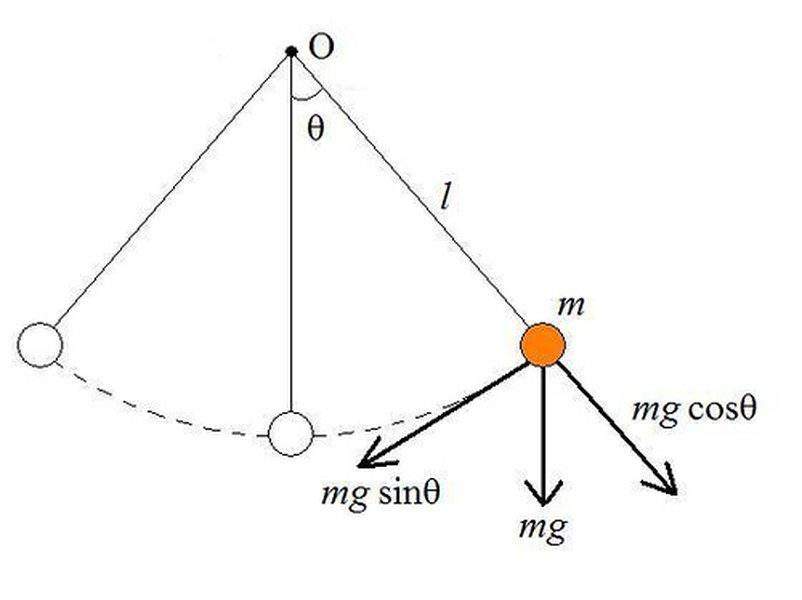
A simple pendulum approximates SHM for small angular displacements.
Its period is approximately \( T \approx 2\pi \sqrt{L/g} \), where \( g \) is the acceleration due to gravity. Notably, for small angles, the period is independent of the mass and the amplitude.
Other Examples
- Tuning Forks and Musical Instruments: The prongs of a tuning fork vibrate with SHM, producing a pure tone. Vibrations of strings and air columns in instruments often involve SHM components.
- Molecular Vibrations: Atoms within molecules can vibrate around their equilibrium positions, often modeled as SHM for small displacements.
- Alternating Current (AC) Circuits: The oscillation of charge, current, and voltage in certain AC circuits, like an LC circuit (inductor-capacitor), is analogous to mechanical SHM.
A Dynamic Overview: Learning with Video
Sometimes, seeing motion helps understanding. This video from Crash Course Physics provides an engaging introduction and overview of Simple Harmonic Motion, covering the core concepts, equations, and examples like springs and pendulums.
The video effectively breaks down the potentially complex topic into digestible segments, explaining Hooke's Law, the relationship between circular motion and SHM, and the significance of period, frequency, and amplitude. It reinforces the idea that SHM is defined by the restoring force being proportional to displacement.
Conditions and Limitations
True SHM occurs under specific ideal conditions:
- The system must possess a stable equilibrium position.
- There must be a restoring force acting on the system that is directly proportional to the displacement from equilibrium and directed towards it (obeys Hooke's Law).
- The system must be free from dissipative forces like friction or air resistance (no damping).
In reality, most oscillating systems experience some form of damping, causing the amplitude to decrease over time (damped harmonic motion). Furthermore, if the displacement is large, the restoring force might deviate from direct proportionality (e.g., large angles for a pendulum), leading to anharmonic motion where the period may depend on the amplitude.
Despite these limitations, SHM is an incredibly useful model because many systems exhibit behavior very close to SHM for small oscillations, and complex periodic motions can often be analyzed as combinations of simple harmonic motions (Fourier analysis).
Frequently Asked Questions about SHM
What's the difference between periodic motion and simple harmonic motion?
Periodic motion is any motion that repeats itself at regular time intervals. Simple Harmonic Motion (SHM) is a specific type of periodic motion. The key distinguishing feature of SHM is the nature of the restoring force: it must be directly proportional to the displacement from equilibrium and always directed towards it (F = -kx). All SHM is periodic, but not all periodic motion is SHM. For example, the uniform circular motion of a planet around the sun is periodic, but not SHM because the force (gravity) depends on the inverse square of the distance, not linearly on displacement from a central point.
Does the amplitude affect the period of SHM?
In ideal Simple Harmonic Motion, the period (\( T \)) and frequency (\( f \)) are independent of the amplitude (\( A \)). This means whether you pull a mass on a spring back a little or a lot (within the elastic limit), it will take the same amount of time to complete one full oscillation. This property is crucial for timekeeping devices like pendulum clocks (which approximate SHM). However, for systems that only approximate SHM (like a real pendulum) or for anharmonic oscillators, the period might slightly depend on the amplitude, especially for larger displacements.
What happens to SHM if there is friction or air resistance?
Friction and air resistance are dissipative forces that remove energy from the oscillating system. This effect is called damping. When damping is present, the motion is no longer perfect SHM. The amplitude of the oscillations gradually decreases over time until the motion eventually stops. This is known as damped harmonic motion. The frequency of oscillation may also be slightly lower compared to the undamped case. If the damping is very strong (overdamping or critical damping), the system might not oscillate at all but simply return slowly to equilibrium.
How is SHM related to waves?
SHM is the fundamental building block for understanding many types of waves. For instance, in a transverse wave on a string, each small segment of the string oscillates up and down, often approximating SHM. In a sound wave traveling through air, air molecules oscillate back and forth about their equilibrium positions, also approximating SHM. Light waves (electromagnetic waves) involve oscillating electric and magnetic fields that vary sinusoidally, analogous to SHM. Complex waves can often be described as a superposition (sum) of multiple simple harmonic waves with different frequencies and amplitudes (Fourier analysis).
Recommended
- Explore the mathematical equations describing velocity and acceleration in Simple Harmonic Motion.
- Investigate how energy transforms between kinetic and potential forms during Simple Harmonic Motion.
- Learn about the differences between ideal SHM, damped oscillations, and forced oscillations.
- Discover diverse real-world applications where the principles of Simple Harmonic Motion are observed or utilized.
References
Last updated April 29, 2025