
Unlocking the Rhythm of Nature: What Exactly is Simple Harmonic Motion?
Discover the fundamental back-and-forth movement that governs springs, pendulums, and even atoms.
Essential Insights into SHM
- Restoring Force is Key: Simple Harmonic Motion (SHM) is defined by a restoring force that is directly proportional to the displacement from an equilibrium position and always acts towards it.
- Sinusoidal Oscillation: The motion follows a smooth, repeating pattern described by sine or cosine functions, leading to predictable changes in position, velocity, and acceleration over time.
- Constant Period: In ideal SHM (without friction or damping), the time taken for one complete oscillation (the period) depends only on the system's physical properties (like mass and spring stiffness), not on how far it initially moves (the amplitude).
Defining Simple Harmonic Motion
Simple Harmonic Motion, often abbreviated as SHM, is a special and fundamental type of periodic motion encountered frequently in physics and the natural world. It describes an oscillation where an object moves back and forth repeatedly about a central, stable equilibrium position. The defining characteristic of SHM is the nature of the force acting on the oscillating object: the restoring force.
The Crucial Role of the Restoring Force
Imagine stretching or compressing a spring attached to a mass. The spring exerts a force trying to return the mass to its original resting position (equilibrium). This force is the restoring force. In SHM:
- The restoring force is always directed towards the equilibrium position.
- The magnitude of the restoring force is directly proportional to the object's displacement (how far it is) from the equilibrium position.
This relationship is mathematically captured by Hooke's Law for an ideal spring:
\[ F = -kx \]Where:
- \( F \) is the restoring force.
- \( k \) is a positive constant representing the stiffness of the system (e.g., the spring constant). A stiffer spring has a larger \( k \).
- \( x \) is the displacement from the equilibrium position.
- The negative sign indicates that the force \( F \) always acts in the opposite direction to the displacement \( x \). If the object is displaced to the right (\( x > 0 \)), the force pulls it left (\( F < 0 \)), and vice versa.
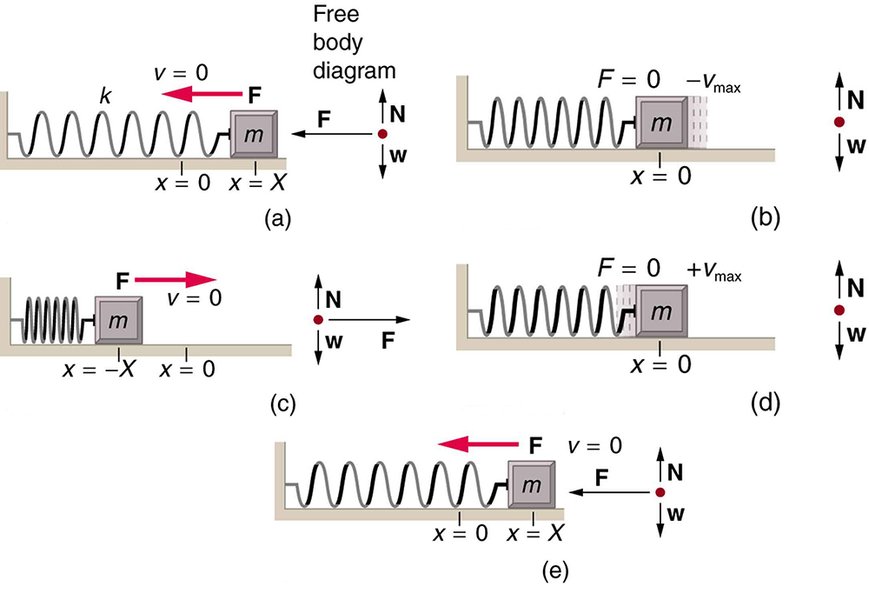
An object attached to a spring on a frictionless surface is a classic example of Simple Harmonic Motion.
The Mathematics Behind the Motion
The relationship between force and displacement dictates the object's acceleration and how its position changes over time.
Acceleration in SHM
Using Newton's second law (\( F = ma \)), where \( m \) is the mass and \( a \) is the acceleration, we can relate the acceleration directly to the displacement:
\[ ma = -kx \] \[ a = -\frac{k}{m}x \]This shows that the acceleration is also proportional to the displacement but in the opposite direction. We often introduce the angular frequency, \( \omega \), defined as:
\[ \omega^2 = \frac{k}{m} \]So, the acceleration equation becomes:
\[ a(t) = -\omega^2 x(t) \]This equation highlights a key feature: the acceleration is greatest when the displacement is maximum (at the endpoints of the motion) and zero when the object passes through the equilibrium position (\( x = 0 \)).
Position, Velocity, and Time: The Sinusoidal Nature
The motion resulting from this acceleration is perfectly described by sinusoidal functions (sine or cosine). The displacement \( x \) as a function of time \( t \) can be written as:
\[ x(t) = A \cos(\omega t + \phi) \]Where:
- \( A \) is the Amplitude: The maximum displacement from the equilibrium position. It's determined by the initial conditions (how far the object is initially pulled or pushed).
- \( \omega \) is the Angular Frequency: Related to how quickly the oscillations occur (measured in radians per second). It depends on the physical properties of the system (\( \sqrt{k/m} \) for a mass-spring system).
- \( t \) is Time.
- \( \phi \) is the Phase Constant (or Phase Angle): Determined by the object's position and velocity at \( t = 0 \). It shifts the cosine curve horizontally, accounting for the starting point of the oscillation.
From this position function, we can derive the velocity \( v(t) \) and acceleration \( a(t) \) using calculus:
\[ v(t) = \frac{dx}{dt} = -A\omega \sin(\omega t + \phi) \] \[ a(t) = \frac{dv}{dt} = -A\omega^2 \cos(\omega t + \phi) = -\omega^2 x(t) \]Notice that velocity is maximum (\( \pm A\omega \)) when displacement \( x \) is zero (equilibrium), and zero when displacement is maximum (\( \pm A \)). Acceleration is maximum (\( \mp A\omega^2 \)) when displacement is maximum (\( \pm A \)) and zero at equilibrium.
Characteristics and Properties of SHM
Period and Frequency: Timing the Oscillation
Two important measures describe the timing of SHM:
- Period (T): The time required for one complete cycle or oscillation (e.g., from maximum positive displacement back to maximum positive displacement). It is related to the angular frequency by: \[ T = \frac{2\pi}{\omega} \] For a mass-spring system, this becomes: \[ T = 2\pi \sqrt{\frac{m}{k}} \]
- Frequency (f): The number of complete oscillations that occur per unit of time (usually per second, measured in Hertz, Hz). It is the reciprocal of the period: \[ f = \frac{1}{T} = \frac{\omega}{2\pi} \] For a mass-spring system: \[ f = \frac{1}{2\pi} \sqrt{\frac{k}{m}} \]
A crucial aspect of ideal SHM is that the period \( T \) and frequency \( f \) depend only on the physical properties of the system (like \( m \) and \( k \)) and not on the amplitude \( A \) of the oscillations. A mass on a spring takes the same amount of time to complete an oscillation whether it's pulled back a little or a lot (within the limits of ideal behavior).
Energy Conservation in SHM
In an ideal system undergoing SHM (with no friction or air resistance), the total mechanical energy \( E \) remains constant. This energy continuously transforms between potential energy (\( U \)) stored in the system (like the stretched spring) and kinetic energy (\( K \)) due to the object's motion.
- Potential Energy (U): For a mass-spring system, \( U = \frac{1}{2}kx^2 \). It is maximum at the extreme points of displacement (\( x = \pm A \)) where the object momentarily stops (\( v = 0 \)), and zero at the equilibrium position (\( x = 0 \)).
- Kinetic Energy (K): Given by \( K = \frac{1}{2}mv^2 \). It is maximum at the equilibrium position (\( x = 0 \)) where the speed is greatest, and zero at the extreme points (\( x = \pm A \)) where the speed is zero.
The total energy is the sum \( E = K + U \):
\[ E = \frac{1}{2}mv^2 + \frac{1}{2}kx^2 \]Since energy is conserved, this total energy is constant throughout the motion and equals the maximum potential energy or the maximum kinetic energy:
\[ E = \frac{1}{2}kA^2 = \frac{1}{2}m(v_{max})^2 \]Where \( v_{max} = A\omega \) is the maximum speed.
Visualizing SHM Dynamics
Relationships Between Key Variables
The interplay between displacement, velocity, acceleration, and energy defines the characteristics of SHM. The following table summarizes these relationships at the key points of the oscillation:
| Variable | Equilibrium Position (x=0) | Maximum Displacement (+A or -A) |
|---|---|---|
| Displacement (x) | 0 | Maximum (\( \pm A \)) |
| Velocity (v) | Maximum (\( \pm A\omega \)) | 0 |
| Acceleration (a) | 0 | Maximum (\( \mp A\omega^2 \)) |
| Restoring Force (F = -kx) | 0 | Maximum (\( \mp kA \)) |
| Kinetic Energy (\( \frac{1}{2}mv^2 \)) | Maximum (\( \frac{1}{2}kA^2 \)) | 0 |
| Potential Energy (\( \frac{1}{2}kx^2 \)) | 0 | Maximum (\( \frac{1}{2}kA^2 \)) |
| Total Energy (K + U) | Constant (\( \frac{1}{2}kA^2 \)) | Constant (\( \frac{1}{2}kA^2 \)) |
Comparative Analysis of SHM Parameters
This radar chart visually compares the relative magnitudes (absolute values) of key physical quantities at the equilibrium position versus the point of maximum displacement during Simple Harmonic Motion. The scale represents relative magnitude, ranging from zero to maximum values achieved during the cycle. Note how quantities peak at different points in the oscillation cycle, reflecting the continuous energy transfer and changing dynamics.
Conceptual Map of Simple Harmonic Motion
This mind map provides a structured overview of the core concepts, characteristics, mathematical formulas, and examples associated with Simple Harmonic Motion.
F = -kx"] id1c["Force directed towards equilibrium"] id2["Key Characteristics"] id2a["Sinusoidal Motion
x(t) = A cos(ωt + φ)"] id2b["Constant Period (T) & Frequency (f)
Independent of Amplitude (A)"] id2c["Energy Conservation (Ideal SHM)
E = K + U = constant"] id2d["Acceleration proportional to displacement
a = -ω²x"] id3["Mathematical Formulas"] id3a["Angular Frequency
ω = sqrt(k/m)"] id3b["Period
T = 2π/ω = 2π sqrt(m/k)"] id3c["Frequency
f = 1/T = ω / 2π"] id3d["Velocity
v(t) = -Aω sin(ωt + φ)"] id3e["Potential Energy (spring)
U = 1/2 kx²"] id3f["Kinetic Energy
K = 1/2 mv²"] id3g["Total Energy
E = 1/2 kA²"] id4["Examples"] id4a["Mass on a Spring (ideal)"] id4b["Simple Pendulum (small angles)"] id4c["Molecular Vibrations"] id4d["Tuning Forks"] id4e["LC Electrical Circuits (analogy)"] id5["Importance"] id5a["Fundamental model for oscillations"] id5b["Basis for understanding waves (sound, light)"] id5c["Applications in engineering & physics"]
Visualizing SHM in Action
Understanding abstract concepts like SHM can be greatly aided by visual explanations. This video provides an engaging overview of Simple Harmonic Motion, covering its core principles, mathematical descriptions, and common examples like springs and pendulums. It helps solidify the concepts of restoring force, period, frequency, and energy transformations discussed above.
Crash Course Physics #16 provides a dynamic introduction to Simple Harmonic Motion.
Real-World Examples and Significance
While often studied using idealized models (like frictionless surfaces and massless springs), SHM provides an excellent approximation for many real-world phenomena:
- Mass-Spring Systems: The classic example, seen in shock absorbers or simple oscillating toys.
- Simple Pendulums: For small angles of swing (typically less than 15 degrees), the motion of a pendulum closely approximates SHM. The restoring force is provided by the component of gravity acting tangential to the path.
- Molecular Vibrations: Atoms within molecules vibrate around their equilibrium positions, and these vibrations can often be modeled as SHM, especially at low energies.
- Acoustics: The vibrations of tuning forks, musical instrument strings, and air columns producing sound often involve SHM. Sound waves themselves involve particles oscillating in SHM.
- Electrical Circuits: The oscillation of charge in an LC circuit (an inductor-capacitor circuit) is mathematically analogous to SHM.
The importance of SHM lies in its ubiquity and its role as a foundational model. Many complex periodic motions can be broken down (using Fourier analysis) into a combination of simple harmonic motions. Understanding SHM is crucial for fields ranging from classical mechanics and acoustics to quantum mechanics and electrical engineering.
Frequently Asked Questions about SHM
What's the difference between periodic motion and simple harmonic motion?
Periodic motion is any motion that repeats itself at regular time intervals (periods). Simple Harmonic Motion (SHM) is a specific type of periodic motion. To qualify as SHM, the motion must not only be periodic but must also be driven by a restoring force that is directly proportional to the displacement from equilibrium (\( F = -kx \)). All SHM is periodic, but not all periodic motion is SHM (e.g., the uniform circular motion of a planet is periodic but not SHM; bouncing a ball is periodic but not SHM because the restoring force isn't proportional to displacement).
Does the amplitude affect the period of SHM?
In ideal Simple Harmonic Motion (meaning no damping forces like friction or air resistance), the period (\( T \)) and frequency (\( f \)) are independent of the amplitude (\( A \)). This means that whether you pull a spring back a small distance or a large distance, it will take the same amount of time to complete one full oscillation. This is a defining characteristic of SHM. However, in real-world systems or for systems that only approximate SHM (like a pendulum at large angles), the period might show some dependence on amplitude.
What happens to SHM in the real world with friction?
In real-world scenarios, forces like friction and air resistance oppose the motion, causing energy to be dissipated from the system, usually as heat. This effect is called damping. In damped harmonic motion, the amplitude of the oscillations gradually decreases over time, eventually causing the motion to cease. While the motion is still oscillatory, it's no longer perfect SHM because the total mechanical energy is not conserved, and the amplitude is not constant. The frequency of oscillation may also be slightly lower than in the undamped case.
Is the motion of a pendulum always SHM?
No, the motion of a simple pendulum is only approximately SHM, and this approximation holds well only for small angles of displacement (typically less than about 15 degrees). For small angles, the restoring force (due to gravity) is very nearly proportional to the displacement. As the angle increases, this proportionality breaks down, and the motion deviates from true SHM. The period of a pendulum also starts to depend slightly on the amplitude at larger angles.
Recommended
- How is energy conserved in simple harmonic motion?
- What are the differences between undamped, damped, and forced oscillations?
- Derive the equations for position, velocity, and acceleration in SHM.
- Explain the simple pendulum approximation for SHM.
References
Last updated April 29, 2025