
Comparing Continuous Probability Distributions and Magic Squares
Exploring underlying principles, structure, and connections
Key Highlights
- Interplay of Structure and Balance: Both continuous probability distributions and magic squares exhibit a deep underlying balance through symmetry and structured patterns.
- Distinct Mathematical Frameworks: While one is based in probability theory and the other in combinatorial arithmetic, they both serve as platforms to explore mathematical properties.
- Bridging Randomness and Determinism: Continuous distributions model randomness with probabilistic functions, whereas magic squares enforce deterministic summation rules, yet each inspires creative mathematical inquiry.
Introduction
Continuous probability distributions and magic square puzzles may initially seem to occupy entirely separate realms of mathematics—one rooted in statistics and randomness, and the other in combinatorial structure and deterministic constraints. However, both concepts provide fertile ground for exploring ideas of symmetry, balance, and structure. This discussion synthesizes their similarities and differences, unraveling how these two seemingly disparate mathematical constructs can be compared meaningfully.
Understanding the Core Concepts
Understanding Continuous Probability Distributions
Continuous probability distributions describe situations where the random variable in question can assume any value in a continuous range. The main characteristics include:
Probability Density Function (PDF)
The probability density function (PDF) is a function that dictates the likelihood of a random variable taking on a particular value within a range. Although the probability at any specific point is zero due to the continuum of possible values, the probability that the variable falls within an interval [\( a \), \( b \)] is given as:
\( \displaystyle P(a \leq X \leq b) = \int_a^b \text{pdf}(x) \, dx \)
This central equation shows how integration over an interval gives the actual probability.
Cumulative Distribution Function (CDF)
Relatedly, the cumulative distribution function (CDF) represents the probability that a given variable is less than or equal to a certain value:
\( \displaystyle F(x) = P(X \leq x) = \int_{-\infty}^x \text{pdf}(t) \, dt \)
Together, the PDF and CDF characterize the distribution completely, holding properties such as the total area under the PDF being equal to 1.
Understanding Magic Squares
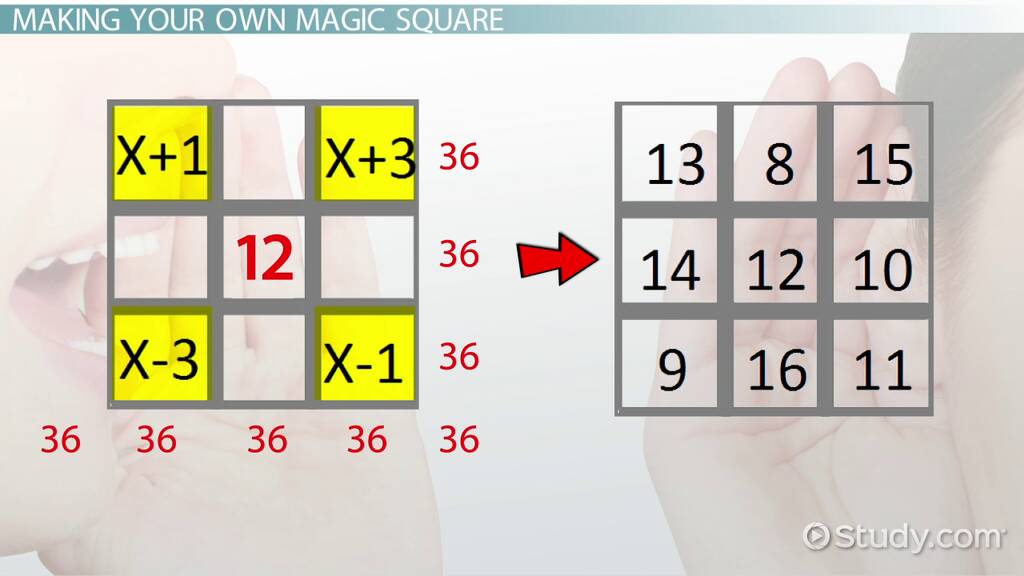
A magic square is a square matrix filled with distinct numbers (most traditionally integers) arranged such that the sums of the numbers in each row, column, and (in many cases) both main diagonals are equal. This common sum is known as the "magic constant."
Construction and Constraints
The beauty of magic squares lies in their rigid arithmetic constraints. In a typical 3×3 magic square using the numbers 1 through 9, each row, column, and diagonal must add up to 15. Constructing these squares involves specific algorithms or rules, particularly distinguished by the size (order) of the square:
Example: In a 3×3 magic square, the central number often plays a pivotal role, ensuring that the distribution of other values meets the defined summation constraint.
Points of Comparison
Underlying Structure and Symmetry
Despite representing different mathematical phenomena, both continuous probability distributions and magic squares rely on an inherent sense of structure:
- Continuous Distributions: They often exhibit symmetry, such as the normal distribution being symmetric about its mean. This symmetry indicates a balance in the distribution of probabilities across the range of values.
- Magic Squares: The defining symmetry here is in the constant sums across all rows, columns, and sometimes diagonals. The rigid numerical structure enforces balance and symmetry.
Both systems, though one abstract (continuous randomness) and the other concrete (discrete arrangement), provide a means to explore balanced outcomes in their respective domains.
Randomness versus Determinism
A compelling contrast between the two is their treatment of randomness:
- Randomness in Continuous Distributions: In continuous probability, randomness is foundational. The outcome of a variable is not predetermined and is represented by its probability distribution. The spread of the distribution and properties like mean, variance, skewness, and kurtosis help quantify and understand this randomness.
- Determinism in Magic Squares: Conversely, magic squares are inherently deterministic. Once a valid magic square is constructed given its fixed rules for summation, the properties of the square—the magic constant and arrangement—are completely determined.
However, exploring near-random magic squares or sampling arrangements can lead to interesting parallels where one might consider the "degree of magic" or measure how close a randomly generated grid is to satisfying the conditions, drawing a subtle connection between randomness and deterministic constraints.
Exploring Mathematical Models
Both domains benefit from the use of mathematical modeling:
- Statistical Modeling in Distributions: Continuous probability distributions are modeled using PDFs and CDFs which require rigorous mathematical treatment involving calculus. Techniques such as integration and the use of limit theorems play a key role.
- Combinatorial Techniques in Magic Squares: Crafting magic squares involves combinatorics, logical reasoning, and sometimes linear algebra. Algorithms for constructing magic squares are designed to ensure the summation properties are preserved.
This modeling reveals an interesting interplay: While probability distributions focus on describing uncertainty across infinitely many outcomes, magic squares encapsulate a harmonious balance amongst finite numbers—a balance echoing the idea of symmetry, a common thread in mathematics.
Table: Comparative Features
| Aspect | Continuous Probability Distributions | Magic Squares |
|---|---|---|
| Nature | Continuous, involving infinite possible values within a range | Discrete, involving a finite set of numbers arranged in a grid |
| Key Functionality | Probability Density Function (PDF) and Cumulative Distribution Function (CDF) | Magic constant derived from summation rules across rows, columns, and diagonals |
| Symmetry | Often symmetric, e.g., the normal distribution | Exhibits balance through equal sums in rows, columns, and sometimes diagonals |
| Randomness vs. Determinism | Random by nature; governed by probability theory | Deterministic outcome based on strict arithmetic rules |
| Mathematical Tools | Calculus, integration, statistical methods | Combinatorics, linear algebra, algorithmic construction |
| Application Scope | Statistics, engineering, natural sciences, economics | Recreational mathematics, puzzles, algorithm design |
Bridging the Concepts: Theoretical Explorations
Extending the Idea of Magic to Continuous Settings
One intriguing extension of the magic square concept to continuous probability is the idea of a “magic square” involving continuous random variables. Imagine a situation where instead of using fixed integers, each cell in the matrix is assigned a value drawn from a continuous probability distribution. In such a case, the goal might be to construct matrices where the expected value of the sum for each row, column, and diagonal is the same.
In this scenario, mathematical modeling would involve ensuring that the integrals of the probability functions corresponding to these cell values align to yield a constant expected sum, revealing a continuous analogue of the magic square’s discrete balance. Although highly non-trivial, such an approach could find theoretical application in complex systems modeling where several continuous variables interact under certain constraints.
Random Generation and Optimization Problems
Both continuous distributions and magic squares offer platforms for exploring optimization problems. In the realm of magic squares, one might investigate the degree of “magic” in a randomly generated grid. From a probabilistic perspective, if numbers are drawn according to a probability distribution and arranged randomly in a grid, the chance that the configuration is exactly “magic” (i.e., meeting the summation conditions) is essentially zero. However, using optimization techniques, one can approach solutions that come arbitrarily close to the desired magic constant—a problem that shares inherent similarities with optimization in continuous probability scenarios where one seeks to maximize likelihood or forecast outcomes under intricate constraints.
Integrating Insights from Different Mathematical Disciplines
Interdisciplinary Lessons
The comparative analysis of continuous probability distributions and magic squares illuminates several interdisciplinary lessons:
- Structural Harmony: Both fields demand a deep understanding of how numbers and functions interact to create balance. In probability, it is the equilibrium of the area under the curve; in magic squares, it is the equal summation across multiple subsets.
- Conceptual Flexibility: The deterministic nature of magic squares can inspire novel probabilistic models, while the intrinsic randomness of continuous distributions offers creative ways to reinterpret deterministic puzzles. This duality encourages cross-pollination between combinatorial design and statistical analysis.
- Mathematical Rigor: The mathematical tools used—calculus for continuous distributions and combinatorial logic for magic squares—highlight the importance of precision, whether quantifying uncertainty through integration or ensuring numerical balance through algebraic constraints.
These interdisciplinary insights not only deepen the understanding of each individual field but also open up new avenues for research into how deterministic and stochastic systems can be unified under shared mathematical principles.
Artificial Intelligence and Modern Applications
Modern computational techniques, including artificial intelligence and algorithmic analysis, have begun to address problems that lie at the intersection of these domains. For example, AI-driven optimization can be applied to searching for nearly-magic configurations in large grids—an area where randomness meets strict constraints—and can further be applied to infer properties of continuous distributions through pattern recognition.
Such methods underscore the practical relevance of these theoretical explorations. Both as a recreational puzzle and as a serious statistical problem, the comparison between continuous distributions and magic squares finds surprising applications in areas such as cryptography, error correction, and even quantum computing, where the principles of balance and symmetry are critical.
References
- Degree of Magic - John D. Cook
- Probability Distributions - Scribbr
- Continuous Probability Distribution - KNIME
- Magic Square - Wikipedia
- Applications of Continuous Distributions - GeeksforGeeks
Recommended Queries
 carnotcycle.wordpress.com
Last updated March 19, 2025