
Unlock Python Mastery: A Rapid Transition for C++ Developers
Leverage your strong C++ foundation to quickly achieve deep proficiency in Python.
Key Insights for a Swift Python Transition
- Embrace Pythonic Paradigms: Shift your mindset from C++'s explicit control to Python's concise, idiomatic constructs like list comprehensions and dynamic typing for optimal efficiency.
- Focus on Core Differences: Prioritize learning Python's automatic memory management, interpretation, and indentation-based syntax, as these are significant departures from C++.
- Project-Based Learning is Key: Rapidly solidify your understanding and explore advanced concepts by applying Python to real-world projects, from simple script conversions to complex data analysis or web development.
Your extensive background in C++ provides an exceptional springboard for mastering Python. While distinct in philosophy and execution, both languages share fundamental programming principles, allowing you to bypass much of the beginner-level learning typically required for new programmers. The journey to Python proficiency for a C++ developer is less about starting from scratch and more about adapting your existing knowledge to Python's unique strengths and "Pythonic" approaches.
This comprehensive guide is meticulously structured to accelerate your learning, focusing on the most impactful areas that will leverage your C++ expertise. We will explore key differences, targeted learning paths, essential Python concepts, and effective practice strategies to ensure you not only learn Python but become truly proficient in it, quickly and efficiently.
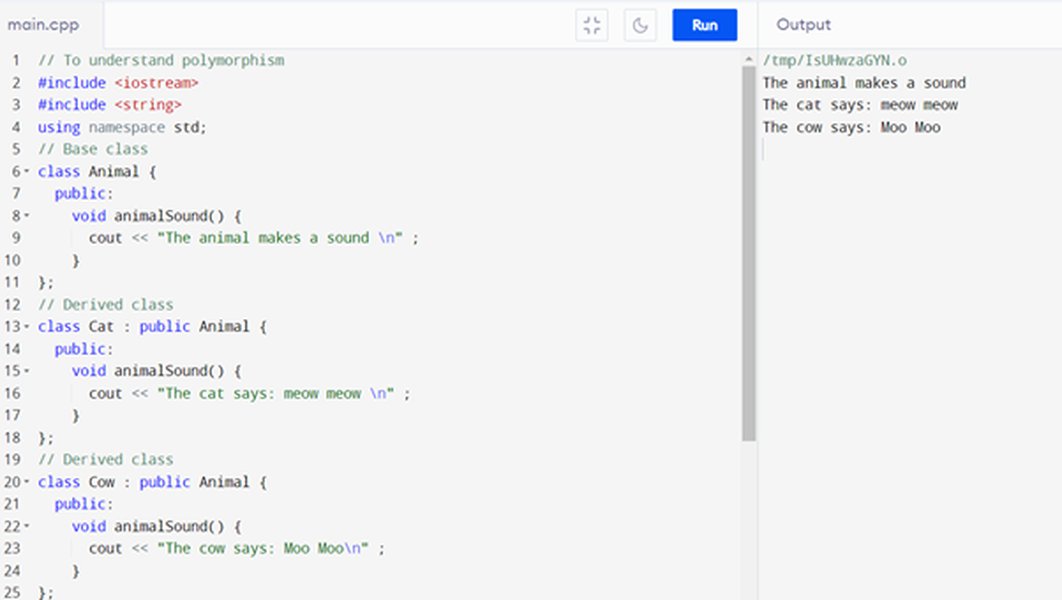
A visual comparison highlighting the syntax and structural differences between Python and C++.
Understanding the Philosophical Divide: C++ vs. Python
The most crucial step in accelerating your Python journey is to understand the fundamental philosophical differences between C++ and Python. This conceptual shift will prevent you from "writing C++ in Python," which often leads to verbose, unidiomatic, and inefficient Python code.
Dynamic Typing vs. Static Typing
Embracing Flexibility in Python
In C++, you rigorously declare variable types (e.g., int x = 10;), ensuring type safety at compile time. Python, conversely, is dynamically typed, meaning you don't declare variable types explicitly. The type of a variable is determined at runtime, offering greater flexibility and reducing boilerplate code. For instance, you can simply write x = 10, and then later x = "hello", and Python will handle the type change seamlessly. This flexibility is a significant paradigm shift that simplifies development but requires careful attention to avoid runtime type errors.
# Python
x = 10        # x is an integer
x = "hello"   # x is now a string

// C++
int x = 10;   // x is an integer
// x = "hello"; // Compilation error: cannot convert string to int
Automated vs. Manual Memory Management
The Freedom of Garbage Collection
Your C++ background has undoubtedly ingrained the importance of manual memory management, using new, delete, pointers, and smart pointers to prevent memory leaks and ensure efficient resource utilization. Python abstracts this complexity away with automatic garbage collection. When objects are no longer referenced, Python's garbage collector automatically reclaims the memory. This feature significantly reduces development time and the likelihood of memory-related bugs, allowing you to focus on logic rather than low-level memory operations.
Interpreted vs. Compiled Execution
The Speed of Iteration
C++ is a compiled language, meaning your source code is translated into machine code before execution, often resulting in high performance. Python is an interpreted language; its code is executed line by line at runtime by an interpreter. This difference provides faster development cycles and easier debugging, as changes can be tested immediately without a compilation step. While Python might be slower for CPU-bound tasks compared to optimized C++, its extensive libraries (often written in C/C++) and suitability for I/O-bound tasks make it incredibly powerful for many applications.
The "Batteries Included" Philosophy
Python's Rich Ecosystem
Python boasts a vast and comprehensive standard library, often described as "batteries included," meaning it provides a wide array of modules for common programming tasks right out of the box (e.g., file I/O, networking, regular expressions, data structures). This contrasts with C++, where you might rely more heavily on external libraries or implement common functionalities manually. Leveraging Python's extensive ecosystem, including third-party packages (e.g., NumPy, Pandas, Django, Flask), will dramatically accelerate your development process.
Embracing Pythonic Idioms
Beyond Syntax: Writing Elegant Python
While you can translate C++ logic directly into Python, true proficiency comes from adopting "Pythonic" idioms. These are conventional ways of writing Python code that are more concise, readable, and efficient. Examples include list comprehensions (for generating lists concisely), generators (for lazy evaluation), and context managers (using with statements for resource management). Moving beyond literal translation to idiomatic Python will be a critical step in your journey.
Strategic Learning Path: Fast-Tracking Python Proficiency
Your C++ background allows for a highly accelerated learning path. The focus should be on grasping Python's distinctive features and adapting your existing conceptual understanding.
Phase 1: Foundations and Syntax Adaptation (Approx. 1-2 Weeks)
Mastering Python's Core Mechanics
Begin by solidifying your understanding of Python's fundamental syntax and built-in data types, specifically noting how they differ from C++.
- Syntax and Indentation: Python uses indentation (typically 4 spaces) to define code blocks, replacing C++'s curly braces
{}and semicolons;. This enforces readability but requires strict adherence. - Variables and Data Types: Understand Python's dynamic typing. Familiarize yourself with basic types like integers, floats, strings, and critically, Python's powerful built-in collections: lists (dynamic arrays), tuples (immutable lists), dictionaries (hash maps/associative arrays), and sets (unordered collections of unique elements).
- Control Flow: Loops (
for,while) and conditional statements (if,elif,else) are conceptually similar to C++, but their syntax is simpler. Pay attention toforloops iterating directly over sequences. - Functions: Learn how to define functions, pass arguments (including default arguments,
*argsfor variable positional arguments, and**kwargsfor variable keyword arguments), and understand that functions are first-class objects in Python. - Error Handling: Embrace Python's
try-exceptblocks for exception handling, a cleaner and more robust mechanism compared to many C++ error-code based approaches. - Modules and Imports: Understand how to organize code into modules and packages, and how to import and use them (analogous to C++ header files and libraries, but simpler to manage).
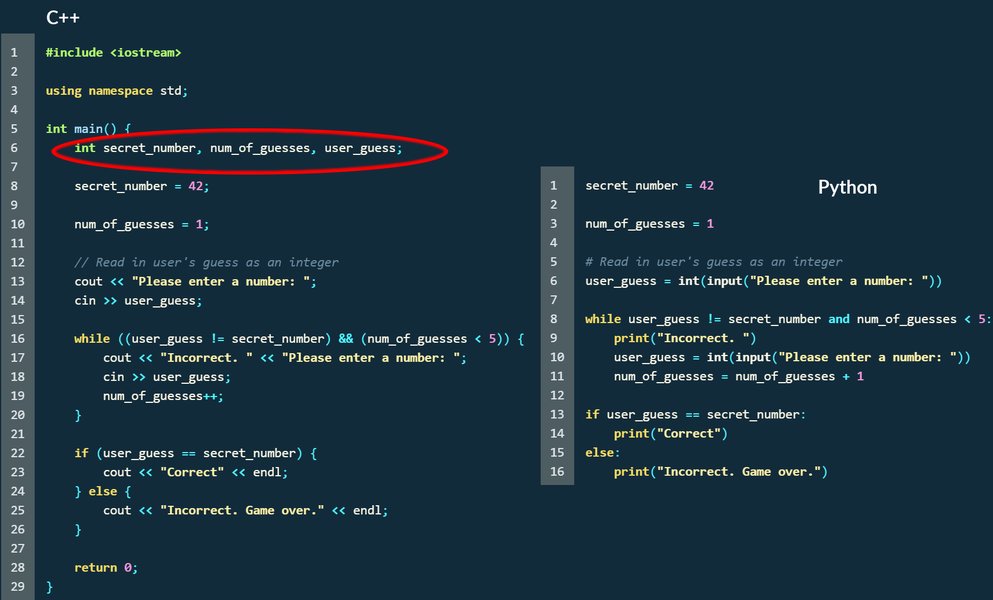
Illustration of variable declaration and usage differences between Python and C++.
Phase 2: Intermediate Concepts and Pythonic Idioms (Approx. 2-3 Weeks)
Writing Efficient and Elegant Python
This phase is where you move beyond direct translation and start thinking "Pythonically."
- Object-Oriented Programming (OOP) in Python: While you know OOP from C++, Python's implementation has nuances. Focus on classes, inheritance (including multiple inheritance), polymorphism (especially duck typing), and "magic methods" (dunder methods like
__init__,__str__,__len__) that define how objects behave. Python has no explicit access specifiers (public/private/protected); convention dictates private members with a single underscore prefix (e.g.,_private_var). - Iterators and Generators: These are powerful concepts for efficient data processing, especially with large datasets. Learn about the
yieldkeyword for creating generators, which provide lazy evaluation. - Decorators: Understand how decorators (functions that modify other functions or methods) work. They are a powerful meta-programming tool for adding functionality.
- Context Managers: Master the
withstatement for proper resource management (e.g., file handling, locks), ensuring resources are correctly acquired and released. - Functional Programming Features: Explore concepts like lambda functions (anonymous functions),
map(),filter(), andreduce()for a more declarative coding style. - List, Dictionary, and Set Comprehensions: These concise syntaxes allow you to create lists, dictionaries, or sets based on existing iterables, significantly reducing code length and improving readability.
Phase 3: Advanced Topics and Ecosystem Exploration (Approx. 3-4 Weeks)
Deepening Your Expertise and Expanding Horizons
At this stage, you'll delve into more specialized areas and explore Python's vast ecosystem.
- Concurrency and Parallelism: Learn about Python's threading, multiprocessing, and the
asynciolibrary for asynchronous programming. Understand the Global Interpreter Lock (GIL) and its implications for multi-threaded CPU-bound tasks. - Metaprogramming: Explore advanced topics like metaclasses and introspection, which allow for dynamic modification of code.
- Interacting with C++: Understand how to integrate C++ code into Python using tools like `pybind11`, `ctypes`, or `SIP` for performance-critical sections. This leverages your existing C++ strengths where Python's speed might be a bottleneck.
- Explore Key Libraries:
- Data Science: For data analysis, machine learning, and scientific computing, delve into
NumPy(numerical operations),Pandas(data manipulation),Matplotlib/Seaborn(data visualization), andScikit-learn(machine learning). - Web Development: If interested in building web applications, explore frameworks like
Flask(micro-framework) orDjango(full-stack framework). - Automation & Scripting: Leverage built-in modules like
os,sys,subprocess, andshutilfor system interaction and automation. - GUI Development: Explore options like
Tkinter(built-in) orPyQtfor graphical user interfaces.
- Data Science: For data analysis, machine learning, and scientific computing, delve into
- Packaging and Virtual Environments: Learn to manage dependencies using
pipand isolate project environments withvenvorconda.
This phased approach, combined with consistent practice, will allow you to quickly achieve a high level of proficiency. For a visual representation of the core concepts to master, consider the mindmap below:
Practice and Application: The Cornerstone of Proficiency
Simply consuming information is not enough; active application is paramount for rapid proficiency. Your C++ experience means you already understand the value of hands-on coding.
Project-Based Learning: Translating and Innovating
The most effective way to learn is by doing. Start by converting some of your simpler C++ programs or algorithms into Python. This "translation" exercise will force you to grapple with syntax differences and begin adopting Pythonic patterns. Gradually, challenge yourself with new Python-specific projects, such as:
- Developing small command-line interface (CLI) tools.
- Building simple web applications using Flask or Django.
- Performing data analysis tasks with Pandas and NumPy.
- Automating personal or work-related tasks (e.g., file organization, web scraping).
Many resources emphasize project-based learning as the fastest route to real-world proficiency.
This video, "9 HOURS of Python Projects - From Beginner to Advanced," provides a comprehensive collection of projects that can help C++ developers apply their programming knowledge to Python, ranging from fundamental exercises to complex applications, solidifying their understanding through practical application.
Daily Coding Challenges and Community Engagement
Consistent practice, even for an hour a day, makes a significant difference. Utilize platforms like LeetCode, HackerRank, or Project Euler to solve coding challenges in Python. These platforms allow you to hone your algorithmic thinking while becoming fluent in Python's syntax and libraries.
Engage with the Python community. Forums like Reddit's r/Python, Stack Overflow, and official Python mailing lists offer invaluable opportunities to ask questions, learn from others' code, and discover best practices. Reading well-written Python code from open-source projects on GitHub can also significantly improve your "Pythonic" style.
Adhering to PEP 8: The Python Style Guide
As a C++ developer, you appreciate clean, consistent code. Python has its own official style guide, PEP 8, which promotes readability and maintainability. Familiarize yourself with its conventions (e.g., variable naming, line length, spacing) and adhere to them strictly. This will make your Python code more professional and easier for others (and your future self) to understand.
Timeline for Proficiency: What to Expect
Given your strong C++ background, your path to Python proficiency will be significantly faster than for a complete novice. While "quickly" is subjective, here's a realistic estimate:
- Foundational Understanding (Syntax, Basics, Core Data Structures): 1-2 weeks of dedicated learning (2-4 hours/day).
- Intermediate Proficiency (Pythonic Idioms, OOP nuances, Generators, Decorators): 2-3 weeks of focused practice and project application.
- Advanced Proficiency (Concurrency, Integration, Specialized Libraries, Real-World Projects): 3-4 weeks of deep dives and consistent development.
Therefore, you could achieve a very high level of Python proficiency within 2 to 3 months of consistent, dedicated effort, potentially even faster depending on your daily commitment. This assumes you are actively coding and applying what you learn, rather than just passively reading tutorials.
To give a comparative perspective on skill acquisition across various programming facets, consider the radar chart below. It illustrates the typical strengths a C++ developer brings to Python learning and where specific focus can yield rapid gains.
Recommended Resources for Accelerated Learning
Leverage resources specifically designed for experienced programmers or those offering a fast-track approach:
| Resource Type | Recommendation | Why It Helps C++ Developers |
|---|---|---|
| Online Courses (C++ Focused) | "Python programming for C++ developers" (Udemy), "Introduction to Python for C++ programmers" (Imperial College London) | Tailored content highlights differences and similarities, accelerating syntax adaptation and conceptual bridging. |
| Official Documentation & Tutorials | The Python Tutorial, Python Wiki: BeginnersGuide/Programmers | Authoritative and comprehensive, providing a solid foundation and catering to those with prior programming experience. |
| Interactive Learning & Books | "C++ for Python Programmers" (Runestone Academy), LearnPython.org, "Fluent Python" by Luciano Ramalho | Interactive platforms offer immediate feedback. "Fluent Python" is excellent for understanding advanced, idiomatic Python. |
| Advanced Tutorials | Real Python Advanced Tutorials, GeeksforGeeks Advanced Python Concepts, Analytics Vidhya: Advanced Python Programming Guide | These delve into the complexities of Python, ensuring a deep understanding beyond basic functionality. |
| Practice Platforms | LeetCode, HackerRank, Project Euler | Essential for applying learned concepts, solving problems, and solidifying coding skills in Python. |
Frequently Asked Questions (FAQ)
What are the biggest differences in memory management between C++ and Python?
new) and deallocation (delete) or smart pointers. Python, conversely, uses automatic garbage collection, where memory is managed by the interpreter, freeing you from direct memory handling. This simplifies development but means you have less direct control over memory.How does Python's OOP differ from C++'s OOP?
Will my C++ knowledge slow me down in learning Python?
What are "Pythonic" idioms, and why are they important?
Conclusion
Your journey from C++ expertise to Python proficiency is not merely a language switch but an expansion of your programming toolkit. By understanding Python's core philosophies—its dynamic typing, automated memory management, and rich "batteries included" ecosystem—you can strategically adapt your existing knowledge. Embracing Pythonic idioms and committing to hands-on project work will be your fastest route to mastery. Within a few months of focused effort, you will find yourself not just comfortable with Python, but truly proficient, ready to leverage its power for diverse applications, from data science to web development and automation.
Recommended Further Exploration
- Deep dive into Python's Global Interpreter Lock (GIL) and concurrency models
- Advanced Python decorators and metaprogramming techniques explained
- Integrating C++ libraries with Python for performance optimization
- Best practices for Python project structure and dependency management
